

Water seepage and persistent dampness can quickly turn a Gauteng basement into a breeding ground for mould and structural problems. Tackling this challenge matters because unchecked moisture not only damages foundations but also impacts your family’s health. Discover how a cementitious waterproofing membrane creates a breathable yet watertight barrier for concrete and masonry, giving your home reliable, long-term defence against South Africa’s harshest wet weather.
Table of Contents
- Cementitious Waterproofing Membrane Defined
- Types and Functions in South Africa
- Application Techniques for Best Results
- Cost, Risks, and Common Mistakes
- Comparing Alternatives for Basements
Key Takeaways
| Point | Details |
|---|---|
| Cementitious Waterproofing Membranes | These membranes provide a durable, waterproof barrier while allowing moisture vapour to escape, making them suitable for Gauteng’s wet conditions. |
| Types and Functions | There are three main types: crystalline admixtures prevent water ingress, elastomeric coatings accommodate structural movement, and grouts address active leaks. |
| Application Importance | Proper surface preparation and multiple coat application are critical for long-lasting results; skipping steps can lead to failures. |
| Cost-Effectiveness | Cementitious membranes are generally more affordable long-term compared to other waterproofing systems due to their durability and minimal maintenance requirements. |
Cementitious Waterproofing Membrane Defined
Cementitious waterproofing membranes are rigid or flexible coatings created from Portland cement blended with waterproofing agents and polymers. When applied to basement walls, concrete foundations, or masonry surfaces, they form a breathable yet waterproof barrier that prevents moisture from penetrating the structure. This makes them an ideal choice for Gauteng homeowners dealing with seasonal rains and groundwater pressure.
Unlike liquid waterproofing products, these membranes create a solid, protective layer that bonds directly to concrete and masonry. The cement base ensures excellent adhesion and durability on mineral surfaces like your basement walls. They work by blocking water entry whilst still allowing the structure to breathe, which prevents trapped moisture that could cause further damage.
How Cementitious Membranes Work
These coatings contain mineral binders like Portland cement combined with synthetic polymers and mineral fillers. Flexible cementitious waterproofing slurries remain flexible after hardening, accommodating minor structural movement common in older basement walls. The polymer component prevents cracking whilst the cement provides structural integrity.
When applied to damp concrete, the membrane penetrates micro-fissures and seals them from within. This dual action—surface coating plus internal sealing—creates a comprehensive moisture barrier that stands up to Gauteng’s challenging wet seasons.
Key Characteristics
- Breathable formula allows moisture vapour to escape whilst blocking liquid water
- Strong adhesion bonds chemically to concrete and masonry without primers
- Crack-bridging capability accommodates movement up to 2-3mm without failing
- Cost-effective compared to membrane-based systems
- Quick-drying reduces application time and gets basements operational faster
Why This Matters for Your Basement
Basement walls face constant pressure from groundwater, especially in areas with clay soil like much of Gauteng. Understanding the role of membranes in waterproofing helps you choose the right solution for your specific conditions. Cementitious membranes specifically excel where flexibility and breathability are needed.
They prevent the cycle of dampness, mould growth, and structural deterioration that develops when basements absorb water. A properly applied cementitious membrane protects your foundation investment and keeps living spaces dry and healthy.
A cementitious waterproofing membrane creates a protective barrier that breathes with your structure whilst blocking water entry entirely.
Pro tip: Apply cementitious membranes to clean, damp (not wet) concrete surfaces for optimal adhesion; allow proper curing time before exposing the basement to water pressure.
Types and Functions in South Africa
South Africa’s demanding climate—from Gauteng’s summer downpours to coastal humidity—has created distinct waterproofing needs. Cementitious membranes come in three main types, each suited to different basement challenges and environmental conditions. Understanding which type matches your situation ensures your waterproofing investment actually solves your moisture problem.
Three Main Types
Crystalline admixtures work from within the concrete itself. These are mixed directly into the concrete during production, creating a self-healing system that blocks water paths before they form. When moisture seeps through microscopic cracks, the crystalline particles activate and fill those gaps automatically.
Elastomeric cementitious coatings are brushed or sprayed onto basement walls after construction. They remain flexible after curing, which matters because basement walls shift slightly over time. This flexibility prevents the coating from cracking under pressure—critical in Gauteng where clay soil movement is common.
Cementitious grouts specialise in sealing existing cracks and porous surfaces. These are injected under pressure into damaged concrete, filling voids and restoring structural integrity. They work well when you’ve discovered active seepage points that need targeted repair.
The following table compares the main types of cementitious waterproofing membranes used in South African basements:
| Type | Application Method | Ideal Scenario | Notable Benefit |
|---|---|---|---|
| Crystalline admixture | Mixed into concrete | New builds or repairs | Auto-seals micro-cracks |
| Elastomeric coating | Brushed or sprayed on walls | Existing basements with movement | Flexible under soil pressure |
| Cementitious grout | Injected into cracks | Repairing localised leaks | Restores structural integrity |
How Each Type Functions in Your Basement
Cementitious capillary crystalline waterproofing materials improve mechanical strength whilst blocking water entry through micro-cracks and capillary pores. This dual action protects your foundation whilst extending concrete lifespan under harsh South African weather conditions.
Elastomeric coatings excel in below-grade applications where groundwater pressure is constant. They create a continuous membrane that bridges cracks up to 2-3mm wide, accommodating seasonal soil movement without failure.
Grouts serve a different purpose—they repair damage rather than prevent it. Use them when crystalline admixtures or coatings haven’t fully solved your problem and you need targeted sealing of specific leak points.
Why Type Selection Matters
- New construction benefits from crystalline admixtures mixed into concrete
- Existing basements often need elastomeric coatings for reliable protection
- Active leaks require grout injection for immediate relief
- Harsh exposure (near water tables) demands the flexibility of elastomeric systems
- Long-term durability improves when you match the type to your specific conditions
Choosing the wrong type wastes money and leaves moisture problems unsolved. Knowing whether waterproofing or damp proofing suits your situation helps you select the right product category first.
Different cementitious types serve different functions—crystalline admixtures prevent, coatings protect, and grouts repair existing damage.
Pro tip: For older Gauteng basements with existing cracks, combine elastomeric coating on walls with grout injection at active seepage points for comprehensive protection.
Application Techniques for Best Results
Getting cementitious waterproofing right comes down to execution. The product itself is only half the battle—how you prepare, apply, and cure the membrane determines whether your basement stays dry for decades or develops leaks within years. Most failures happen because contractors skip steps or ignore environmental conditions.
Surface Preparation Is Everything
Your concrete or masonry substrate must be clean, structurally sound, and properly levelled before any coating touches it. Dirt, algae, loose concrete, and old failed sealants block adhesion and create weak points where water will eventually breach.
Start by pressure washing at 100–150 bar to remove surface contamination. Allow the substrate to dry completely—ideally for 24–48 hours depending on weather. Fill holes, cracks wider than 5mm, and depressions with a compatible concrete repair mortar. Sand rough areas smooth so the membrane can bond evenly across the entire surface.
Application Process
Cementitious waterproofing application involves multiple coats applied with a brush or trowel to ensure consistent thickness and complete coverage. The slurry must be mixed properly—typically at a 3:1 water-to-powder ratio, though always follow manufacturer instructions as products vary.
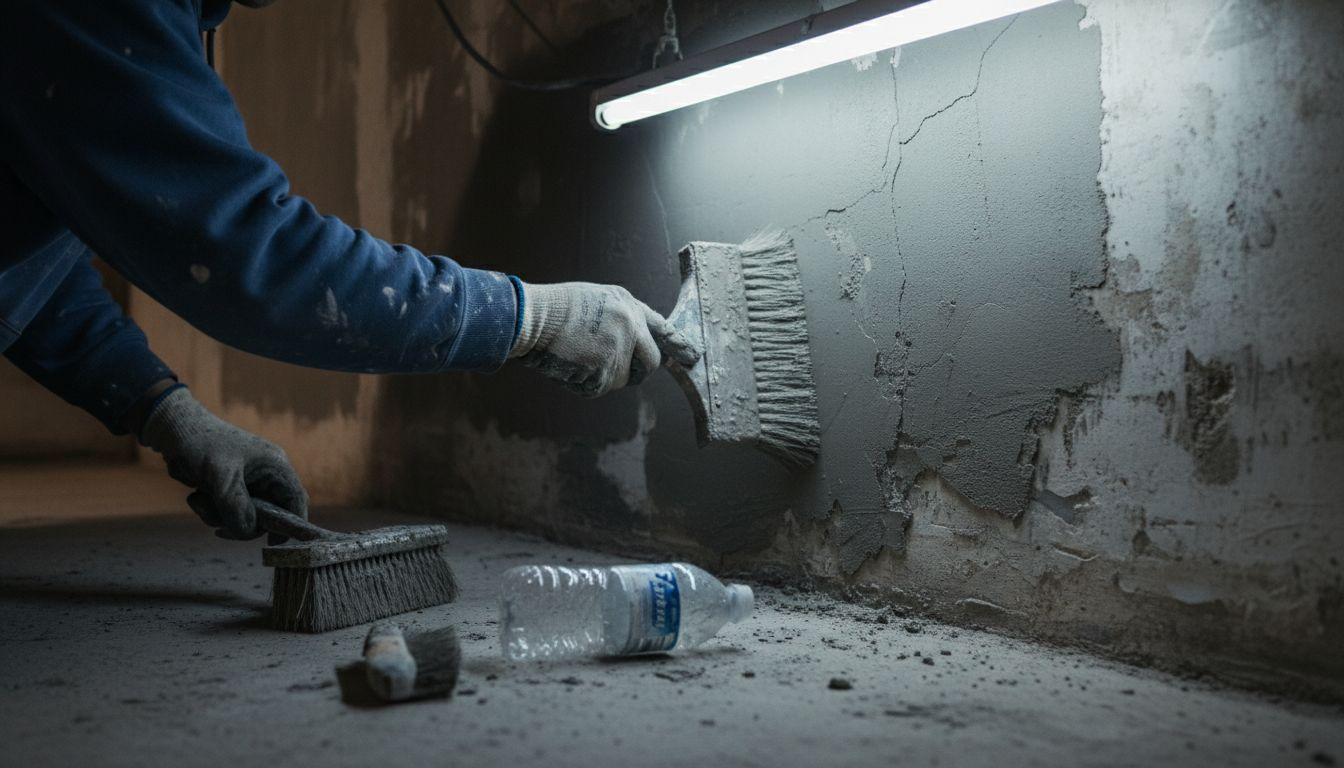
Apply the first coat in one direction, working methodically across the wall. Aim for 1.5–2mm thickness. After 24 hours, apply a second coat perpendicular to the first, ensuring complete overlap and no thin patches. Some situations demand a third coat, particularly in areas with active seepage or high water pressure.
Critical Details
- Overlaps and edges must be sealed thoroughly to prevent water finding a path around the membrane
- Temperature should stay between 5°C and 30°C during application and curing
- Humidity above 85% slows curing; below 40% causes the membrane to dry too quickly and crack
- Protection from rain or direct sunlight during curing prevents surface degradation
- Thickness consistency matters more than speed—rushing produces weak spots
Curing and Aftercare
Allow minimum 7 days curing before exposing the membrane to water pressure. In Gauteng’s summer heat, this accelerates slightly but also increases cracking risk if you don’t maintain consistent moisture. Light misting during the first 48 hours helps prevent rapid surface drying that causes crazing.
Proper curing in controlled environmental conditions is as critical as the application itself—rushing this step undermines months of protective work.
Pro tip: Apply cementitious membranes in early morning to avoid intense afternoon heat, and keep drying substrate lightly misted with water for the first two days to achieve maximum adhesion and flexibility.
Cost, Risks, and Common Mistakes
Cementitious waterproofing membranes offer exceptional value compared to alternative systems, but only when applied correctly. A cheap installation that fails costs far more than a properly executed project. Understanding where costs sit and which mistakes derail projects helps you make informed decisions.
Cost Reality
Material costs for cementitious membranes typically range from R150–R350 per square metre, depending on type and brand. Labour adds another R200–R400 per square metre when you hire qualified contractors. A 50 square metre basement waterproofing project therefore costs R17,500–R37,500 in total.
Cementitious crystalline waterproofing materials are more cost-effective than bituminous felt alternatives over their lifespan, since they require minimal maintenance and rarely need replacement. You’re paying for long-term protection, not just an initial fix.
However, choosing the cheapest contractor often leads to costly failures. A contractor cutting corners on surface preparation might save R2,000 but cost you R50,000 in water damage within two years.
Common Mistakes That Destroy Waterproofing
Insufficient surface preparation is the leading cause of failure. Contractors rushing through cleaning, not repairing existing cracks, or ignoring algae growth create weak adhesion points where water breaches.
Incorrect mixing ratios compromise the membrane’s flexibility and durability. If the powder-to-water ratio is wrong, the coating dries too brittle or too soft and fails prematurely.
Inadequate thickness happens when contractors apply single thin coats instead of multiple coats as specified. A 1mm membrane fails faster than a 3mm membrane under Gauteng’s water pressure.
Poor overlapping and edge sealing leaves gaps where water finds a path around the membrane entirely.
Skipping curing time accelerates failure dramatically. Exposing the membrane to water pressure before 7 days curing allows moisture to penetrate before the coating fully sets.
Risks to Monitor
- Delamination occurs when inadequate surface prep prevents adhesion
- Cracks develop from incorrect mixing or rapid drying in hot weather
- Water seepage emerges from gaps at overlaps or around penetrations
- Structural damage spreads when early failures go unaddressed
The most expensive waterproofing project is the one that fails and requires complete remediation.
Pro tip: Request written proof of surface preparation procedures, mixing ratios, application thickness, and curing time from your contractor before work begins—these details separate lasting solutions from costly failures.
Comparing Alternatives for Basements
You have options when waterproofing a basement, and not all perform equally. Cementitious membranes compete against bituminous systems, liquid coatings, and interior sealants. Understanding the trade-offs between cost, durability, and effectiveness helps you choose the right solution for your Gauteng property.
Cementitious vs Bituminous Membranes
Bituminous felt membranes have dominated basement waterproofing for decades. They’re thick, durable, and provide excellent moisture barriers. However, they cost significantly more to install and require periodic replacement every 15–20 years as the material deteriorates under UV exposure and temperature fluctuations.
Cementitious crystalline waterproofing materials deliver superior long-term value with lower maintenance needs and extended lifespan. Installation costs run 20–30% lower than bituminous systems, and you won’t replace the membrane repeatedly over 50 years of ownership.
Cementitious systems also breathe naturally, preventing trapped moisture that causes mould and deterioration. Bituminous membranes create a vapour barrier that can trap condensation inside concrete, creating secondary dampness problems.
Here is a concise comparison of basement waterproofing systems to help guide your selection:
| System | Installation Cost | Maintenance Needed | Typical Lifespan |
|---|---|---|---|
| Cementitious membrane | Lower, once-off | Minimal (rare replacement) | 30–50 years |
| Bituminous membrane | High, regular replacement | Moderate (15–20 year cycles) | 15–20 years |
| Liquid coating | Low, easy application | Frequent reapplication | 5–8 years |
| Interior sealant | Low, temporary | Masking only | 2–5 years (problem persists) |
Liquid Coatings: Convenient but Limited
Liquid waterproofing coatings offer ease of application and require no specialist equipment. You simply paint them onto walls like standard masonry paint. They cost less upfront than cementitious or bituminous systems.
However, they lack durability in high-water-pressure environments like basements. Liquid coatings typically last 5–8 years before degrading, requiring frequent reapplication. They also don’t bridge cracks wider than 1mm, leaving vulnerable points where water eventually penetrates.
Interior Sealants: A Band-Aid Solution
Interior basement sealants trap water between the sealant and concrete. This moisture eventually causes mould, efflorescence, and structural deterioration. Interior sealants only mask the problem temporarily whilst damage accelerates behind the scenes.
Proper waterproofing works from the outside, blocking water before it reaches your walls. Interior solutions never achieve this protection level.
The Clear Winner for Basements
- Cementitious membranes offer breathability, longevity, and cost-effectiveness
- Bituminous systems provide durability but cost more and require eventual replacement
- Liquid coatings suit minor dampness but fail under serious water pressure
- Interior sealants treat symptoms, not causes
Understanding why basement waterproofing matters helps you avoid false economy of choosing cheaper, inferior solutions that fail prematurely.
Cementitious membranes deliver the highest long-term value: lower installation cost, minimal maintenance, and protection lasting 30+ years.
Pro tip: When comparing quotes, ask contractors about 10-year maintenance costs and expected lifespan rather than just installation price—this reveals true value across your property ownership period.
Secure Your Basement with Expert Cementitious Waterproofing Solutions
Basement dampness and water infiltration cause more than just inconvenience—they threaten your home’s structural integrity and the health of your living spaces. This article highlights how cementitious waterproofing membranes create a breathable yet robust barrier, preventing moisture while accommodating soil movement common in Gauteng. If you are aiming to protect your property from costly water damage, understand that selecting the right membrane type and ensuring expert application are essential for long-term success.
At Pro Waterproofing, we specialise in professional waterproofing services tailored to South African conditions. Our team guides you through crucial decisions such as choosing between crystalline admixtures, elastomeric coatings, or cementitious grouts based on your basement’s unique needs. We focus on quality workmanship and thorough surface preparation to deliver a waterproofing system that stands the test of time. Learn more about the importance of quality contractors and waterproofing techniques in our Uncategorized – Pro Waterproofing articles.
Take control of your basement’s future today by contacting Pro Waterproofing for a detailed assessment and expert quote. Visit our main site at Pro Waterproofing to start your journey towards a dry, healthy home. Don’t wait until water damage escalates—secure professional help now for peace of mind and lasting protection.
Frequently Asked Questions
What is a cementitious waterproofing membrane?
Cementitious waterproofing membranes are rigid or flexible coatings made from Portland cement mixed with waterproofing agents and polymers. They create a breathable yet waterproof barrier that prevents moisture from penetrating structures like basement walls and concrete foundations.
How do cementitious waterproofing membranes work?
These membranes work by forming a solid, protective layer that bonds directly to concrete and masonry. The cement blocks water entry while allowing moisture vapour to escape, preventing trapped moisture that can cause damage.
What are the different types of cementitious waterproofing membranes?
The three main types are crystalline admixtures, elastomeric cementitious coatings, and cementitious grouts. Crystalline admixtures prevent water ingress from within the concrete, elastomeric coatings provide flexibility for existing structures, and cementitious grouts are used for sealing cracks and porous surfaces.
How should I prepare the surface before applying a cementitious waterproofing membrane?
Surface preparation is crucial. The concrete or masonry substrate must be clean, structurally sound, and levelled. Pressure wash to remove contamination, allow it to dry, and fill any cracks or holes with compatible repair mortar before application.