

TL;DR:
- Exterior foundation waterproofing in South Africa requires selecting the appropriate membrane system based on site conditions and application scenario. HDPE sheet, bituminous membranes, crystalline slurries, bentonite panels, and cavity drain systems each have specific strengths and ideal uses, especially considering the importance of proper installation and protection layers. Proper adherence to standards like SANS 10021 and thorough site assessments ensure durable, effective waterproofing that minimizes costly failures.
For most South African new builds, the best exterior foundation waterproofing products are HDPE sheet membranes or bituminous sheet membranes combined with a perimeter drainage system. For retrofits with active leaks, cavity drain membranes are the most practical choice. Crystalline cementitious slurries (such as Vandex or Permastop) suit concrete substrates where excavation is not possible, and bentonite panels work well in high-hydrostatic-pressure conditions on new builds.
Quick shortlist by scenario:
- New build on clay soil (Johannesburg, Sandton): HDPE or bituminous sheet membrane plus perimeter French drain and protection board
- Retrofit with active groundwater: Cavity drain membrane system with internal drainage channel and sump pump
- High hydrostatic pressure, below-grade concrete: Crystalline cementitious slurry (Vandex SUPER, Permastop) or bentonite panel system
- Damp-prone blockwork, surface treatment only: Elastomeric masonry coating (Plascon Waterproof or equivalent)
- Under-slab DPM (all new builds): Polyolefin membrane, minimum 0.25 mm thick with laps of 100–150 mm per Agrément/SANS guidance
When you call a supplier for the first time, ask specifically for a below-grade exterior membrane or external tanking system rather than a generic “waterproofing product.” That single distinction filters out surface coatings that are not rated for sustained hydrostatic pressure.
Table of Contents
- What is exterior foundation waterproofing, and why does it matter?
- What product types are used for exterior foundation waterproofing?
- How do these products compare for South African projects?
- How are exterior membrane and coating systems applied?
- How do you choose the right product for your project?
- DIY or professional installation: which is right for your project?
- What South African standards apply to foundation waterproofing?
- What causes waterproofing to fail, and how long should it last?
- Key takeaways
- Why the cheapest product is rarely the right call
- Prowaterproofing: site assessments and professional installation across South Africa
- Useful sources and further reading
What is exterior foundation waterproofing, and why does it matter?
Exterior foundation waterproofing is the application of a continuous barrier on the outside face of a foundation wall, before backfill, to stop groundwater from reaching the structure. It is distinct from interior damp-proofing, which manages moisture that has already entered. The exterior approach stops water at source, protecting both the concrete or masonry substrate and the interior of the building.
The problems it prevents are specific and serious: penetrating water degrades concrete over time through carbonation and chloride ingress; hydrostatic pressure (the weight of saturated soil pushing against a wall) can force water through hairline cracks that would otherwise be inconsequential; and rising damp wicks up through foundations into walls, causing plaster failure, mould, and structural deterioration.
SANS 10021 sets the performance objective clearly: no visible damp penetration on the interior face of a wall under normal weather conditions. The standard also requires a continuous damp-proof membrane (DPM) beneath all slab-on-ground floors, with the DPM lapped and bonded to the wall damp-proof course (DPC) to form an unbroken barrier.
For new builds, exterior waterproofing is applied before backfill and is far less costly than retrofitting later. Retrofitting requires full excavation around the foundation, which on a completed property can cost several times the original waterproofing budget. Skipping adequate drainage alongside the membrane compounds the risk: without a perimeter drain to relieve hydrostatic pressure, even a well-applied membrane faces sustained water load that shortens its service life. You can read more about SANS 10021 and SANS 10400 requirements and how they affect membrane selection on the Prowaterproofing resource library.
What product types are used for exterior foundation waterproofing?
There are five main product families used on South African projects. Each stops water differently, and each has a specific set of conditions where it performs best.
HDPE and polyolefin sheet membranes
High-density polyethylene (HDPE) sheet membranes are factory-manufactured rolls of thermoplastic film, typically 1.0–2.0 mm thick, applied to the exterior face of a foundation wall. Laps are heat-welded or extrusion-welded to form a continuous, seamless barrier. They handle high hydrostatic pressure well, resist root penetration, and carry long manufacturer warranties when correctly installed.
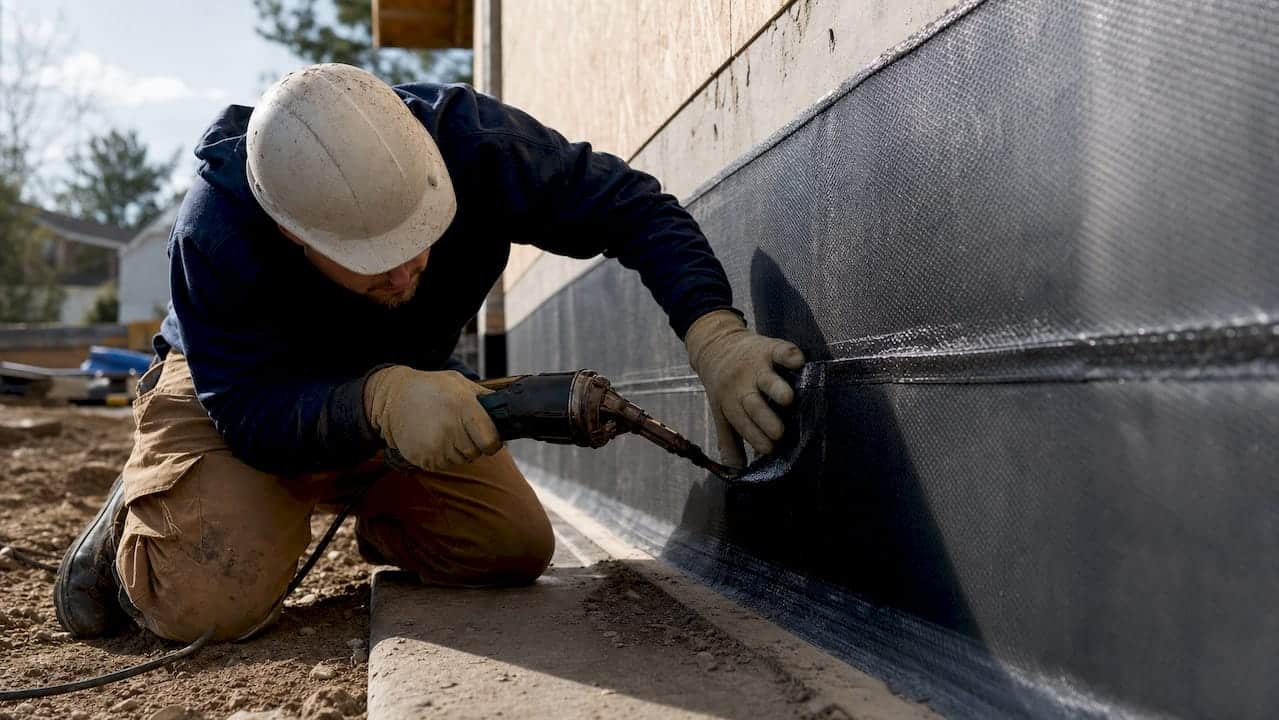
The limitation is installation complexity. Welding requires specialist equipment and a trained applicator; a poorly welded lap is the single most common failure point. HDPE membranes also need a protection board before backfill to prevent puncture from aggregate.
Bituminous sheet membranes (torch-on and self-adhesive)
Bituminous membranes, including GCP Bituthene (a self-adhesive modified bitumen sheet), are applied by torching or cold-bonding to a primed substrate. They conform well to irregular surfaces and are widely available through South African builders’ merchants. GCP Bituthene is a self-adhesive system that bonds directly to concrete or blockwork without torching, which reduces fire risk on site.
Bituminous sheets are vulnerable to UV degradation if left exposed, so they must be protected by a board before backfill. They are not suitable for applications where significant structural movement is expected without a flexible modified bitumen grade.
Liquid-applied elastomeric membranes
Liquid-applied systems (brush, roller, or spray) form a seamless, monolithic membrane that bridges minor cracks and conforms to complex geometry, including corners, pipe penetrations, and re-entrant angles. Plascon Waterproof and similar elastomeric masonry coatings fall into this category for surface applications; more robust liquid-applied systems rated for below-grade use include polyurethane and modified bitumen emulsions.
The advantage over sheet systems is the absence of laps. The risk is film thickness: an under-applied liquid membrane (below the manufacturer’s specified dry film thickness) will fail under sustained hydrostatic pressure. Application in wet or cold conditions also affects curing.
Crystalline and cementitious slurries
Products such as Vandex SUPER and Permastop work by a chemical reaction within the concrete matrix. When moisture is present, the active ingredients form insoluble crystals that block capillaries and hairline cracks up to 0.4 mm wide. Crucially, the membrane becomes integral with the substrate rather than sitting on its surface, which means it cannot delaminate and tolerates punctures better than sheet systems.
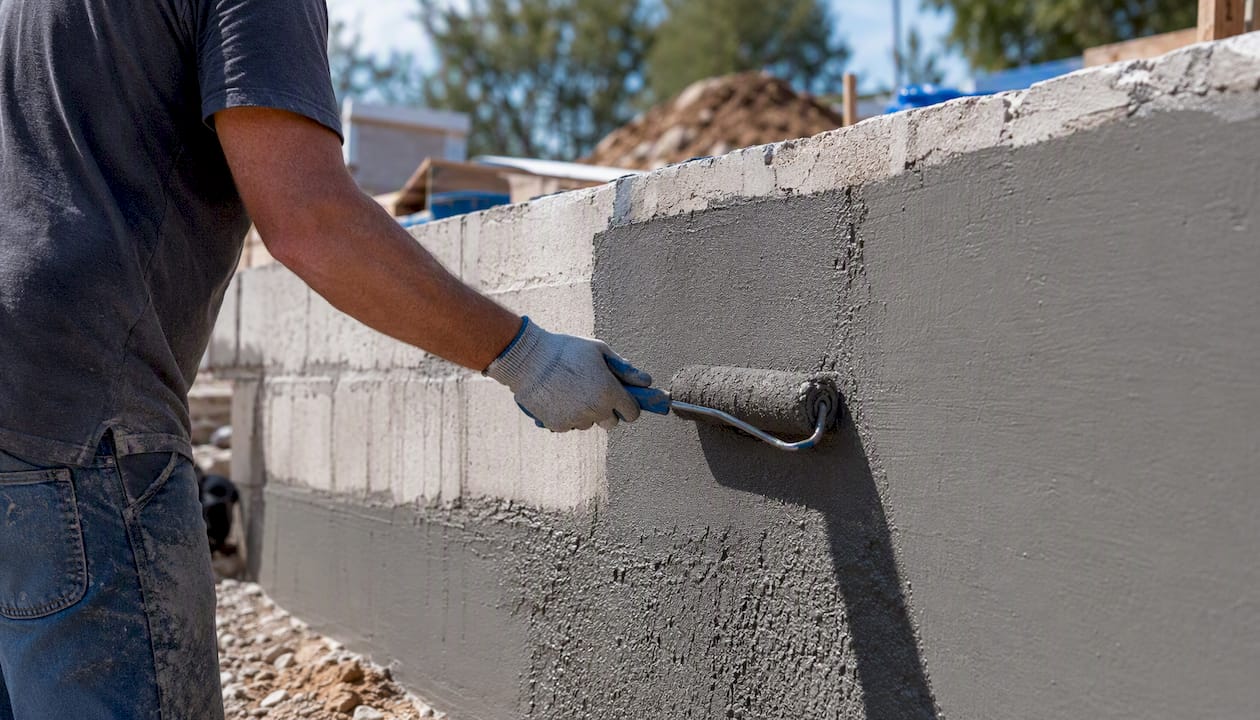
Crystalline slurries remain vapour-permeable while blocking liquid water. This matters for interior finishes: plaster and paint applied over a crystalline-treated wall are less likely to blister from trapped moisture. The constraint is substrate compatibility: these products work only on cement-based substrates (concrete and masonry), not on timber or steel.
Vandex SUPER is also tested for use in contact with potable water, making it suitable for water-retaining structures and rainwater harvesting tanks.
Bentonite panels (Voltex and equivalents)
Bentonite waterproofing, such as GCP Voltex, uses sodium bentonite clay sandwiched between geotextile layers. When the panel is wetted by groundwater, the bentonite swells to form a dense, self-sealing gel. It is self-healing: if a panel is punctured, the surrounding clay migrates to fill the gap.
Bentonite panels are particularly suited to new builds where the wall will be in permanent contact with moist soil, and they perform well in high-hydrostatic-pressure conditions. They cannot be used in free-draining granular soils where the clay cannot hydrate, and they require a concrete or masonry substrate against which to confine the swelling gel.
Pro Tip: When specifying a system for a new build, sequence the waterproofing before the protection board and drainage layer, not after. Applying protection board directly over the membrane before any backfill begins is the single most effective way to prevent aggregate puncture damage during compaction.
How do these products compare for South African projects?
The table below maps each product family to the scenarios, costs, and availability factors most relevant to South African builders and property owners. Brand names appear as examples only; always confirm local availability and current pricing with your supplier.
| Product type | Best for | Below-grade suitability | Application | Expected lifespan | Ballpark cost per m² (SA) | Drainage / protection board needed | SA availability / warranty notes |
|---|---|---|---|---|---|---|---|
| HDPE / polyolefin sheet membrane | New build, high hydrostatic pressure | Yes, rated for full submersion | Specialist applicator (heat welding) | 25–50 years | — | Protection board essential; perimeter drain recommended | Widely available; manufacturer warranties typically 10–25 years with certified installer |
| Bituminous sheet (e.g. GCP Bituthene) | New build and retrofit, moderate pressure | Yes, below-grade rated | Specialist (torch-on) or semi-skilled (self-adhesive) | 15–25 years | — | Protection board required; drainage board advisable | Available through major SA builders’ merchants; installer warranty varies |
| Liquid-applied elastomeric | Retrofit, complex geometry, pipe penetrations | Yes, if below-grade rated grade specified | Skilled DIY to specialist depending on product | 10–20 years | — | Protection board advisable; drainage board for high-pressure sites | Widely available (Plascon, Sika SA); warranty depends on certified application |
| Crystalline / cementitious slurry (e.g. Vandex SUPER, Permastop) | New build and retrofit on concrete, potable water structures | Yes, positive and negative pressure | Skilled DIY (brush/spray) | 20+ years (integral with substrate) | — | No protection board required; drainage still advisable | Available via Euclid Chemical SA, Cemcrete; manufacturer datasheets available locally |
| Bentonite panels (e.g. GCP Voltex) | New build, high hydrostatic pressure, clay soils | Yes, permanent wet conditions | Specialist installer | 25–50 years | — | Confinement layer required; perimeter drain recommended | Available through GCP Applied Technologies SA; installer warranty with certified applicator |
| Cavity drain membrane (HDPE studded) | Retrofit with active leaks, where excavation is impractical | Interior face only (not exterior tanking) | Specialist installer | 25+ years | R150–R300 installed | Internal drainage channel and sump pump required | Available through specialist waterproofing suppliers in SA |
Note on costs: The ranges above are indicative ballpark figures based on typical South African market conditions and do not include excavation, drainage aggregate, or sump pump costs. Always obtain itemised quotes from at least two installers. Sika South Africa, GCP Applied Technologies, Euclid Chemical SA, and Cemcrete are among the local suppliers who can confirm current pricing and provide technical datasheets.
For a detailed comparison of basement waterproofing methods tailored to South African conditions, the Prowaterproofing guide covers cost drivers and method trade-offs in more depth.
How are exterior membrane and coating systems applied?
The sequence below applies to a standard exterior tanking project on a new build or retrofit. Steps vary by product family; the notes after each step flag the key differences.
-
Excavate to the base of the foundation. On a retrofit, this means full perimeter excavation to footing level. Trench safety is non-negotiable: shoring or battered sides per the Occupational Health and Safety Act requirements. Allow for working space of at least 600 mm between the wall face and the trench wall.
-
Prepare the substrate. Remove loose material, efflorescence, and contamination. Fill voids, honeycombing, and cracks with a cementitious repair mortar. For sheet membranes, the surface must be smooth and free of protrusions that could puncture the membrane. For crystalline slurries, the surface must be clean, damp, and free of curing compounds.
-
Form the cove fillet at the wall/slab junction. This is the most commonly missed step. A triangular cove of cementitious mortar (minimum 50 mm sides) at the base of the wall creates a smooth transition for the membrane from vertical to horizontal. Without it, sheet membranes bridge an air void at the corner and fail under pressure.
-
Apply primer (sheet and bituminous systems). Bituminous primers are solvent-based; allow full cure before applying the membrane. Ensure adequate ventilation in confined spaces. PPE: solvent-resistant gloves, eye protection, and a respirator rated for organic vapours.
-
Apply the membrane or slurry.
- HDPE/polyolefin sheets: unroll and fix to the wall, then heat-weld or extrusion-weld all laps with a minimum 100 mm overlap per SANS 10021 guidance.
- Bituminous sheets: torch or cold-bond to primed substrate; minimum 75–100 mm side laps and 150 mm end laps.
- Liquid-applied systems: apply in two coats at right angles to each other; confirm wet film thickness with a comb gauge at each coat.
- Crystalline slurries: apply two coats by stiff brush or spray to a pre-dampened surface; allow the first coat to reach initial set before applying the second.
- Bentonite panels: nail or staple to the wall face with overlaps per manufacturer specification; the panels must be confined before backfill.
-
Install protection board. A 20–50 mm extruded polystyrene (XPS) or proprietary drainage/protection board is fixed over the membrane before any backfill. This step is mandatory for sheet and bituminous systems and advisable for liquid-applied systems on sites with angular aggregate.
-
Install perimeter drainage. A perforated pipe (minimum 100 mm diameter) in a gravel-filled trench at footing level, wrapped in geotextile filter fabric, directs groundwater away from the foundation. On sloped sites, the pipe discharges to a soakaway or storm drain. This drainage layer is what relieves hydrostatic pressure from the membrane.
-
Backfill in compacted layers. Use clean, non-aggressive fill. Compact in 200–300 mm lifts with a plate compactor, keeping heavy machinery away from the wall face to avoid lateral pressure on the fresh membrane system.
Pro Tip: The vertical-to-horizontal junction (where the wall membrane meets the under-slab DPM) is the most common leak point on completed projects. Per SANS 10021, this joint must be welded or bonded with a dedicated overlap, not simply taped. Specialists use extrusion welding or a compatible bonding agent specified by the membrane manufacturer to create a continuous sealed corner.
How do you choose the right product for your project?
The right product is determined by five site-specific factors. Get these confirmed before you contact a supplier, and the recommendation narrows quickly.
Soil type and drainage. Clay soils (common in Gauteng and parts of the Western Cape) retain water and generate sustained hydrostatic pressure. Sandy or well-drained soils reduce pressure but can allow aggressive groundwater movement. Clay sites almost always need a drainage layer alongside the membrane; sandy sites may tolerate a lighter specification.
Wall substrate. Poured concrete accepts the full range of products. Concrete blockwork (hollow or solid) needs a render coat before sheet membranes to eliminate surface voids. Crystalline slurries work on both, but require a cement-based substrate throughout.
Depth and hydrostatic head. Below 1.5 m, hydrostatic pressure becomes significant. At 3 m or more, only HDPE sheet, bentonite, or crystalline systems rated for high pressure should be specified. Confirm the product’s rated hydrostatic head from the manufacturer’s datasheet before specifying.
Expected movement. Buildings on expansive soils (black cotton clay) experience seasonal movement. Rigid cementitious systems can crack at movement joints; flexible sheet or liquid-applied membranes accommodate movement better. Joint details at construction joints and movement joints need specific detailing regardless of the membrane type.
Budget and lifespan expectation. A bentonite or HDPE system costs more upfront but carries a 25–50-year expected lifespan. A liquid-applied system is cheaper to install but may need re-application within 10–15 years. For a new build, the higher upfront cost of a durable system is almost always justified.
Before calling a supplier, confirm these five facts about your site: soil type, wall substrate material, maximum depth below ground, whether groundwater is seasonal or permanent, and whether there are any movement joints in the foundation wall. A supplier who does not ask these questions before recommending a product is not giving you a specification — they are giving you a catalogue entry.
Questions to ask your supplier or contractor:
- Does the product datasheet confirm suitability for below-grade, sustained hydrostatic pressure at my site depth?
- What primer is required, and is it compatible with my substrate?
- What are the minimum lap widths and the required welding or bonding method?
- Which protection board do you recommend, and is it included in the quote?
- What is the warranty scope: does it cover materials only, or materials and labour, and what voids it?
- Is the installer certified by the manufacturer, and will the warranty be backed by the manufacturer or the installer alone?
Pro Tip: Always request the manufacturer’s technical datasheet, not just a product brochure. The datasheet states the rated hydrostatic head, minimum application temperature, required film thickness, and substrate preparation requirements. If a contractor cannot produce the datasheet for the product they are proposing, ask a different contractor.
DIY or professional installation: which is right for your project?
The honest answer is that most exterior foundation waterproofing is not DIY territory, but some products genuinely are accessible to a skilled owner-builder.
Products that are DIY-friendly (with care):
- Crystalline cementitious slurries (Vandex SUPER, Permastop, Xypex Modified) applied to accessible concrete surfaces. The application is brush or spray, the products are not hazardous beyond normal cement precautions, and the self-healing property provides a margin for minor application inconsistencies.
- Surface elastomeric coatings (Plascon Waterproof, Sika elastomeric coatings) for above-grade damp-prone masonry. These are roller-applied and widely available.
- Under-slab polyolefin DPM on a new build, where the membrane is laid flat on a blinded hardcore base before the slab is poured. Laps still need to be welded or taped per SANS requirements, but the geometry is simple.
Products that require a specialist:
- HDPE sheet membranes: heat welding and extrusion welding require dedicated equipment and training. An unwelded or poorly welded lap will fail.
- Bituminous torch-on membranes: open-flame application near formwork, timber, or other combustibles is a fire risk. Solvent-based primers in confined trenches require forced ventilation and appropriate PPE.
- Full external tanking systems on retrofit projects: excavation safety, correct sequencing of membrane, protection board, and drainage, and the cove/junction detail at the slab all require experience to execute correctly.
- Bentonite panel systems: confinement detailing and lap sequencing are critical and not intuitive.
The warranty question is also decisive. Most manufacturer warranties for below-grade sheet and bentonite systems are conditional on installation by a certified applicator. A DIY installation, however well executed, will not carry a manufacturer-backed warranty, which affects the property’s value and your recourse if a failure occurs.
Pro Tip: If your site has a water table within 1.5 m of the foundation base, or if you can see active seepage or efflorescence on the existing wall, hire a specialist. These are signs of sustained hydrostatic pressure, and a product failure under those conditions means excavation and full re-application. The cost of getting it right the first time is always lower.
For a detailed breakdown of how to waterproof a basement from outside, including contractor selection and what to expect at each stage, the Prowaterproofing guide covers the full process.
What South African standards apply to foundation waterproofing?
South African foundation waterproofing is governed primarily by SANS 10021 (Waterproofing of Buildings) and SANS 10400-K (Walls), with Agrément South Africa providing product certification for membranes and systems.
The core requirements that directly affect product selection and installation:
| Requirement | Standard / Source | Practical implication |
|---|---|---|
| Continuous DPM under all slab-on-ground floors | SANS 10021 / Agrément guidance | No gaps, penetrations, or untaped laps permitted |
| Minimum DPM thickness: 0.25 mm polyolefin | SANS 10400 / AfriSam guidance | Thinner films do not comply; confirm on datasheet |
| Laps: 100–150 mm, extrusion- or wedge-welded | SANS 10021 / Agrément | Adhesive tape alone is not compliant for below-grade laps |
| DPC must project 10 mm beyond plaster face | Agrément / SANS 10400-K | Prevents bridging of the DPC by render or plaster |
| DPM must lap and bond to wall DPC | SANS 10021 | Creates continuous barrier from slab to wall |
| Basement waterproofing: membrane must be continuous and protected before backfill | SANS 10021 Section 5 | Protection board is a compliance requirement, not optional |
The SANS 10021 standard covers polyolefin sheet membranes, mastic asphalt, bituminous felt membranes, and waterproof concrete in separate clauses, each with specific application requirements. For polyolefin membranes, laps must be extrusion- or wedge-welded to achieve a waterproof joint; simple overlap without welding does not meet the standard.
Agrément South Africa certifies specific products against these performance criteria. When a manufacturer claims SANS compliance, ask for the Agrément certificate number, not just a reference to the standard. The certificate confirms the product has been independently tested to the relevant performance criteria.
For a full overview of waterproofing regulations in South Africa and what they mean for your project, the Prowaterproofing compliance guide covers the key clauses in plain language.
What causes waterproofing to fail, and how long should it last?
Most exterior waterproofing failures are not product failures. They are installation failures, and they cluster around a small number of recurring mistakes.
Common causes of failure:
- Poor or missing cove fillet at the wall/slab junction, leaving the membrane unsupported at the most stressed point
- Inadequate lap width or unwelded laps on sheet membranes, which open under hydrostatic pressure
- Missing or damaged protection board, allowing aggregate to puncture the membrane during backfill compaction
- Bridged DPC, where render or plaster is applied over the DPC projection, creating a capillary path for rising damp
- Insufficient or blocked perimeter drainage, causing hydrostatic pressure to build against the membrane
- Poor backfill compaction technique, which can displace or tear the membrane and protection board
- Inadequate joint detailing at construction joints, movement joints, and pipe penetrations
Maintenance and inspection:
Exterior waterproofing is largely inaccessible once backfilled, so the inspection focus shifts to symptoms. Check annually and after heavy rainfall:
- Interior wall faces for damp patches, efflorescence (white salt deposits), or paint blistering
- Floor/wall junctions for moisture or mould
- Perimeter drainage outlets to confirm they are clear and flowing
- DPC projection at the base of external walls to confirm it has not been bridged by render or garden beds
Expected lifespans and warranties:
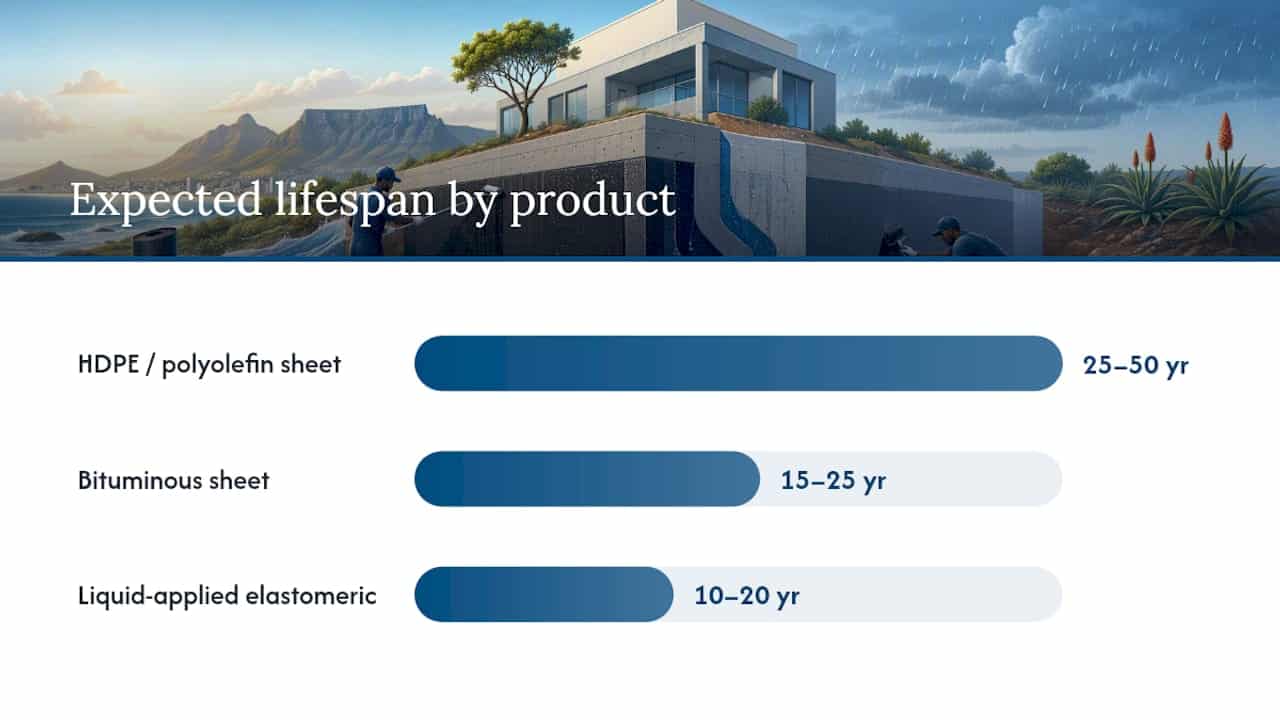
HDPE and bentonite systems, correctly installed, carry expected service lives of 25–50 years and manufacturer warranties of 10–25 years with a certified installer. Bituminous sheet systems typically carry 15–25-year lifespans. Crystalline slurries, once integral with the concrete, are effectively permanent for the life of the structure, though the manufacturer warranty period is typically 10–20 years. Liquid-applied elastomeric coatings have the shortest service life at 10–20 years and are the most likely to require re-application within the building’s life.
Warranties in South Africa are typically split between materials (manufacturer) and workmanship (installer). Always confirm in writing which party covers which risk, and whether the warranty is transferable if the property is sold.
Key takeaways
For exterior foundation waterproofing in South Africa, HDPE or bituminous sheet membranes with perimeter drainage are the most durable new-build solution, while crystalline slurries and cavity drain systems cover the retrofit and high-pressure scenarios where excavation is impractical.
| Point | Details |
|---|---|
| Minimum DPM thickness | SANS and Agrément require a polyolefin DPM of at least 0.25 mm with laps of 100–150 mm, welded for below-grade use. |
| Match product to scenario | Sheet membranes for new builds under high pressure; crystalline slurries for concrete retrofits; cavity drain for active leaks where excavation is not feasible. |
| Protection board is mandatory | SANS 10021 requires the membrane to be protected before backfill; skipping this step is the most common cause of premature failure. |
| Lifespan expectations | HDPE and bentonite systems last 25–50 years; liquid-applied coatings typically need re-application within 10–20 years. |
| Prowaterproofing | Prowaterproofing offers on-site assessments, external tanking, and cavity drain installations across South Africa, with SANS compliance and warranty support. |
Why the cheapest product is rarely the right call
The instinct to specify the lowest-cost waterproofing product for a foundation is understandable, especially when the membrane is invisible once backfilled. But the cost calculus changes completely when you factor in what a failure actually costs: full perimeter excavation on a completed property, removal of landscaping, replacement of the membrane system, and repair of any interior damage. On a modest residential project, that remediation can run to several times the original waterproofing budget.
What I see repeatedly on South African projects is a mismatch between product specification and site conditions. A liquid-applied coating specified for a site with a seasonal high water table, or a cementitious slurry applied to blockwork without a render coat, will fail not because the product is poor but because it was not the right tool for that specific condition. The product families described in this article each have a genuine sweet spot, and the selection criteria in the buying section above are not theoretical: they are the questions that separate a durable installation from an expensive callback.
The other pattern worth naming is the protection board omission. It is almost always a cost-cutting decision, and it almost always results in aggregate puncture damage during backfill compaction. SANS 10021 requires it for a reason. Specifying a 25-year HDPE membrane and then skipping the R40/m² protection board is the waterproofing equivalent of fitting a security door and leaving the frame unanchored.
For new builds on clay soils; external tanking with perimeter drainage remains the specification I would recommend first. For retrofits where excavation is genuinely impractical, a cavity drain system managed by a specialist is the pragmatic choice. Crystalline treatments earn their place on concrete structures where the substrate is sound and the budget is constrained. The right answer is always site-specific, but the framework for getting there is consistent.
Prowaterproofing: site assessments and professional installation across South Africa
Exterior foundation waterproofing done properly is a once-in-a-generation investment. Prowaterproofing gives you the technical assessment upfront so you are specifying the right system for your actual site conditions, not a generic product from a catalogue.
Services cover the full scope: external tanking with HDPE or bituminous sheet membranes, crystalline slurry application, cavity drain systems for retrofits, perimeter drainage installation, and warranty and SANS compliance documentation. Every project includes a site assessment that confirms soil conditions, substrate type, hydrostatic pressure exposure, and the correct product specification before a single metre of membrane is quoted.
Whether you are a property owner dealing with a damp basement or a builder specifying a new below-grade structure, the starting point is the same: a proper site assessment, a product matched to the conditions, and an installation backed by both manufacturer and workmanship warranty.
Book a site assessment with Prowaterproofing and get a SANS-compliant specification with a written warranty before work begins.
Useful sources and further reading
The documents and resources below are the primary technical references for exterior foundation waterproofing in South Africa. Each is worth bookmarking before you contact a supplier or contractor.
| Resource | Why it is useful |
|---|---|
| SANS 10021: Waterproofing of Buildings | The governing standard for all building waterproofing in SA; covers membrane types, application requirements, and basement waterproofing clauses. |
| Agrément SA: Performance Criterion — Water Penetration and Damp-Proofing | Confirms minimum DPM thickness (0.25 mm), lap requirements, and DPC projection; the document to cite when checking product compliance. |
| AfriSam: Waterproofing and Rising Damp | Practical guidance on polyolefin under-slab membranes, welded laps, and DPC details aligned with SANS 10400. |
| Vandex SUPER product datasheet (Euclid Chemical SA) | Full technical datasheet for a leading crystalline slurry available in SA; confirms hydrostatic pressure rating, substrate requirements, and potable water approval. |
| Permastop product information (Cemcrete / Specifile) | Datasheet for a brush-applied crystalline system; confirms crack-sealing capability (hairline cracks ≤ 0.4 mm) and substrate compatibility. |
| Prowaterproofing: waterproofing standards guide | Plain-language explanation of SANS 10021 and SANS 10400 requirements for SA property owners and builders. |
| Prowaterproofing: below-grade waterproofing guide | Step-by-step guidance for below-grade applications, including application sequencing and maintenance. |
Local installer resources:
- TT Waterproofing — local installer and product resource pages covering a range of waterproofing systems available in South Africa.
- Sealtek Cape — regional installer with technical resources and product information for Cape-based projects.