
TL;DR:
- Fibre-reinforced elastomeric liquid membranes offer crack-bridging, flexibility, and high tensile strength for flat roofs and ponding areas. Proper surface preparation, detail reinforcement, and application control are critical to prevent failures and ensure durability in South Africa’s climate. Specification and quality control, including film thickness logging, guarantee long-lasting waterproofing performance.
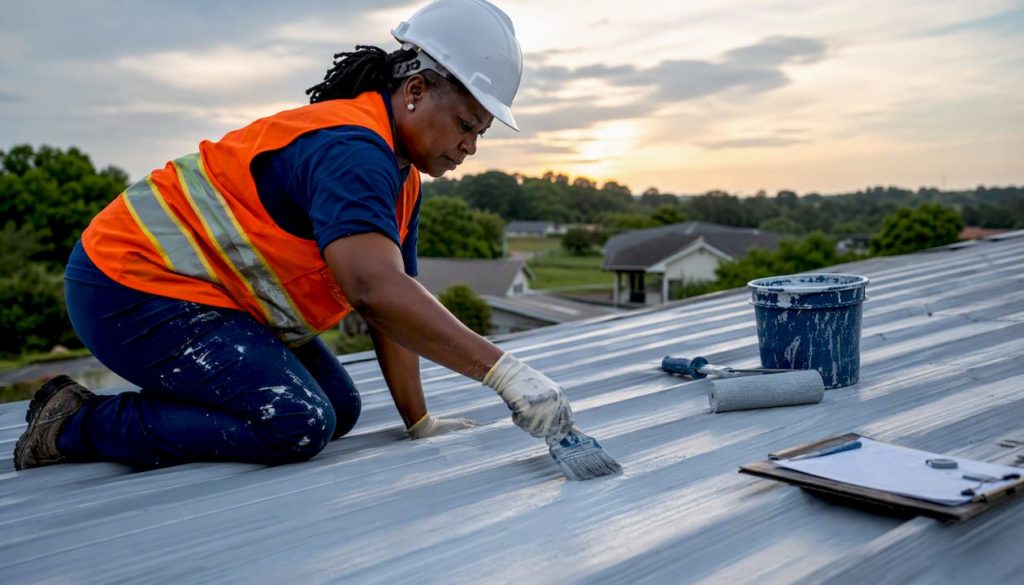
A fibre reinforced elastomeric liquid waterproofing membrane is a single-component liquid coating that cures to a seamless, crack-bridging elastomeric film, with short alkali-resistant fibres dispersed throughout the formulation to form a three-dimensional internal network that raises tensile and tear strength. The result is a system well suited to flat-roof renovation, ponding-prone areas, terraces, and certain under-tile applications, without requiring full-area reinforcing fabric in most zones.
Use it when:
- You are renovating a flat roof with existing cracking or ponding risk
- The substrate has minor movement and you need crack-bridging without a full fabric overlay
- You need a seamless, flexible finish around penetrations, drains, and irregular shapes
- Under-tile waterproofing is required and tile-adhesive compatibility is confirmed on the TDS
Notable limits: application is weather-sensitive (temperature, humidity, and substrate moisture all matter), and supplementary reinforcing fabric is still required at corners, drains, and movement joints regardless of the fibre content in the mix. Products such as the Sikalastic family from Sika are available in South Africa across multiple polymer bases. Prowaterproofing installs and inspects these systems for residential, commercial, and industrial projects across South Africa.
Table of Contents
- How fibre reinforcement changes what a liquid membrane can do
- Where these membranes work well and where they do not
- What performance specifications to require for South African projects
- How to prepare the surface and apply the membrane correctly
- Why systems fail and how to fix them
- How to specify a product and choose a contractor in South Africa
- What determines lifespan and how to maintain the membrane
- Procurement checklist and one-line verdict
- Key takeaways
- The detail work is where most waterproofing money gets wasted
- Prowaterproofing: specification, supply, and installation in South Africa
- Useful sources and where to find product datasheets
How fibre reinforcement changes what a liquid membrane can do
The polymer base determines the membrane’s fundamental character. Acrylic formulations are water-based, UV-stable, and straightforward to apply, but they tend to have lower elongation than polyurethane (PU) alternatives. PU and PU-hybrid systems cure to a highly elastic film with superior elongation and are preferred where substrate movement is expected. Elastomeric formulations generally sit between the two: flexible enough to bridge cracks, durable enough for exposed roofs.
What the fibres add is structural. Short alkali-resistant fibres are incorporated into the liquid and, once applied, they release from their binder and spread out in a non-linear manner throughout the wet coat. As the resin saturates them, it bonds chemically, creating a matrix where the fibres act as reinforcement and the polymer provides flexibility and waterproofness. The outcome is a composite membrane with meaningfully higher tensile and tear strength than an unfilled coating of the same polymer.
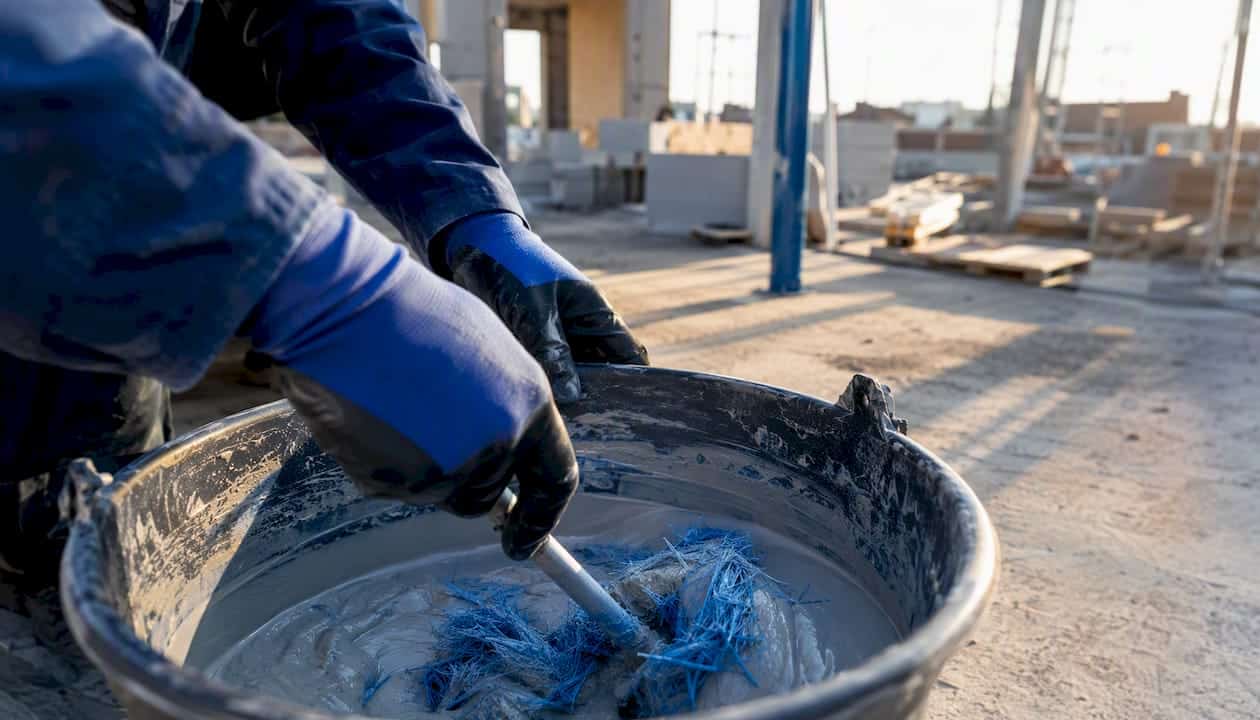
Manufacturer datasheets cite crack-bridging capability measurable in millimeters, and some product-specific lab figures quote significant tensile and tear strength improvements over unreinforced equivalents. Treat those numbers as product claims requiring TDS verification, not universal benchmarks. Real-world performance depends on applied film thickness, substrate condition, and curing environment.
Fibre-reinforced PU liquids, such as single-component detailing products, create an elastomeric membrane with exceptional crack-bridging and are particularly convenient for repairs and complex details because they typically require no mixing and no additional reinforcement fabric for those localised areas.
Where these membranes work well and where they do not
Fibre-reinforced liquid membranes suit a wide range of substrates and geometries. Typical applications include:
- Flat and low-pitch roofs subject to ponding, where seamless coverage eliminates lap joints
- Terraces and balconies, including those with complex drainage details
- Parapets and upstands up to 200 mm high, where brush-applied detailing products excel
- Planter boxes and podium decks, provided the system is rated for root resistance or protected
- Under-tile waterproofing on wet areas and bathroom floors, where the product TDS confirms compatibility with cement-based tile adhesives (as TAL Superflex Fibre 1K explicitly does)
- Repair and overlay work on aged bitumen or existing membranes, subject to adhesion testing
Clear limits exist. These systems are not appropriate where permanent heavy foot or wheeled traffic is expected without a protection layer. Application must stop when substrate moisture exceeds the product limit (TAL Superflex Fibre 1K, for example, requires substrate moisture ≤3% before application). Cold, wet, or high-humidity conditions outside the product’s stated window will compromise adhesion and curing. Substrates with active rising damp are unsuitable without prior damp-proofing treatment.
Pro Tip: Fibre enrichment simplifies full-area application and can speed installation, but it does not replace fabric reinforcement at high-stress junctions. Corners, drains, pipe penetrations, and movement joints still need a strip of reinforcing fabric bedded into the first coat. Skipping this step is the most common cause of long-term leak recurrence at those points. See Prowaterproofing’s guide on reinforcement mat in waterproofing for the correct detailing sequence.
What performance specifications to require for South African projects
When writing a specification or tender document, demand measurable values rather than marketing descriptors. The table below shows typical manufacturer-stated ranges drawn from product datasheets; use these as a baseline for what to request, not as guaranteed performance figures.
| Parameter | Typical manufacturer range | Verification method |
|---|---|---|
| Dry film thickness (DFT) total | 1,500–2,000 microns | Thickness gauge on cured film |
| Number of coats | 4 coats for a final build close to 2,000 microns; 3 coats may be acceptable above 1,500 microns for sheltered areas | Site inspection log |
| Crack-bridging capability | 0.5–3 mm | TDS / lab test certificate |
| Tensile strength improvement | 30–80% over unreinforced (product-specific lab claim) | TDS — verify independently |
| Recoat window | 1–2 hours touch-dry; full cure 24–48 hours | TDS |
| Substrate moisture limit | ≤3% | Moisture meter on site |
Beyond the table, include these in your specification checklist:
- Adhesion values to the specific substrate (concrete, old bitumen, tiles) — pull-off test results from the TDS
- UV/QUV test results — minimum 5,000 hours QUV with no delamination for exposed roofs (HydroFlex Fibre, for instance, passes 5,000 hours QUV with slight fading and no delamination)
- Abrasion resistance rating where trafficable surfaces are specified
- Allowable substrate moisture content — stated as a percentage, not “dry”
- Required priming — type and coverage rate for each substrate in the project
Site verification methods to call for in the specification: holiday (spark) testing of the cured membrane, wet-film thickness gauge checks during application, adhesion pull-tests on cured test patches, and a site test patch applied and inspected before full-area work begins. For local standards compliance, cross-reference applicable SANS requirements with the product TDS before finalising the specification.
How to prepare the surface and apply the membrane correctly
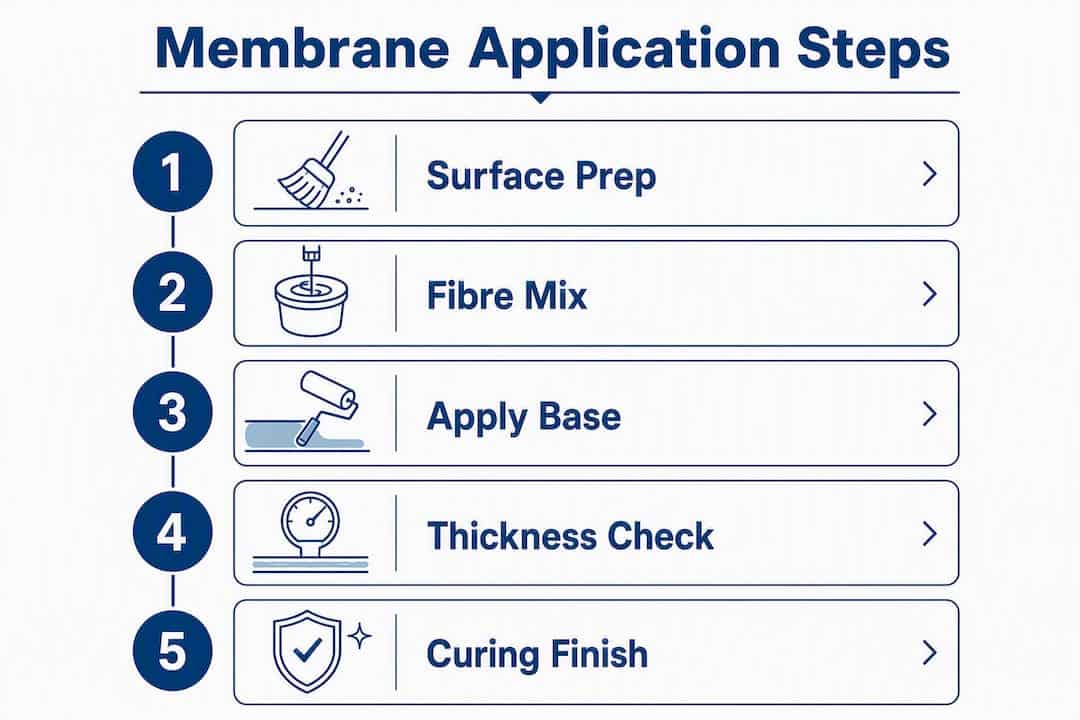
Surface preparation determines whether the membrane performs or fails. Work through these steps in sequence:
- Clean thoroughly. Remove all dust, grease, oil, laitance, and loose material by mechanical means (wire brushing, grinding, or pressure washing). Allow to dry fully.
- Repair cracks and voids. Fill cracks wider than 0.5 mm with a compatible filler or mortar and allow to cure before priming.
- Check substrate moisture. Use a calibrated moisture meter. Do not proceed if readings exceed the product limit (typically ≤3%).
- Prime the substrate. Use the primer specified for the substrate type: a penetrating acrylic primer for concrete, a bitumen-compatible primer for old felt or torch-on, and a bonding agent for glazed tiles. Allow the primer to reach the correct tack before applying the membrane.
- Install detail reinforcement first. Bed a strip of reinforcing fabric into the first coat at all corners, drains, upstands, and movement joints before proceeding to full-area application.
Application parameters vary by product, but the table below gives typical working values:
| Parameter | Typical value |
|---|---|
| Coverage rate | 10–25 m² per 20 L (product-dependent) |
| Wet film thickness per coat | Target 500 microns (4 x 500 = 2,000 microns) for roofs requiring a 2,000 micron DFT; use 375–400 microns for areas targeting the 1,500 micron minimum |
| Recoat time | 1–2 hours (touch-dry); do not exceed 24 hours |
| Application temperature | 5°C–35°C; avoid direct midday sun on hot SA summers |
| Relative humidity limit | Below 85%; do not apply if rain is forecast within 2 hours |
Use a short-pile mohair roller for flat areas and a stiff brush for details and upstands. For detailing products such as single-component PU fibre systems, brush application is standard. Apply in a consistent dominant direction to help align fibres and create a more uniform internal matrix.
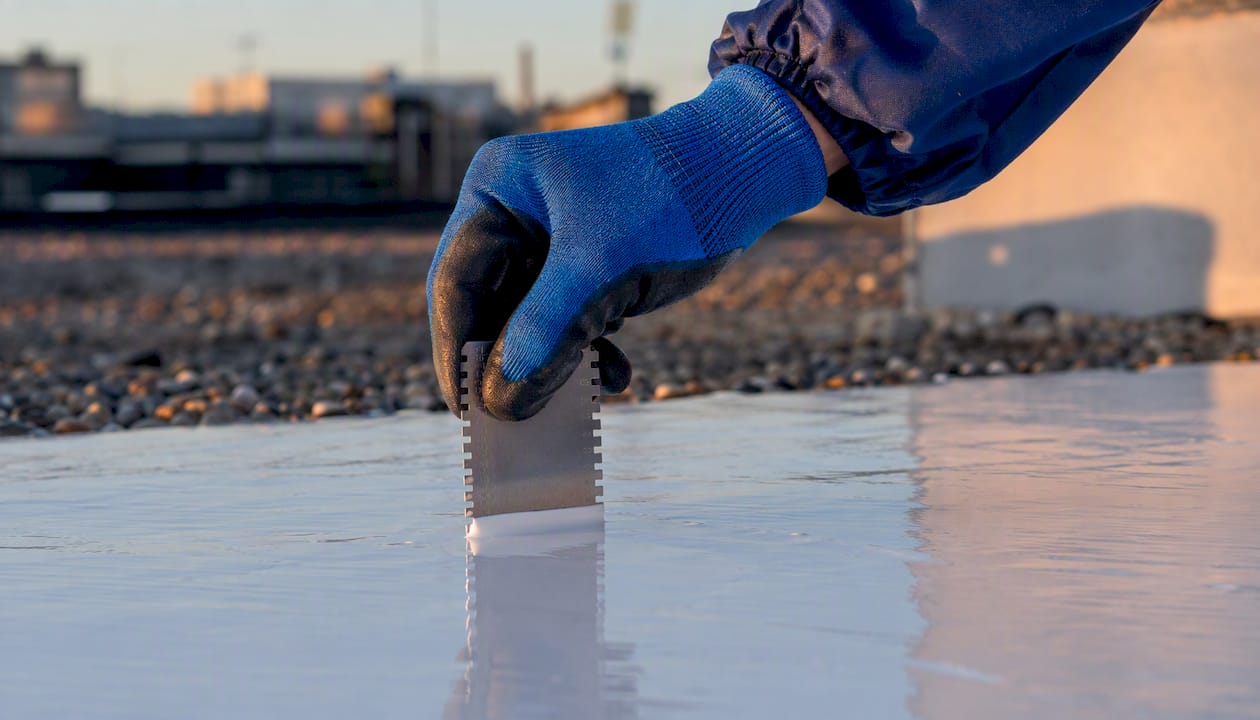
Pro Tip: Wet-film thickness control is the single most important application variable. Buy a wet-film comb gauge and check every coat. Under-application is the leading cause of premature failure, and it is invisible once the membrane cures. The HydroFlex Fibre datasheet specifies a final membrane build of approximately 2,000 microns across four coats — that target only lands if each coat is measured, not estimated.
Why systems fail and how to fix them
Most failures trace back to a small set of avoidable errors.
Common failure modes:
- Insufficient film thickness — the single most frequent cause; membrane is too thin to bridge cracks or resist ponding pressure
- Poor substrate preparation — contamination or laitance prevents adhesion; delamination follows
- Missing detail reinforcement — fabric omitted at corners, drains, or movement joints; stress concentrates and the membrane splits
- Ponding-related breakdown — prolonged standing water softens or lifts an under-specified membrane
- UV degradation — unprotected acrylic membranes chalk and crack when left exposed beyond their rated UV life
- Tile-adhesive incompatibility — using a membrane not rated for cement-based adhesive under tiles causes debonding
Inspection and troubleshooting checklist:
- Check DFT with a thickness gauge; readings below specification require additional coats after surface preparation
- Look for blistering or bubbling — usually caused by moisture trapped under the membrane during application
- Check for delamination by tapping; hollow sounds indicate loss of adhesion; cut out and patch
- Inspect all detail junctions first; hairline cracks at corners or around drains point to missing or failed fabric reinforcement
- For localised damage: cut back to sound membrane, clean, re-prime, bed a fabric patch into fresh membrane, and apply two finish coats
- After any repair, run a holiday test across the repaired area and check adhesion with a pull-test
Full replacement is warranted when DFT is consistently below specification across the whole roof, when delamination is widespread, or when the polymer has degraded beyond recoating (chalking, brittleness, or loss of elasticity across the field).
How to specify a product and choose a contractor in South Africa
A well-written specification protects you before a contractor sets foot on site. Include these items in every tender document:
- Polymer base type (acrylic, PU-hybrid, or elastomeric) and product name with TDS reference
- Specified total DFT and number of coats, with wet-film thickness targets per coat
- Crack-bridging capability (mm) and tensile strength — minimum values, not “as per manufacturer”
- UV rating and QUV test hours for exposed applications
- Compatibility note for under-tile use where applicable, with tile-adhesive type specified
- Required TDS and Safety Data Sheet (SDS) to be submitted before work begins
- Warranty terms: duration, what is covered, and the process for making a claim
- Required site testing: holiday test, thickness gauge log, adhesion pull-test on cured patches
For contractor pre-qualification, ask for:
- Documented experience with fibre-reinforced liquid systems on comparable projects
- Local case studies with contact references (not just photos)
- Description of on-site quality control process, including who checks wet-film thickness and how
- Holiday testing policy — do they test every job, or only on request?
- Corrective action procedure if DFT or adhesion tests fail
- Public liability insurance and professional indemnity cover
- Warranty period and what triggers a warranty call-out
Pro Tip: Ask the contractor to name the exact product they plan to use and supply the TDS before you accept their quote. A contractor who cannot or will not provide the TDS is a red flag. Cross-reference the waterproofing methods guide for South African properties to confirm the system suits your specific roof type and climate zone.
For a broader view of waterproofing options in South Africa, Prowaterproofing’s resource library covers system comparisons, contractor questions, and local standards in detail.
What determines lifespan and how to maintain the membrane
Realistic service life depends on several interacting factors, not just the polymer chemistry. UV exposure in South Africa is intense, particularly in the Western Cape and Highveld, and it degrades acrylic and some elastomeric membranes faster than laboratory QUV tests suggest. Ponding frequency matters too: a membrane rated for ponding still degrades faster under permanent standing water than under intermittent exposure. Building movement, substrate quality, and whether the membrane was applied at the correct DFT all feed into the final number.
A practical maintenance schedule:
- Annual inspection — walk the roof, check drains and outlets for blockage, inspect upstands and parapet flashings for lifting or cracking
- Clear debris after storms; organic matter retains moisture and accelerates degradation at the membrane surface
- Localised touch-ups — address any mechanical damage (foot traffic, dropped tools) promptly before water finds the substrate
- Check UV condition — chalking or colour change signals the UV-protective layer is depleting; a maintenance topcoat at this stage extends life significantly
- Plan a recoat when the membrane shows consistent thinning or loss of elasticity across the field, rather than waiting for a leak
Manufacturer-stated lifespans are laboratory-conditional. In South African conditions, a well-applied and maintained fibre-reinforced acrylic membrane on a flat roof can realistically serve for a decade or more before a full recoat is needed, but that lifespan shortens sharply without annual maintenance. For detailed local longevity factors, Prowaterproofing’s guide on waterproofing lifespan in South Africa gives climate-specific guidance.
Procurement checklist and one-line verdict
Use this checklist when writing a specification or RfQ:
- Product class: fibre-reinforced elastomeric or acrylic liquid waterproofing membrane, single-component
- Specified total DFT: 2,000 microns for exposed or ponding applications, applied in 4 separate coats
- Coats: 4 for all high-exposure applications; 3 may be sufficient for sheltered or internal applications if DFT exceeds 1,500 microns
- Detail reinforcement: reinforcing fabric strip at all corners, drains, upstands, and movement joints
- Environmental limits: application between 5°C and 35°C, relative humidity below 85%, no rain forecast within 2 hours
- Required documents: TDS and SDS before work starts; QUV test certificate for exposed applications
- Site testing: holiday test on cured membrane, wet-film thickness log per coat, adhesion pull-test on cured test patch
Verdict: A fibre-reinforced elastomeric liquid membrane is the right choice for flat-roof renovation and ponding-prone surfaces in South Africa, provided application conditions are controlled and detail junctions are fabric-reinforced regardless of the fibre content in the mix.
Key takeaways
A fibre-reinforced elastomeric liquid membrane is the most practical single-component waterproofing system for flat-roof renovation in South Africa, but only when specified with correct DFT, detail reinforcement, and controlled application conditions.
| Point | Details |
|---|---|
| Specify DFT precisely | Require a total DFT of 2,000 microns for exposed, ponding-prone, or roof applications, installed in 4 coats; 1,500 microns (in 3–4 coats) may be acceptable for sheltered/internal use. Wet-film gauge checks per coat are non-negotiable. |
| Fabric at critical details | Fibre content does not replace reinforcing fabric at corners, drains, and movement joints — specify it explicitly. |
| Control application conditions | Temperature 5°C–35°C, humidity below 85%, substrate moisture ≤3%; these are pass/fail thresholds, not guidelines. |
| Demand TDS before work starts | Require the contractor to submit the product TDS and SDS before accepting any quote or starting work. |
| Prowaterproofing for SA projects | Prowaterproofing supplies specification review, installation, and on-site testing for fibre-reinforced systems across South Africa. |
The detail work is where most waterproofing money gets wasted
The conversation around fibre-reinforced liquid membranes tends to focus on the polymer chemistry and the crack-bridging numbers. Those matter, but they are not where most South African waterproofing projects go wrong. The failures I see repeatedly come down to two things: insufficient film thickness and skipped fabric at the junctions.
Fibre enrichment is genuinely useful. It simplifies full-area application, speeds up installation on large flat roofs, and reduces the need for a full non-woven overlay. But it creates a false sense of security at the details. A contractor who understands the system knows that the fibres distribute stress across the field area well, yet a corner or a drain is a stress concentration point that the fibres alone cannot handle. Fabric reinforcement at those junctions is not optional; it is the difference between a ten-year roof and a two-year callback.
The other issue is that wet-film thickness is invisible once the membrane cures. Without a gauge on site and a log per coat, there is no way to verify that the specified DFT was achieved. Requiring a thickness gauge log as a contract deliverable, not just a verbal assurance, is the single most effective quality control step a property owner or project manager can take. Prowaterproofing builds this into every installation as standard practice.
Prowaterproofing: specification, supply, and installation in South Africa
When a flat roof needs a fibre-reinforced liquid membrane system done properly, the gap between a good specification and a good outcome is the contractor. Prowaterproofing offers specification review, product selection guidance, full supply and installation, and on-site quality control including wet-film thickness logging and holiday testing on every job. For property owners who have already had a failed waterproofing attempt, Prowaterproofing also carries out independent inspections and remediation assessments before any new system goes down.
Whether you are an architect writing a tender document, a property manager dealing with a leaking flat roof, or a homeowner who wants the job done once and done correctly, contact Prowaterproofing for a specification review or site inspection. The team covers residential, commercial, and industrial properties across South Africa.
Useful sources and where to find product datasheets
Always request the following documents from your contractor or supplier before work begins:
- Technical Data Sheet (TDS) — specifies DFT, coats, coverage, recoat windows, substrate moisture limits, and application conditions
- Safety Data Sheet (SDS) — required for site safety compliance
- QUV test certificate — for any membrane that will be left exposed to UV
- Adhesion test results — pull-off values to the specific substrate in your project
- Warranty document — duration, scope, and claims procedure in writing
Asking for the TDS before accepting a quote is the single most effective step a property owner or specifier can take. A contractor who cannot supply it is not ready to do the work. Once on site, require wet-film thickness logs and a holiday test result as contract deliverables — not optional extras.
Specific product and technical references used in this article:
- Fibre reinforced elastomeric liquid waterproofing membrane — Jiarun Jianhai
- HydroFlex Fibre reinforced acrylic waterproofing coating — Sealtek Cape sitemap
- TAL Superflex Fibre 1K product datasheet — TAL
- SRS PU Fibre — SRS Flat Roof Systems
- Pros and cons of liquid-applied reinforced roof membranes — Beachco Roofing
- Fiberglass reinforcement with liquid applied membranes — Stormcure
- TAL Superflex Fibre 1K product page — TAL
- TT Waterproofing — South African waterproofing contractor
- Sealtek Cape — local product and installer group