

TL;DR:
- Polyurethane liquid membrane waterproofing offers a seamless, UV-resistant, crack-bridging system suitable for South African roofs and decks. Proper surface preparation, skilled installation, and reinforcement at details are essential for a service life of up to ten years, with topcoat maintenance every five to seven years. Moisture control and weather scheduling are critical to avoiding failures such as blistering and pinholing.
Polyurethane liquid membrane waterproofing is a seamless, elastomeric, liquid-applied system that cures to form a fully bonded waterproof layer directly on the substrate. For South African roofs, balconies, terraces, podiums and exposed walkways, it is often the strongest specification choice, particularly where high UV exposure, thermal movement and crack-bridging are the primary concerns.
When is it the right call? Three situations point clearly to polyurethane:
- The surface is exposed to direct sunlight and needs long-term UV stability without a separate paint system.
- The substrate moves, whether through thermal cycling on a concrete deck or minor structural settlement, and the membrane must bridge hairline cracks without splitting.
- The geometry is complex, with drains, penetrations, upstands and corners where a sheet membrane would require multiple laps and seams.
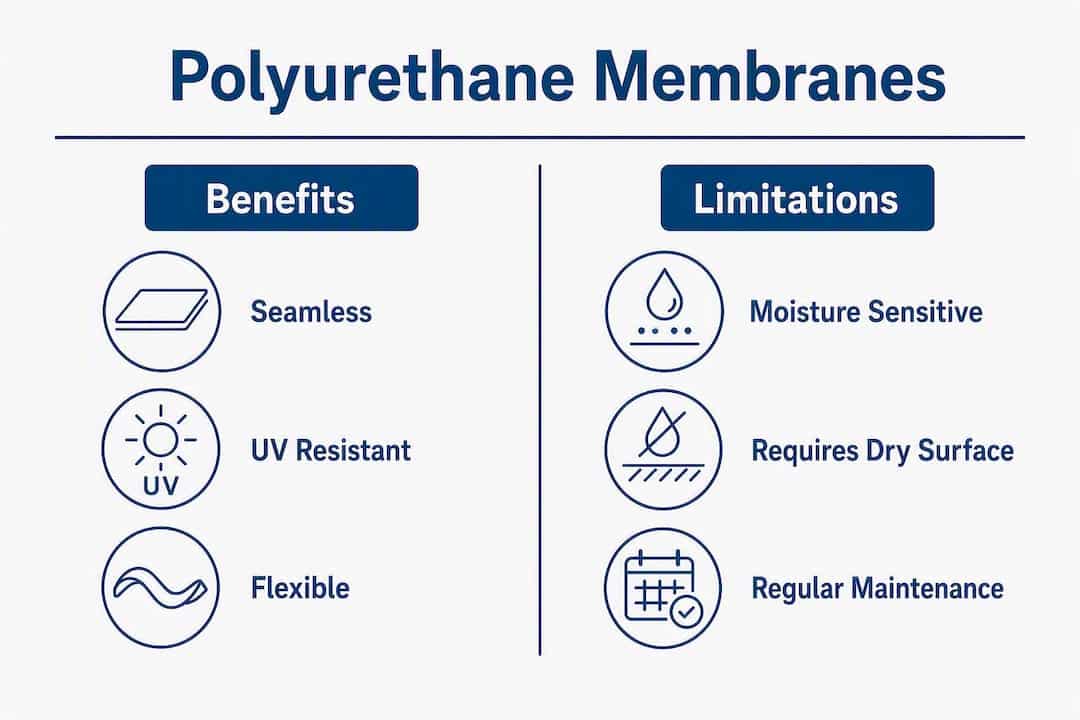
Quick cautions before you specify: polyurethane is moisture-sensitive during application, so a damp substrate or an unexpected rain shower between coats can cause blistering. Two-component systems have a short pot life. Both factors demand skilled installers and disciplined site sequencing.
Pro Tip: Plan your application window around a minimum 48-hour dry period and always embed reinforcement fleece at corners, drains and pipe penetrations. Those details are where most membrane failures start.
Table of Contents
- What is a polyurethane liquid membrane? Types and chemistry explained
- Where polyurethane liquid membranes are used: common applications
- Key properties and performance benefits that drive specification
- Limitations and failure modes you need to understand
- System build-up and South-Africa–available product types
- Step-by-step surface preparation and application for contractors
- How to estimate quantities and understand cost drivers in South Africa
- Inspection, maintenance and repairing common defects
- South Africa–specific risks, scheduling and best practices
- Key takeaways
- A practical perspective on polyurethane in South African conditions
- Prowaterproofing: professional polyurethane membrane installation in South Africa
- Useful sources and manufacturer datasheets
What is a polyurethane liquid membrane? Types and chemistry explained
Liquid-applied membranes divide into two main chemistries, and the choice between them shapes everything from pot life to cure speed.

One-component (1C) moisture-curing polyurethane reacts with atmospheric moisture to cure. Products like Sikalastic-625 are cold-applied by roller or squeegee, making them practical for smaller roofs and refurbishment work. Cure rate depends on ambient humidity and temperature, which in South Africa means faster cure in the humid coastal regions and slower cure on the dry Highveld in winter.
Two-component (2C) reactive polyurethane and PU/polyurea hybrids mix a resin with a hardener immediately before application. Spray-applied 2C systems cure almost instantly at the nozzle, allowing rapid overcoating and making them well-suited to large industrial roofs or parking decks where speed matters. The trade-off is a short pot life, typically 20–40 minutes depending on temperature, and the need for specialist spray equipment and trained operators.
Beyond the 1C/2C split, product families include:
- Water-based polyurethane (WBPU): lower VOC, easier clean-up, suited to occupied buildings.
- Solvent-based polyurethane (SBPU): stronger adhesion on contaminated or difficult substrates.
- Aliphatic formulations: colour-stable under UV, used as topcoats where aesthetics matter.
- Aromatic formulations: lower cost but yellow under UV, so typically used as base coats under an aliphatic finish.
- PU-bitumen and cementitious hybrids: for specific tanking or below-grade situations where a pure PU system is not the right fit.
Practical implication: always check the product TDS for pot life, minimum and maximum application temperatures, and recoat windows before committing to a system on site.
Where polyurethane liquid membranes are used: common applications
Polyurethane liquid-applied membranes cover a wide range of horizontal and vertical applications. The common thread is that they perform best where seamlessness, flexibility and UV resistance are required simultaneously.
Typical applications:
- Flat and low-pitch concrete roofs, both new build and refurbishment over existing substrates.
- Balconies and terraces subject to foot traffic, where a reinforced system with a slip-resistant finish is specified.
- Podium decks over occupied spaces, where any leak carries serious consequences.
- Gutters, parapet cappings and roof details where sheet membranes struggle to form watertight laps.
- Planter boxes and green roof build-ups, where root resistance may be required (check product certification).
- Certain tanking situations, such as water-retaining structures, provided the product is specifically certified for permanent water contact.
Polyurethane is especially advantageous on surfaces that see direct sun, thermal movement and occasional ponding. It is not the default choice for permanently submerged conditions unless the manufacturer’s TDS explicitly approves that use. For below-grade waterproofing of basements or water tanks, a cementitious or specialist tanking product is often more appropriate. You can compare the options in detail in this guide to waterproofing methods for South African properties.
Key properties and performance benefits that drive specification
High elasticity, seamless application and strong adhesion to concrete, bitumen, metal and timber are the three properties that make polyurethane the preferred system for exposed South African conditions.
Performance properties to look for on the TDS:
- Elongation at break: typically 300–600% for quality systems, allowing the membrane to bridge hairline cracks without tearing.
- Tensile strength: confirms the membrane resists mechanical stress from foot traffic and thermal movement.
- Adhesion to concrete: pull-off values above 1.0 MPa are a reasonable minimum for exposed roof applications.
- UV resistance: aliphatic topcoats maintain colour and surface integrity; aromatic base coats degrade without a UV-stable finish layer.
- Crack-bridging: the ability to span cracks up to a defined width without failure, typically tested to ASTM or equivalent standards.
Those properties translate directly into lifecycle benefits. A seamless membrane has no laps or seams for water to track laterally beneath the film. Recoating is straightforward: clean, lightly abrade and apply a fresh topcoat without stripping the whole system. Repairs are localised. Polyurethane systems typically deliver 8–10 years of service life depending on UV exposure and maintenance, and manufacturer warranties on certified installations commonly extend to 10 years when the full specified system is applied by an approved installer.
Pro Tip: Request the manufacturer’s test data for elongation and adhesion before specifying. A product with 150% elongation is not the same as one with 500%, even if both are labelled “polyurethane waterproofing”.
Limitations and failure modes you need to understand
Higher material cost and the need for skilled labour are the two most frequently cited drawbacks, but the failure modes that actually cost money on site are more specific.
Common limitations:
- Material cost is higher per m² than torch-on bitumen or acrylic coatings.
- Multiple layers are required, so total installed cost includes primer, base coat(s), reinforcement and topcoat.
- Two-component systems require precise mix ratios; off-ratio mixing produces a membrane that never fully cures.
- Pot life pressure on hot South African days can cause applicators to rush, leading to uneven film thickness.
Typical failure modes:
- Blistering: the most common failure, caused by applying over a damp substrate or between rain events. Moisture trapped beneath the film expands under solar heating and lifts the membrane.
- Pinholing: thin application or outgassing from a porous concrete substrate produces pinholes that allow water ingress.
- Detail failure: inadequate reinforcement at corners, drains and penetrations allows movement to crack the membrane at its thinnest and most stressed points.
- UV degradation: aromatic systems applied without an aliphatic topcoat chalk and crack within two to three seasons in South African sun.
South Africa adds its own complications; to protect perimeter edges and exposed areas, consider advantages of weather-resistant fencing for your property. The Western Cape experiences summer south-easters and unpredictable afternoon showers; the Highveld has intense afternoon thunderstorms from October through March. Coastal sites from Durban to Cape Town face salt-laden air that accelerates surface degradation on poorly specified topcoats.
Applying polyurethane over a substrate with residual moisture is the single most common cause of membrane failure in South Africa. A substrate moisture content test before priming is not optional — it is the difference between a 10-year membrane and a call-back within 12 months.
System build-up and South-Africa–available product types
A polyurethane waterproofing system is not a single coat. Success depends on every layer being correctly specified and applied in sequence.
Typical system layers:
- Substrate preparation: mechanical grinding, crack repair, fillet formation at upstands.
- Primer: solvent-based or water-based depending on substrate porosity and product compatibility; allows 2–4 hours cure before membrane application.
- Base coat(s): applied in one or two passes to achieve the specified nominal dry-film thickness (DFT), typically 1.0–2.0 mm.
- Reinforcement fleece/mesh: embedded wet-in-wet into the base coat at all corners, drains, penetrations and perimeter upstands.
- Intermediate coat (where specified for thicker systems or traffic decks).
- Aliphatic topcoat: UV-stable finish coat, typically 0.3–0.5 mm DFT, applied once the base coat has reached the manufacturer’s minimum recoat time.
South-Africa–available product types and typical data:
| Product type / brand | Typical pack sizes | Nominal coverage (m² per pack at 1.5 mm DFT) | Recommended DFT |
|---|---|---|---|
| Sika 1C PU (e.g. Sikalastic-625) | 15 kg, 25 kg | 8–12 m² per 15 kg | 1.0–2.0 mm |
| Desmopol / Tecnopol 1C PU | 15 kg, 25 kg | 8–12 m² per 15 kg | 1.0–1.5 mm |
| 2C PU/PUA spray systems | 20 kg kits | 10–15 m² per kit | 1.5–2.5 mm |
| Aliphatic topcoat | 5 kg, 15 kg | 15–20 m² per 5 kg | 0.3–0.5 mm |
All figures are typical ranges only. Always verify coverage rates, DFT targets and pot life against the specific product TDS/SDS before ordering materials.
Sika South Africa supplies a full LAM system including primers, Sikalastic membranes and aliphatic topcoats, with downloadable TDS and SDS from their local site. Desmopol, manufactured by Tecnopol, is distributed in South Africa and offers a hand-applied 1C system with a strong track record on balconies and terraces. Safeguard Chem provides independent technical commentary on polyurethane performance in South African conditions, which is worth reading before specifying. For a full materials checklist, see the essential waterproofing materials list for South African properties.
Step-by-step surface preparation and application for contractors
Sequence matters more than speed. A well-prepared substrate with a thin membrane outperforms a thick membrane on a poorly prepared one.
Application checklist:
- Assess and document: walk the deck, mark cracks, delaminated areas, standing water zones and existing membrane condition.
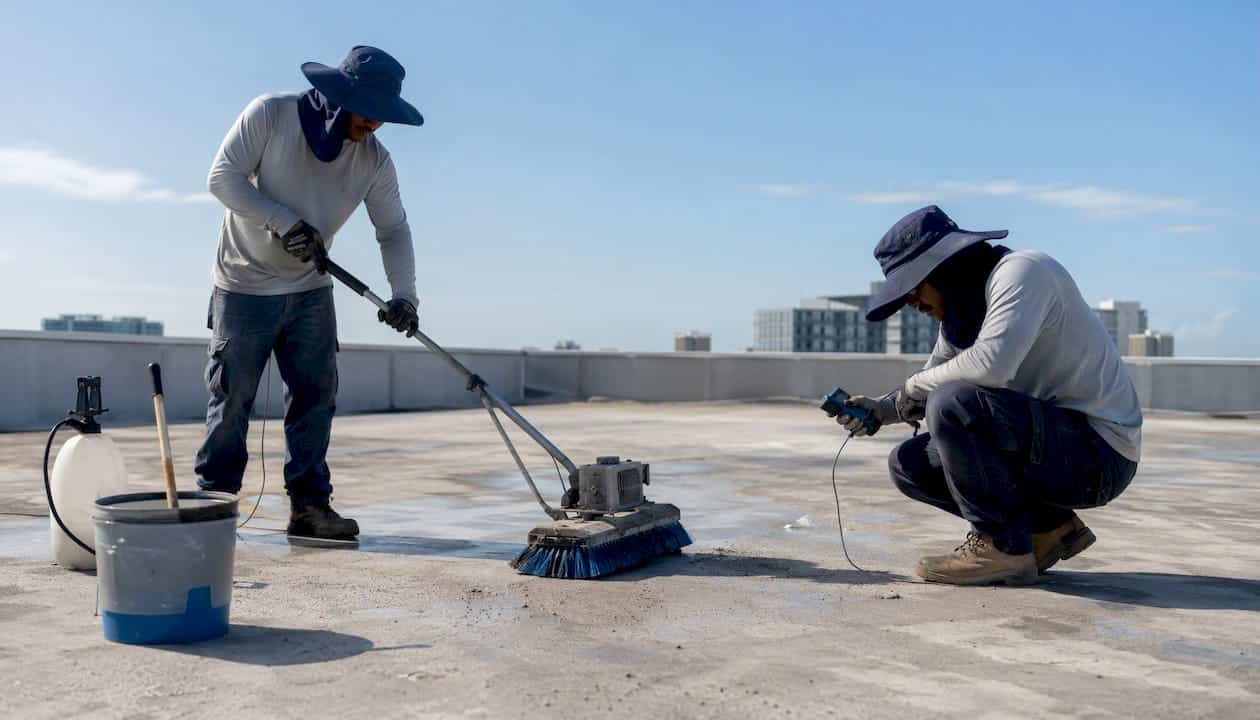
- Mechanical preparation: grind, scarify or shot-blast to remove laitance, loose material and contamination. Blow clean with compressed air.
- Crack and defect repair: fill cracks wider than 0.3 mm with a compatible polyurethane or epoxy filler. Form 45° fillets at all upstand/deck junctions using mortar or filler.
- Moisture check: confirm substrate moisture content is within the product’s specified limit before priming. Use a surface moisture meter.
- Prime: apply primer by roller at the specified rate. Allow full cure before proceeding.
- First membrane coat: apply by roller or squeegee, working in one direction. Measure wet-film thickness (WFT) with a comb gauge at regular intervals.
- Embed reinforcement: while the first coat is still wet, lay reinforcement fleece into all corners, drains and penetrations. Smooth out air bubbles.
- Second membrane coat: apply once the first coat has reached the manufacturer’s minimum recoat time. Cross-roll for even coverage.
- Aliphatic topcoat: apply once the membrane has cured to the specified hardness. Two thin coats are better than one thick coat.
Tools and methods: a 12 mm nap roller suits most hand-applied 1C systems. A squeegee is faster on large open areas. Airless spray suits 2C systems on large industrial roofs but requires operator certification and containment for overspray.
Cure management data (typical ranges — verify against product TDS):
| System type | Tack-free time | Minimum recoat window | Full cure |
|---|---|---|---|
| 1C moisture-curing PU (23°C, 50% RH) | 2–4 hours | 6–12 hours | 5–7 days |
| 2C spray PU/PUA (23°C) | 5–30 seconds | 30–60 minutes | 24–48 hours |
| Aliphatic topcoat (23°C) | 1–2 hours | 4–8 hours | 3–5 days |
High humidity accelerates 1C cure; high temperatures shorten 2C pot life. Adjust scheduling accordingly.
PPE requirements: solvent-based systems require organic vapour respirators, chemical-resistant gloves and eye protection. Water-based systems still require gloves and eye protection. Check the product SDS for full requirements under South African OHS Act regulations.
Pro Tip: Measure WFT at least every 10 m² using a comb gauge. A membrane that looks uniform to the eye can vary by 30–40% in thickness across a deck. Thin spots are where failures start.
How to estimate quantities and understand cost drivers in South Africa
Coverage rate calculation is straightforward once you have three numbers: the deck area in m², the required nominal DFT in mm, and the product’s theoretical coverage rate from the TDS.
Worked example:
- Deck area: 120 m²
- Required DFT: 1.5 mm (two coats)
- Product coverage rate: 1.0 m² per kg at 1.0 mm DFT (from TDS)
- Material required: 120 m² × 1.5 mm ÷ 1.0 = 180 kg, plus 10–15% wastage = approximately 200 kg
- Pack size: 25 kg packs → 8 packs
Typical pack sizes and coverage (nominal ranges):
| Product layer | Pack size | Coverage at specified DFT |
|---|---|---|
| Primer | 5 L, 15 L | 8–12 m² per litre |
| 1C PU base membrane | 15 kg, 25 kg | 8–12 m² per 15 kg at 1.5 mm |
| Reinforcement fleece | — | Detail areas only |
| Aliphatic topcoat | 5 kg, 15 kg | 15–20 m² per 5 kg |
Labour and access are often larger cost drivers than materials on South African projects. Working at height on a multi-storey building requires scaffolding or a suspended platform, which can add R150–R300 per m² to the installed cost. Traffic management on a podium deck over a retail car park adds further programme cost. Isolated patch repairs cost proportionally more per m² than a full system replacement because mobilisation, access and set-up costs are spread over a small area.
Weather delays are a real budget risk. Product selection and scheduling are key determinants of success in South African projects because of variable weather and high UV exposure. Build a 10–15% contingency into both the programme and the material budget for weather-related delays and rework.
Inspection, maintenance and repairing common defects
A polyurethane membrane is not maintenance-free, but it is straightforward to maintain if you inspect it annually and address minor defects before they become major ones.
Routine inspection checklist:
- Check for ponding water 24 hours after rain; persistent ponding accelerates UV and biological degradation.
- Look for discolouration, chalking or cracking of the topcoat, which signals UV breakdown.
- Inspect perimeter upstands and drains for delamination or lifting edges.
- Check all penetrations and corners for cracking or separation of the reinforcement zone.
- Clear drains and outlets of debris.
Repairing common defects:
- Blisters: cut out the blister with a sharp knife, allow the substrate to dry completely (minimum 48 hours, confirm with moisture meter), apply primer, patch with compatible membrane material and embed reinforcement if the blister is at a detail.
- Pinholes and thin spots: clean the area, lightly abrade, apply a fresh coat of membrane to the affected zone, feathering the edges.
- Topcoat wear: clean the surface, lightly sand, apply a fresh aliphatic topcoat. No need to strip the base membrane if it remains intact and adhered.
- Perimeter delamination: cut back to sound material, re-prime and recoat, extending the patch at least 150 mm beyond the delaminated zone.
Topcoat recoating is typically required every 5–7 years under South African UV exposure. If the base membrane is still sound and fully adhered, a topcoat refresh is far more economical than a full system replacement. When patches cover more than 30% of the deck area, a full system renewal usually makes more financial sense than continued spot repairs.
South Africa–specific risks, scheduling and best practices
South Africa’s climate is not uniform, and the risks it poses to polyurethane installations vary significantly by region.
Local risks by region:
- Western Cape: summer south-easters and afternoon showers from November through February create narrow application windows. Morning starts are often the only viable option.
- Highveld (Gauteng, Mpumalanga): intense afternoon thunderstorms from October through March mean morning-only application windows and strict weather monitoring.
- KwaZulu-Natal coast: high humidity year-round slows 1C cure and increases the risk of moisture entrapment; solvent-based primers may be preferable to water-based on porous substrates.
- Coastal sites generally: salt-laden air accelerates topcoat degradation; aliphatic topcoats with marine-grade UV resistance are worth specifying.
Best-practice controls:
- Confirm a minimum 48-hour dry weather window before starting membrane application.
- Require installers to demonstrate authorised applicator status with the membrane manufacturer before awarding the contract.
- Specify adhesion pull-off testing over existing substrates before applying a new system.
- Embed reinforcement fleece at every junction, drain, penetration and upstand without exception.
- Require the installer to submit the product TDS and SDS before work commences, and check that the specified product matches what arrives on site.
Prowaterproofing’s experience across residential, commercial and industrial projects in South Africa consistently shows that the projects that fail are not the ones where the wrong product was chosen. They are the ones where the right product was applied in the wrong conditions or without reinforcement at the details. Safeguard Chem’s published commentary on South African conditions reinforces this: moisture sensitivity and scheduling are the primary site risks, not product chemistry.
For current waterproofing standards applicable to South African properties, verify compliance requirements with your specifier before finalising the system.
Pro Tip: Ask your installer for the manufacturer’s installation video before work starts. Most major suppliers, including Sika and Tecnopol, publish step-by-step application videos. If the installer has not watched it, that is a red flag.
Key takeaways
Polyurethane liquid membrane waterproofing is the right system for exposed South African roofs and decks when UV resistance, crack-bridging and seamless adhesion are the primary requirements, provided moisture control and reinforcement at details are managed without compromise.
| Point | Details |
|---|---|
| Right use cases | Specify polyurethane for exposed roofs, balconies, terraces and podiums where UV resistance and crack-bridging are required. |
| Critical site risk | Never apply over a damp substrate; blistering from moisture entrapment is the leading cause of membrane failure in South Africa. |
| System lifespan | Quality systems deliver 8–10 years service life; topcoat recoating is typically needed every 5–7 years under South African UV exposure. |
| Quantity estimation | Calculate material from deck area × DFT ÷ coverage rate, then add 10–15% for wastage and weather contingency. |
| Prowaterproofing | Prowaterproofing provides site inspection, specification and certified installation of polyurethane membrane systems across South Africa. |
A practical perspective on polyurethane in South African conditions
The conversation around polyurethane membranes in South Africa often focuses on the product itself, which formulation, which brand, which thickness. That is the wrong starting point.
What actually determines whether a polyurethane membrane lasts 10 years or fails in 18 months is almost never the product. It is the substrate condition on the day of application, the weather window the installer chose, and whether reinforcement fleece was embedded at every detail. Those three things are controllable. The product chemistry is largely a solved problem at this point.
The transition away from torch-on bitumen towards liquid-applied systems has been driven partly by safety (removing open flame from occupied buildings) and partly by genuine performance gains in high-UV environments. Both reasons are valid. But the shift has also brought a wave of under-qualified applicators who treat polyurethane as a paint rather than a system. The result is a generation of roofs with beautiful-looking membranes that blister within a season because the substrate was damp, or crack at every drain because reinforcement was skipped to save time.
For building owners, the practical implication is straightforward: ask for the installer’s manufacturer authorisation, ask to see the TDS for the specific product being applied, and ask how they will verify substrate moisture before priming. If those three questions produce vague answers, find a different contractor. The application methods and best practices for liquid polyurethane membranes are well-documented. There is no excuse for guessing on site.
Prowaterproofing: professional polyurethane membrane installation in South Africa
Prowaterproofing installs certified polyurethane liquid membrane systems on residential, commercial and industrial properties across South Africa. Where most contractors quote a price and start rolling, Prowaterproofing begins with a site inspection and a written specification, confirming substrate condition, product selection and weather scheduling before a single litre of primer is opened.
The service includes a full system quotation with itemised material and labour costs, TDS and SDS documentation for the specified product, and a post-installation inspection report. Warranty documentation is provided on completion of certified installations. For podium decks, balconies and exposed roofs where a failure means water in an occupied space below, that level of process is not a luxury.
Request a site inspection and quotation from Prowaterproofing and get a specification you can hold the installer to.
Useful sources and manufacturer datasheets
Before specifying any polyurethane liquid membrane system, download and read the product TDS and SDS. Coverage rates, cure times, pot life, minimum application temperatures and substrate requirements all vary between products, and the TDS is the only authoritative source for those figures.
Key resources:
- Sikalastic-625 product datasheet (Sika South Africa): TDS for Sika’s 1C reinforced polyurethane membrane, including coverage rates, application temperatures and warranty conditions.
- Sika liquid-applied membrane technical overview: overview of 1C and 2C PU/PUA systems, application methods and system build-up guidance.
- Safeguard Chem: polyurethane vs torch-on in South African conditions: independent technical commentary on scheduling, moisture risk and UV performance specific to South Africa.
- ALCHIMICA: advantages of polyurethane liquid membranes: detailed overview of seamless membrane performance and application principles.
- Prowaterproofing: elastomeric liquid waterproofing membrane guide: updated guidance on elastomeric systems and South African standards.
- Prowaterproofing: roof waterproofing types in South Africa: comparison of roof waterproofing systems to help with specification decisions.
- TT Waterproofing: waterproofing resources: additional South African industry reference for waterproofing products and application guidance.
- Sealtec Cape: waterproofing solutions: Cape-based supplier resource for waterproofing materials and technical support.
| Resource type | What to look for |
|---|---|
| Product TDS | Coverage rate, DFT targets, pot life, recoat windows, application temperature range |
| Product SDS | PPE requirements, VOC content, disposal and spill procedures |
| Manufacturer installation video | Step-by-step application sequence, reinforcement placement, thickness checking |
| Installer certification | Manufacturer-authorised applicator status, warranty eligibility |
| Local supplier | Stock availability, pack sizes, lead times for your region |