
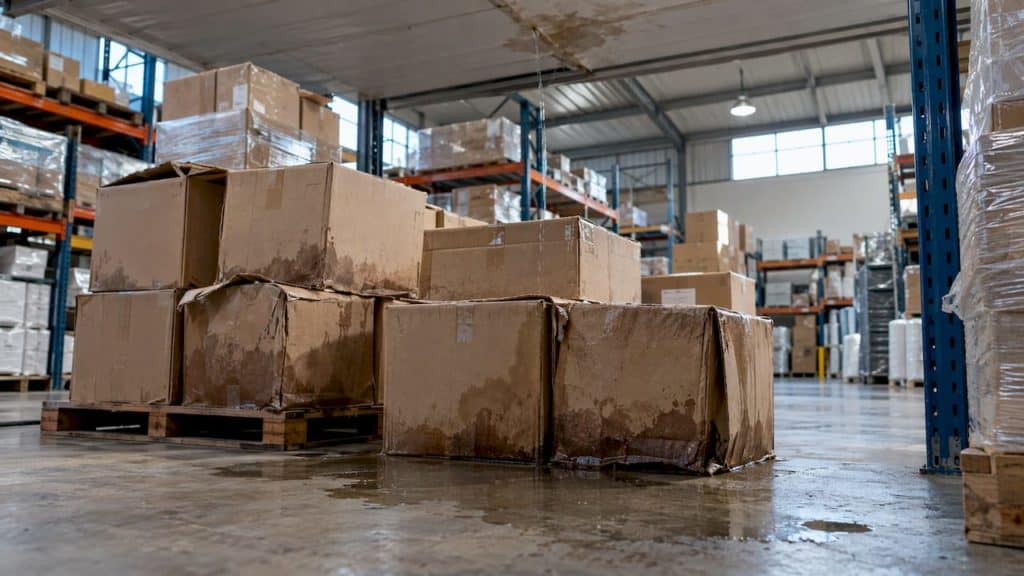
When waterproofing fails on a commercial building, water gets into places it was never meant to reach: ceilings, plant rooms, stock, electrics and structure. The damage is often costly enough that the owner or tenant turns to the property insurer. The cover is not automatic. Most policies pay for sudden, accidental damage and refuse losses blamed on wear and tear, poor maintenance or faulty workmanship, so the cause and timing of the failure decide the outcome. This guide explains how failures turn into claims, why insurers push back, and what building owners and managers can do before and after a leak.
TL;DR
- Roof leaks, failed flashings, weak joints and poorly detailed transitions are the typical waterproofing failures behind commercial water-damage claims.
- Insurers separate sudden accidental damage from gradual deterioration, defective design, faulty workmanship and neglected maintenance, and they commonly exclude the latter.
- Timing matters: policies expect you to stop the water, report promptly and prove what happened. Renasa’s South African wording, for example, sets a 30-day outer limit for notice.
- Records of inspections, repairs and warranties make the difference between a paid claim and a disputed one.
- Fixing the building envelope before a loss is cheaper than fighting over a claim after it.
Table of Contents
- How a waterproofing failure becomes an insurance claim
- The waterproofing failures insurers see most often
- Why insurers question these claims
- What insurers now look for in the building envelope
- Failure points and likely claim outcomes
- Reporting and documenting a claim
- Reducing the chance of a claim in the first place
- Our perspective
- Get the right contractor before the leak
- FAQ
- Sources
How a waterproofing failure becomes an insurance claim
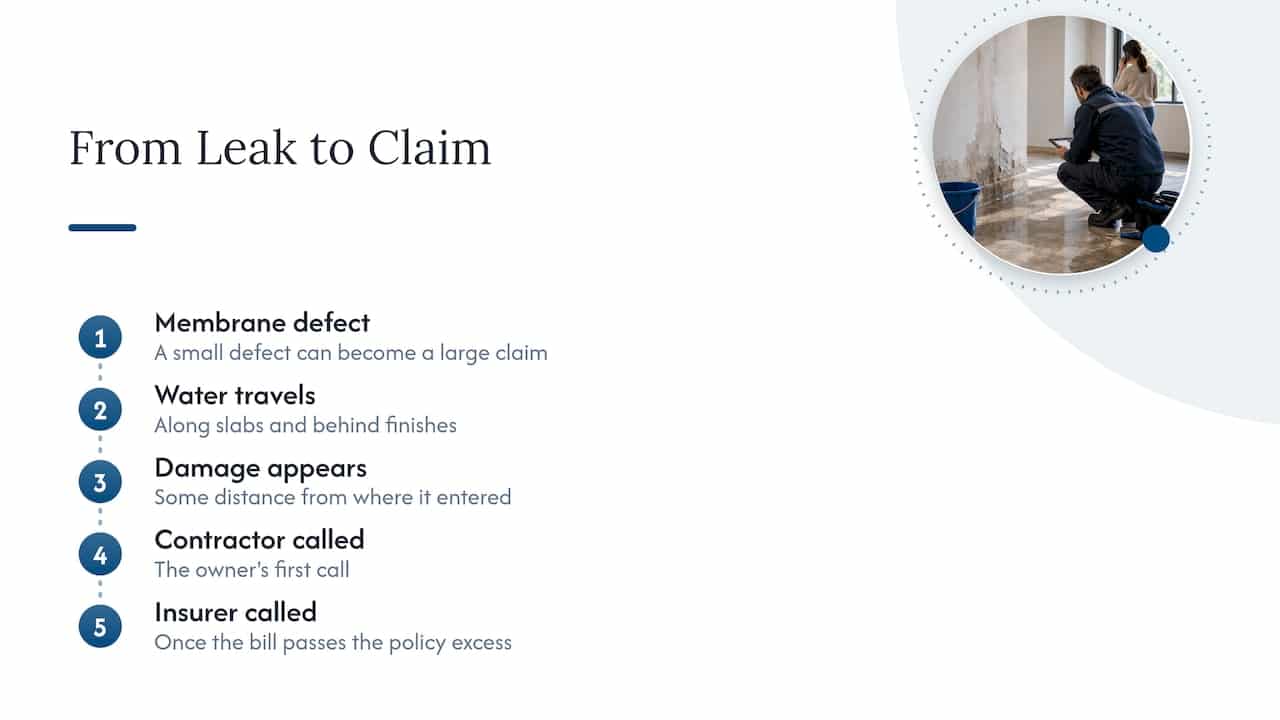
Waterproofing is the barrier between the weather, the ground and the inside of the building. It sits in roofs, balconies, podium decks, basements, walls, wet areas and joints. When it breaks down, the water does not stay in one place. It travels along slabs and behind finishes, and it shows itself some distance from where it entered.
That is why a small membrane defect can end up as a large claim. The visible damage might be stained ceiling tiles, wet insulation, lifted floor finishes, corroded fittings, mould, damaged stock or a shut-down tenant. The owner’s first call is to the contractor, but once the bill passes the policy excess, the second call is to the insurer.
The scale of water losses explains why insurers watch this closely. Chubb’s analysis of more than 470,000 industry claims from 2013 to 2018 ranks water damage as the third most common global claim. Aon notes that one client’s liquid-damage claims made up 34% of its closed claims from 2009 to 2018, and that many losses go unreported because they fall below the deductible, so the real number is probably higher.
Not every water claim is a waterproofing problem. Insurer data show that burst pipes, frozen pipes and sprinkler discharges lead many commercial losses. AIG’s review of roughly 3,788 US claims from 2014 to 2017 found burst or leaking pipes were the leading cause. The building envelope is the second big source, and it is the part waterproofing contractors deal with.
The waterproofing failures insurers see most often
Roofs and flat decks
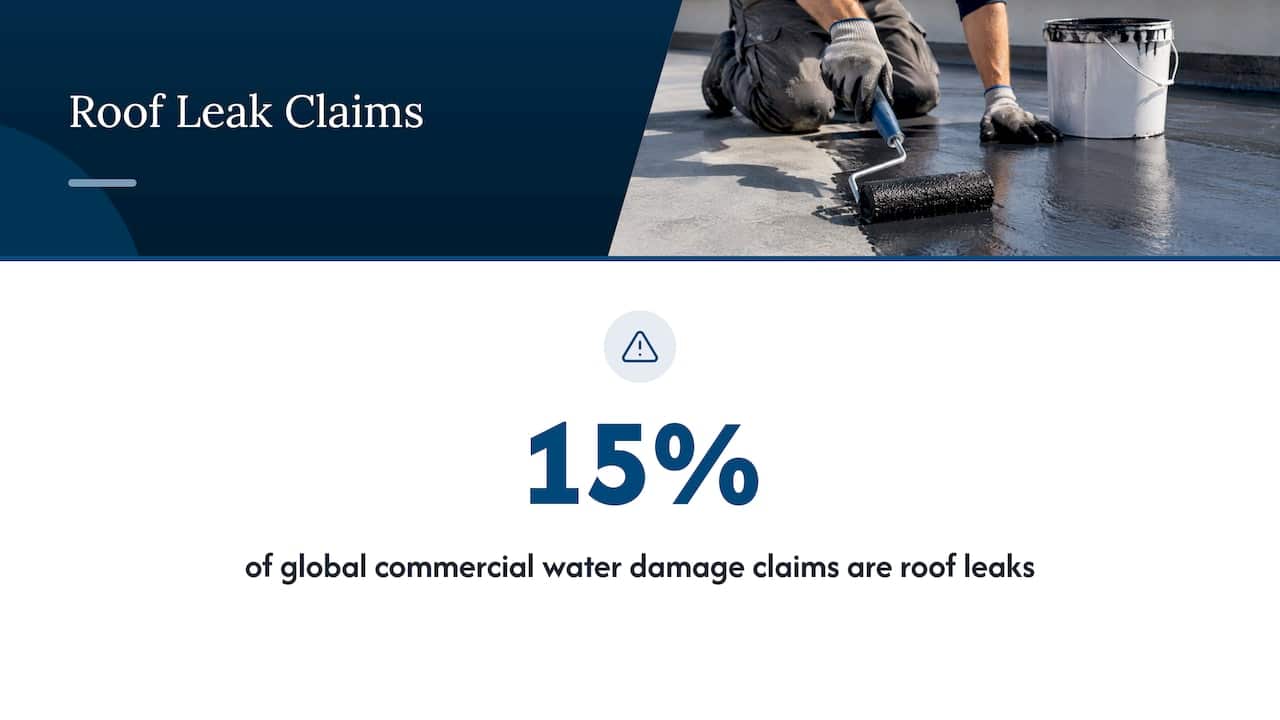
Chubb reports that roof leaks account for an estimated 15% of commercial water damage claims globally and are the leading cause of ceiling water damage. Flat and low-slope roofs are the usual suspects. A US law firm that handles these claims lists pooling water, membrane failure and seam separation as typical triggers on such roofs.
In South Africa, where many commercial and industrial buildings have flat concrete roofs and decks, the same pattern applies. Ponding water, blocked outlets and aged membranes are the everyday causes. Our guide to commercial waterproofing in South Africa covers the systems used on these roofs.
Flashing, joints and sealants
A membrane can be sound across the field and still leak at the edges. Modern Building Envelope describes common failures as poorly integrated flashing, inadequate drainage planes, sealant-dependent joints and transitions left unresolved in design documents. One industry blog puts the share of failures at transition points, such as where a below-grade membrane meets an above-grade barrier, as high as 80%. Treat that as an industry view rather than a fixed statistic, but the direction is clear: details fail first.
For a closer look at the detail that is most often wrong, read flashing in waterproofing and what property managers need to know.
Walls and the point where wall meets ground
The Hanover Insurance Group points out that exterior walls have many openings, from vents and intakes to window and door joints, plus unplanned holes such as aged brick joints, vanished sealants and settling cracks. It also describes the junction of wall and ground as a notoriously high-risk area for water intrusion.
Basements, foundations and drainage
Allianz Commercial’s loss prevention guide lists building envelope deficiencies, site drainage problems and cracks in waterproofing structures among the typical causes of water damage. Below-grade failures are slow to show and expensive to reach, which makes them awkward for claims. Drainage boards that are installed the wrong way round are one avoidable cause, covered in our note on drainage board orientation.
Other South African examples are collected in waterproofing failures property owners must know.
Why insurers question these claims
The insurer’s first question is not how much water came in. It is why, and when. The reason is the structure of property cover.
Sudden and accidental versus gradual
Property policies are written to cover insured events. Take a UK example: Hiscox’s commercial buildings wording covers damage during the policy period but excludes wear and tear, gradually operating causes, misuse, faulty workmanship, defective design and faulty materials. A membrane that has slowly perished over fifteen years looks like wear and tear. A leak from a badly lapped seam looks like faulty workmanship. Neither is a storm.
South African policies work the same way. The Renasa commercial wording may cover accidental water leakage but excludes wear and tear, gradual deterioration and failure to carry out necessary maintenance. Policy wording differs between insurers and countries, so your own schedule and exclusions are what count.
Repeated seepage
Some policies go further and exclude long-running leaks. The US CP 10 30 form, for instance, excludes continuous or repeated seepage or leakage over 14 days or more. That is an American form, but it shows the principle: a leak that has been quietly running is treated differently from a burst event.
Cause, timing and forensic evidence
Rimkus, a forensic engineering firm, explains that working out where water got in, how long it had been entering and whether it came through a storm-created opening, a construction defect or a lack of maintenance often needs a forensic investigation. The distinction between covered loss, defect and maintenance condition can shape the outcome of a claim. This is why a single leak can start an expert-report process.
Defects that cause later damage
Policies are not always all-or-nothing. In a US case, TMW Enterprises v Federal Insurance, the policy excluded faulty workmanship or design, but an ensuing-loss clause could still cover later damage from an independent, non-excluded peril. A US ruling does not decide a South African or UK claim, but it shows why the exact wording and a broker’s advice matter. If you are unsure how your policy treats a defect, ask your broker or insurer before you assume either way.
What insurers now look for in the building envelope
Insurers are paying more attention to how buildings are made. Modern Building Envelope reports that underwriters increasingly look for robust envelope characteristics such as redundant drainage and effective slope, and are moving away from sealant-only water control. For owners, this means design and detailing are part of your risk profile, not just a construction matter.
If you are rebuilding or extending, envelope decisions deserve early attention. A homeowner’s guide to rebuilding a landed home shows how many design choices are settled before a membrane is ever laid, and the same is true on commercial projects.
Failure points and likely claim outcomes
The table below is a general guide to how insurers tend to view common situations. It is not a coverage opinion: your policy wording decides.
| Situation | Typical insurer view | What helps your case |
|---|---|---|
| Roof membrane damaged in a storm | May be an insured event if the damage is sudden | Dated weather record, photos, recent inspection report |
| Aged membrane leaking after years of ponding | Often treated as wear and tear or gradual deterioration | Maintenance log, evidence of regular servicing |
| Poorly lapped seam or missing flashing from installation | Often treated as faulty workmanship or defective design | Contractor warranty, installation records |
| Sudden pipe or sprinkler discharge soaking a waterproofed floor | More likely an accidental water event | Plumber’s report, quick shut-off, photos |
| Slow basement seepage found after months | May fall under gradual or repeated seepage exclusions | Earlier inspection records showing when it began |
Reporting and documenting a claim
If water is coming in, act in this order.
- Stop the water. Promptly identifying and stopping the source is a standard policy requirement, and failing to do so can jeopardise a claim. Temporary protection is normally acceptable and expected.
- Notify the insurer or broker quickly. Renasa’s wording asks for notice as soon as reasonably possible and no later than 30 days after an event that may lead to a claim. Check your own policy for its limit.
- Stick to facts. One Canadian adjuster’s guidance is to avoid speculating about the cause or admitting responsibility when you notify the insurer, because this can cause delays or misclassification.
- Record everything. Take photos or video, note the date, time and circumstances, list damaged items, and keep repair estimates and contractor statements, as this business claim guide recommends.
- Track business interruption. The same guide suggests keeping tax returns, profit-and-loss statements, revenue and payroll records, and notes of extra costs such as a temporary location.
- Get the cause investigated. A written report from a qualified waterproofing specialist, ideally with moisture readings, supports the claim. One claims firm argues that underpayment mostly comes from missing moisture mapping and scientific records, which is a view worth taking seriously when drying and repair costs are disputed.
Do not strip out or repair the failed area before the insurer has had the chance to inspect, unless it is needed to stop further damage. Keep any removed material if you can.
Reducing the chance of a claim in the first place
Most claims that are refused trace back to one thing: the building was not maintained or the original work was poor. That is also where an owner has the most control.
- Inspect on a schedule. Roofs, decks, outlets, gutters and flashings should be checked at least yearly and after severe weather. Keep dated reports.
- Clear drainage. Blocked outlets cause ponding, which stresses membranes and seams.
- Fix small defects early. A resealed joint costs a fraction of a ceiling replacement and removes the argument that the leak was neglected.
- Keep warranties and records. Installation details, product data and contractor warranties show how the work was specified and done.
- Pay attention to fire and plant areas. Sprinkler and mechanical zones need waterproofing planned around them. See our 2026 guide to commercial fire suppression areas.
Our commercial waterproofing checklist turns this into a walk-round list, and waterproofing maintenance explains what a maintenance routine should include. For wider context, see the role of waterproofing in building maintenance, common water damage causes in South Africa and best practices for exterior waterproofing.
Our perspective
Insurance claims are rarely about the water. They are about the paperwork behind the building: who installed the system, what it was meant to do, and whether anyone looked at it since.
We see the same pattern again and again. The owners who have the least trouble are the ones who hired a qualified contractor, asked the right questions about licensing, experience and warranties at the start, and kept a simple record afterwards. The ones with the most trouble discover at claim time that nobody can say who did the work or when it was last checked.
That is why we put contractor selection first. Good waterproofing, properly detailed at flashings, joints and transitions, protects the building and also protects your position with the insurer. Getting that right is much cheaper than any dispute.
Eben
Get the right contractor before the leak
If your commercial, industrial or residential building has ageing waterproofing, recurring damp or an unresolved leak, the time to act is before the insurer asks about maintenance. Pro Waterproofing connects property owners and managers in South Africa with vetted waterproofing professionals for roofs, basements, bathrooms, foundations and concrete decks, and our guidance helps you ask about quality, experience, licensing and warranties.
Request a quote through Pro Waterproofing and tell us about the building. A proper inspection and a documented repair are the evidence your insurer will want to see if you ever need to claim.
FAQ
Does commercial property insurance cover a leaking roof?
It can, when the leak comes from a sudden insured event such as a storm that damaged the roof. It is much less likely when the insurer attributes the leak to age, wear and tear or poor maintenance. Read the exclusions in your own policy, and ask your broker if the cause is unclear.
Will faulty waterproofing workmanship be covered?
Many policies exclude the cost of repairing faulty workmanship, design or materials, as the Hiscox wording does. Some may still cover resulting damage from a separate insured peril. Your contractor’s warranty is often the first place to look for the repair itself.
How quickly must I report water damage?
As soon as you can. Policies set their own limits: the Renasa commercial wording asks for notice as soon as reasonably possible and no later than 30 days. You are also expected to take reasonable steps to stop further damage.
What records help most with a waterproofing-related claim?
Dated photos, inspection and maintenance logs, contractor reports and warranties, repair quotes, and for business interruption, financial records such as revenue and payroll. A specialist’s written cause assessment is also valuable.
Sources
- Chubb: Preventing Water Damage
- Aon: Liquid Damage, a Significant Cause of Property Losses
- AIG: Property Risk Engineering Insight, Water Intrusion
- Chubb: 10 most common sources of commercial water damage
- Pandit Law: Understanding Commercial Water Damage Claims
- Modern Building Envelope: Insurance Is Quietly Rewriting the Rules
- Helonic: Waterproofing Failures
- Hanover: Water damage prevention for commercial buildings
- Allianz Commercial: Water Damage Loss Prevention Guide
- Hiscox: Property Buildings wording (UK)
- Renasa Commercial Policy Wording 2023
- Menlo Insurance: CP 10 30 explained
- Rimkus: Water Leaks in Commercial Buildings
- TMW Enterprises v. Federal Insurance
- haio: Rebuilding a landed home guide
- My Claim Adjuster: Commercial Water Damage Claims
- Ezel: Business Insurance Claim Guide
- Claim Supplement Pro: Commercial Water Damage Claims