

Chloride-laden sea spray and salt aerosols penetrate coatings and concrete, break down the passive steel film inside reinforced structures, and cause rapid pitting that destroys waterproofing integrity from the inside out. The result is cracking, spalling and recurring leaks that no amount of surface recoating can fix once chlorides sit against the rebar. Owners within a few kilometres of the Cape coastline, especially in the path of the South-Easterly wind, should treat salt exposure as its own maintenance category, not a variation on standard weathering.
TL;DR:
- Structures within 100 meters of the coast, especially under the South-Easterly wind, face the highest chloride deposition and corrosion rates.
- Silicone coatings outperform acrylics in salt-laden environments by resisting moisture and hydrolysis, extending roof life beyond two to three years.
- Regular salt removal, proper substrate preparation, and shorter recoat intervals are key to preventing chloride buildup and reducing long-term repair costs.
- Once chlorides reach the rebar, surface coatings cannot stop active corrosion, and remediation options include removal, patching, or cathodic protection.
- Coastal-specific inspections and testing should inform all waterproofing and structural repair decisions, rather than relying on standard inland specifications.
Table of Contents
- How chloride salt and coastal moisture attack steel and waterproofing systems
- Which waterproofing materials resist salt and which fail fastest
- How exposure and location change your corrosion risk
- Inspection checklist: spotting salt-induced waterproofing failure early
- Preventative maintenance and life-cycle costing for coastal properties
- When salt has already contaminated the concrete: remediation options
- Choosing a contractor who understands coastal corrosion
- What actually matters most in coastal corrosion decisions
- Get a coastal-specification waterproofing quote from Prowaterproofing
- Sources
How chloride salt and coastal moisture attack steel and waterproofing systems
Steel reinforcement inside concrete survives for decades because a thin, invisible layer of ferric oxide coats the surface and stops further oxidation. Chloride ions from sea spray change that. They travel through microcracks, pores and capillaries in concrete and, once concentration at the rebar crosses a critical threshold, they strip that protective layer away in a process engineers call depassivation.
What happens next is electrochemical, not just chemical. Depassivated patches on the steel become anodes; nearby passive areas act as cathodes. Current flows between them through the moisture trapped in the concrete, and that current eats the steel from specific points rather than evenly. This is pitting corrosion, and it is far more destructive per gram of lost metal than uniform rust, because it concentrates structural weakness at single points along a bar.
Humidity cycles and ponding water keep the whole system charged. Wet concrete conducts; dry concrete does not. Coastal humidity in the Cape Peninsula rarely drops low enough for long enough to interrupt the cycle, which is why corrosion here often runs faster than inland structures with similar chloride loads.
- Chloride ions penetrate through microcracks and capillary pores, not just surface abrasion.
- Corrosion current needs an electrolyte, and coastal humidity supplies it almost continuously.
- Once chlorides reach the rebar, a new topcoat does nothing to stop the reaction underneath.
- Expanding rust product physically cracks the concrete cover, letting in more moisture and salt.
Structures within roughly 100 metres of breaking spray typically show the highest degradation rates, and the prevailing South-Easterly wind corridor in the Cape Peninsula measurably increases chloride deposition further inland than many owners assume. A UCT study on marine-exposed reinforced concrete recorded chloride-driven deterioration many kilometres from the shoreline in cases where wind funnelling and topography concentrated salt aerosol against particular facades.
Which waterproofing materials resist salt and which fail fastest
Not all coatings age the same way in salt air, and the differences show up faster than most specification sheets suggest. Organic coatings with weaker chemical bonds, particularly standard acrylics, absorb moisture over time. Continuous ponding softens the film, and repeated wet-dry cycling with dissolved salts accelerates blistering and delamination. Torch-on bitumen membranes fare little better where standing water sits for days, since prolonged saturation degrades the bitumen’s flexibility and adhesion.
Silicone coatings behave differently because silicone is hydrophobic by nature and does not hydrolyse under sustained wetting. That single property explains why silicone consistently outperforms acrylic systems on industrial flat roofs where ponding is unavoidable, and why acrylic coatings in the same coastal conditions often blister within two to three years rather than lasting a full maintenance cycle. Aliphatic polyurethanes, correctly specified, also resist salt aerosol well and add useful abrasion resistance where roofs see foot traffic.
For exposed structural steel, duplex systems, hot-dip galvanising with an organic overcoat, extend service life dramatically. Bolts and fixings specified with more than 60 microns of zinc coating hold up far longer in coastal installations than standard mild steel fixings.
- Acrylic coatings: cheaper upfront, but prone to blistering under ponding within two to three years.
- Torch-on bitumen: adequate on well-drained roofs, poor where water sits.
- Silicone coatings: the stronger option for flat industrial roofs with standing water.
- Duplex galvanised steel: the standard for exposed structural fixings near the coast.
Pro Tip: Never approve a like-for-like acrylic recoat on a coastal flat roof that has already failed once. If it blistered in three years, it will blister again in three years, it just delays the same bill.
How exposure and location change your corrosion risk
Distance from the shoreline is the first variable that matters, but it is not the only one. Wind direction, elevation and how exposed a particular roof edge or parapet sits relative to prevailing airflow all shift the risk profile, sometimes dramatically between buildings a street apart.
- Distance band, within roughly 100 metres of breaking surf or spray: this is the highest risk zone, where chloride deposition on exposed surfaces is at its most concentrated.
- The South-Easterly wind corridor: buildings sitting directly in the path of the Cape’s prevailing wind can see chloride exposure several kilometres inland that rivals sites much closer to the sea on a sheltered aspect.
- Elevation and exposed edges: parapets, roof edges and anything projecting into open airflow catch more wind-driven salt than sheltered courtyard-facing walls.
- Local topography: valleys and wind funnels between buildings can concentrate or divert salt-laden air unpredictably, which is why two buildings a kilometre apart sometimes show very different corrosion rates.
Prioritise inspections on parapets, roof edges, external steel fixings and any south-easterly-facing facade first. Those surfaces take the brunt of the exposure long before it shows up on sheltered elevations.
Inspection checklist: spotting salt-induced waterproofing failure early
Salt-driven failure rarely announces itself with a dramatic leak on day one. It builds slowly, and the early signs are easy to write off as cosmetic. A routine visual inspection should look for:
- Rust staining bleeding through render or coatings, often the earliest visible sign of internal corrosion.
- Blistering or delamination on flat roof coatings, especially near ponding areas.
- Efflorescence, the white, powdery salt deposits that indicate moisture movement through concrete.
- Hairline cracking that traces the line of reinforcement beneath the surface.
- Spalling, where chunks of concrete cover detach as rust expands behind them.
Operationally, watch for leaks that return within months of a recoat, and a rising frequency of reactive patch repairs on the same section of roof or wall. Both point to chlorides already embedded rather than a simple surface defect.
For every finding, record the location, its exposure category, and the coating or repair history for that surface. That record is what an engineer needs to judge whether the problem is surface-level or structural.
Pro Tip: If a patch repair has failed twice on the same spot, stop patching and commission a chloride test or half-cell potential survey before spending on a third attempt.
Preventative maintenance and life-cycle costing for coastal properties
Reactive patch repairs feel cheaper in the moment and cost more over the life of the building. Engineers reviewing marine-exposed structures consistently find that planned, preventative maintenance strategies reduce total repair spend compared with repeated low-cost patching that never addresses the chloride source.
A practical maintenance plan for a Western Cape industrial site should follow a clear sequence:
- Specify the right chemistry from the start. Silicone coatings for flat roofs, appropriate polyurethanes for high-traffic areas, and duplex galvanising for exposed steel and fixings.
- Prepare the substrate properly. Poor substrate preparation is one of the most common causes of premature coating failure on coastal roofs, regardless of how good the coating itself is.
- Clean salt deposits on a schedule. Routine washdowns remove accumulated salt before it concentrates enough to matter, particularly on parapets and exposed fixings.
- Recoat at shorter intervals than inland guidance suggests. Coastal exposure shortens the practical life of most coatings, so budgeting for earlier recoats avoids the crisis-repair cycle.
- Budget for periodic chloride testing. Building the cost of testing into a maintenance cycle catches contamination before it reaches the rebar, which is far cheaper than remediation after the fact.
Cover depth matters too. Marine-exposed concrete in the Cape Peninsula performs measurably better with 75 to 100mm of cover rather than standard inland specifications, a detail worth raising with your structural engineer on any new build or major refurbishment near the coast. For guidance on selecting coatings that extend asset life within a life-cycle costing framework, industrial coatings protection strategies offer a useful complementary reference.
When salt has already contaminated the concrete: remediation options
Once chlorides sit against the reinforcement, a new coating on top solves nothing. Barrier coatings work by keeping moisture and salt out; they cannot reverse corrosion that is already active inside the concrete. At that point, three remediation paths exist, each with different costs and expected service life.
- Patch repair: fast and cheap, but limited if chlorides remain in the surrounding concrete, since corrosion often restarts at the patch edge within a few years.
- Removal of contaminated concrete and rebar treatment: more thorough, addressing the source directly, though it requires structural assessment before cutting back cover.
- Cathodic protection: impressed current or sacrificial anode systems are the only technique with consistent evidence of halting active corrosion in chloride-contaminated concrete where full removal isn’t practical.
Salt-contaminated plaster on masonry walls needs similar caution. Specialist plaster removal guidance explains why simply re-rendering over a salt-affected wall usually fails within a season. Budget for a qualified structural repair specialist rather than a general contractor once testing confirms chloride contamination at the rebar.
Choosing a contractor who understands coastal corrosion
Not every waterproofing contractor has coastal-specific experience, and that gap shows up in specification choices long before it shows up in failed work. Ask any prospective contractor for references from projects within a few kilometres of the coast, not just general commercial work.
Confirm they can distinguish silicone from acrylic in their quote, and ask why they’ve chosen one over the other for your specific roof geometry and ponding profile. A contractor worth hiring will offer chloride mapping or half-cell potential testing as an option, not treat every job as a standard recoat. Ask directly about substrate preparation method, expected service life in years, warranty coverage, and who carries liability if the coating fails within that warranty period. Prowaterproofing’s guidance on evaluating waterproofing contractors covers the licensing and specification questions worth raising before you sign anything.
What actually matters most in coastal corrosion decisions
Most advice on coastal waterproofing focuses on the coating, and that’s the wrong starting point. The coating is the last line of defence, not the first. The decision that actually determines whether a Western Cape industrial building has a fifteen-year maintenance problem or a fifty-year one gets made at design and specification stage, cover depth, chemistry choice, substrate prep, long before anyone picks a colour or a brand of silicone.
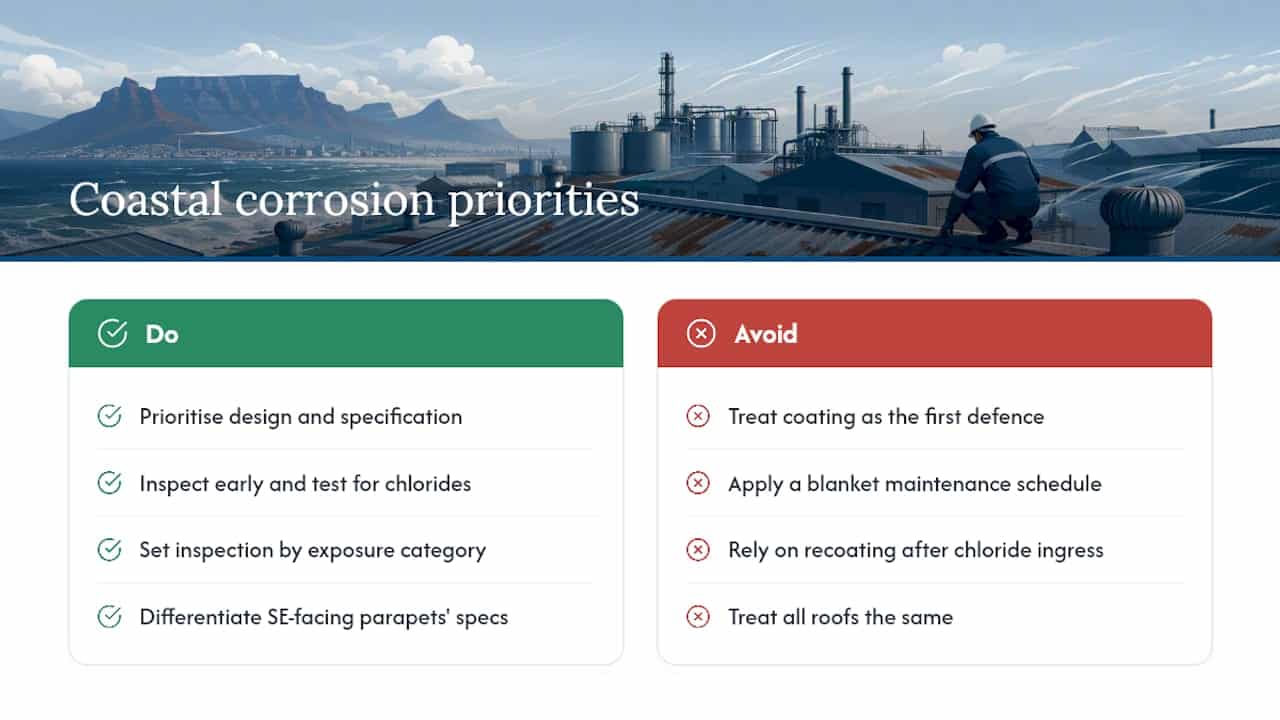
The conventional wisdom treats recoating frequency as the main lever owners can pull. It isn’t. Once chlorides are inside the concrete, recoating is cosmetic. The real lever is catching exposure early, through proper inspection and, where warranted, chloride testing, before contamination reaches the rebar. That’s cheaper by a wide margin than any remediation that follows.
If you take one thing from this: stop treating every roof and facade on your portfolio the same way. A parapet facing the South-Easterly wind corridor needs a different inspection frequency and a different coating spec than a sheltered inland wall on the same site. Exposure category should drive your maintenance budget, not a blanket schedule applied across the whole property.
— Eben
Get a coastal-specification waterproofing quote from Prowaterproofing
Generic waterproofing quotes rarely account for chloride exposure, wind corridor position, or the difference between an acrylic recoat that fails in three years and a silicone system built for ponding and salt air. Prowaterproofing connects Western Cape property owners with contractors who specify materials against actual exposure risk, not a one-size-fits-all recoat.

That means getting a proper assessment of your building’s distance from the coast, wind exposure and existing coating history before any material gets recommended, whether that’s a silicone roof system, duplex galvanised fixings, or a full concrete remediation plan following chloride testing. If your industrial or commercial property sits anywhere near the Cape coastline and you’re due a recoat, an inspection, or you’re already chasing a recurring leak, request a quote through Pro Waterproofing and get a specification built around your actual exposure category rather than a standard inland job sheet.
Sources
- Corrosion of steel in concrete and its prevention in aggressive chloride bearing environments (Purdue-hosted paper)
- Deterioration of reinforced concrete in a marine environment: repair costs and maintenance strategies (UCT dissertation)
- Silicone vs liquid rubber: flat roof coating guidance (Technical Solutions Supplies)