

Many property owners invest in waterproofing only to face costly water damage months later. The misconception that all waterproofing solutions offer equal protection leads to expensive repairs and structural deterioration. Polymer waterproofing represents a superior approach, using advanced materials like polyurethane and acrylic to create seamless, durable barriers that genuinely protect residential and commercial properties. This guide explains what polymer waterproofing is, how different polymer types perform, and why proper application matters for your South African property investment.
Table of Contents
- Understanding Polymer Waterproofing: Definition And Materials
- Polyurethane Coatings In Construction: Features And Advantages
- Comparing Polymer Waterproofing Systems And Practical Application Tips
- Case Study: Hybrid Polyurea Waterproofing Success Story
- Protect Your Property With Pro Waterproofing Solutions
Key takeaways
| Point | Details |
|---|---|
| Polymer waterproofing creates durable barriers | Advanced polymer materials form seamless layers protecting structures from water damage and environmental stress. |
| Polyurethane offers superior performance | This polymer type provides excellent adhesion, flexibility, and crack-bridging capabilities ideal for demanding applications. |
| Surface preparation determines success | Proper cleaning, crack repair, priming, and substrate drying are essential for lasting waterproofing effectiveness. |
| Different polymers suit different conditions | Polyurethane and acrylic variants accommodate specific climatic challenges and substrate requirements across South Africa. |
| Regular maintenance extends lifespan | Scheduled inspections and minor repairs prevent small issues escalating into costly structural damage. |
Understanding polymer waterproofing: definition and materials
Polymer waterproofing involves applying polymer-based materials to create waterproof barriers protecting structures from water damage. Unlike traditional bitumen or cementitious systems, polymer solutions use synthetic materials engineered for specific performance characteristics. These materials form continuous, flexible membranes that adapt to substrate movement whilst maintaining watertight integrity.
The chemistry behind polymer waterproofing centres on long-chain molecules that cross-link during curing, creating tough, elastic films. When properly applied, these films bond directly to substrates, eliminating the weak points common in sheet membrane systems. This seamless coverage proves particularly valuable for complex roof geometries, penetrations, and areas prone to movement.
Polyurethane is a versatile material revolutionising waterproofing with exceptional properties. It offers outstanding adhesion to concrete, metal, and timber substrates when appropriately primed. The material’s inherent flexibility allows it to bridge cracks up to several millimetres, accommodating thermal expansion and structural settlement without tearing. This crack-bridging capability makes polyurethane ideal for roofs, industrial floors, parking decks, and high-traffic areas.
Acrylic polymers provide cost-effective alternatives for less demanding applications. These water-based systems offer excellent UV resistance, making them suitable for façades and vertical surfaces exposed to direct sunlight. Whilst acrylics lack polyurethane’s mechanical strength, they deliver adequate protection for walls, render, and decorative finishes. Their ease of application and lower cost appeal to residential projects with moderate performance requirements.
Selecting appropriate polymers requires understanding South African climatic variations. Coastal properties face salt spray and humidity, demanding polymers with superior chemical resistance. Inland regions experience extreme temperature fluctuations, requiring flexible materials that won’t crack during cold snaps or soften excessively in heat. Different types of waterproofing membranes address these varied conditions.
Successful waterproofing depends on matching polymer properties to specific challenges:
- Mechanical strength for areas subjected to foot traffic or equipment loads
- Chemical resistance for industrial environments or polluted atmospheres
- UV stability for exposed surfaces requiring long-term colour retention
- Thermal flexibility for substrates experiencing significant temperature swings
- Adhesion characteristics compatible with concrete, metal, timber, or existing coatings
Pro Tip: Always request technical data sheets specifying elongation percentages, tensile strength, and service temperature ranges before selecting a polymer system for your property.
The liquid polyurethane waterproofing membrane category includes both aromatic and aliphatic variants. Aromatic polyurethanes cure quickly and offer excellent mechanical properties but yellow under UV exposure. Aliphatic versions maintain colour stability, making them preferable for visible surfaces where aesthetics matter. Understanding these distinctions helps property owners specify systems matching both functional and visual requirements.
Polyurethane coatings in construction: features and advantages
Polyurethane membranes effectively bridge cracks and resist thermal and structural movement in roofs, providing reliable protection where rigid systems fail. The material’s elasticity allows elongation exceeding 400% in some formulations, meaning it stretches rather than tears when substrates shift. This characteristic proves essential for concrete roofs that expand during hot days and contract overnight, creating stresses that fracture inflexible waterproofing.
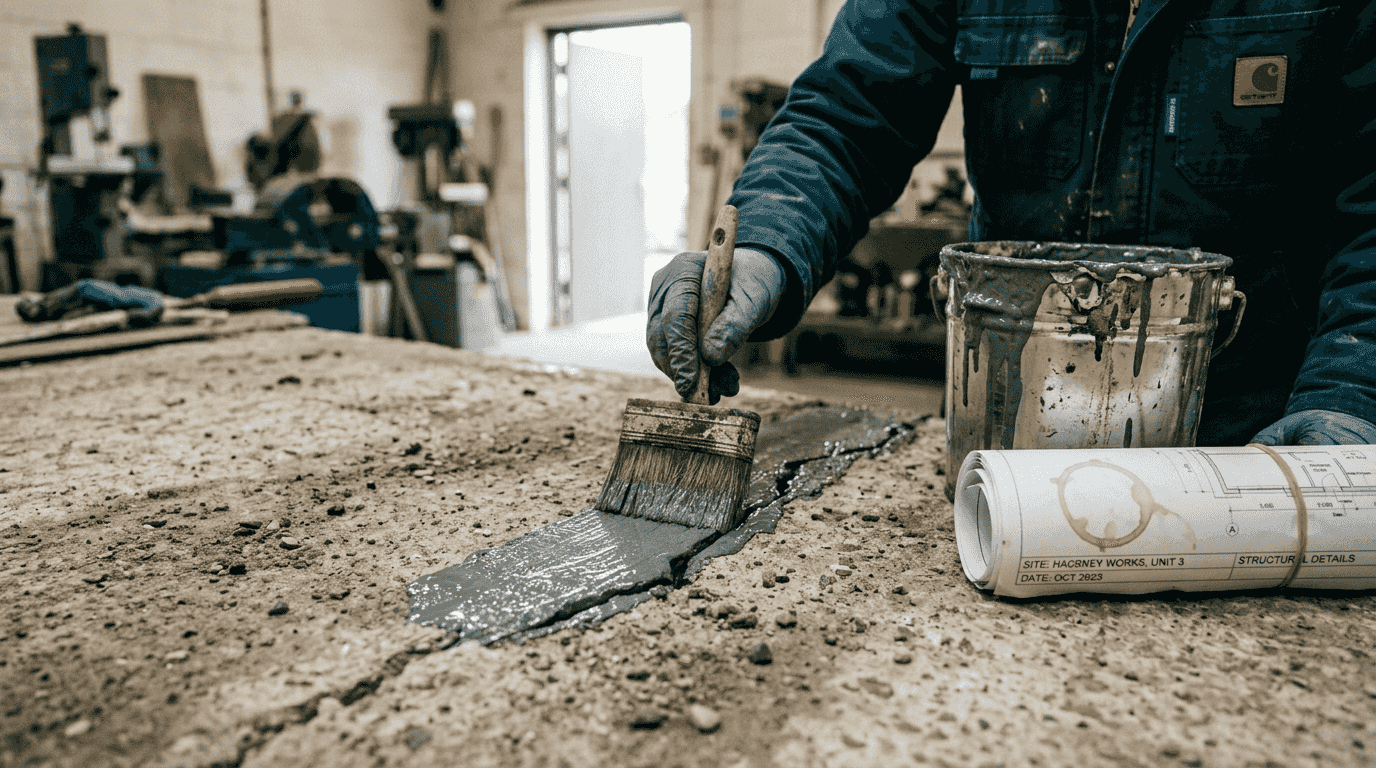
They bond exceptionally well to numerous substrates when appropriately primed, ensuring long-lasting adhesion that prevents water tracking beneath the membrane. Primers chemically modify substrate surfaces, creating anchor points for polyurethane molecules. This molecular bonding surpasses the mechanical adhesion of sheet membranes, which rely solely on adhesive layers that may degrade over time. Proper priming transforms porous concrete into a receptive surface that becomes one with the waterproofing layer.
Sikalastic®-833 R is a pure polyurea membrane about 2.0 to 2.4 mm thick, hot spray applied in two-part formulation. This system exemplifies high-performance polymer waterproofing, offering crack-bridging class A4 capabilities that accommodate substrate movements up to 4 mm. The rapid cure time allows trafficking within hours, minimising construction delays. Such products demonstrate how advanced polymer chemistry delivers measurable performance advantages over conventional membranes.
Common applications extend beyond roofs to include industrial floors, vehicle protection, and mining equipment. Polyurethane coatings provide tough, seamless layers shielding surfaces from wear and corrosion, crucial in mining and industrial sectors. In parking structures, polyurethane systems resist fuel spills, de-icing salts, and constant tyre abrasion. Mining equipment benefits from spray-applied coatings that protect hoppers and chutes from impact and chemical attack, extending service life significantly.
Key advantages of polyurethane waterproofing include:
- Seamless application eliminating joints and overlaps where leaks typically originate
- Rapid installation reducing project timelines and weather exposure risks
- Self-levelling properties ensuring uniform thickness across irregular surfaces
- Chemical resistance protecting against acids, alkalis, and petroleum products
- Low-temperature flexibility maintaining performance during winter conditions
Pro Tip: Specify an aliphatic topcoat for exposed polyurethane roofs to prevent UV degradation and maintain the membrane’s mechanical properties throughout its service life.
Using an aliphatic topcoat on exposed roofs protects aromatic polyurethane from UV damage, extending service life substantially. Aromatic systems offer superior toughness and economy but degrade under sunlight, losing elasticity and developing surface cracks. A thin aliphatic layer acts as a sacrificial barrier, absorbing UV radiation whilst the underlying aromatic membrane provides structural waterproofing. This two-layer approach optimises both performance and cost.
The versatility of polyurethane systems allows customisation for specific requirements. Cold-applied versions suit smaller projects or areas where hot spray equipment proves impractical. Solvent-based formulations penetrate deeply into substrates, ideal for priming old concrete. Water-based variants minimise odour and environmental impact, appropriate for occupied buildings. Understanding these options enables property managers to select systems matching operational constraints whilst achieving reliable waterproofing. Exploring roof coating facts and liquid polyurethane waterproofing membrane details further clarifies selection criteria.
Comparing polymer waterproofing systems and practical application tips
Polyurethane and acrylic systems differ significantly in durability, cost, UV resistance, flexibility, and suitable applications. Understanding these distinctions prevents mismatched specifications that compromise protection. Polyurethane coatings last 8 to 12 years in sheltered areas, whilst acrylics last 6 to 10 years on façades. This performance gap reflects fundamental chemical differences affecting long-term stability.
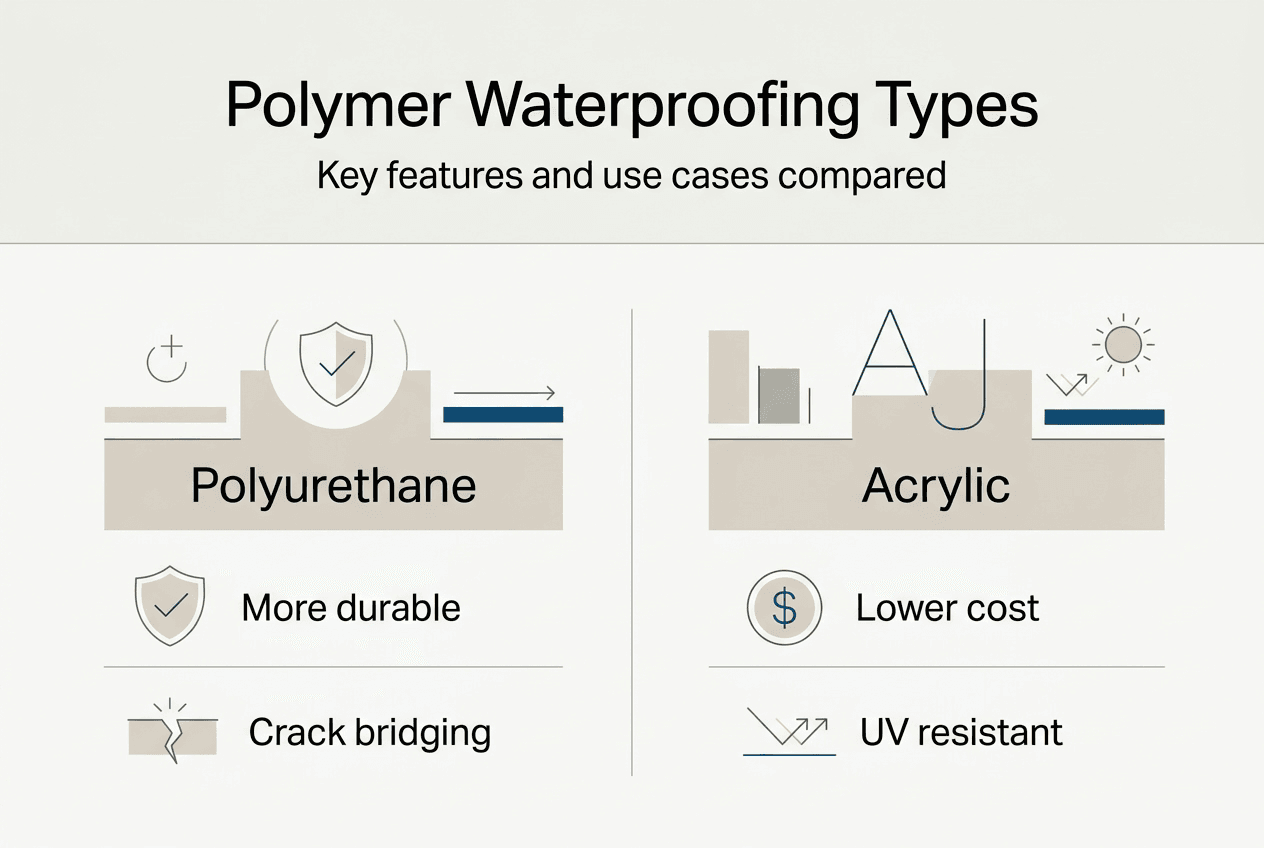
| Feature | Polyurethane | Acrylic |
|---|---|---|
| Durability | 8 to 12 years sheltered | 6 to 10 years exposed |
| Cost | Higher initial investment | Lower upfront cost |
| UV resistance | Requires aliphatic topcoat | Inherently UV stable |
| Flexibility | Excellent, bridges large cracks | Moderate, limited movement |
| Best applications | Roofs, decks, industrial floors | Façades, walls, decorative |
| Chemical resistance | Superior against oils, solvents | Adequate for atmospheric exposure |
| Application complexity | Requires skilled applicators | Easier DIY application |
Proper surface preparation is crucial, involving cleaning, repairing cracks, and ensuring dryness. Skipping preparation steps accounts for most waterproofing failures, as polymers cannot bond to contaminated or unstable substrates. Oil, dust, loose material, and moisture prevent molecular adhesion, creating pathways for water ingress regardless of membrane quality.
Essential preparation steps include:
- Remove all loose material, dirt, vegetation, and existing failed coatings using wire brushes, grinders, or pressure washing
- Repair cracks wider than 2 mm with flexible sealants or repair mortars, ensuring structural stability before waterproofing
- Clean oil stains and chemical residues with appropriate degreasers, then rinse thoroughly to eliminate contamination
- Allow substrates to dry completely, testing moisture content with meters to confirm readings below manufacturer specifications
- Apply primer systems matched to substrate type and polymer chemistry, following recommended coverage rates precisely
- Verify primer cure before applying waterproofing membranes, as premature application compromises adhesion
Application methods vary from spraying to rolling, each offering distinct advantages depending on project scale and complexity. Spray application delivers uniform thickness quickly across large areas, ideal for commercial roofs and industrial facilities. Rolling suits smaller residential projects and detail work around penetrations. Trowel application works for thicker systems requiring build-up in multiple passes. Selecting appropriate methods ensures efficient coverage whilst maintaining specified thickness.
Pro Tip: Use moisture meters to verify concrete substrates contain less than 4% moisture before applying polymer membranes, preventing adhesion failure and blistering from trapped vapour.
Surface movement and extreme weather require flexible polymers with good adhesion and crack-bridging capabilities. South African properties experience significant thermal cycling, with roof surfaces reaching 70°C during summer days and dropping to near freezing on winter nights. This 50°C temperature swing causes substantial expansion and contraction, stressing waterproofing systems. Only polymers engineered for high elongation and recovery maintain integrity under such conditions.
Maintenance and inspection schedules help identify small issues before they escalate into damage. Annual inspections should examine membrane condition, particularly around penetrations, edges, and areas subjected to traffic. Early detection of minor cracks, blisters, or delamination allows targeted repairs preventing extensive water ingress. Cleaning debris from drains and gutters maintains proper drainage, reducing hydrostatic pressure on waterproofing systems. Consulting resources about best waterproofing materials 2025 and reviewing the waterproofing application process guide provides comprehensive preparation knowledge.
Case study: hybrid polyurea waterproofing success story
A documented installation using Hybron®-H90 elastomeric polymer demonstrates polymer waterproofing’s effectiveness in South African conditions. Hybron®-H90 provided over 20 years of expected service life with significant resistance to thermal expansion and weathering. This hybrid polyurea system adapted to substrate movement and harsh weather, maintaining watertight integrity throughout temperature extremes and UV exposure.
The Hybron®-H90 elastomeric polymer adapted to substrate movement and harsh weather conditions typical of South African climates. Its formulation balanced rapid cure with sufficient working time, allowing applicators to achieve uniform coverage across complex roof geometries. The material’s self-levelling properties filled minor surface irregularities, creating a smooth, continuous membrane without pinholes or thin spots.
Opalon-S30 topcoat enhanced durability and provided an appealing glossy finish that reflected solar radiation. The combined system prevented water ingress successfully, maintaining structural integrity with a bright, glossy finish. This aliphatic topcoat protected the underlying polyurea from UV degradation whilst improving aesthetic appeal. The reflective surface reduced heat absorption, lowering roof temperatures and contributing to building energy efficiency.
No leaks or water ingress occurred during the observed lifespan, protecting the roof structure from deterioration. Regular inspections confirmed the membrane remained flexible and intact, with no cracking, blistering, or delamination. This performance validated the system’s design and application quality, demonstrating how proper polymer selection and skilled installation deliver long-term protection.
Performance benchmarks from this installation include:
- Zero leak incidents over the monitoring period
- Membrane elongation maintained above 300% after weathering
- Adhesion strength exceeding 1.5 MPa throughout service life
- Surface temperature reduction of 15°C compared to dark conventional membranes
- No visible degradation or colour change in topcoat layer
| Performance metric | Specification | Achieved result |
|---|---|---|
| Expected service life | 15 to 20 years | 20+ years projected |
| Crack-bridging capability | Class A4, 4 mm movement | Maintained throughout |
| UV resistance | No chalking or cracking | Excellent, no degradation |
| Water ingress incidents | Zero tolerance | Zero leaks recorded |
| Membrane thickness | 2.5 to 3.0 mm | Uniform 2.8 mm average |
This system exemplifies how advanced polymers defend property investment long-term, delivering measurable value through reduced maintenance costs and extended asset life. The combination of robust base membrane and protective topcoat addresses both immediate waterproofing needs and long-term durability requirements. Property owners benefit from peace of mind knowing their structures remain protected against water damage, preserving building integrity and avoiding costly repairs. Learning about waterproof membrane roof solutions provides additional context for selecting appropriate systems.
Protect your property with Pro Waterproofing solutions
Professional application ensures correct polymer selection and surface preparation, eliminating guesswork that leads to failures. Experienced applicators understand how substrate condition, weather patterns, and building use influence system choice. They specify primers, membranes, and topcoats that work together as integrated systems rather than incompatible layers.
Pro Waterproofing offers expert advice and tailored waterproofing systems for homes and commercial buildings throughout South Africa. Our specialists assess your property’s specific challenges, recommend proven solutions, and execute installations meeting manufacturer standards. Using established products like polyurethane membranes maximises durability and protection, backed by material warranties and application guarantees. Contacting specialists prevents common pitfalls such as poor application or product mismatches that compromise performance. Visit Pro Waterproofing services and solutions to discuss your waterproofing requirements and receive personalised recommendations protecting your investment for decades.
FAQ
What polymers are most commonly used in waterproofing?
Polyurethane and acrylic polymers dominate waterproofing applications across South Africa. Polyurethane is praised for exceptional durability, flexibility, and crack-bridging capabilities, making it ideal for roofs, decks, and industrial floors subjected to movement and harsh conditions. Acrylic systems offer cost-effectiveness and inherent UV resistance, suiting façades, walls, and decorative applications where moderate performance suffices. Some projects use hybrid formulations combining polymer types to optimise specific characteristics.
How long does polymer waterproofing typically last?
Typical lifespan ranges from 6 to 12 years depending on polymer type, climate exposure, and maintenance quality. Polyurethane coatings last 8 to 12 years in sheltered areas, whilst acrylics last 6 to 10 years on façades. Exposed roofs with aliphatic topcoats often exceed these ranges, particularly when regular inspections identify and address minor issues promptly. Coastal environments and high UV exposure reduce lifespan, whilst protected applications extend it. Proper installation and substrate preparation significantly influence longevity.
What are the key steps to ensure successful polymer waterproofing application?
Proper surface preparation includes cleaning, repairing cracks, and ensuring dryness; correct application methods are essential for adhesion. Clean the surface thoroughly, removing all loose material, dirt, and contaminants that prevent bonding. Repair any cracks or damage beforehand using appropriate sealants or mortars, ensuring structural stability. Ensure the substrate is completely dry, testing moisture content to confirm readings meet manufacturer specifications. Apply polymer coatings according to technical data sheets, respecting temperature ranges, humidity limits, and cure times for optimal performance.
Can polymer waterproofing be applied over existing membranes?
Applying polymer systems over existing membranes is possible but requires careful assessment of substrate condition and compatibility. The existing membrane must be firmly bonded, clean, and free from contaminants that prevent adhesion. Incompatible chemistries may require complete removal or isolation layers preventing reactions. Bitumen substrates often need specialist primers to ensure polyurethane adhesion. Professional evaluation determines whether overlay application proves viable or complete removal becomes necessary, avoiding failures from inadequate preparation or chemical incompatibility.
What maintenance does polymer waterproofing require?
Polymer waterproofing requires minimal but regular maintenance to maximise lifespan and performance. Annual inspections should examine membrane condition, particularly around penetrations, edges, and high-traffic areas where damage typically initiates. Clean debris from drains and gutters to maintain proper drainage, reducing hydrostatic pressure on the system. Address minor cracks, blisters, or delamination immediately with patch repairs before water ingress occurs. Reapply topcoats every 5 to 7 years on exposed surfaces to maintain UV protection and aesthetic appearance, extending the base membrane’s service life significantly.