
TL;DR:
- Proper below grade waterproofing prevents water ingress, structural damage, and costly repairs.
- Compliance with South African standards and using certified systems are legally mandatory.
- Adequate drainage is essential to alleviate hydrostatic pressure and ensure system longevity.
Most water damage in South African basements is not inevitable. It is preventable. The persistent belief that damp walls and wet foundations are simply part of owning a below-ground structure has cost property owners millions in unnecessary repairs. Below grade waterproofing, when specified correctly and installed by accredited professionals, creates a lasting barrier that protects your structure, your investment, and the people inside. This guide covers the core concepts, proven methods, compliance obligations under South African law, and the practical steps you need to take before water becomes a serious problem.
Table of Contents
- Understanding below grade waterproofing
- How below grade waterproofing works
- Common risks and how to avoid them
- Legal and compliance standards in South Africa
- An expert’s perspective: how to prioritise waterproofing for peace of mind
- Protect your property with certified below grade waterproofing
- Frequently asked questions
Key Takeaways
| Point | Details |
|---|---|
| Requires expert design | Below grade waterproofing relies on thoughtful planning, skilled installation, and certified products for long-term results. |
| Drainage is critical | Proper perimeter drainage prevents the majority of failures and must never be neglected. |
| Local compliance matters | South African law sets strict standards for waterproofing basements and underground walls, with legal and financial penalties for non-compliance. |
| Prevention beats repair | Installing solutions proactively during construction is far more effective and affordable than fixing damage later. |
Understanding below grade waterproofing
The term below grade refers to any part of a building that sits below the natural ground level. This includes basements, subterranean walls, retaining walls, and foundations. When soil surrounds a structure, water in that soil exerts constant pressure against the walls and floor. Without a purpose-built barrier, that water finds a way in.
Below grade waterproofing is the system of membranes, coatings, drainage layers, and sealants applied to these subterranean surfaces to prevent water ingress. It is not the same as damp-proofing, which only resists moisture vapour. A proper below grade system handles liquid water under pressure, which is a far more demanding task.
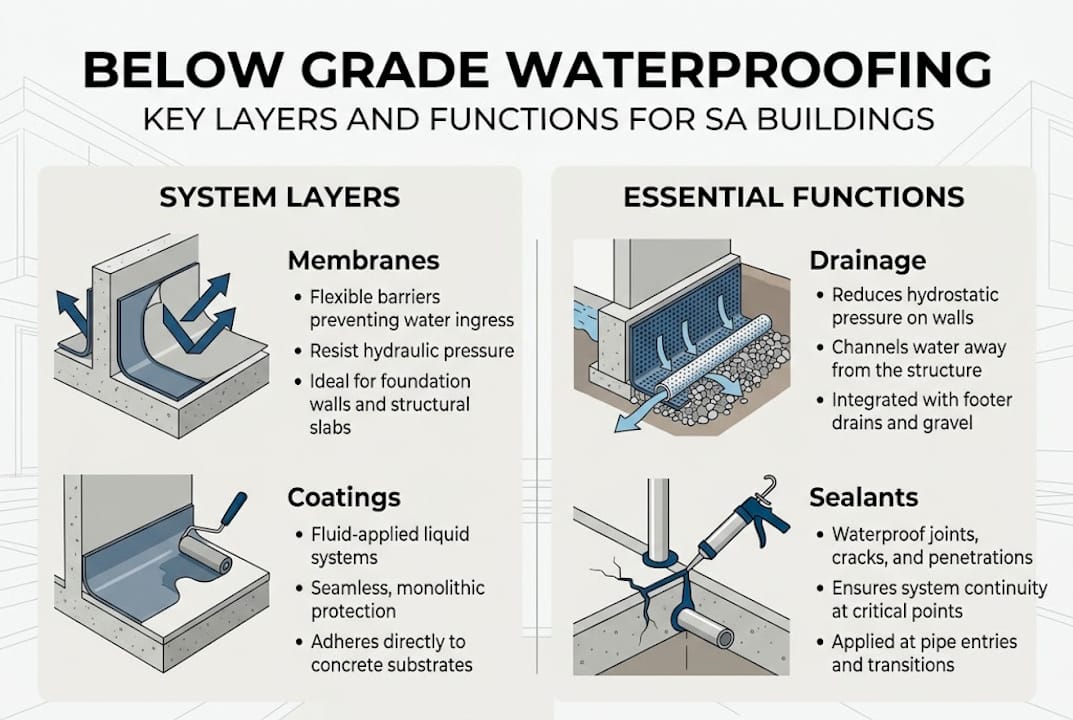
In South Africa, the need for this protection is significant. Many properties in Gauteng, the Western Cape, and KwaZulu-Natal experience high seasonal rainfall, clay-heavy soils, and fluctuating water tables. These conditions make below grade waterproofing not a luxury but a necessity.
Common scenarios where below grade waterproofing is required include:
- Basement car parks in commercial buildings
- Residential basement rooms and storage areas
- Retaining walls holding back soil on sloped properties
- Underground service tunnels and lift pits
- Swimming pool structures and water features
Waterproofing regulations in South Africa confirm that below grade waterproofing is required for basements and subterranean walls to meet SANS and NHBRC standards. The relevant frameworks are SANS 10400 Parts K and L, which govern moisture exclusion and roof and waterproofing work respectively, alongside NHBRC certification requirements for new residential builds.
Failure to comply does not just mean a failed inspection. It means persistent damp, mould growth, structural deterioration, and repair bills that dwarf the original waterproofing cost. Understanding the relevant waterproofing standards before you build or renovate is the single most cost-effective decision you can make.
“Damp is not a cosmetic problem. Once water penetrates a below grade structure, it begins degrading concrete, corroding reinforcing steel, and creating conditions for mould that affect air quality throughout the entire building.”
Pro Tip: Always confirm that your contractor is familiar with the industry standards for waterproofing applicable to your project type before any work begins.
How below grade waterproofing works
Understanding the process helps you ask better questions and make smarter decisions when appointing a contractor. Below grade waterproofing is not a single product applied in an afternoon. It is a system, and every component matters.
Here is how a professional installation typically unfolds:
- Site inspection and assessment: A specialist evaluates the soil type, water table level, and existing structure to determine the appropriate system.
- Surface preparation: Concrete surfaces are cleaned, cracks are repaired, and honeycombing (voids in the concrete) is filled to create a sound substrate.
- Installation of the primary barrier: A membrane or coating is applied to the external face of the structure where possible, or internally where external access is unavailable.
- Sealing penetrations and joints: Pipe entries, construction joints, and movement joints are sealed with compatible sealants or waterstops, as these are the most common failure points.
- Drainage layer installation: A drainage board or gravel layer is placed against the membrane to channel water away from the structure.
- Perimeter drain installation: A slotted pipe at the base of the wall collects water and directs it to a sump or stormwater system. Well-designed basement water drainage systems are essential for long-term performance.
- Backfilling and finishing: Soil is carefully compacted back against the drainage layer without damaging the membrane.
The choice of membrane type has a major impact on durability and suitability. Here is a comparison of the three main options:
| Membrane type | Advantages | Disadvantages |
|---|---|---|
| Bituminous (torch-on or self-adhesive) | Proven performance, cost-effective, widely available | Requires skilled application, can crack in extreme temperature shifts |
| Liquid-applied (polyurethane or cementitious) | Seamless finish, excellent for irregular shapes and penetrations | Sensitive to surface preparation, cure time required |
| Sheet membrane (HDPE or PVC) | High puncture resistance, consistent thickness | Laps and joints must be welded precisely, more expensive |
Poor sub-soil drainage causes inadequate drainage and poor joints, with hydrostatic pressure being a major source of retaining wall failure. Hydrostatic pressure is the force exerted by water-saturated soil against a wall. It builds silently and relentlessly.
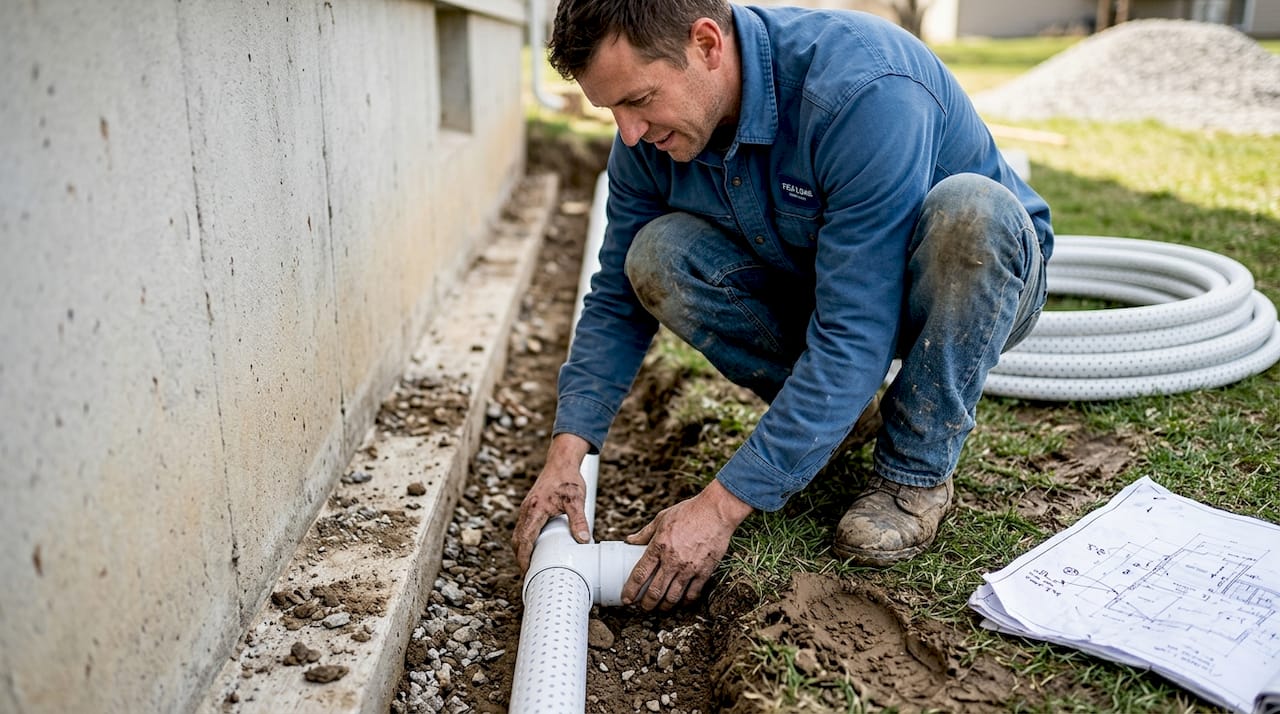
Pro Tip: For properties with a high water table, consider the benefits of waterproof basements that incorporate both an external membrane and an internal drainage channel as a two-line defence.
Common risks and how to avoid them
Even well-intentioned waterproofing projects fail. Knowing why helps you avoid the same mistakes.
The most frequent causes of below grade waterproofing failure are:
- Inadequate drainage: No membrane survives indefinitely under constant hydrostatic pressure. Drainage relieves that pressure before it builds.
- Incomplete joint and penetration sealing: Water finds the path of least resistance. Unsealed joints are an open invitation.
- Poor surface preparation: A membrane applied over a dusty, cracked, or contaminated surface will delaminate and fail prematurely.
- Using the wrong system for the conditions: A light cementitious coating on a basement with a high water table is not fit for purpose.
- Neglected maintenance: Drainage outlets blocked by debris allow water to back up and overwhelm the system.
Hydrostatic pressure accounts for 42% of retaining wall failures, with inadequate drainage cited as a leading cause. That figure should change how you think about the drainage component of your waterproofing system. It is not secondary. It is foundational.
“The most expensive waterproofing job we ever see is the remediation of a failed system. Cutting corners at installation stage multiplies the eventual cost by a factor of three to five.”
Practical steps to protect your investment:
- Commission a geotechnical report before designing the waterproofing system on any new build
- Insist on a perimeter drain as a non-negotiable element of the specification
- Use only products that carry SANS or equivalent certification
- Schedule annual inspections of drainage outlets and visible membrane areas
- Address any signs of damp, efflorescence (white salt deposits on walls), or cracking immediately
For a thorough look at what can go wrong, the basement waterproofing risks specific to South African conditions are well worth reviewing before you finalise your specification. If your property has an existing basement showing signs of ingress, waterproofing basement walls externally is almost always the preferred remediation approach where access allows.
Legal and compliance standards in South Africa
South African property owners and developers are bound by specific legal requirements when it comes to below grade waterproofing. Understanding these obligations protects you from liability, failed inspections, and costly rework.
The two primary frameworks are:
- SANS 10400 Parts K and L: These national standards govern moisture exclusion and waterproofing work in buildings. They specify minimum performance requirements and acceptable materials and methods.
- NHBRC (National Home Builders Registration Council): For residential properties, the NHBRC requires that waterproofing systems be installed by registered contractors and that the work carries a documented warranty.
SANS 10400 Parts K/L and NHBRC require certified systems and a 5-year minimum watertight guarantee for basements. This is not a guideline. It is a legal obligation on new residential builds enrolled with the NHBRC.
Here is a summary checklist of compliance requirements:
| Requirement | Residential | Commercial |
|---|---|---|
| SANS 10400 compliance | Mandatory | Mandatory |
| NHBRC registration of contractor | Mandatory | Recommended |
| Geotechnical assessment | Required for sloped/complex sites | Required |
| 5-year watertight guarantee | Mandatory (NHBRC enrolment) | Best practice |
| Compliance documentation | Required at handover | Required at handover |
| Approved materials and systems | Mandatory | Mandatory |
Penalties for non-compliance include failed municipal building inspections, voided structural warranties, and personal liability for damage caused to neighbouring properties by water migration. In serious cases, the building may be required to be rectified at the owner’s cost before an occupancy certificate is issued.
For a full breakdown of what the law requires, the South African waterproofing standards guide and the owner guide to waterproofing compliance are practical starting points. The complete regulations guide covers both residential and commercial obligations in detail.
An expert’s perspective: how to prioritise waterproofing for peace of mind
Here is the uncomfortable truth that most waterproofing conversations avoid: the property owners who spend the least on waterproofing at construction stage almost always spend the most over the lifetime of the building. Remediation of a failed below grade system costs three to five times more than a correctly specified installation from the outset. The excavation, membrane removal, drainage reinstatement, and structural repairs add up fast.
What we consistently see is that budget pressure during construction leads to the drainage component being value-engineered out or reduced. This is the single worst decision you can make. No membrane, regardless of quality, is designed to carry the full load of hydrostatic pressure indefinitely without drainage relief.
Smart planning during construction is dramatically more affordable than fixing problems after the fact. If you are at design stage, insist that perimeter drainage is written into the specification as a non-negotiable item. Use accredited installers who can provide the NHBRC-compliant guarantee your project requires.
For those working with concrete structures, understanding concrete waterproofing for SA buildings gives you a clearer picture of how integral waterproofing admixtures can complement surface-applied systems for superior long-term performance. Prevention is not just cheaper. It is the only strategy that actually works.
Protect your property with certified below grade waterproofing
Knowing what below grade waterproofing requires is the first step. Acting on that knowledge before water becomes a problem is what separates properties that hold their value from those that become expensive liabilities.
At Pro Waterproofing, we work with residential and commercial property owners across South Africa to assess, specify, and install below grade waterproofing systems that meet SANS and NHBRC requirements. Our team understands local soil conditions, water table challenges, and the compliance documentation your project needs. Whether you are building new, renovating, or dealing with an existing ingress problem, we can help you find the right solution before it becomes a structural crisis. Contact us today for an expert assessment.
Frequently asked questions
What does ‘below grade’ mean in waterproofing?
It refers to any structure or wall built below the natural ground level, as defined in South African waterproofing regulations, which requires special measures to prevent water ingress.
Do I need to waterproof my basement by law in South Africa?
Yes. SANS and NHBRC standards require basements to be waterproofed with certified systems and backed by a documented 5-year watertight guarantee on residential builds.
What is the main cause of waterproofing failure?
Inadequate sub-soil drainage is the most common cause, as poor drainage allows hydrostatic pressure to build and force water through joints and membranes.
How long must a basement waterproofing system last under South African regulations?
It must deliver watertight performance for a minimum of five years, as required by both NHBRC enrolment conditions and SANS standards.