

TL;DR:
- Industrial roofs face severe weather and mechanical stresses, increasing failure risks without waterproofing.
- Proper preparation, material choice, and regular maintenance are essential for long-lasting waterproofing.
- Continuous inspection and upkeep are critical to prevent costly water damage and structural failure.
Water damage costs South African industrial property owners millions of rands each year in structural repairs, lost stock, and operational downtime. A single undetected roof leak can compromise a steel frame, destroy inventory, and force a temporary shutdown within months. The good news is that a properly executed waterproofing solution can extend your roof’s lifespan by decades and protect everything beneath it. This guide walks you through every stage, from understanding the risks unique to South African conditions, to preparing your site, applying the correct system, and verifying that your investment is secure for the long term.
Table of Contents
- Understanding the risks: why waterproofing matters for industrial roofs
- Preparation essentials: tools, materials, and safety for waterproofing
- Step-by-step guide: how to waterproof your industrial roof
- Verifying success and maintaining a waterproofed roof
- Our take: why most industrial roofs in South Africa fail and how to break the cycle
- Let Pro Waterproofing secure your investment
- Frequently asked questions
Key Takeaways
| Point | Details |
|---|---|
| Assess risk early | Identify potential water damage sources before beginning waterproofing work. |
| Use quality materials | Select compatible, high-performance products designed for industrial roofs. |
| Follow proven steps | Adhere strictly to preparation, application, and verification procedures. |
| Maintain routinely | Inspect regularly and address issues before they compromise roof integrity. |
| Call the experts when in doubt | Professional input can save money and extend your industrial roof’s lifespan. |
Understanding the risks: why waterproofing matters for industrial roofs
Industrial roofs face punishment that residential roofs rarely encounter. Large surface areas, heavy mechanical equipment, foot traffic from maintenance crews, and exposure to industrial chemicals all accelerate wear. When waterproofing fails, the consequences are rarely minor.
The most serious risks include:
- Structural damage: Water infiltrating steel purlins and concrete decks causes corrosion and spalling, weakening the entire frame over time.
- Asset and inventory loss: A single overnight leak can destroy raw materials, finished goods, or expensive machinery.
- Operational disruption: Roof repairs on an active facility often require partial shutdowns, costing far more than the repair itself.
- Health and safety hazards: Damp conditions encourage mould growth and create slip hazards for workers.
The most common sources of industrial roof leaks are membrane failures caused by UV degradation, blocked or poorly designed drainage systems that allow ponding water, and expansion joint failures where sections of the roof move independently. South Africa’s climate makes each of these worse. Highveld thunderstorms deliver intense rainfall in short bursts, hailstones can puncture older membranes, and the extreme temperature swings between summer and winter cause significant thermal expansion and contraction in metal roofing systems.
“Industrial roofs without waterproofing are at significantly higher risk of structural damage, making proactive treatment a non-negotiable priority for property owners.”
The financial argument for prevention is straightforward. A full waterproofing application on a large industrial roof typically costs a fraction of what a structural repair or full roof replacement would demand. You can see examples of commercial roof waterproofing that illustrate just how varied and effective modern solutions can be. Understanding the difference in approach between commercial vs residential waterproofing also helps you set realistic expectations for scale and product selection.
Prevention is not just cheaper. It is less disruptive, less stressful, and far better for the long-term value of your property.
Preparation essentials: tools, materials, and safety for waterproofing
Getting the preparation right is where most successful waterproofing projects are won or lost. Rushing this phase is one of the most common mistakes on industrial sites.
Essential tools and safety equipment:
- Pressure washer and stiff-bristle brooms for surface cleaning
- Wire brushes and angle grinders for rust and loose material removal
- Safety harnesses, anchor points, and non-slip footwear for roof access
- Application rollers, brushes, and notched squeegees for membrane work
- Measuring tape, chalk lines, and marking paint for layout
- Personal protective equipment including gloves, goggles, and respirators
Choosing the correct waterproofing product comparison is critical, and choosing the correct waterproofing materials ensures maximum lifespan for your specific roof type.
| Material type | Best application | Expected lifespan |
|---|---|---|
| Bituminous torch-on membrane | Flat concrete or screed roofs | 15 to 25 years |
| Liquid-applied polyurethane | Complex shapes, penetrations | 10 to 20 years |
| Acrylic elastomeric coating | Metal and existing membranes | 5 to 10 years |
| EPDM rubber membrane | Large flat industrial roofs | 20 to 30 years |
| Fibre-reinforced bitumen | High-traffic flat roofs | 15 to 20 years |
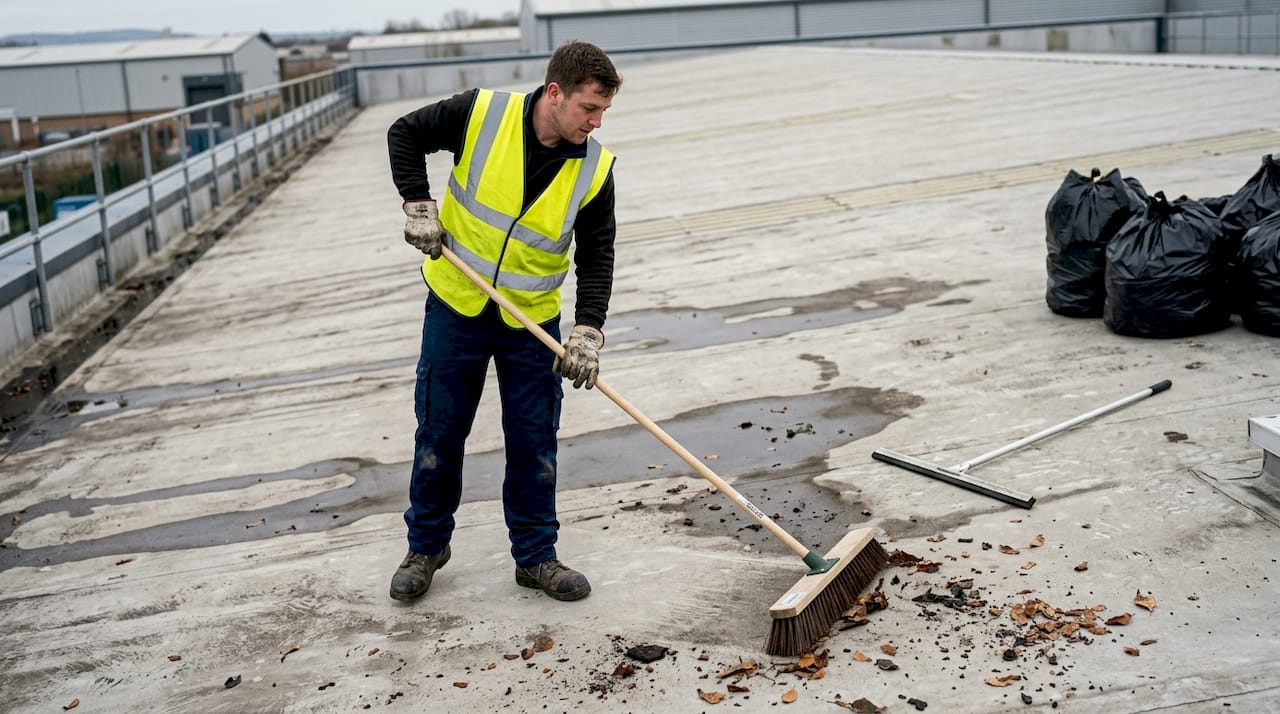
Before any product touches the roof, complete these site preparation steps. Clear all debris, leaves, and standing water. Inspect and clean every drain outlet and downpipe. Check that existing flashings and penetrations are secure. Identify any areas of previous patching that may need to be stripped back. Finally, confirm roof access is safe and that a fall-arrest system is in place for all workers.
For deeper insight into what works on large-scale sites, the industrial strength waterproofing insights from experienced contractors are worth reviewing before you finalise your material selection.
Pro Tip: Always check product compatibility between your primer, membrane, and topcoat. Mixing brands without confirming chemical compatibility can cause delamination within months, voiding warranties and wasting your entire investment.
Step-by-step guide: how to waterproof your industrial roof
With everything prepared, follow these key steps for successful industrial roof waterproofing. The roof waterproofing workflow matters as much as the products you choose.
- Surface preparation: Mechanically clean the entire roof surface. Remove all loose material, rust, and contamination. Fill cracks and voids with an appropriate filler and allow to cure fully.
- Priming: Apply a compatible primer to the clean, dry surface. Primer improves adhesion and seals porous substrates. Allow the recommended drying time before proceeding.
- Membrane or coating application: Apply your chosen system in the specified number of coats or layers. For torch-on membranes, ensure full bond with no air pockets. For liquid systems, maintain the correct wet-film thickness throughout.
- Sealing joints and penetrations: All expansion joints, pipe penetrations, skylights, and parapet walls need special attention. Use reinforcing fabric and additional sealant at every junction point.
- Final inspection: Walk the entire roof systematically, checking for pinholes, thin spots, unbonded edges, and unsealed penetrations. Mark any defects and rectify before signing off.
Proper application technique is central to waterproofing success, and skipping even one step can create a failure point that undermines the entire system.
Flat vs pitched roof considerations:
| Factor | Flat industrial roof | Pitched metal roof |
|---|---|---|
| Primary risk | Ponding water | Fastener and lap joint leaks |
| Recommended system | Full membrane system | Elastomeric coating or seam tape |
| Drainage priority | Critical, slope to falls required | Gutters and downpipes |
| Expansion joint treatment | Mandatory | Lap and ridge sealing |
For a detailed breakdown of each phase, the seven key waterproofing steps guide provides additional clarity on timing and quality checks.
Pro Tip: Photograph each stage of the application process. These records are invaluable for future maintenance assessments, insurance claims, and contractor accountability if issues arise later.
Verifying success and maintaining a waterproofed roof
Once the waterproofing is installed, ongoing maintenance is essential for lasting results. Installation is only the beginning.
How to conduct a post-installation inspection:
- Perform a visual inspection in daylight, looking for any sheen inconsistencies, bubbling, or missed areas.
- Conduct a water test by running a hose over sections of the roof for at least 30 minutes while someone checks inside for any moisture.
- Inspect all joints, flashings, and penetrations closely, as these are the most common failure points.
- Check that all drainage outlets are clear and water flows freely off the roof.
“Regular inspections are crucial to sustaining waterproof integrity, particularly after South Africa’s intense summer storm season.”
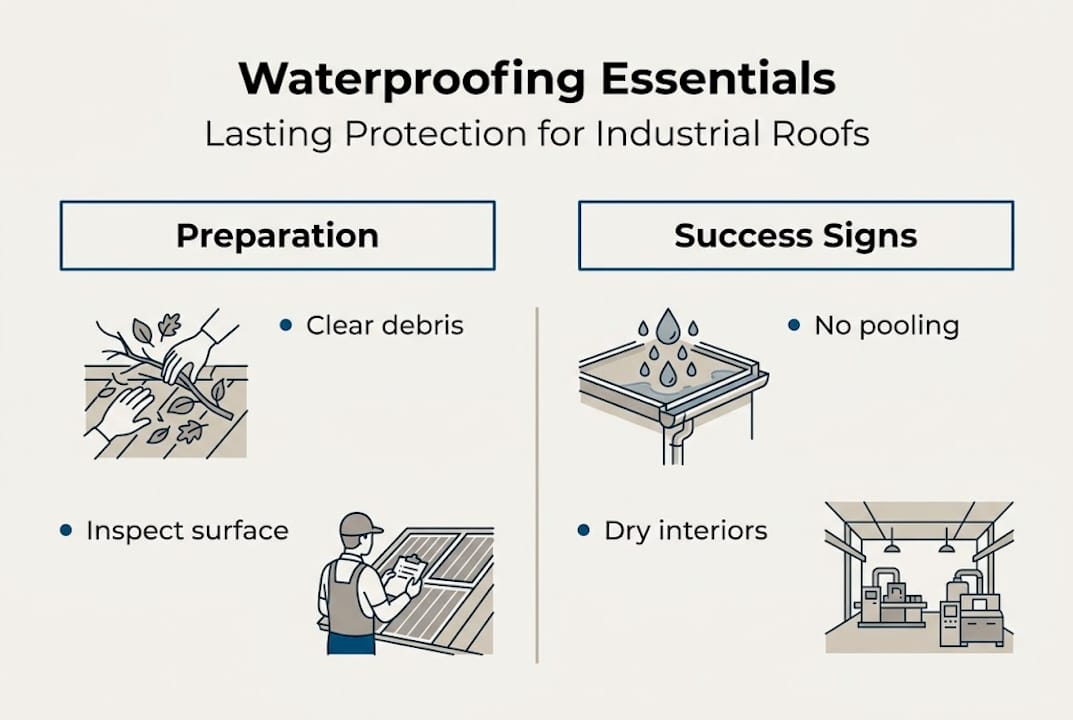
Signs that your waterproofing is performing well include a uniform surface appearance, no pooling after rainfall, and dry interior ceilings and walls. Warning signs that something may be wrong include blistering or peeling of the membrane, visible cracks at joints, damp patches on internal ceilings, and efflorescence (white salt deposits) on walls near the roof line.
For ongoing maintenance steps for industrial roofs, a structured schedule is far more effective than reactive repairs.
| Maintenance task | Recommended interval | Notes |
|---|---|---|
| Full visual inspection | Every 6 months | After storm season and before winter |
| Drain and gutter clearing | Every 3 months | More frequently in leafy areas |
| Joint and flashing check | Annually | Look for cracking or separation |
| Recoating or reapplication | Every 5 to 10 years | Depends on product and exposure |
| Professional assessment | Every 2 to 3 years | Especially for roofs over 10 years old |
Building a maintenance log for your roof is one of the simplest ways to catch problems early and extend the life of your waterproofing system well beyond its standard warranty period.
Our take: why most industrial roofs in South Africa fail and how to break the cycle
After working across dozens of industrial sites, the pattern is almost always the same. The waterproofing was done once, years ago, by the cheapest contractor available, and nobody has looked at it since. That is not a waterproofing failure. That is a maintenance failure.
South Africa’s climate is genuinely harsh on roofing systems. The Highveld combination of intense UV radiation, hailstorms, and dramatic temperature swings degrades even quality membranes faster than European or temperate-climate benchmarks suggest. Products rated for 20 years in mild climates may deliver 12 to 15 years here without proper maintenance.
The uncomfortable truth is that most property owners treat waterproofing as a once-off expense rather than an ongoing asset protection strategy. The result is predictable: premature failure, expensive emergency repairs, and the cycle repeating. Our expert waterproofing perspectives consistently show that properties with structured maintenance programmes spend significantly less over a 20-year period than those relying on reactive repairs. Invest in quality upfront, follow the process, and commit to a maintenance schedule. That is how you break the cycle.
Let Pro Waterproofing secure your investment
Protecting an industrial property from water damage is not a job that rewards cutting corners. The risks are too high and the consequences too costly.
Pro Waterproofing specialises in custom waterproofing solutions for South African industrial, commercial, and residential properties. Our team understands the specific climate challenges and roof types common across the country, and we tailor every solution to your building’s needs. Whether you need a full roof waterproofing system, a maintenance assessment, or expert advice on the right products for your structure, we are ready to help. Contact us today for a free assessment and take the first step towards lasting, reliable protection for your property.
Frequently asked questions
What is the best waterproofing method for flat industrial roofs?
Bituminous membranes and high-quality liquid-applied systems are the most durable options for flat industrial roofs in South Africa, offering reliable long-term performance under heavy UV and rainfall exposure.
How often should an industrial roof be inspected after waterproofing?
Roofs should be inspected at least twice a year and after any severe weather event. Regular inspections prolong roof lifespan by catching minor issues before they become costly failures.
Can waterproofing products be applied in wet conditions?
No. Surfaces must be completely dry before application to ensure proper adhesion and effectiveness. Dry surfaces are essential for correct product performance and long-term bond integrity.
What are signs that a waterproofed industrial roof may be failing?
Visible cracks, ponding water, and leaks inside the building are the clearest indicators of waterproofing failure. Leaks and cracks signal the need for immediate professional assessment and repair.