

TL;DR:
- Waterproofing failures lead to the majority of costly structural damages in South Africa.
- Regional climate conditions require tailored waterproofing and thorough inspections at every project stage.
- Choosing qualified contractors with proper credentials and adhering to standards ensures long-term protection.
Waterproofing failure is not a minor inconvenience. It is one of the leading causes of structural damage across South African properties, and the numbers are striking. Moisture causes 85% of construction defects, with improper waterproofing responsible for 80% of building defects nationwide. Yet most property owners only act after visible damage appears, by which point repair costs have already multiplied. This guide gives you a practical, evidence-based inspection checklist to use before, during, and after any waterproofing project, along with clear guidance on contractor vetting, compliance requirements, and the climate-specific nuances that make South African waterproofing uniquely demanding.
Table of Contents
- Why waterproofing inspections matter in South Africa
- Core waterproofing inspection checklist: Step-by-step breakdown
- Selecting the right waterproofing contractor: Key qualifications
- Common inspection pitfalls and climate-driven nuances
- Our take: Why lifecycle value should outweigh initial cost
- Protect your building with expert waterproofing solutions
- Frequently asked questions
Key Takeaways
| Point | Details |
|---|---|
| Inspection is essential | Skipping diligent waterproofing checks in South Africa invites costly building defects. |
| Follow a checklist | Structured, SANS-driven inspection processes ensure thorough coverage and compliance. |
| Vetting contractors | Proper credentials, onsite surveys and established warranties separate the best contractors from risky choices. |
| Adapt for climate | Inspection priorities must shift to address salt, humidity, UV, and structural stressors depending on regional conditions. |
| Focus on lifecycle value | Spending more on proven solutions and robust inspections saves far more over a building’s lifespan. |
Why waterproofing inspections matter in South Africa
South Africa’s built environment faces waterproofing pressures that many other countries simply do not experience in the same combination. Coastal cities like Cape Town and Durban contend with persistent salt-laden humidity that accelerates membrane degradation. The Highveld, including Johannesburg and Pretoria, experiences intense UV radiation and dramatic temperature cycling between scorching summer days and near-freezing winter nights. Each of these conditions attacks waterproofing systems differently, and a checklist that ignores regional context is only half useful.
The financial stakes are real. Construction defects from moisture account for the majority of costly building failures in South Africa, and remedial waterproofing work consistently costs far more than prevention. A leaking basement, a saturated flat roof, or rising damp in a load-bearing wall can trigger structural repairs, mould remediation, and insurance disputes simultaneously.
One distinction that many property owners miss entirely is the difference between waterproofing and damp-proofing. They are not interchangeable. Waterproofing resists high-pressure water, while damp-proofing addresses low-level, non-pressured moisture. Using a damp-proof solution in a situation that demands full waterproofing is a common and expensive mistake. Climate variation across South Africa makes it essential to select systems tailored to the specific stressors of your location.
A structured inspection checklist addresses all of this directly. It removes guesswork, creates a documented paper trail for insurance and warranty purposes, and ensures that every stage of a waterproofing project meets the required waterproofing standards guide. Consider the core reasons why inspections are non-negotiable:
- Waterproofing failures are responsible for the majority of costly structural defects in South Africa
- Climate differences between coastal, inland, and below-grade environments demand tailored approaches
- SANS (South African National Standards) compliance is a legal and insurance requirement on most projects
- Documented inspections protect you in disputes with contractors or insurers
- Early detection through regular checks prevents minor issues from becoming structural crises
“A waterproofing inspection is not a formality. It is the single most reliable mechanism for protecting your property’s long-term structural integrity.”
Core waterproofing inspection checklist: Step-by-step breakdown
A reliable waterproofing inspection follows a logical sequence. Skipping steps, even seemingly minor ones, is how costly failures begin. The checklist covers site assessment through to post-application testing, and every stage must be documented.
- Site assessment: Identify all risk areas including flat roofs, balconies, basement walls, wet rooms, and below-grade slabs. Map moisture sources and drainage paths before any work begins.
- Surface preparation: Remove all loose material, contaminants, and existing failing membranes. This step is the most frequently neglected and the most consequential. No membrane performs well on a compromised substrate.
- Material and SANS certification check: Verify that all materials carry SANS certification. Request documentation from the contractor before application starts. Uncertified products void warranties and may breach building regulations.
- Membrane application and coverage: Confirm full, continuous coverage with no pinholes, thin spots, or bridging. All seams and joints must be properly sealed with compatible products.
- Drainage inspection: Ensure all drainage outlets are unobstructed and correctly positioned. Pooling water is a leading cause of premature membrane failure.
- Post-application testing: Flood testing, electric field vector mapping (EFVM), or electronic leak detection (ELD) should be conducted after application. Visual inspection alone is insufficient.
- Documentation: Record all materials used, application dates, test results, warranties, and SANS compliance certificates. This file is your protection if disputes arise.
- Biannual maintenance checks: Schedule visual inspections every six months. The waterproofing application process degrades gradually, and early detection of minor issues prevents major failures.
Pro Tip: Before your contractor begins, ask to see the commercial waterproofing checklist they intend to follow. A contractor who cannot produce a structured methodology is a contractor worth questioning.
| Inspection stage | Key action | SANS compliance required |
|---|---|---|
| Site assessment | Map all risk zones | Yes |
| Surface preparation | Remove contaminants | Yes |
| Material verification | Check SANS certification | Yes |
| Application | Full coverage, sealed joints | Yes |
| Post-application testing | Flood or EFVM test | Recommended |
| Documentation | Retain all certificates | Yes |
The step-by-step methodology from inspection through to biannual maintenance is what separates a system that lasts from one that fails within three years. Knowing how to prepare for waterproofing before a contractor arrives puts you in a far stronger position.

Selecting the right waterproofing contractor: Key qualifications
Even the best checklist cannot compensate for an unqualified contractor. South Africa has no shortage of operators offering cheap quotes with minimal credentials, and the consequences of engaging the wrong firm can be severe.
The most reliable indicators of a legitimate waterproofing contractor are industry association memberships and formal credentials. Look for membership in WTASA (Waterproofing Trade Association of South Africa), DWASA (Decorators and Allied Workers of South Africa), or CWP (Certified Waterproofing Professional). For larger commercial or industrial projects, CIDB grading is an additional marker of legitimacy. These memberships are not honorary; they require demonstrated competence and adherence to industry standards.
Beyond credentials, verify the following before signing any contract:
- Written warranty of at least 5 years: Verbal assurances are worthless. Insist on a written guarantee covering both materials and workmanship.
- Proof of professional indemnity and public liability insurance: Without this, you carry the risk if something goes wrong on site.
- Mandatory on-site survey before any quote: A contractor who quotes without visiting the site has not assessed the actual risk. This is a significant red flag.
- Manufacturer training certificates: Contractors should be trained and authorised to apply the specific products they recommend.
- References and past project evidence: Ask for verifiable references from similar projects. Check online reviews independently.
| Credential | Why it matters |
|---|---|
| WTASA/DWASA/CWP membership | Demonstrates industry accountability |
| CIDB grading | Required for larger commercial projects |
| Written 5-year warranty | Legal protection for workmanship and materials |
| Proof of insurance | Protects you from liability on site |
| Manufacturer training | Ensures correct product application |
Pro Tip: Request all documentation in writing before work begins. A contractor who delays providing credentials or deflects questions about waterproofing contractor assurance is telling you something important about how they operate.
Contractors who prioritise industry association membership and provide written guarantees consistently deliver better outcomes. Understanding the industry standards for waterproofing before you engage a contractor gives you the language and confidence to ask the right questions.
Common inspection pitfalls and climate-driven nuances
Knowing what to check is only half the challenge. Knowing where inspections typically go wrong, and why, is what separates a thorough assessment from a superficial one.
Poor surface preparation is the single most frequent cause of waterproofing failure. No matter how advanced the membrane, it will not bond correctly to a contaminated, dusty, or structurally unsound substrate. Poor preparation causes most failures and non-compliance in this area can void both insurance and warranty claims. Always verify that the substrate has been properly cleaned, primed, and approved before any membrane is applied. Reviewing surface preparation tips before your project begins is time well spent.
Climate-driven nuances are equally critical:
- Coastal environments: Salt air and persistent humidity accelerate membrane degradation. Coastal applications need polymer-modified systems with enhanced resistance to salt and moisture cycling.
- Inland/Highveld environments: Extreme UV exposure and wide thermal ranges demand flexible membranes that can expand and contract without cracking.
- Below-grade applications: Basements and underground structures require perimeter drainage systems and geotechnical assessment. Ignoring hydrostatic pressure in these environments leads to catastrophic failure.
Testing is another area where corners are frequently cut. Flood testing, EFVM, and ELD are not optional extras; they are the only reliable way to confirm that a membrane is performing as specified. Visual inspection alone misses pinholes, thin spots, and compromised seams.
“Skipping post-application testing is the equivalent of having a security system installed and never checking whether it actually works.”
Finally, documentation gaps are a hidden risk that many property owners underestimate. Failing to retain SANS certificates, test reports, and written warranties can result in insurance claims being rejected and legal disputes becoming unwinnable. Every inspection, every test, every material certificate must be filed and retained.
Our take: Why lifecycle value should outweigh initial cost
After years of working across South African properties, we have seen the same pattern repeat itself. A property owner accepts the lowest quote, skips a thorough inspection process, and within five years faces repair costs that dwarf the original saving. It is not a coincidence. It is a predictable outcome of prioritising price over performance.
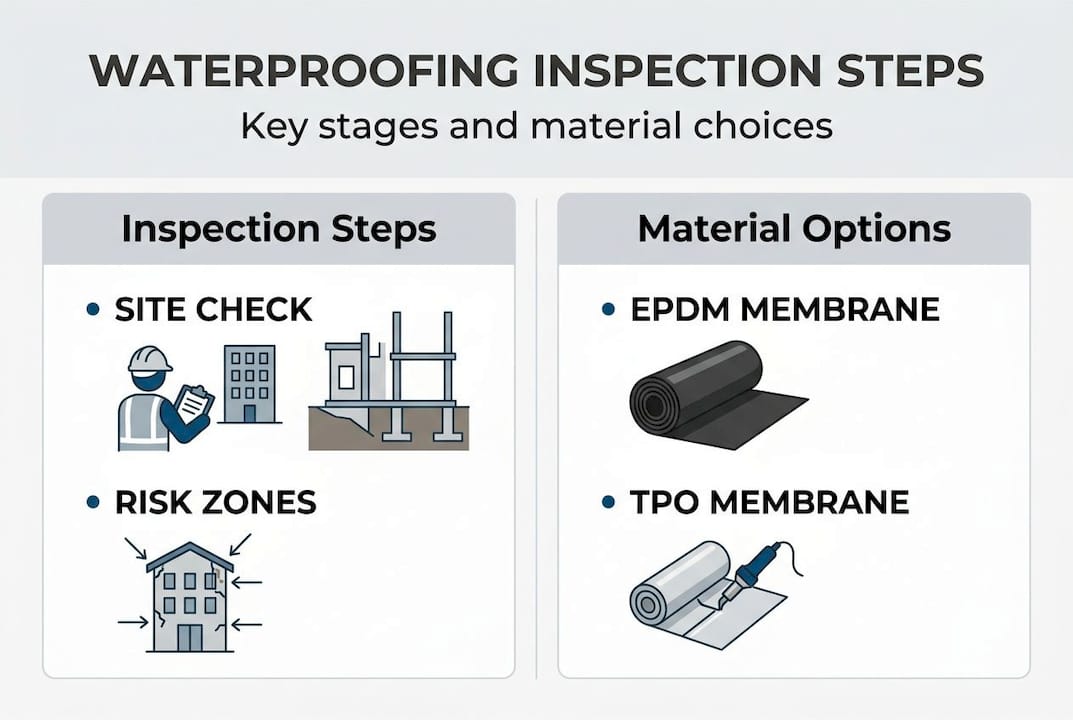
The material choice alone illustrates this clearly. Modern systems like EPDM and TPO last 15 to 30 years. Traditional bitumen membranes typically last 5 to 10 years. The upfront cost difference rarely reflects the true lifecycle gap. When you factor in repeat applications, structural repairs, and potential insurance complications, the cheaper option is almost never cheaper over time.
Robust inspections, thorough documentation, and SANS-approved materials are not bureaucratic overhead. They are the mechanisms that protect your investment across decades. Understanding the role of specialist waterproofing contractors in delivering that lifecycle value is essential before you sign any contract. The inspection checklist is not a formality. It is the foundation of every waterproofing system that actually works.
Protect your building with expert waterproofing solutions
If this guide has clarified what a rigorous waterproofing inspection should look like, the next step is ensuring you have the right team to carry it out. At Pro Waterproofing, we provide certified, SANS-compliant inspections and waterproofing solutions for residential, commercial, and industrial properties across South Africa.
Every project we undertake is fully documented, from initial site assessment through to post-application testing and warranty certification. That documentation protects you with your insurer, your building manager, and your tenants. Whether you need a first-time inspection, a contractor assessment, or a full waterproofing solution, our specialists are ready to help. Contact us today for a professional quote and take the guesswork out of protecting your property.
Frequently asked questions
What key documents should I request from a waterproofing contractor?
You should always request SANS-compliance certificates, manufacturer warranties of at least 5 years, proof of insurance, and written test reports. Waterproofing contractors must provide full documentation covering warranties and compliance certificates before work concludes.
How often should waterproofing inspections be scheduled?
Biannual maintenance inspections are recommended, meaning at least twice per year, to catch early signs of membrane degradation before they become costly structural problems.
What is the difference between waterproofing and damp-proofing?
Waterproofing prevents water under high pressure from penetrating a structure, while damp-proofing addresses low-level non-pressured moisture. Using the wrong system for your specific conditions is a common and expensive error.
What is the most common reason a waterproofing system fails inspection?
Failure is most often linked to inadequate surface preparation or the use of uncertified materials. Poor preparation causes most failures and can void both your warranty and your insurance coverage.