
TL;DR:
- Cementitious waterproofing forms a reliable, seamless barrier suitable for South Africa’s varied climates.
- Its self-healing and crack-bridging abilities make it ideal for below-ground and moisture-prone structures.
- Proper application and surface preparation are essential for long-lasting performance and cost savings.
Choosing the right waterproofing method for a South African property can feel overwhelming. The market is flooded with synthetic membranes, bituminous coatings, and liquid-applied systems, each promising the best protection. Yet one of the most reliable options, cementitious waterproofing, is frequently passed over in favour of newer-sounding alternatives. This guide cuts through the noise. You will learn exactly what cementitious waterproofing is, how it works, where it performs best across South Africa’s varied climates, and how to ensure it is applied correctly for lasting results.
Table of Contents
- What is cementitious waterproofing?
- How cementitious waterproofing works
- Where and when is cementitious waterproofing effective?
- Installation tips and best practices
- Why cementitious waterproofing is underused in South Africa
- Get expert help with your waterproofing project
- Frequently asked questions
Key Takeaways
| Point | Details |
|---|---|
| Reliable water barrier | Cementitious waterproofing forms a long-lasting shield ideal for South Africa’s extreme wet and humid weather. |
| Works for many surfaces | It is effective for basements, tanks, bathrooms, roofs, and retaining walls in all property types. |
| Easy application and care | Application is straightforward for professionals or DIYers, and regular inspection prolongs its life. |
| Versatile and cost-effective | Among waterproofing techniques, it is affordable, strengthens concrete, and offers self-healing for minor cracks. |
What is cementitious waterproofing?
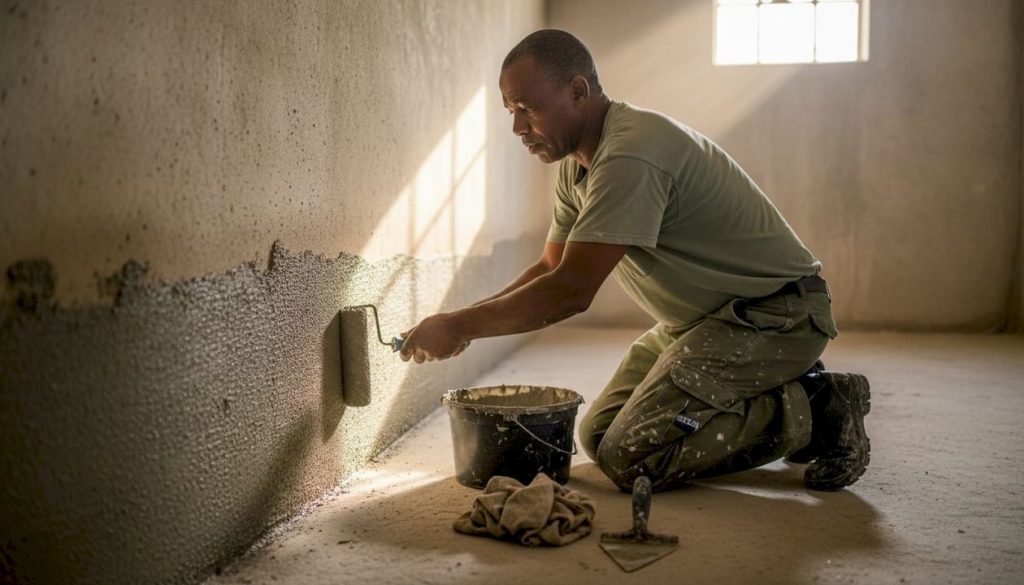
Cementitious waterproofing is a method that involves applying a specially formulated mix of cement, fine aggregates, and chemical additives directly onto concrete or masonry surfaces. The result is a seamless, rigid barrier that blocks water ingress at the surface level. It is one of the oldest and most widely trusted approaches in professional construction, and for good reason.
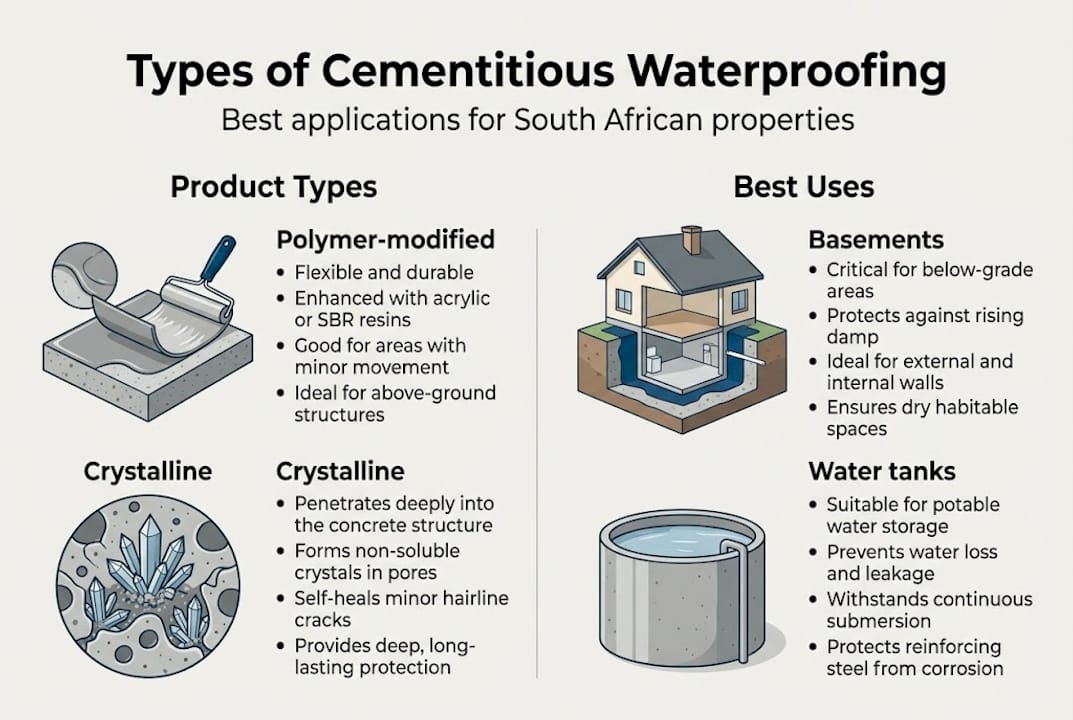
The term covers several distinct product types, each suited to different conditions. Understanding the waterproofing methods overview available helps you choose the right fit from the outset.
| Product type | Key feature | Best use |
|---|---|---|
| Polymer-modified | Flexible, extended service life | Roofs, bathrooms, above-ground walls |
| Crystalline | Self-heals cracks, penetrates deep | Basements, water tanks, below-ground structures |
| Admixture-based | Mixed into concrete during batching | New construction, slabs, foundations |
Polymer-modified products offer a service life of 10 to 15 years, while crystalline types can self-heal cracks up to 0.5mm wide. Admixture-based products, when added to fresh concrete at a 2% dosage, show a 25 to 37% compressive strength increase alongside meaningfully reduced porosity and water absorption.
Common applications in South Africa include:
- Basements and below-ground structures subject to groundwater pressure
- Water storage tanks and reservoirs requiring food-safe or potable-water approval
- Bathrooms and wet rooms in both residential and commercial buildings
- Flat and low-pitch roofs exposed to heavy seasonal rain
- Retaining walls that face persistent soil moisture and hydrostatic pressure
Pro Tip: Always clarify which type of cementitious product is appropriate for your specific surface and exposure conditions before purchasing. Polymer-modified suits flexible, above-ground applications, while crystalline is the go-to for below-ground or permanently wet environments.
How cementitious waterproofing works
With a basic definition in hand, it is important to understand how these materials actually block water and withstand years of climate extremes.
Cementitious waterproofing works through two distinct mechanisms depending on the product type. Polymer-modified products form a physical barrier by bonding tightly to the substrate surface, filling micro-pores and preventing moisture from passing through. Crystalline products go further, reacting chemically with water and free lime within the concrete to form insoluble crystals deep inside the capillary structure.
Here is how the process unfolds for crystalline waterproofing:
- The product is applied to a damp concrete surface as a slurry or dry-shake.
- Active chemicals penetrate the concrete matrix via water movement.
- A chemical reaction generates insoluble crystite crystals (calcium silicate hydrate compounds) inside the capillaries.
- These crystals block water passage even under significant hydrostatic pressure.
- If a crack forms later, the process reactivates in the presence of moisture, self-healing cracks up to 0.5mm without any intervention.
This self-healing ability is particularly valuable in South Africa’s climate, where thermal cycling between hot, dry summers and cold, wet winters causes concrete to expand and contract repeatedly. A material that repairs itself under those conditions is genuinely remarkable.
Polymer-modified products work differently. The polymer chains woven into the cement matrix add elasticity, allowing the coating to flex slightly with substrate movement rather than cracking. This makes them better suited to surfaces that experience minor movement, such as rooftops or external walls.
“Empirical data highlights the remarkable durability and self-healing properties of cementitious waterproofing. Polymer-modified systems deliver service lives of 10 to 15 years, while crystalline systems actively repair themselves in the presence of water, making them ideal for long-term, low-maintenance protection.”
To compare waterproofing methods side by side, it helps to evaluate each option against your specific substrate type, exposure level, and maintenance capacity.
Pro Tip: Ensure the substrate is properly prepared and structurally sound before application. Loose, contaminated, or weak surfaces dramatically reduce the effectiveness of any cementitious product, regardless of its quality.
Where and when is cementitious waterproofing effective?
After learning how cementitious waterproofing functions, let us explore specific local applications and where it stands out compared to alternatives.
Cementitious waterproofing is common for basements, water tanks, bathrooms, roofs, and retaining walls across residential, commercial, and industrial properties in South Africa. Its suitability for the country’s varied climates, from the sub-tropical humidity of KwaZulu-Natal to the heavy winter rains of the Western Cape, makes it a versatile first choice for many projects.

| Method | Flexibility | Durability | Cost | Best for |
|---|---|---|---|---|
| Cementitious | Low to medium | High | Low to medium | Concrete, masonry, tanks |
| Bituminous | Medium | Medium | Medium | Roofs, below-ground |
| Liquid-applied membrane | High | Medium to high | Medium to high | Complex shapes, decks |
| Damp proofing | Low | Low | Low | Minor moisture, walls |
Climate scenarios where cementitious waterproofing excels:
- Heavy summer rainfall zones (Gauteng, KwaZulu-Natal): Ideal for basements and retaining walls under sustained hydrostatic pressure.
- Sub-tropical coastal areas (Durban, Richards Bay): Excellent for bathrooms and water tanks where humidity is constant.
- Dry interior regions (Northern Cape, Free State): Suitable for water reservoirs where preserving stored water is the priority.
- Mediterranean winter-rain zones (Cape Town, Garden Route): Effective on flat roofs and external masonry exposed to seasonal downpours.
For detailed guidance on roof waterproofing types suitable for South African conditions, it is worth reviewing the options before committing to a product.
Cementitious waterproofing does have limitations. It is not suitable for substrates that experience significant movement, such as timber decks, lightweight steel structures, or areas with active structural cracking. In those cases, a flexible liquid membrane or sheet-applied system is a better fit. Always consult waterproofing best practices to avoid mismatching the product to the substrate.
Installation tips and best practices
Having explored where cementitious waterproofing excels, let us turn to practical advice on installation and ongoing protection.
Correct installation is the single biggest factor in how long a cementitious waterproofing system performs. Even the best product will fail prematurely on a poorly prepared surface. Admixture-based products, for example, only deliver their 25 to 37% strength increase when batched at the correct dosage and mixed thoroughly into the concrete.
Follow these five essential steps for a successful application:
- Prepare the surface thoroughly. Remove all dust, oil, loose material, and existing coatings. The substrate must be structurally sound. Use a wire brush, grinder, or pressure washer as needed.
- Dampen the substrate. Cementitious products bond best to a saturated surface-dry (SSD) condition. Wet the surface thoroughly but remove standing water before application.
- Mix the product correctly. Follow the manufacturer’s water-to-powder ratio precisely. Over-watering weakens the mix and reduces waterproofing performance significantly.
- Apply in two coats. The first coat seals the surface; the second coat fills any pinholes or thin spots. Allow adequate curing time between coats as specified on the product data sheet.
- Protect the cured coating. Keep the applied surface away from direct rain or rapid drying for at least 48 hours. Use wet hessian or plastic sheeting in hot or windy conditions to prevent premature drying.
Using a waterproofing checklist before and after application helps you catch common errors before they become costly problems.
For ongoing performance, refer to a waterproofing lifespan guide to understand what to expect over time and when to plan for reapplication.
Pro Tip: Schedule a visual inspection every one to two years. Look for hairline cracks, surface erosion, or areas where the coating has lifted. Catching minor issues early extends the service life considerably and avoids expensive remedial work.
Why cementitious waterproofing is underused in South Africa
With practical know-how established, it is worth considering the bigger picture. Why is cementitious waterproofing not more widespread among South African property owners?
The honest answer is perception. Many contractors and property managers view cementitious products as old technology, something used before modern membranes arrived. That view ignores significant advances in admixture chemistry and crystalline technology over the past two decades. These are not the same products used in the 1980s.
Synthetic and liquid-applied systems often receive more marketing attention, which shapes purchasing decisions. But for below-ground applications, water tanks, and areas of persistent moisture, cementitious waterproofing is frequently unrivalled on cost, durability, and simplicity of application. It does not require specialist equipment or complex surface primers in most cases.
Understanding the difference between waterproofing vs damp proofing is also key. Many property owners apply damp proofing where full waterproofing is needed, and then wonder why the problem returns.
“Property investors reduce long-term maintenance by prioritising proven materials. Cementitious solutions are often their backbone.”
The cost savings over a 15-year horizon are real. Prioritising proven materials over trendy alternatives is not conservatism. It is sound property management.
Get expert help with your waterproofing project
With a solid grasp of cementitious waterproofing’s value, you may want expert support to ensure it is applied correctly for your property.
Cementitious solutions are effective, but they require technical know-how for lasting results. Surface preparation, product selection, and application technique all affect performance. A professional assessment removes the guesswork and ensures the right method is matched to your specific project, substrate type, and local climate conditions. The Pro Waterproofing experts team works with residential, commercial, and industrial property owners across South Africa. Contact us today to discuss your waterproofing needs and arrange a property consultation.
Frequently asked questions
How long does cementitious waterproofing last?
Polymer-modified systems last 10 to 15 years when correctly applied and maintained, while crystalline systems can offer longer protection due to their self-healing properties.
Can cementitious waterproofing be used for roofs in South Africa?
Yes, cementitious products are suitable for concrete roofs across South Africa’s varied climates, provided the surface is properly prepared and the correct product type is selected.
Is cementitious waterproofing safe for drinking water tanks?
Approved cementitious waterproofing products can be safely used in potable water tanks, but only if the specific product carries a supplier certification for contact with drinking water.
What are the main advantages of cementitious waterproofing?
It is durable, cost-effective, and straightforward to apply, with 25 to 37% compressive strength gains and reduced porosity making it highly resistant to water penetration on concrete and masonry surfaces.