
TL;DR:
- Choosing the best flat roof waterproofing system requires considering substrate condition, drainage, and exposure conditions beyond just product selection. A successful system includes proper substrate preparation, detailed junctions, and thorough installation, emphasizing system quality over individual materials. Regular inspections and meticulous detailing at critical points significantly extend roof lifespan and prevent leaks.
Choosing the best flat roof waterproofing system is genuinely difficult. Unlike pitched roofs, flat roofs face ponding water, complex detailing around parapets and outlets, and rapid degradation when even one component underperforms. The right choice is never just about picking a membrane off a price list. It depends on your roof’s substrate condition, drainage design, exposure, and how the whole assembly is installed and maintained. This guide walks you through the evaluation criteria, the leading materials and systems, a clear comparison, and a practical decision framework so you can act with confidence.
Key takeaways
| Point | Details |
|---|---|
| System quality over product alone | A matched assembly of substrate prep, membrane, detailing, and drainage determines long-term success. |
| Detailing is where leaks start | Leaks most often originate at joints, parapets, and penetrations, not the flat membrane field. |
| Match material to conditions | Roof use, drainage, foot traffic, and exposure should drive your membrane choice, not price alone. |
| Seamless systems reduce failure points | Liquid-applied membranes eliminate seams and laps that are common leak initiators in sheet systems. |
| Professional assessment pays off | Early professional specification and installation saves significantly more than post-leak remediation. |
What makes the best flat roof waterproofing solution
The phrase “best flat roof waterproofing” gets used loosely in product marketing, but the industry standard term is a waterproofing system, and the distinction matters enormously. A system includes the substrate, the primer, the membrane or coating, the detailing at critical junctions, and the drainage design. No single product performs well without the supporting elements.
Here is what to evaluate before selecting any material:
- Substrate condition and compatibility. Is the existing deck structurally sound? Is it concrete, timber, or steel? Adhesion compatibility between substrate and waterproofing product determines whether the coating bonds or eventually fails.
- Surface preparation. Contamination, moisture, and open cracks are the most common reasons coatings fail prematurely. The greatest impact on performance often comes from preparation, not product quality.
- Detailing at critical junctions. Flashings, corners, expansion joints, pipe penetrations, and parapet upstands all require reinforced detailing. Failures frequently start at these points, not across the open field.
- Drainage and slope. Ponding water dramatically increases leakage risk, especially at details. Accurate slope and drainage design must be matched to your waterproofing strategy.
- Roof usage and exposure. A roof terrace with regular foot traffic needs a different specification to a plant-room roof with minimal access. UV intensity, wind uplift, and chemical exposure in industrial settings all affect material selection.
- Durability versus budget. Longer-lasting systems cost more upfront but deliver lower lifecycle costs. Calculate the total cost of ownership, not just the installation price.
Pro Tip: Ask your contractor for the full system specification in writing, including primer, membrane thickness, and detailing method. A reputable installer will provide this without hesitation.
1. Liquid-applied seamless coatings
Liquid-applied systems are applied in liquid form and cure to form a monolithic, seamless membrane. Products like polyurethane, PMMA (polymethylmethacrylate), and acrylic elastomers bond directly to the substrate and eliminate the seams, welds, and laps that are the most common failure points in traditional sheet membranes.
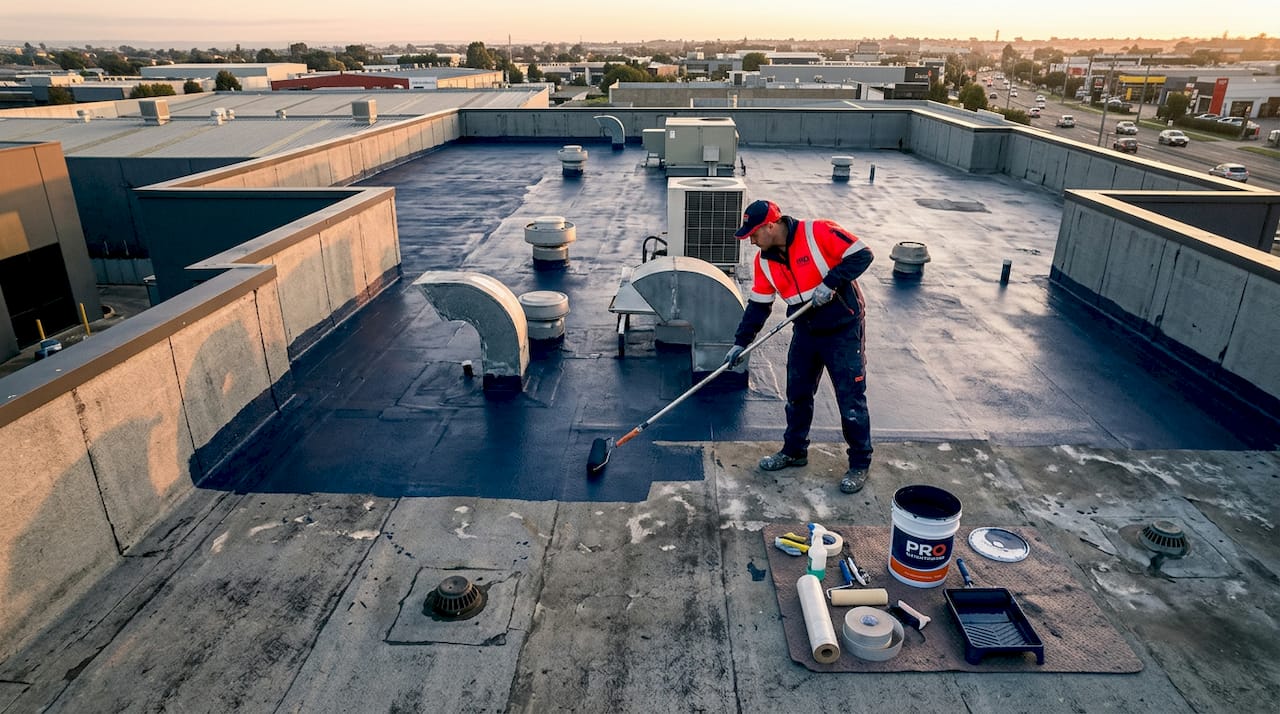
These systems excel at complex geometries. Curved upstands, awkward pipe penetrations, and irregular parapets are all handled without cutting or welding sheets. They are particularly suited to refurbishment over existing surfaces where removing the old membrane would be disruptive or costly.
The critical caveat is substrate preparation. Moisture and contamination cause adhesion failure. A liquid coating applied over a damp or poorly prepared deck will delaminate, regardless of product quality.
Pro Tip: Look for systems with BBA certification. BBA-backed testing provides independent verification of UV resistance and weathering performance, giving building managers a credible quality benchmark.
2. EPDM rubber membranes
EPDM (ethylene propylene diene monomer) is a synthetic rubber membrane with a proven track record stretching back decades. It handles ponding water well, accommodates thermal movement without cracking, and typically lasts 25 to 30 years when installed correctly.
EPDM is available in large rolls, which reduces the number of seams across a roof field. Seams are bonded with adhesive tape, which is the main vulnerability. Seam quality is critical. In single-ply systems, seam and edge detailing determine watertightness more than the base membrane chemistry itself.
Typical installed costs run between $3 and $6 per square foot (with regional variation applying in South Africa), making EPDM one of the more cost-accessible options among the top flat roof membranes.
3. TPO membranes
TPO (thermoplastic polyolefin) has become the most widely specified single-ply option for commercial flat roofs. It reflects solar radiation, which reduces building cooling loads, and its seams are heat-welded rather than adhesive-bonded. Heat-welded seams, when done properly, are stronger than the membrane itself.
Typical installed costs run $4 to $8 per square foot with an expected lifespan of 20 to 30 years. TPO works well for large, open commercial roofs with limited penetrations. The more penetrations and details there are, the more the quality of installation matters, as each junction is a potential weak point.
For commercial building managers weighing up a restoration versus replacement decision, TPO is frequently specified for full replacement projects where budgets allow for a long-term solution.
4. PVC membranes
PVC (polyvinyl chloride) membranes are the premium option in the single-ply category. They resist grease, chemicals, and oils better than TPO or EPDM, making them the preferred choice for restaurant rooftops, industrial facilities, and food-processing buildings.
Like TPO, PVC seams are heat-welded and extremely durable when installed by trained applicators. The higher upfront cost is offset by chemical resistance properties that other membranes simply cannot match in the right environment. PVC does become brittle in sustained cold exposure, which is worth considering in regions with harsh winters.
5. Modified bitumen
Modified bitumen is an evolution of traditional built-up roofing. It incorporates APP (atactic polypropylene) or SBS (styrene-butadiene-styrene) polymer modifiers to improve flexibility and temperature performance.
Installed costs typically sit between $4 and $7 per square foot with a lifespan of 15 to 20 years. It is applied in multiple layers, which provides redundancy. If one layer is compromised, the others continue to provide protection. This makes it a sensible choice for roofs with regular foot traffic or mechanical plant access.
Repairs are straightforward. A damaged section can be torched or cold-applied with bitumen-compatible patches, without needing to disturb the wider roof.
6. Felt roofing
Traditional mineral felt is the most affordable flat roof sealing option and is still widely used on domestic extensions and outbuildings. The trade-off is longevity. A standard three-layer felt system may only last 10 to 15 years, and performance is highly sensitive to workmanship quality.
Modern high-performance felts, sometimes called torch-on or SBS-modified felts, perform significantly better than older grades and can approach modified bitumen in durability. If budget is genuinely constrained and the roof is a low-priority outbuilding, felt remains a legitimate option. For anything else, upgrading the specification is almost always worth it.
7. GRP fibreglass systems
GRP (glass-reinforced polyester) creates a hard, seamless shell over the roof deck. It is extremely durable, handles foot traffic well, and is popular for balconies and walkable roof terraces in residential settings.
The limitation is installation sensitivity. GRP must be laid in suitable temperatures and humidity conditions. Incorrect mixing ratios or application in cold, damp weather leads to delamination or poor curing. When it is installed correctly, it is one of the most reliable flat roof waterproofing solutions available for smaller domestic roofs.
Comparing flat roof waterproofing materials
| Material | Approx. lifespan | Relative cost | Seams/joints | Best suited for |
|---|---|---|---|---|
| Liquid-applied (polyurethane/PMMA) | 20+ years | Medium | None (seamless) | Refurbishment, complex geometry |
| EPDM | 25 to 30 years | Low to medium | Adhesive-bonded | Residential, green roofs |
| TPO | 20 to 30 years | Medium | Heat-welded | Commercial, large open roofs |
| PVC | 20 to 30 years | Medium to high | Heat-welded | Industrial, chemical exposure |
| Modified bitumen | 15 to 20 years | Medium | Overlapping layers | High foot traffic, plant access |
| Felt (standard) | 10 to 15 years | Low | Overlapping layers | Budget domestic applications |
| GRP fibreglass | 25+ years | Medium | Seamless | Domestic terraces, balconies |
Matching membrane type to your roof environment, drainage reality, and maintenance capacity leads directly to lower lifecycle costs. A cheaper membrane that requires repair every five years is rarely a saving.
Pro Tip: Request warranty documentation that covers both the membrane product and the installation workmanship separately. A 20-year product warranty is meaningless if a poor installation is not backed by the contractor.
How to decide the best waterproofing option for your roof
Here is a practical, step-by-step approach to arriving at the right specification:
- Inspect the existing roof. Identify any active leaks, blistering, cracking, or saturated insulation. A professional inspection will clarify whether you need a full replacement or targeted repairs followed by a new membrane.
- Assess drainage. Check outlets and gutters for blockages. Confirm that the roof has adequate fall. Standing water after rainfall is a warning sign that drainage design needs attention before any waterproofing is applied.
- Define your roof’s usage. Is it a purely functional roof or an accessible terrace? Heavy foot traffic, vehicle access, or rooftop plant equipment each demand specific membrane durability and surface protection.
- Establish your budget alongside lifecycle expectations. A property manager planning a 20-year hold should invest in a system that performs for at least that period, rather than deferring costs through a cheaper short-term fix.
- Prioritise detailing. Ask your contractor specifically about their approach to flashings, upstands, outlets, and penetrations. System performance is driven by installation quality, not membrane choice alone.
- Engage a professional assessment. An experienced waterproofing specialist will survey the substrate, assess drainage, and produce a written specification. This document protects you if disputes arise and gives you a clear baseline for comparing quotes.
- Plan for maintenance. Even the best waterproofing systems benefit from annual inspection. Addressing causes early in surface preparation and ongoing maintenance prevents premature leakage and extends service life significantly.
You can read Prowaterproofing’s detailed guide on how to waterproof flat roofs for a thorough breakdown of the inspection and preparation process.
What I have learned from years of watching flat roofs fail
I have seen property owners spend significant amounts on branded membranes only to have leaks reappear within two years. Every time, the root cause was the same. It was never the membrane. It was the corners, the upstands, or a drain outlet that was not properly detailed.
There is a persistent belief that waterproofing is primarily a product decision. Choose the right brand, and the roof will be fine. What I have found is that the opposite is closer to the truth. A mid-range membrane installed by a meticulous team with proper substrate preparation will outperform a premium product slapped over a poorly cleaned, inadequately primed deck.
The roofs I have seen last the longest share three things: disciplined surface preparation, painstaking detailing at every junction, and an annual inspection that catches minor splits before they become interior damage. The membrane type matters, but it matters less than most suppliers would like you to believe.
Liquid systems are genuinely impressive for refurbishment scenarios, and I would not dismiss them as a gimmick. But they are not a panacea. Applied over a substrate with hidden moisture, they will delaminate. The solution is never the coating alone. It is the full process.
If you are managing a building or property portfolio, the single best investment you can make is in a proper written specification from an experienced contractor before any product is even selected. That document, and the discipline to follow it on site, is what separates a roof that lasts 25 years from one that needs attention in five. Take a look at this overview of waterproofing material selection for further context on matching materials to real conditions.
— Eben
Get expert flat roof waterproofing from Prowaterproofing
If this guide has clarified your options, the logical next step is a professional assessment of your specific roof. Generic advice only goes so far. What your building actually needs depends on its substrate, its drainage, its usage, and its exposure conditions.
Prowaterproofing provides end-to-end waterproofing services for residential, commercial, and industrial properties across South Africa, covering inspection, surface preparation, membrane specification, and installation. Acting before a leak develops is always less expensive than repairing the damage after one does. Contact Prowaterproofing today for a professional assessment and a clear, written waterproofing specification tailored to your property.
You can also find practical guidance on the full roof waterproofing workflow on the Prowaterproofing site.
FAQ
What is the best waterproofing method for a flat roof?
There is no single answer. The best method depends on your substrate, drainage, roof usage, and budget. Liquid-applied seamless systems are excellent for refurbishment, while heat-welded TPO or EPDM suits larger commercial applications well.
How long does flat roof waterproofing last?
Lifespan varies by material. EPDM and TPO typically last 20 to 30 years, GRP fibreglass 25 or more years, and standard felt systems around 10 to 15 years. Installation quality is the single biggest variable in any system’s longevity.
Where do most flat roof leaks start?
Leaks most commonly originate at joints, flashings, parapets, and pipe penetrations rather than across the open membrane field. Detailing quality at these points matters more than membrane choice.
Is a liquid waterproofing coating sufficient on its own?
Not without proper substrate preparation. Coatings alone rarely solve waterproofing problems if the underlying substrate has moisture issues or open defects. The preparation and detailing must be addressed first.
How often should a flat roof be inspected?
Annual inspections are recommended for most flat roof systems, with additional checks after severe storms. Early identification of minor splits or blocked outlets prevents them from becoming costly interior leaks.