
TL;DR:
- Negative side waterproofing manages water after it penetrates walls, risking long-term structural damage.
- It often fails to prevent moisture-related issues like efflorescence, mould, and rebar corrosion.
- Professional assessment and exterior waterproofing are recommended for durable, long-term solutions.
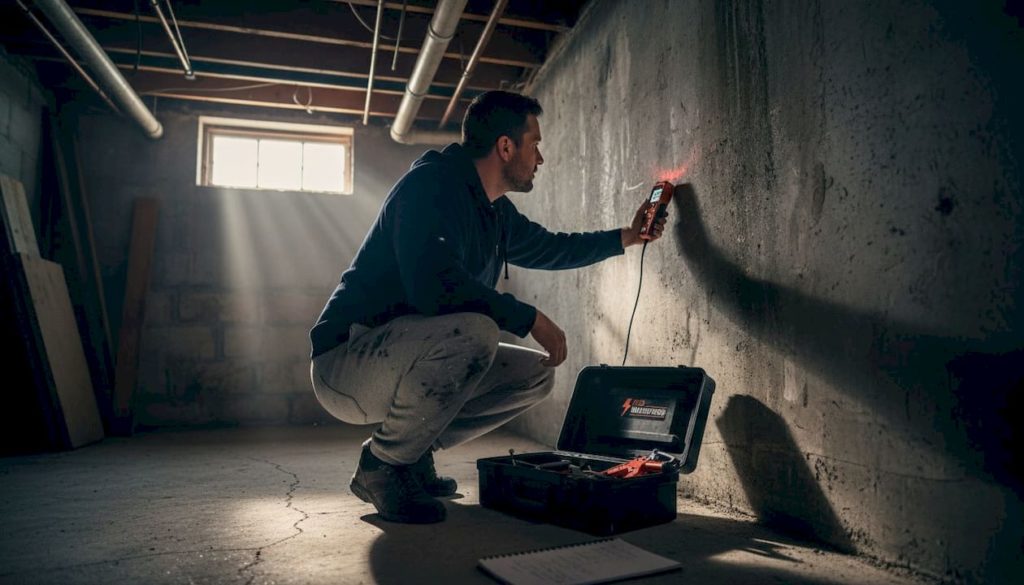
Many property owners in South Africa treat negative side waterproofing as a clever shortcut. It seems affordable, it’s relatively quick to apply, and it appears to solve the immediate problem of damp walls or a wet basement. What’s not to like? Quite a lot, as it turns out. Negative side waterproofing carries a set of serious limitations that rarely get discussed at the point of sale, and these limitations can quietly undermine your property’s structure over months or even years. Before you commit to this approach, it’s worth understanding exactly what you’re choosing and what you might be giving up.
Table of Contents
- What is negative side waterproofing and where is it used?
- The main drawbacks of negative side waterproofing
- Maintenance challenges and long-term risks
- Better alternatives and when to seek expert advice
- A local expert’s perspective: Why quick fixes can cost you more
- Get comprehensive, long-lasting waterproofing solutions
- Frequently asked questions
Key Takeaways
| Point | Details |
|---|---|
| Not a true barrier | Negative side waterproofing manages water after entry but does not prevent ingress. |
| Hidden risks remain | This method can leave structures at risk of ongoing damage and costly repairs. |
| Alternatives are superior | Positive side waterproofing offers more durable, comprehensive protection. |
| Expert input matters | Professional assessment helps select the best system for each property. |
What is negative side waterproofing and where is it used?
To understand the drawbacks, you first need a clear picture of what negative side waterproofing actually is and how it differs from other methods.
Negative side waterproofing refers to the application of waterproofing products on the interior face of a wall or floor, specifically the side that water is pushing against from the outside. In other words, the barrier is placed on the wet side rather than the dry side. The product is designed to resist hydrostatic pressure (the force that water exerts as it pushes through a structure) from the inside.
This is fundamentally different from positive side waterproofing, which is applied on the exterior of the structure, between the soil or water source and the building itself. Positive side waterproofing intercepts moisture before it ever touches the structural material, which is the most logical point of protection. Then there is blind side waterproofing, which is applied to formwork or permanent structures before the concrete is poured, making it impossible to access later.
For a broader overview of these distinctions, the essential waterproofing methods article on our site provides useful context for South African property owners weighing their options.
Where is negative side waterproofing typically chosen?
- Basement interiors where exterior excavation is impractical or too expensive
- Older properties where the original waterproofing membrane has failed and exterior access is blocked
- Retaining walls and underground structures with restricted access
- Quick remediation projects with tight budgets and limited timelines
- Properties in high water table areas where ongoing seepage management is the priority
Comparison of waterproofing methods
| Feature | Positive side | Negative side | Blind side |
|---|---|---|---|
| Applied on | Exterior (dry side) | Interior (wet side) | Before structure is built |
| Stops water at source | Yes | No | Yes |
| Suitable for existing structures | Yes (with excavation) | Yes | No |
| Long-term reliability | High | Moderate to low | High |
| Cost of access | Higher | Lower | Lowest |
| Structural protection | Full | Partial | Full |
The appeal of negative side waterproofing is mostly about access and upfront cost. When a homeowner discovers a damp basement and faces the prospect of excavating around the entire foundation to apply exterior treatment, the interior option feels like the sensible middle ground. In many cases, contractors reinforce this view by emphasising speed and affordability. What often gets left out of that conversation is the range of limitations that come with the method.
The main drawbacks of negative side waterproofing
Now that you know where and why negative side waterproofing is used, it’s important to uncover the main disadvantages that could affect property value and longevity.
The core problem is simple but significant. Negative side waterproofing does not stop water from entering your structure. It only attempts to manage water after it has already penetrated the outer face of the wall or floor. This distinction matters enormously, because once water is inside the structural material, it begins to cause damage regardless of what you apply to the interior surface.
Key disadvantages at a glance:
- Water continues to saturate the structural material itself, even if the visible seepage is reduced
- Ongoing moisture within concrete or masonry accelerates carbonation and weakens the structure over time
- Products applied on the negative side must resist continuous hydrostatic pressure, and they often fail as cracks develop or pressure fluctuates
- Efflorescence (white salt deposits) frequently appears as minerals leach through walls, signalling ongoing moisture movement
- Mould and mildew can develop within wall cavities even when the interior surface appears dry
- The method provides no protection against freeze-thaw cycles or seasonal ground movement, both of which are relevant in certain South African regions
A common basement waterproofing myth is that applying a crystalline or cementitious product to an interior wall creates a permanent seal. In reality, these products depend on the absence of active cracks and stable substrate conditions. As a structure shifts or settles, which every structure does over time, the integrity of the application is quickly compromised.
“Negative side waterproofing is sometimes the only practical option in specific scenarios, but it should never be considered a permanent solution or a substitute for proper exterior protection.”
The structural risk is real and compounding. Water trapped within masonry or concrete causes corrosion of reinforcing steel (rebar), expansion of rust products, and eventually spalling (flaking or crumbling of the surface material). These processes are slow and invisible until significant damage has already occurred. By the time visible cracking or spalling appears, the repair cost is substantially higher than it would have been with a preventive exterior approach.
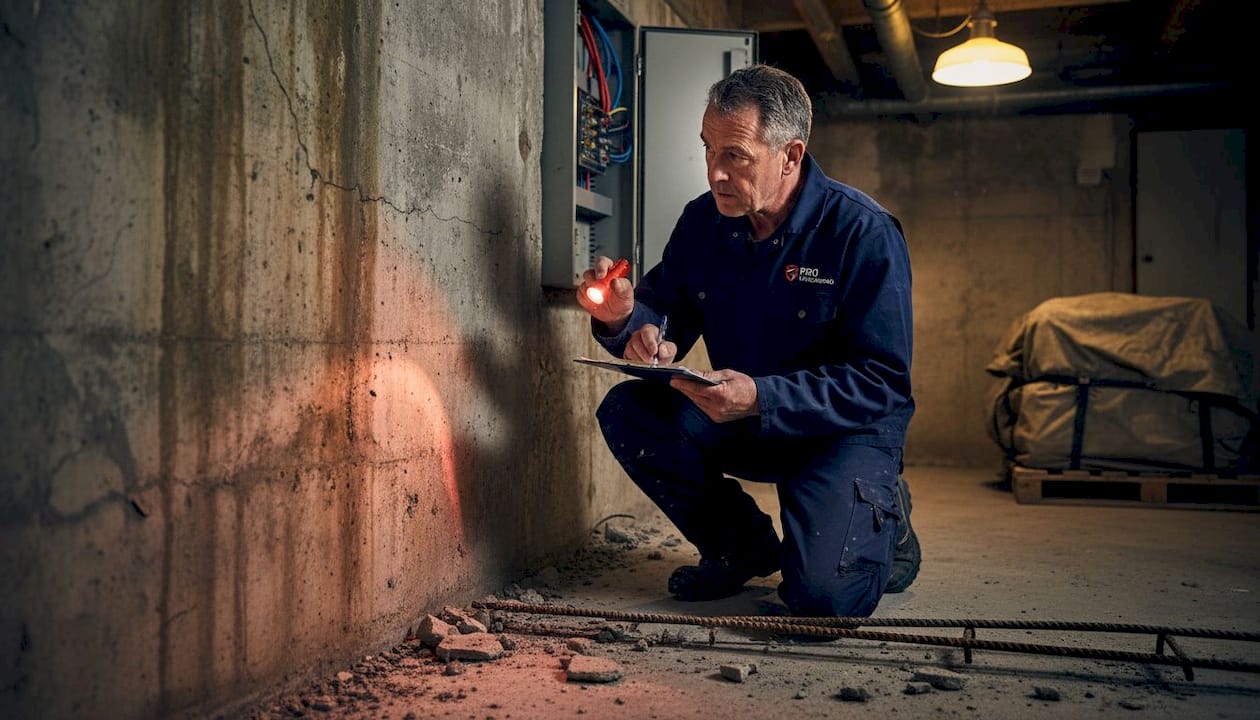
Cost is another area where misconceptions are common. Negative side waterproofing appears cheaper upfront, but when you account for repeat applications, ongoing maintenance, and eventual structural repairs, exterior waterproofing techniques often prove more economical over a ten to twenty year horizon.
Pro Tip: If a contractor quotes exclusively for interior waterproofing without assessing the exterior condition of your foundation walls, ask for a full structural moisture assessment before committing. Interior treatment alone rarely resolves the underlying cause.
For property owners who want a direct comparison, the article on waterproofing exterior basement walls outlines exactly what comprehensive exterior treatment involves and why it protects the full structure rather than just managing the symptoms.
Maintenance challenges and long-term risks
Beyond the initial issues, it’s important to consider how negative side waterproofing affects maintenance routines and long-term reliability.
One of the least discussed aspects of negative side systems is how difficult they are to monitor effectively. Because the waterproofing product is on the interior face, you cannot easily see what is happening within the wall itself. Moisture can be migrating through the full depth of a 300mm concrete wall for months before any visible evidence appears inside. By that point, the structural material has been saturated repeatedly through multiple wet seasons.
Typical maintenance timeline for negative side waterproofing in South African conditions:
| Year | Common issue | Likely intervention |
|---|---|---|
| 1 to 2 | Minor seepage at joints and penetrations | Resealing and topical product reapplication |
| 3 to 5 | Efflorescence, hairline cracks | Crack injection and surface treatment |
| 5 to 8 | Active leaks, mould in wall cavities | Drainage channels, sump systems, or full retreatment |
| 8 to 15 | Structural deterioration, rebar corrosion | Major structural repair or exterior excavation |
The pattern above is not hypothetical. It reflects what happens when moisture is managed at the wrong side of the structure for an extended period. The costs escalate at each intervention, and many property owners find themselves spending more in reactive repairs than they would have paid for a proper exterior solution at the outset.
Steps you should take if you currently have negative side waterproofing:
- Schedule a professional moisture assessment at least once a year, particularly before the rainy season
- Check for efflorescence, new cracks, or damp patches after heavy rainfall
- Inspect any drainage channels or sump pumps (where installed) monthly to ensure they are functioning
- Monitor indoor humidity levels, as elevated readings can indicate ongoing moisture infiltration through walls
- Keep records of any interventions, product applications, and observations to share with your contractor
Regular waterproofing maintenance is essential for any waterproofing system, but it is particularly critical for negative side applications because failure can occur without any obvious warning signs.
A further complication is that many South African properties use mixed construction methods, combining brick, blockwork, concrete, and render. Each material responds differently to hydrostatic pressure and moisture migration, which means a single negative side product rarely performs uniformly across a surface. Localised failures are common, particularly at junctions between different materials.
Understanding the role of waterproofing in building maintenance across different property types helps illustrate why a one-size approach to interior treatment carries significant risk.
Pro Tip: If your property has a basement or below-grade level, consider installing a calibrated hygrometer (humidity measuring device) inside the space. A consistent reading above 70% relative humidity during dry weather is a clear signal that moisture is entering through the structure, not just through condensation.
Better alternatives and when to seek expert advice
Understanding the risks and maintenance challenges paves the way to evaluating better alternatives and knowing when professional support is vital.
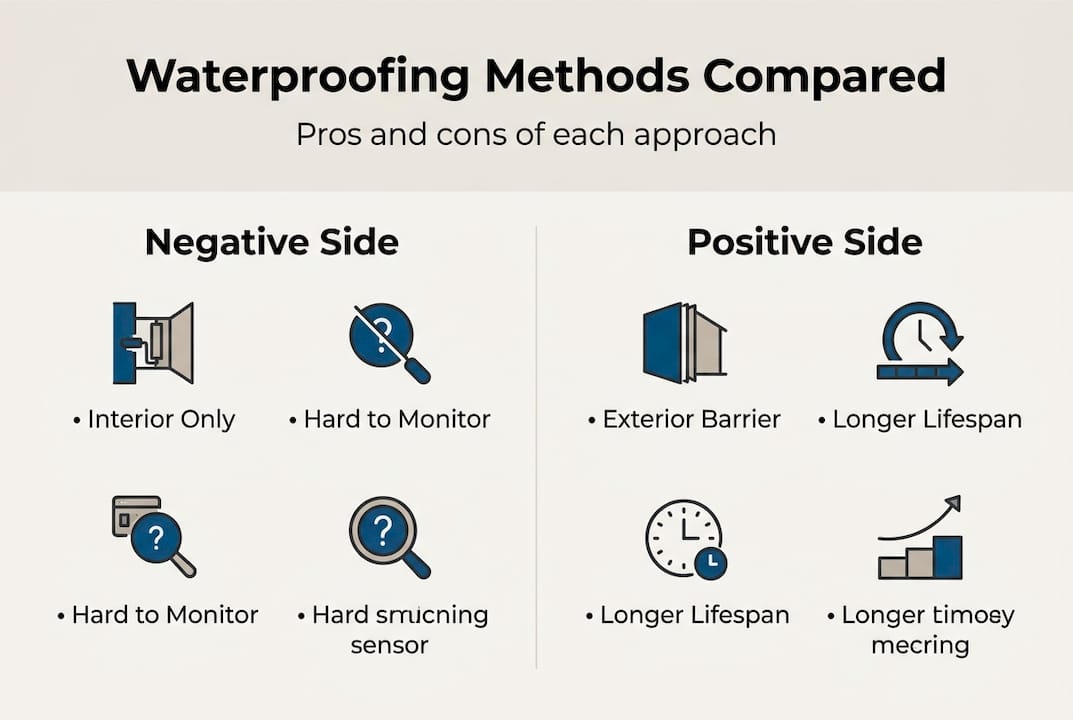
Positive side waterproofing remains the gold standard for a straightforward reason. By placing the waterproofing barrier on the exterior of the structure, between the moisture source and the building material, you prevent water from ever contacting the structural fabric. The wall or floor stays dry through its full depth, reinforcing steel remains free from corrosion, and the building material retains its designed strength and durability.
For properties where full exterior excavation is genuinely not possible, there are integrated solutions that combine drainage systems, injection grouting, and improved ventilation to reduce the impact of moisture without relying solely on a negative side membrane. These are more complex and more costly than a simple interior coating, but they address the root cause far more effectively.
Signs that you need professional assessment immediately:
- Recurring damp patches that reappear within weeks of treatment
- Visible mould or mildew growth, especially black mould on interior surfaces
- A persistent musty odour in basement or below-grade areas
- Structural cracks that are widening or appearing in new locations
- Rust staining on walls or floors, indicating corroding reinforcement
- Water pooling inside the structure after rainfall
- Paint or plaster bubbling and lifting from walls
If you recognise any of these signs in your property, the article on preventing basement water damage offers a structured guide to understanding the severity and appropriate next steps.
Choosing the right waterproofing method is not a decision that should be made on price alone. The upfront cost difference between negative and positive side approaches is real, but it represents only a fraction of the total lifecycle cost when structural repairs are factored in. For a thorough comparison of approaches, the guide on best basement waterproofing methods is an essential reference.
The key questions to ask any waterproofing contractor before accepting a quote are: Where will the product be applied? What does it protect against? What happens if the product fails? What warranty is offered? A contractor who cannot answer these questions clearly is unlikely to deliver a solution that holds up over time.
A local expert’s perspective: Why quick fixes can cost you more
Across years of working with South African homeowners and property managers, one pattern becomes impossible to ignore. The clients who chose negative side waterproofing to save money almost always return needing more work. Not because the products are entirely without merit, but because they were applied as a substitute for proper exterior protection rather than as a temporary measure in a broader remediation plan.
South Africa’s climate adds pressure to this problem. Coastal regions face high humidity and salt-laden air. Highveld properties experience intense summer thunderstorms followed by dry winters. These swings in moisture and temperature put structures under recurring stress, and negative side products simply are not designed to handle that sustained cycle without periodic failure.
The smarter investment is in solutions that stop water where it originates. A property that stays genuinely dry through its structural depth, as explored in the article on moisture to comfort upgrades, retains its value, requires less maintenance, and provides a healthier living environment. The upfront cost of doing it properly is not a loss. It is money you would have spent anyway, just spread across a decade of repeated interventions.
Get comprehensive, long-lasting waterproofing solutions
Dealing with damp and moisture problems is stressful enough without worrying whether the solution you’ve chosen will last. If you’ve read through this article and recognised your own property in some of these scenarios, now is the right time to get a professional assessment rather than waiting for the damage to deepen.
At Pro Waterproofing, we work with homeowners and property managers across South Africa to assess moisture problems accurately and recommend solutions that address the root cause. Whether you’re facing a leaking basement, recurring damp walls, or need to evaluate whether your existing waterproofing is performing as it should, our team can guide you through the options with honesty and expertise. Contact us today for a consultation that could save you years of frustration and thousands in unnecessary repairs.
Frequently asked questions
What is the main difference between negative and positive side waterproofing?
Negative side waterproofing is applied to the interior face of a structure where water seeps in, whereas positive side waterproofing is applied to the exterior to prevent water from ever penetrating the structural material.
Why is negative side waterproofing not recommended for basements?
It cannot stop water from entering the wall or floor slab itself; it only attempts to manage moisture after it has already passed through the structure, leaving the structural material vulnerable to ongoing damage.
Can negative side waterproofing fix all damp problems?
No, it typically fails to address the root cause of moisture ingress, and over time it may allow hidden structural damage including rebar corrosion and material degradation to worsen without visible warning signs.
When should I call a waterproofing professional?
You should call a professional if you notice recurring damp patches, mould growth, water staining, structural cracks, or a persistent musty smell, as these signs indicate active moisture ingress that requires a targeted and informed response.