

TL;DR:
- Assuming all damp is the same can lead to costly mistakes in property repairs. Different types of damp, such as condensation, rising, or penetrating damp, require specific diagnoses and treatments. Proper assessment and climate-aware solutions are essential for effective, lasting waterproofing in South African homes.
Damp looks deceptively similar no matter where it appears, but assuming all wet walls share the same cause is one of the most expensive mistakes a property owner can make. Treat rising damp as condensation and you will repaint a wall that will blister again within months. Confuse penetrating damp with a plumbing leak and you could gut perfectly sound pipework while the real entry point keeps letting in water. This guide walks you through the most common damp types found in South African properties, the health risks they carry, the correct treatment steps, and the mistakes that cause repairs to fail before they even get started.
Table of Contents
- Typical examples of damp problems in South African properties
- Key health risks and benchmarks for damp in homes
- Effective methods for diagnosing and treating damp problems
- Why treatments fail: common mistakes and nuanced cases
- What most guides miss about damp in South Africa
- Professional waterproofing solutions for your property
- Frequently asked questions
Key Takeaways
| Point | Details |
|---|---|
| Recognise the damp type | Identifying whether you have condensation, rising, or penetrating damp guides the right solution. |
| Prioritise professional diagnosis | Expert assessment prevents wasted money and ensures repairs address the moisture source. |
| Control indoor humidity | Keep humidity below 50 percent to slow mould growth and protect your health. |
| Avoid common treatment mistakes | Choose breathable finishes and maintain workmanship to prevent future damp recurrence. |
| Seek tailored solutions | South African property conditions need local expertise for lasting waterproofing results. |
Typical examples of damp problems in South African properties
Not all damp arrives through the same door. South African properties face a particularly wide range of damp types because the country’s climate shifts dramatically between regions. A Cape Town home endures cold, wet winters. A Durban apartment battles year-round humidity. A Johannesburg property alternates between dry winters and fierce summer thunderstorms. Each environment creates different damp pressures, and understanding which type you are dealing with is the first step to fixing it properly.
The three main damp types
Condensation damp is the most frequently misidentified. It happens when warm, moisture-laden air meets a cold surface and drops its water content. Indoor humidity condensing on cold surfaces is extremely common in bathrooms, kitchens, and poorly ventilated rooms, and it typically presents as musty odours and mould growth on walls, ceilings, and around window frames. Poor ventilation is the root cause, not water ingress from outside.
Rising damp is far less common than most people fear, but it is genuinely damaging when it does occur. Groundwater is drawn upward through porous masonry by a process called capillary action. You will typically see tide marks, white salt deposits (efflorescence), and peeling plaster at low wall levels. Understanding why walls get damp in detail helps property owners separate this from surface condensation before spending money on the wrong solution.
Penetrating damp enters horizontally through external walls, roofs, or window surrounds. Cracked render, deteriorating mortar, failed sealant around window frames, and damaged roof flashings are the typical culprits. Stains tend to appear after heavy rainfall and may occur at any height on a wall.
A real South African example
A roughly 70-year-old Durban North face-brick high-rise experienced persistent moisture ingress traced to aged, porous mortar joints and structural movement cracks. The solution required a multi-step exterior restoration combined with a penetrating water repellent treatment, which eliminated further moisture ingress entirely. That case illustrates how building age and coastal humidity combine in ways that no single off-the-shelf product can address alone.
You can also read more about common causes of damp walls across different South African regions to see how location changes the diagnosis.
Common symptoms at a glance
- Musty or earthy odour that returns after cleaning
- Mould growth, particularly in corners or on north-facing walls
- Peeling, bubbling, or flaking paint and plaster
- Yellowish or brownish water stains on walls or ceilings
- White salt crusting (efflorescence) at the base of walls
- Condensation on windows or cold surfaces during cooler months
| Damp type | Typical location | Key symptom | Primary cause |
|---|---|---|---|
| Condensation | Bathrooms, kitchens, bedrooms | Mould on cold surfaces | Poor ventilation |
| Rising damp | Ground-level walls | Tide marks, efflorescence | Failed damp-proof course |
| Penetrating damp | Any external wall or roof | Stains after rain | Cracks, failed seals |
Remember: symptoms overlap. A damp patch at skirting board level could be rising damp or a leaking pipe below the floor. Never assume without proper investigation.
Key health risks and benchmarks for damp in homes
Recognising damp types is important for your building, but the health consequences make it urgent for the people living inside. Mould is not merely unsightly. It releases spores that irritate the respiratory system and, in more serious cases, trigger fungal infections that are genuinely dangerous for vulnerable individuals, including young children, the elderly, and anyone with a compromised immune system.
The 50% humidity rule
Netcare advises keeping indoor humidity below 50% to slow mould growth risk in damp homes. This is a practical benchmark every property owner can use. Inexpensive digital hygrometers, sold at most hardware stores, give you a live reading of indoor humidity so you can act before mould becomes visible.
Statistic to note: Indoor humidity above 60% creates near-ideal conditions for most mould species to colonise within 24 to 48 hours on porous surfaces such as plaster and timber.
Proper damp proofing of walls addresses the moisture source at its root, which is always more effective than dehumidifiers alone. Dehumidifiers manage symptoms. Waterproofing removes the cause.
Health risk summary
| Risk level | Humidity range | Likely consequence |
|---|---|---|
| Low | Below 50% | Mould growth unlikely |
| Moderate | 50% to 60% | Surface mould possible over weeks |
| High | Above 60% | Rapid mould colonisation likely |
| Severe | Above 70% | Structural damage and serious health risk |
Pro Tip: Place a hygrometer in the most vulnerable room in your home, usually the bathroom or a room with limited windows. Check it morning and evening. If readings consistently exceed 55%, take action before mould becomes visible.
Respiratory symptoms including coughing, wheezing, and worsening asthma are often the first signs a household experiences from damp-related mould, long before the mould patch itself becomes obvious. Acting on humidity readings rather than waiting for visible mould puts you well ahead of the problem.
Effective methods for diagnosing and treating damp problems
Knowing the risks creates the motivation to fix damp properly. But “fixing it” only works if the diagnosis is correct first. The single most costly mistake in damp remediation is applying the right treatment to the wrong problem.
Step-by-step professional diagnosis
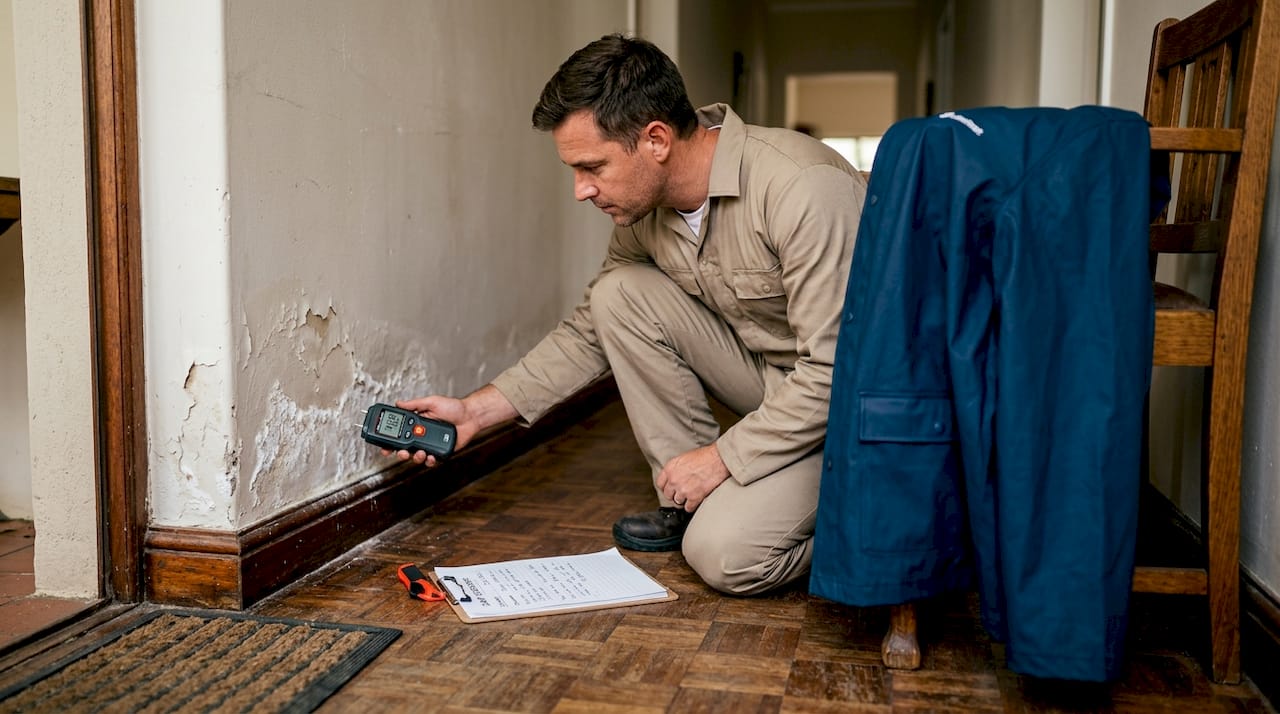
A qualified waterproofing professional will typically:
- Inspect the exterior for cracks, failed pointing, damaged flashings, or blocked gutters that could allow water ingress.
- Assess the interior for tide marks, salt crystallisation, mould patterns, and condensation evidence.
- Use a moisture meter to measure wall moisture at different heights and identify whether moisture is rising, penetrating, or surface-based.
- Check ventilation in high-risk rooms to determine whether condensation is a contributing factor.
- Review building history, including age, construction type, and any previous repair attempts.
A professional waterproofing assessment does not just confirm the damp type. It maps where the moisture is coming from, how far it has travelled, and what structural damage may already have occurred behind visible surfaces.
Treating rising damp correctly
Rising damp treatment follows a specific sequence. Getting it wrong, or skipping steps, results in recurrence.
- Remove all contaminated plaster from affected walls to a height above the visible damp line, typically 300 to 500 mm beyond the tide mark.
- Allow the exposed masonry to dry fully.
- Drill holes at regular intervals along a horizontal mortar course, then inject a chemical damp-proof course at measured intervals, followed by replastering with salt-resistant, moisture-tolerant finishes.
- Apply a salt-resistant, breathable render rather than a standard sand and cement mix.
- Allow adequate curing time before applying any decorative finish.
“The replastering stage is where most DIY attempts and under-qualified contractors fail. Standard plaster allows salt migration and re-contamination. Only salt-resistant render breaks that cycle.”
Following essential damp proofing tips throughout this process ensures you do not undermine the chemical injection with incompatible finishing products.
Treating penetrating damp
Treatment depends entirely on the entry point. Cracked render requires removal and reapplication. Failed pointing requires raking out and repointing with appropriate mortar. Damaged flashings require replacement, not patching with sealant tape. In the Durban North high-rise case, exterior restoration combined with a penetrating water repellent was the correct solution because the mortar itself had become porous over seven decades, rather than there being a single identifiable crack.
Why treatments fail: common mistakes and nuanced cases
Even when a property owner invests properly in remediation, treatments can fail. Understanding why reveals how important both the diagnosis and the finish selection are.
The most common failure points
- Incorrect diagnosis: Treating rising damp when the actual cause is penetrating damp means the entry point remains open.
- Using the wrong render: Inappropriate render can force rising damp higher up the wall. A dense cement-based plaster traps moisture behind it, making the problem worse and the affected area larger.
- Injection voids: Poor workmanship during chemical damp-proof course installation leaves gaps in the injection line. Water simply travels around the incomplete barrier.
- No breathable finish: Painting a freshly treated wall with an impermeable paint traps residual moisture and accelerates blistering.
- Rushing the drying phase: Replastering before walls have adequately dried locks in moisture and salts, guaranteeing re-contamination.
“The finish is not cosmetic. It is functional. A breathable, salt-resistant render is as much a part of the treatment as the chemical injection itself.”
Understanding waterproofing failures before starting a project saves far more money than discovering these failures after the fact. Rework costs in damp remediation are significant because walls typically need to be stripped back to masonry and the entire process restarted.
For tiled rooms, the risk of trapping moisture is especially high because grout and adhesive layers can hide ongoing water movement. Guidance on avoiding damp in tiled rooms reinforces why waterproofing beneath tiles must be correctly specified before tiling begins, not applied as an afterthought when damp appears.
Why nuanced cases need expert eyes
Some cases defy simple categorisation. A wall might show both condensation and rising damp simultaneously. An older property might have a failing original damp-proof course that has never been replaced, combined with inadequate roof drainage that adds penetrating moisture from above. In these layered scenarios, treating only one cause leaves the others active and the property continues to deteriorate.
What most guides miss about damp in South Africa
Most damp guides are written for temperate European climates where construction materials, building techniques, and humidity patterns are relatively uniform. South Africa is not that. The country spans multiple climate zones, uses a distinct range of construction materials, and has a housing stock that ranges from recently built modern estates to century-old Victorian-era masonry homes.
Face-brick construction, which is extremely common across South Africa, behaves very differently from cavity wall construction when it comes to moisture movement. Many South African homes also lack the fully embedded horizontal damp-proof courses that are standard in European residential builds. This means the rising damp risk is structurally higher in certain property types here than guidelines from elsewhere would suggest.
There is also the matter of seasonal extremes. Johannesburg’s Highveld experiences almost zero rainfall from April to September, followed by intense afternoon thunderstorms from October onwards. Walls that have dried and contracted through winter develop micro-cracks that suddenly face high-volume water exposure. No generic damp guide accounts for that cycle.
We have seen repeatedly that property owners who follow standard internet advice, apply a waterproof paint, or insert a DIY injection kit, create sealed walls that look better for one season and then fail dramatically. The moisture has not gone anywhere. It has been redirected, and it will find another path.
The difference between a lasting repair and a recurring problem nearly always comes down to two things: an accurate, site-specific diagnosis, and a treatment system selected for the actual materials and climate of that specific building. Commercial waterproofing differences from residential approaches further illustrate why a one-size approach simply does not hold up across South Africa’s diverse property landscape.
Investing in an expert who understands local construction norms is not a luxury. In damp remediation, it is the only route to a repair that actually lasts.
Professional waterproofing solutions for your property
Understanding the cause of damp in your property is one thing. Fixing it correctly, and permanently, requires specialist knowledge, the right materials, and the experience to match the treatment to the building. That is exactly what professional waterproofing services are designed to deliver.

At Pro Waterproofing, our teams carry out site-specific assessments that identify the actual source of moisture rather than simply treating visible symptoms. Whether you are dealing with penetrating damp after a rainy season, rising damp in an older property, or persistent condensation in a poorly ventilated room, we match the diagnosis to a treatment plan designed for your building’s materials, age, and local climate. Getting a professional quote is straightforward and puts you one step closer to a dry, healthy property.
Frequently asked questions
What are the first signs of damp in South African homes?
Early signs include musty odours, peeling paint, visible mould patches, dark water stains, and condensation on cold surfaces such as windows and external walls, particularly in winter or poorly ventilated rooms.
How can I distinguish rising damp from condensation?
Rising damp appears as ground-level staining and salt crusting that works upward from the floor, while condensation forms on cold surfaces in bathrooms and kitchens and is worst in winter or when ventilation is poor.
Is it safe to live in a damp home?
Persistent damp increases your risk of mould growth and respiratory problems; keeping humidity below 50% and repairing the source of damp promptly is essential to protect your health and your household.
What can cause damp treatments to fail?
Treatments fail most often when diagnosis is wrong or when finishes trap moisture, forcing damp higher up the wall or creating injection voids that allow the moisture barrier to remain incomplete.
Should I use DIY damp-proofing solutions?
DIY products typically mask the visible symptoms without addressing the underlying cause; a professional assessment is the only reliable way to diagnose and treat damp fully before it causes structural damage.
Recommended
- Identify signs of damp walls and solve them effectively
- 5 Ways to Deal with Damp in Your Home
- How to prevent rising damp in South African homes
- 7 Effective Examples of Damp Proofing Techniques – Pro Waterproofing
- 7 praktische Beispiele Dachdämmung für Hausbesitzer erklärt
- Fliesen für Feuchträume: So vermeiden Sie 60% der Schäden