

TL;DR:
- Moisture damage in South African homes often presents with visible signs like staining, bubbling paint, and mould, which require early detection for cost-effective repair. Professional assessments using specialized equipment are crucial to identify hidden water intrusion sources and ensure appropriate waterproofing solutions are applied. Choosing experienced local contractors, using suitable materials, and maintaining for longevity help prevent common failures and safeguard property health and value.
Picture this: you walk into your lounge on a rainy Monday morning and notice a dark stain spreading across the wall, a faint musty odour hanging in the air, and paint beginning to bubble near the skirting board. It is an unsettling discovery, and one that thousands of South African homeowners and property managers face every year. Moisture damage rarely announces itself until it has already taken hold, and by the time the signs are visible, the cost of repair has often multiplied. This guide walks you through every stage of addressing moisture problems, from recognising the early warning signs to selecting the right waterproofing method and finding a trusted local professional who delivers lasting results.
Table of Contents
- Identifying common moisture problems in South African properties
- Preparing your property for waterproofing: Tools, materials and assessments
- Choosing the best waterproofing methods for your needs
- How to find trusted waterproofing professionals near you
- Ensuring quality and long-term protection: How to verify results
- Why most waterproofing solutions fail – and how to avoid common traps
- Trusted waterproofing solutions for South African properties
- Frequently asked questions
Key Takeaways
| Point | Details |
|---|---|
| Early detection matters | Spotting signs of moisture quickly prevents costly damage to your property. |
| Professional assessment is key | Expert evaluations ensure the right waterproofing method is chosen for your home or building. |
| Choose local expertise | South African waterproofing specialists understand local climate and construction nuances. |
| Verify and maintain solutions | Inspections and maintenance keep your waterproofing effective for years. |
| Long-term value | Quality waterproofing is a worthwhile investment for protection and peace of mind. |
Identifying common moisture problems in South African properties
Spotting trouble early is the single most effective way to keep repair bills manageable. Moisture problems in South African homes tend to follow recognisable patterns, and learning to read those patterns gives you a significant advantage.
The most common visible signs include:
- Stained or discoloured walls, often appearing as yellow, brown, or grey patches that grow larger after heavy rain
- Peeling or bubbling paint, which happens when water vapour forces its way between the surface coating and the substrate beneath
- Efflorescence, the white, chalky residue left behind when water moves through masonry and carries mineral salts to the surface
- Visible mould or mildew, usually appearing in corners, around window frames, or along ceiling edges
- A persistent musty smell, even in rooms that appear dry, which signals moisture trapped inside walls or under floors
- Warped or swollen timber, particularly in door frames, skirting boards, and wooden flooring
Each of these signs points to a specific type of moisture intrusion, whether it is rising damp moving upward through a foundation, penetrating damp driven in by rain, or condensation forming on cold surfaces. Misidentifying the source leads to mismatched solutions that waste time and money.
From a health perspective, mould is not a cosmetic nuisance. Prolonged exposure to mould spores has been linked to respiratory conditions, skin irritation, and aggravated asthma, making it a genuine risk for families and building occupants. Structural consequences are equally serious: prolonged moisture weakens concrete, corrodes steel reinforcement, and rots timber, all of which affect the safety and resale value of your property.
A professional damp survey provides a precise diagnosis that goes well beyond what the eye can see. Specialist equipment such as moisture metres, thermal imaging cameras, and endoscopic probes can detect water pathways hidden inside walls and under slabs. A waterproofing assessment helps pinpoint moisture issues before damage escalates, saving you from expensive remedial work down the line.
Important: Never assume a damp patch is cosmetic. What looks like a surface stain is often the visible tip of a much larger moisture problem lurking beneath.
Preparing your property for waterproofing: Tools, materials and assessments
Once the source and extent of moisture are understood, the next logical step is to prepare your property for professional waterproofing. Good preparation is not glamorous, but it is the stage where most successful waterproofing projects are won or lost.
A thorough site assessment determines which waterproofing methods fit local building conditions, accounting for the specific substrate, the local climate, and the source of water intrusion. Whether this assessment is carried out by a specialist or a knowledgeable property owner, it must answer three questions: Where is the water coming from? How severe is the intrusion? What surface or structure needs protection?
Common waterproofing materials and their uses
| Material | Typical application | Key characteristic |
|---|---|---|
| Bituminous membrane | Flat roofs, basements | High flexibility, excellent adhesion |
| Acrylic sealant | Joints, cracks, window frames | UV resistant, paintable finish |
| Cementitious coating | Internal walls, water tanks | Rigid, easy to mix and apply |
| Polyurethane liquid membrane | Roofs, balconies, decks | Seamless coverage, very durable |
| Crystalline waterproofing | Concrete structures | Self-sealing, grows into cracks |
Before any product is applied, surfaces must be clean, dry, and structurally sound. This means removing loose render, cleaning off mould with an appropriate biocide, grinding out cracks and re-filling them with the correct material, and allowing sufficient drying time before proceeding. Attempting to waterproof a damp surface is the equivalent of painting over rust: it looks fine initially and fails completely soon after.
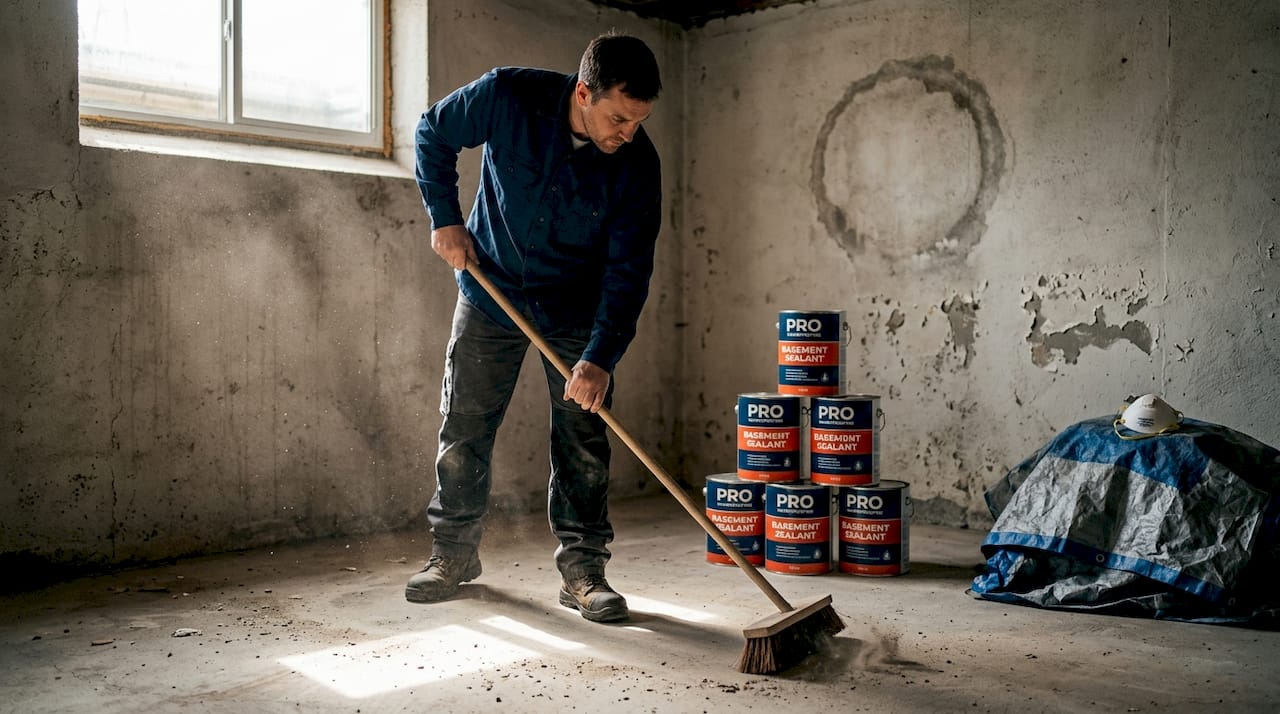
Detailed damp and timber reports are invaluable at this stage, particularly for older properties where multiple moisture sources may overlap. These reports flag timber decay that could compromise the performance of any waterproofing layer applied over it.
Pro Tip: Always allow freshly cleaned or repaired surfaces at least 48 hours to dry before applying waterproofing products, especially in humid coastal conditions like those found in Durban or Cape Town.
For property owners unsure whether to manage a project themselves or bring in help, reviewing guidance on selecting a waterproofing contractor early in the planning process helps you understand what a quality job should look like, regardless of who carries it out.
Choosing the best waterproofing methods for your needs
Equipped with the right tools and a solid assessment, property owners can now pick the waterproofing method that fits both their budget and building structure. South Africa’s diversity of climates, from the arid Karoo to the subtropical KwaZulu-Natal coast and the wet Cape winters, means there is no single solution that works everywhere.
Comparison of main waterproofing methods
| Method | Best suited for | Lifespan estimate | Relative cost |
|---|---|---|---|
| Sheet membrane | Roofs, podium decks, basements | 15 to 25 years | Medium to high |
| Liquid-applied membrane | Irregular surfaces, balconies | 10 to 20 years | Medium |
| Cementitious coating | Internal wet areas, tanks | 5 to 15 years | Low to medium |
| Injection grouting | Active leaks in concrete | Varies by severity | Medium to high |
| Exterior curtain drain | Basements, retaining walls | Long-term structural | High |
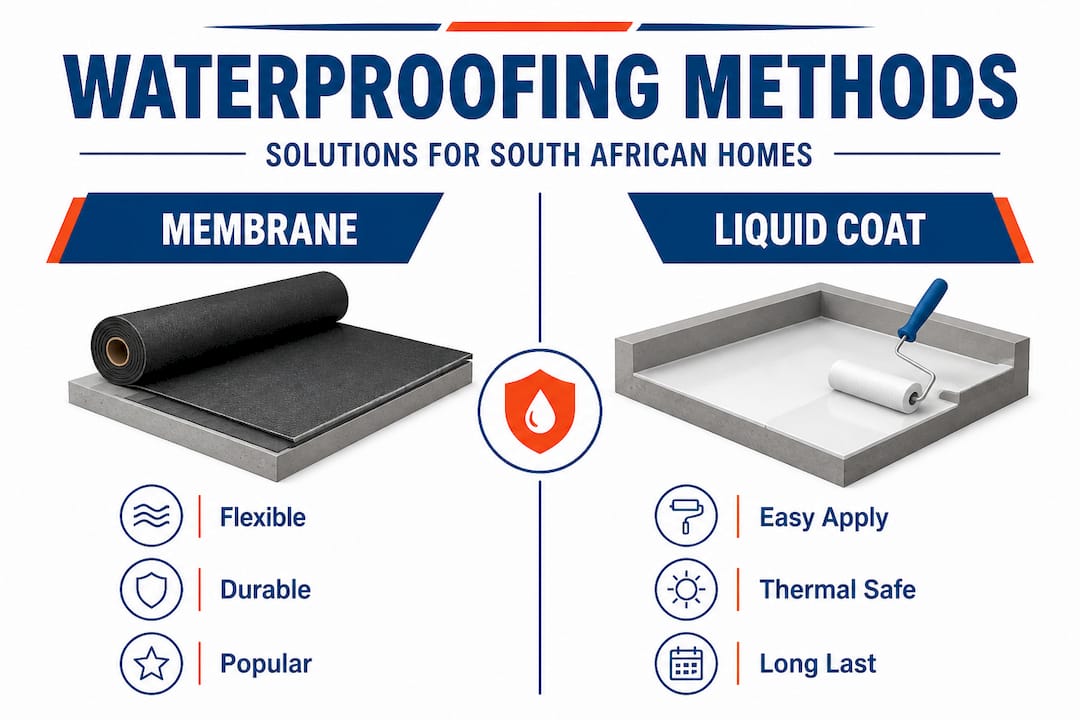
The three most widely used systems in South African residential and commercial projects are membrane waterproofing, liquid-applied systems, and cementitious coatings. Each has a distinct application process.
- Sheet membrane installation: The surface is primed, the membrane is rolled out and bonded using heat or adhesive, laps are overlapped by at least 100 mm, and all edges are mechanically fixed and sealed.
- Liquid-applied membrane application: The primer coat is applied and allowed to cure, the liquid product is brushed or rolled on in multiple thin coats, each coat is allowed to dry before the next is applied, and the final coat thickness is checked against the manufacturer’s specification.
- Cementitious coating application: The dry powder is mixed with water to a smooth consistency, the first coat is applied by brush in a circular motion, the second coat is applied perpendicular to the first once dry, and the surface is misted with water during curing to prevent cracking.
Basements present a unique challenge because water pressure acts against the structure from the outside. Proven basement waterproofing techniques can provide lasting protection against flooding and damp where standard surface coatings alone would fail under hydrostatic pressure. For properties where the external face of the foundation is accessible, exterior waterproofing techniques offer the most durable long-term solution by stopping water before it ever contacts the structure.
Understanding wall damp guidance for your specific wall construction, whether cavity wall, solid brick, or rendered blockwork, is equally important when selecting a compatible system.
Pro Tip: Match your method to your climate. Highly flexible liquid membranes cope better with the thermal expansion and contraction experienced on Highveld roofs where temperatures swing dramatically between summer and winter.
How to find trusted waterproofing professionals near you
After understanding and comparing methods, many property owners choose professional help for peace of mind and top results. But not all waterproofing contractors are equal, and choosing the wrong one can leave you worse off than when you started.
A reliable contractor should demonstrate the following:
- Verifiable credentials and relevant experience, including a portfolio of similar projects completed locally
- Insurance cover, both public liability and workman’s compensation, which protects you if something goes wrong on site
- A clear written quotation that specifies materials, preparation methods, number of coats, and the scope of work
- Positive references or reviews from clients in your area or with similar property types
- A workmanship guarantee that covers the installation for a defined period, typically between five and ten years
- Transparency about material brands so you can independently verify the quality of what is being used
Questions worth asking before you sign any agreement include: How long have you been operating in this region? Can you show me a completed project similar to mine? What happens if a problem develops within the guarantee period? Do you carry out the work yourselves or subcontract?
Local expertise matters enormously in South Africa. Local waterproofing companies offer tailored solutions built around South African climates and local building materials, knowledge that a general contractor without waterproofing specialisation simply cannot replicate.
“A guarantee is only as good as the company standing behind it. Always verify that a contractor is still actively trading before relying on their warranty.”
Consulting a thorough contractor selection guide helps you prepare the right questions and understand the red flags that separate reputable specialists from fly-by-night operators. Reviewing underpinning guidance is also worthwhile if you suspect structural movement has contributed to your moisture problems, as waterproofing over an unstable foundation will not hold for long.
Ensuring quality and long-term protection: How to verify results
Quality control and ongoing maintenance are essential, whether you go DIY or use a professional service. Here is how to ensure your waterproofing delivers lasting results.
Steps to verify completed waterproofing work
- Visual inspection immediately after completion: Check that all surfaces are uniformly coated, that there are no thin patches, pinholes, or bubbles, and that all edges and junctions have been properly sealed and reinforced.
- Water test where practical: For flat roofs and balconies, a flood test involves ponding water on the surface for 24 to 48 hours and checking underneath for any signs of penetration.
- Check all penetrations and upstands: Pipes, drains, parapet walls, and any protrusion through the waterproofed surface are the most common failure points and deserve close attention.
- Confirm cure times were respected: Ask for records showing that each coat was given adequate drying or curing time before the next stage proceeded.
- Request a handover document: A reputable contractor should provide a record of materials used, batch numbers, applied thicknesses, and the terms of the guarantee.
Routine maintenance checks should happen at least once a year, ideally before and after the rainy season. Look for moisture management tips to supplement your waterproofing by controlling condensation and ventilation throughout the year.
Common maintenance tasks include:
- Clearing debris and leaf litter from roof drains and gutters
- Resealing any joints or cracks that have opened up due to thermal movement
- Touching up small areas of damage before they expand
- Checking that flashings and roof edge details remain secure
Expert follow-up assessment can confirm that waterproofing has been successful and highlight areas needing attention before the next wet season arrives. Scheduling a professional inspection every three to five years is a sensible investment, particularly for flat roofs and below-grade spaces where failure is hardest to detect early.
“The cheapest maintenance you will ever do is the inspection that catches a small problem before it becomes a large one.”
Why most waterproofing solutions fail – and how to avoid common traps
After working through the full process, it is worth pausing to consider why so many waterproofing projects fail even when carried out with good intentions. The pattern is consistent and the causes are almost always avoidable.
Cutting corners on preparation is the number one culprit. Contractors under pressure to reduce costs or complete jobs quickly sometimes apply membranes over surfaces that have not been properly cleaned, dried, or primed. The product may look fine on the day, but within one or two wet seasons the adhesion breaks down and moisture finds its way through. Waterproofing failures often result from skipping site assessments or selecting unsuitable methods, and this is a lesson learnt at considerable expense by property owners who chose the cheapest quote without scrutinising what it included.
Method mismatch is the second most common failure. Using a rigid cementitious coating on a surface that experiences significant movement, such as a suspended concrete deck or a timber-framed wall, will result in cracking as the structure flexes. The method must match the substrate, not just the budget.
Inadequate detailing at junctions and penetrations accounts for a large proportion of post-installation failures. A membrane can be flawlessly applied across an entire roof surface and still allow water ingress through a poorly sealed pipe penetration or a flashing that lifts in strong wind.
Investing in quality materials and skilled labour is genuinely cost-effective over the long term. A slightly more expensive but correctly specified system installed by experienced hands will outperform three rounds of cheap patch repairs carried out over the same period. Guidance on working with experts reinforces this principle and helps you evaluate whether a contractor truly understands the work they are quoting for.
Pro Tip: Always document the waterproofing process with photographs, keep your invoice and material specifications, and store these with your property records. This documentation is valuable for insurance claims, future maintenance decisions, and when selling your property.
Trusted waterproofing solutions for South African properties
Combining the knowledge you have gained here with experienced professional support is the surest way to protect your property for years to come. From the initial assessment through to post-installation checks and routine maintenance, having a specialist team on your side removes uncertainty at every stage.
Pro Waterproofing connects South African homeowners and property managers with experienced, vetted waterproofing specialists who understand local climates, building materials, and regulatory requirements. Whether you need a detailed site assessment, a full waterproofing installation, or expert advice on the best system for your property type, the team is ready to assist. Request a free quote today and take the first step towards a drier, safer, and more valuable property.
Frequently asked questions
What is the best waterproofing method for South African homes?
The best method depends on your property’s construction and climate, but membrane and liquid-applied systems are popular choices for lasting protection across most South African property types.
How can I tell if my waterproofing was done properly?
Professional follow-up inspections can confirm waterproofing success and identify areas that may need attention before problems develop.
How long does waterproofing last before needing renewal?
Quality waterproofing can last from five to twenty years, depending on the method, materials used, local weather conditions, and how consistently routine maintenance is carried out.
Are professional waterproofing services worth the cost?
Yes. Tailored local solutions come with workmanship guarantees and long-term support, which makes professional services a sound investment compared to repeated DIY repairs.
Can waterproofing help with mould and health issues?
Absolutely. Effective waterproofing prevents moisture from accumulating inside walls and floors, which directly reduces the conditions that allow mould to grow and the health risks that come with it.