

TL;DR:
- Choosing a qualified waterproofing contractor in South Africa requires verifying CIDB registration, insurance, references, and written guarantees to prevent costly failures. A structured evaluation process helps property owners make objective decisions, ensuring projects are completed on time and within scope. Contractors who welcome rigorous vetting demonstrate professionalism and reduce client risk, fostering successful long-term property protection.
Hiring the wrong waterproofing contractor in South Africa can cost you far more than the original job. Poorly applied waterproofing fails within months, moisture seeps into structural elements, and remedial work often costs two to three times the initial quote. Many property owners assume that anyone advertising waterproofing services meets national standards, yet unqualified operators without proper certification, insurance, or a verifiable track record are disturbingly common. This guide gives you a practical, step-by-step checklist tailored to South African conditions, so you can evaluate contractors with confidence, avoid expensive mistakes, and protect the long-term value of your property.
Table of Contents
- Why a contractor assessment checklist matters
- Key components of a waterproofing contractor assessment checklist
- Comparing contractors: A practical evaluation table
- Final steps and common pitfalls to avoid
- A new perspective on hiring waterproofing contractors
- Take the next step with waterproofing experts
- Frequently asked questions
Key Takeaways
| Point | Details |
|---|---|
| Verify CIDB grading | CIDB certification confirms a contractor’s eligibility and protects you from legal or quality issues. |
| Use written contracts | Never proceed without detailed written agreements covering guarantees, payment terms, and scope of work. |
| Check experience and insurance | Always verify past projects and ensure contractors have valid insurance for peace of mind. |
| Apply the checklist objectively | Use a standardised checklist to compare contractors and avoid being swayed by price or word-of-mouth alone. |
| Ask tough questions | Professional contractors welcome thorough vetting and transparency in discussions. |
Why a contractor assessment checklist matters
Selecting a waterproofing contractor without a structured approach is one of the most common mistakes property owners in South Africa make. The instinct is understandable: you get a few quotes, go with the lowest price or the person a neighbour recommended, and assume the job will be done properly. But that shortcut creates serious exposure.
When a waterproofing job fails, the consequences extend well beyond a damp patch on the ceiling. Persistent moisture intrusion causes mould growth, timber rot, concrete spalling (where concrete surfaces break away due to internal corrosion), and eventually structural compromise. The repair bill for these secondary problems routinely dwarfs the cost of doing the waterproofing correctly the first time.
South African property owners make a handful of recurring errors during contractor selection:
- Choosing solely on price without assessing qualifications
- Accepting verbal promises instead of written guarantees
- Failing to check whether a contractor is registered with the Construction Industry Development Board (CIDB)
- Overlooking proof of insurance and liability cover
- Not requesting references or visiting completed projects
The CIDB is central to this conversation. CIDB grading is a government-administered capability and eligibility mechanism that rates contractors based on their financial strength and work track record. A contractor’s CIDB grade directly determines which projects they are legally eligible to undertake. Asking for CIDB registration details is not bureaucratic box-ticking — it is a genuine safeguard against hiring someone whose capacity is mismatched to your project.
“A checklist transforms a high-stakes emotional decision into a systematic, evidence-based process. It removes the guesswork and gives you an objective framework to stand behind your final choice.”
Using a formal checklist also reduces stress. When you have a clear set of criteria, every contractor answers the same questions. You are not swayed by a persuasive personality or an attractive quote that omits critical line items. For more guidance on choosing the right waterproofing contractor, it pays to understand exactly what red flags look like in practice. Pairing that knowledge with an inspection checklist for SA buildings gives you a complete picture before any work begins.
Key components of a waterproofing contractor assessment checklist
Understanding the checklist’s importance, let’s break down the specific points you should examine every time you evaluate a contractor. These are the non-negotiable items. Missing even one of them creates a gap that could cost you dearly later.
-
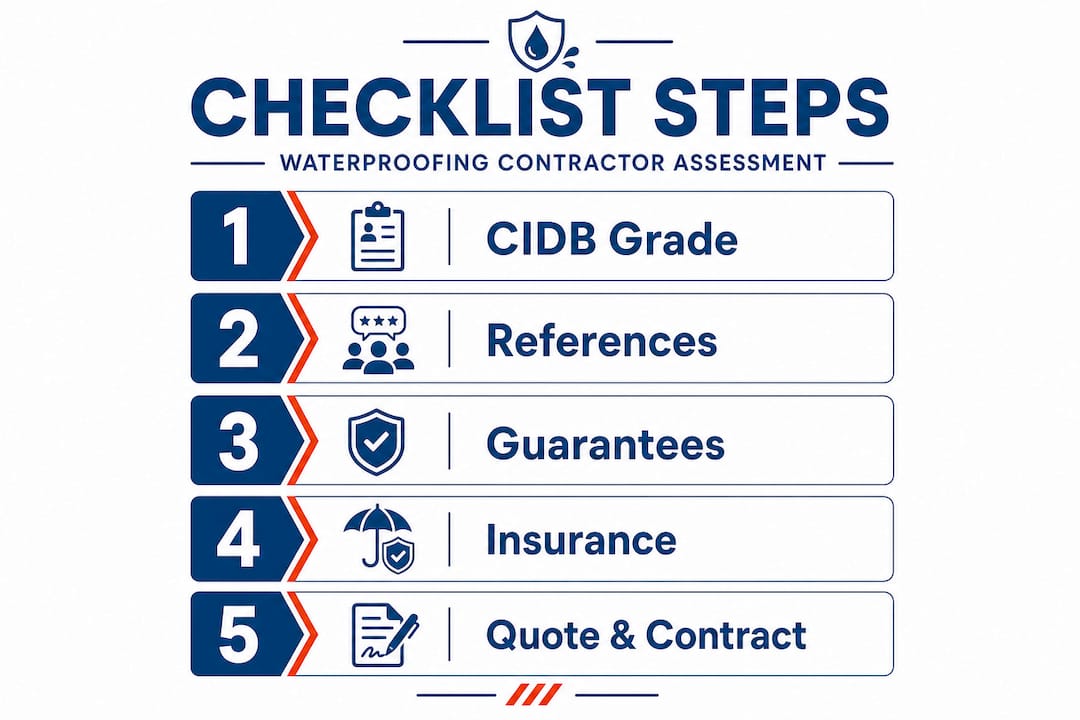
CIDB certification. Request the contractor’s CIDB registration number and verify it. As noted by industry resources, owners should verify the CIDB grade relevant to their specific project scope. A contractor registered at a grade too low for your project size cannot legally or competently manage the work.
-
Proof of insurance. Any credible contractor carries public liability insurance and, where applicable, employers’ liability cover. Ask to see the actual policy documents, not just a verbal assurance. If a worker is injured on your property and the contractor has no insurance, you may face legal and financial consequences.
-
Work history and verifiable references. Request a portfolio of completed waterproofing projects similar in scope to yours. Then actually contact those references. Ask specific questions: Did the contractor finish on time? Did any areas fail within the first year? Was communication clear throughout?
-
Written contracts covering scope, materials, and payment. A professional contractor will never hesitate to provide a detailed written contract. It should specify the exact areas to be treated, the products and systems to be applied, the payment schedule, and the timeline. Vague contracts invite disputes.
-
Detailed inspection and reporting protocol. Before quoting, a competent contractor should inspect the affected areas thoroughly and provide a written assessment. If someone gives you a price without setting foot on the property, treat that as a serious warning sign.
-
Warranty and guarantee terms. Waterproofing guarantees in South Africa typically range from five to ten years depending on the system used. Get the warranty terms in writing, and confirm whether the guarantee is backed by the product manufacturer, the contractor, or both.
-
Communication style and responsiveness. Pay attention to how quickly a contractor responds during the quoting phase. Slow or vague communication before the job rarely improves once work begins.
Pro Tip: Always request the contractor’s CIDB registration number before the first meeting, then verify it independently through the official CIDB online register. A legitimate contractor will not only provide it willingly but will often bring documentation along unprompted.
For a structured set of interview questions for waterproofing success, prepare your questions in advance and note the contractor’s answers verbatim. This makes comparison far easier. You can also review a broader list of essential contractor questions to ensure nothing is missed during the evaluation conversation.

Comparing contractors: A practical evaluation table
With your checklist in hand, you’ll want a method to objectively weigh up your top contractor choices. Here’s how to do it effectively.
One of the most powerful things a checklist does is enable direct, side-by-side comparisons. Without a table, you are holding several quotes in your head and trying to remember which contractor said what about guarantees or insurance. That mental juggling act almost always results in trade-offs you don’t consciously intend to make, often defaulting to price as the deciding factor.
A structured evaluation table forces you to score each contractor on the same criteria. It reveals trade-offs that a simple quote cannot. Contractor A might be R3,000 cheaper but has no verifiable CIDB registration and offers only a one-year verbal guarantee. Contractor B costs more but presents a ten-year written warranty, full insurance documentation, and a CIDB grade appropriate for your project. The table makes that difference impossible to ignore.
It is worth noting that CIDB grading governs eligibility and maximum tender value, which means a contractor operating above their grade is not just under-qualified — they may also expose you to contractual and legal risk if anything goes wrong on the project.
Use the table below as a starting framework. Rate each contractor out of five for each criterion, then total the scores before making your final shortlist.
| Evaluation criterion | Contractor A | Contractor B | Contractor C |
|---|---|---|---|
| CIDB grade (verified) | /5 | /5 | /5 |
| Proof of public liability insurance | /5 | /5 | /5 |
| Relevant project experience | /5 | /5 | /5 |
| Written contract provided | /5 | /5 | /5 |
| Warranty terms (written) | /5 | /5 | /5 |
| Communication and responsiveness | /5 | /5 | /5 |
| References checked and verified | /5 | /5 | /5 |
| Quote clarity and itemisation | /5 | /5 | /5 |
| Total | /40 | /40 | /40 |
Property owners who skip thorough vetting frequently report regret once problems emerge post-project. The table above is simple, but it is also remarkably effective because it objectifies what is otherwise a subjective and emotionally influenced decision. For practical guidance on tips for hiring contractors in the South African context, and to understand the critical questions for contractors that are most likely to reveal true capability, use these as companion resources alongside your table.
Final steps and common pitfalls to avoid
After evaluating and comparing, it’s time to finalise your decision. Here’s how to wrap up the process with confidence.
Before you sign anything, work through this final checklist. Many owners reach this stage feeling relieved and eager to get started, which is precisely when they let their guard down.
- Confirm the CIDB grade one final time. As project details are confirmed, always verify the grade relevant to the exact scope of your project, not just a general check done weeks earlier. Circumstances change, and so can registration status.
- Re-read the full contract before signing. Do not skim. Pay specific attention to clauses covering change-of-scope costs, payment triggers, and dispute resolution processes.
- Confirm insurance is current. Policies expire. Ask for a certificate of currency dated within the last thirty days.
- Settle on a commencement date and put it in writing. Verbal start dates are meaningless once disputes arise.
- Establish a single point of contact. Know exactly who to call if an issue arises during the project.
Common oversights even diligent owners make include skipping reference checks because they feel awkward calling strangers, misunderstanding what the quoted scope actually covers (for example, assuming flashings and drainage channels are included when they are quoted separately), and failing to verify CIDB grading independently. These are not unusual mistakes — they are nearly universal among first-time buyers of waterproofing services.
Selecting a contractor without this rigour is addressed in detail when selecting waterproofing contractors and is reinforced by reviewing top tips for choosing waterproofing contractors, both of which expand on the practical realities South African property owners face.
Pro Tip: Ensure all guarantee and warranty terms are embedded directly in the signed contract rather than supplied as a separate document that could be misplaced or disputed. Request that the contractor’s company name, registration number, and CIDB grade all appear on the contract header.
A new perspective on hiring waterproofing contractors
Here is something that most guides on this topic will not tell you: the vetting process itself is a filter.
When you present a well-prepared checklist to a prospective waterproofing contractor, you learn a great deal about them before a single brick is touched. A contractor who becomes evasive, dismissive, or irritated by your questions is showing you exactly how they will respond when something goes wrong mid-project. Contractors who welcome the process — who bring their CIDB documentation unprompted, who offer references proactively, who hand you a written contract rather than waiting to be asked — are demonstrating a professional culture. That culture is what protects you when unexpected complications arise.
Many South African property owners default to referrals or the lowest quote because it feels like the path of least resistance. The problem is that referrals carry incomplete information. Your neighbour’s positive experience of a small leak repair tells you nothing about how a contractor handles a large flat-roof replacement or a basement tanking project with unusual substrate conditions.
We have seen, time and again, that the contractors who score highest on a thorough assessment are also the ones who deliver projects on time, within scope, and with guarantees that actually hold up. The rigorous process does not just identify quality — it attracts quality. Unqualified operators who know they cannot pass a formal check rarely pursue clients who ask for it.
The uncomfortable truth is that a checklist empowers you and subtly shifts the dynamic of the hiring conversation. You are no longer a passive buyer choosing from whoever pitches up. You become a knowledgeable client with clear standards, and that changes who shows up to quote. Before you ask for those first quotes, review the questions to ask a builder to sharpen your approach even further. The investment of an hour preparing good questions can save you months of remediation headaches.
Take the next step with waterproofing experts
Your checklist is ready. Your evaluation table is set up. Now it’s time to put both to work with professionals who will welcome every question on your list rather than sidestep them.
At Pro Waterproofing, we work with verified, experienced specialists across South Africa’s residential, commercial, and industrial sectors. We understand that property owners need more than a quote — they need clarity about who is doing the work, what systems are being applied, and what recourse exists if anything falls short. Use the checklist from this article as your opening agenda when you contact us. Our team is equipped to provide CIDB documentation, detailed written proposals, and transparent warranty terms from the very first conversation. Getting started is straightforward: visit our website, complete the enquiry form, and receive a structured, no-obligation response from a qualified waterproofing professional.
Frequently asked questions
What is CIDB grading and why does it matter?
CIDB grading is a government-administered capability and eligibility mechanism that rates South African contractors on financial strength and work track record, ensuring they are qualified to undertake projects of a certain size and complexity.
Which documents should I request from a waterproofing contractor?
Always obtain CIDB certification, current proof of insurance, an itemised written quote, and a signed contract that includes detailed warranty terms — verifying the grade relevant to your project scope is essential before signing anything.
Can I trust a referral alone for contractor selection?
No. Referrals are a useful starting point but must be supplemented by formal CIDB grade verification, written guarantees, and direct reference calls, since a neighbour’s small repair experience rarely reflects capacity for larger or more complex projects. CIDB grading governs eligibility in ways a personal referral simply cannot confirm.
What are the risks if a contractor’s CIDB grade is too low?
A contractor operating above their registered grade creates legal and financial exposure for both parties. As outlined in industry guidance, CIDB grading governs maximum tender value and owners should verify the grade matches the project scope, or face potential project cancellations, disputes, or voided guarantees.
How do I check if a contractor’s CIDB grading is valid?
Request the contractor’s CIDB registration number and verify it directly through the official South African CIDB online register. Any contractor with a valid government-administered registration will have a record that is publicly searchable and straightforward to confirm.