

TL;DR:
- Tanking provides a fully sealed, hydrostatic-pressure-resistant barrier essential for below-ground structures and high-pressure environments. It requires careful surface preparation, appropriate material selection, and skilled application to ensure long-lasting waterproofing. Proper assessment and installation are vital to prevent costly future repair and water damage in South African properties.
Surface waterproofing works well for walls, roofs, and exposed facades — but it is simply not built to handle the sustained pressure of groundwater pushing against a basement floor or foundation wall. Many property owners in South Africa discover this the hard way, watching expensive repairs stack up after assuming a basic coating would do the job. Tanking is the waterproofing method designed specifically for these high-pressure, below-ground conditions, creating a sealed enclosure that keeps water out entirely. This guide explains what tanking is, how it works, which materials suit your situation, and how to decide whether your property needs it.
Table of Contents
- What is tanking in waterproofing?
- Tanking methods and materials explained
- Tanking versus other waterproofing techniques
- How tanking is installed: process overview
- When and where to use tanking
- The uncomfortable truth about tanking in South Africa
- How Pro Waterproofing can help
- Frequently asked questions
Key Takeaways
| Point | Details |
|---|---|
| Tanking creates total protection | By fully enclosing at-risk areas, tanking stops water from ever reaching your property’s vulnerable points. |
| Right method matters | Choosing the appropriate tanking system and material is vital for long-term success, especially for underground structures. |
| Expert installation pays off | Professional assessment and workmanship mean fewer failures and more reliable results over decades. |
| Tanking is an investment | Spending on proper tanking now prevents far higher costs due to water damage and repairs later. |
What is tanking in waterproofing?
Tanking is a method of waterproofing that fully encloses a structure, or a specific part of it, to prevent any water ingress. The term comes from the idea of turning a space into a sealed “tank” — one that water cannot penetrate from any direction, whether from the sides, the floor, or joints between surfaces. Unlike surface treatments that simply coat exterior walls to reduce dampness, tanking creates a continuous, impermeable barrier that resists hydrostatic pressure (the force water exerts when it builds up against a surface underground).
This distinction matters enormously in South Africa. The Western Cape, KwaZulu-Natal, and parts of Gauteng experience intense seasonal rainfall. In Cape Town, winter storms regularly saturate the ground around older homes built with basements or semi-subterranean foundations. In Durban, high humidity and heavy downpours place constant pressure on below-ground structures. Rising damp — moisture travelling upward through masonry from the ground — is another widespread problem that surface-only treatments struggle to address permanently.
A successful tanking solution shares several key features:
- Continuity: No gaps, missed joints, or untreated corners. Water finds any weakness.
- Adhesion: The tanking material must bond tightly to the substrate, whether concrete, brick, or block.
- Flexibility or rigidity, as appropriate: Cementitious systems suit rigid concrete structures; flexible membranes suit areas prone to movement.
- Correct thickness: Applying too thin a coat defeats the entire purpose.
“Tanking is not just another coat of waterproofing — it is a complete system that must be designed, selected, and applied as a whole. Treating it as a simple paint job is the most expensive mistake a property owner can make.”
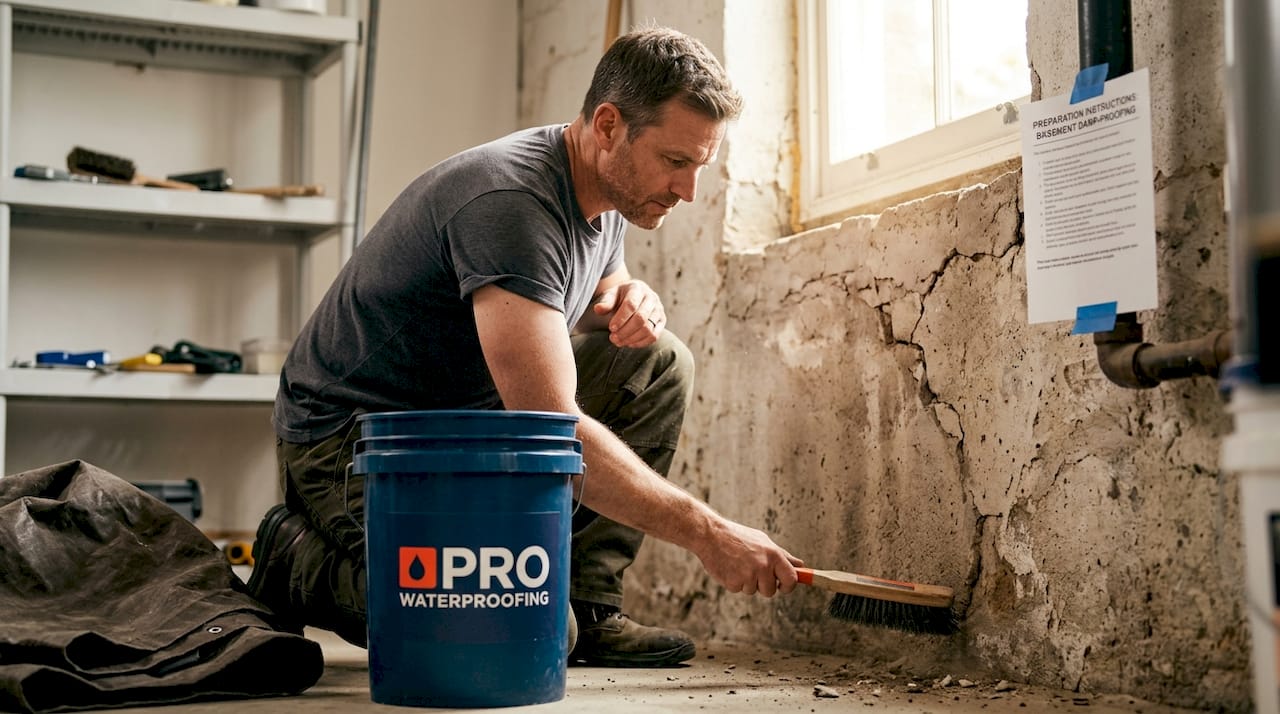
The waterproofing application process requires careful surface preparation and correct product selection before a single litre of material is applied. Cutting corners at any stage compromises the entire installation.
Pro Tip: If you can see white salt deposits (efflorescence) on your basement or retaining wall, water is already moving through the structure. This is one of the earliest signs you need tanking, not just a surface repaint.
Tanking methods and materials explained
Understanding what tanking is gives you the basics — now let’s look into the methods and materials at your disposal. Three main systems dominate the tanking market in South Africa, each with distinct advantages depending on where you are applying them and what your budget allows.
Cementitious (slurry) coatings are rigid, cement-based products mixed with waterproofing additives to create a dense, water-resistant layer. They are applied by brush or spray directly onto masonry, concrete, or block surfaces. These coatings bond tightly to the substrate and are particularly well-suited to basements, water tanks, and lift pits where movement is minimal. They are cost-effective and widely available across South Africa. Their main limitation is that they can crack if the structure shifts, which makes them a poor choice for areas with significant structural movement or on lightweight materials.
Bituminous membranes are either torch-applied (heated to bond to the surface) or self-adhesive sheets made from bitumen reinforced with polyester or fibreglass. They are excellent for flat roofs, below-slab tanking, and retaining walls where a thick, durable barrier is needed. Bitumen systems handle waterlogged ground conditions well and resist root penetration, which matters in landscaped gardens around basement walls. Their downside is that they require skilled application; a poorly torched seam creates a leak point that is difficult to locate later.
Cavity drain systems take a different approach entirely. Rather than stopping water at the wall surface, they manage water that enters the structure by directing it to a drainage channel and sump pump. A studded plastic membrane is fixed to the wall, creating an air gap behind it. Water trickles down behind the membrane and is pumped away harmlessly. This method is practical for older buildings where applying a bonded membrane to deteriorated masonry is not feasible. It does not seal the building in the traditional sense, but it protects the interior effectively.
| System | Best use | Durability | Cost (relative) | DIY-friendly? |
|---|---|---|---|---|
| Cementitious coating | Basements, lift pits, tanks | 15 to 25 years | Low to medium | Possible for small areas |
| Bituminous membrane | Flat roofs, below-slab, retaining walls | 20 to 30 years | Medium to high | Not recommended |
| Cavity drain | Older structures, retrofit projects | 25 years+ | High | No |
Choosing the right product is not a matter of preference. The structure type, groundwater level, expected movement, and access for installation all determine which system performs best. The best waterproofing materials for tanking in 2025 and beyond are those matched precisely to the problem, not simply the most marketed product on the shelf.
For larger commercial projects, tanking examples in commercial buildings show how these systems are integrated into underground parking, service corridors, and plant rooms where failure would be catastrophic.
Pro Tip: Always ask your supplier for the product’s tested hydrostatic pressure rating. For basements more than 1.5 metres below ground, you need a system rated for at least 3 bar of water pressure.
Tanking versus other waterproofing techniques
With a solid understanding of methods and materials, it is important to see how tanking fits alongside other waterproofing solutions available to South African property owners.
Most residential waterproofing projects involve surface treatments: acrylic coatings, elastomeric paints, or bitumen emulsions applied to exterior walls and roofs. These products are effective at repelling rainwater on exposed surfaces, but they are not designed to withstand sustained hydrostatic pressure. They also depend on the surface remaining sound; if the substrate cracks, surface coatings crack with it.
Liquid-applied membranes bridge the gap between surface coatings and full tanking systems. They are flexible, seamless when applied correctly, and can handle moderate water exposure. They are appropriate for balconies, wet rooms, and above-ground basement walls where the water pressure is low. However, they are not substitutes for full tanking in below-ground applications.
Here is a direct comparison:
| Method | Best for | Water pressure resistance | Lifespan | Typical cost |
|---|---|---|---|---|
| Tanking (cementitious) | Basements, tanks, pits | High | 15 to 25 years | Medium |
| Tanking (membrane) | Below slab, retaining walls | Very high | 20 to 30 years | Medium to high |
| Liquid membrane | Balconies, wet rooms | Low to medium | 10 to 15 years | Low to medium |
| Acrylic/elastomeric coating | Exterior walls, roofs | Low | 5 to 10 years | Low |
| Cavity drain system | Retrofit basements | Managed (not stopped) | 25+ years | High |
The reality is that waterproofing compared to tanking is not an either-or decision for most properties. You may need a tanking system below ground and a liquid membrane on the roof deck. Treating them as competing choices rather than complementary systems leads to gaps in your overall waterproofing strategy.
Water damage accounts for a significant proportion of structural repair costs in South African buildings. Many cases originate from inadequate or entirely absent below-ground waterproofing, which could have been addressed at a fraction of the repair cost if tanking had been installed at construction or at the first sign of ingress.
Situations where tanking is the only practical choice include permanent below-grade structures with hydrostatic pressure, swimming pools, lift pits, and underground water storage tanks. In these cases, no surface coating will hold.
How tanking is installed: process overview
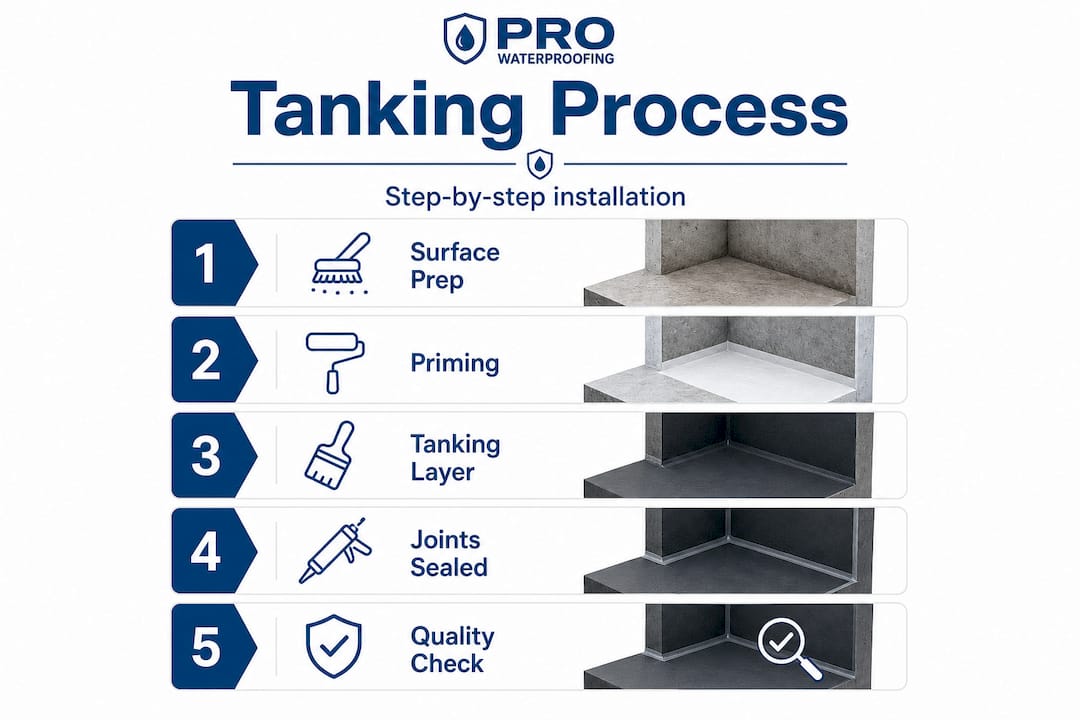
Seeing how tanking compares with other waterproofing approaches lays the groundwork for understanding the installation process. A properly executed tanking job follows a clear sequence, and deviating from it is where most failures begin.
- Surface assessment and preparation: All loose material, contamination, oil, and old coatings are removed. Concrete surfaces are ground or shot-blasted to create a sound, porous key for the tanking material to bond to. Cracks and joints are filled with a compatible repair mortar.
- Priming: A primer compatible with the chosen tanking system is applied to improve adhesion and reduce the substrate’s porosity. Skipping this step is a common shortcut that shortens the life of the entire system.
- Application of the first coat: The tanking material is applied to the required thickness. For cementitious systems, this is typically 1 to 2 mm per coat, brushed or sprayed in one direction.
- Detailing joints, corners, and penetrations: Pipes, wall-to-floor junctions, and corners receive reinforcement tape or fillet beads. These are the most vulnerable points in any tanking installation.
- Application of subsequent coats: Most systems require two or three coats applied in alternating directions to ensure no gaps or pin-holes remain.
- Curing: The material is allowed to cure for the manufacturer’s specified period before backfilling or loading. Rushing this stage causes the system to fail under pressure.
- Inspection and testing: Joints and seams are checked visually and, where warranted, a water test is conducted.
For a more detailed tanking process breakdown, including material-specific guidance, the steps differ slightly for membrane and cavity drain systems. For smaller domestic projects, DIY waterproofing processes can guide you through what is feasible without professional help.
Pro Tip: The wall-to-floor junction is where nearly every failed tanking job leaks first. Insist on a coved fillet (a rounded bead of repair mortar) at this junction before any tanking material is applied. It prevents the membrane from bridging a sharp corner and cracking under pressure.
When and where to use tanking
Having covered the tanking process, let us look at practical cases and when tanking makes sense for your property.
Signs your property may need tanking:
- Persistent damp patches on internal basement or cellar walls, especially after rain
- White salt deposits (efflorescence) on masonry surfaces
- A musty smell in below-ground rooms that does not resolve with ventilation
- Visible structural cracks in basement walls or floor slabs
- Water pooling on the basement floor after heavy rainfall
- Paint or plaster bubbling or peeling repeatedly despite repainting
Residential applications: Basements converted to living space or storage, wine cellars, subterranean garages, and retaining walls in landscaped gardens are the most common residential tanking projects. Many older South African homes, particularly in Cape Town’s southern suburbs and Johannesburg’s older northern suburbs, have basements that were never tanked during construction.
Commercial applications: Underground parking structures, lift pits, service tunnels, plant rooms, and shopping centre basements all require professional-grade tanking. In these environments, water ingress does not just cause cosmetic damage; it can destroy electrical infrastructure, compromise structural steel, and create serious liability.
The cost of skipping tanking is not theoretical. A straightforward basement tanking installation might cost between R15,000 and R60,000 depending on size and system. Remedial repairs after prolonged water ingress, including addressing mould, damaged finishes, structural repairs, and repeat waterproofing, routinely exceed R150,000 for a mid-sized basement.
Knowing when to hire a waterproofing expert is just as important as knowing what system to use. For commercial tanking projects, professional assessment and execution are non-negotiable given the scale of potential damage.
The uncomfortable truth about tanking in South Africa
Having established when and where tanking is best used, here is a frank perspective that most guides avoid.
Property owners in South Africa frequently delay tanking. The reasoning is understandable: the problem is below ground, the damage is not immediately visible, and spending money on something you cannot see feels difficult to justify. We have seen this pattern play out repeatedly, and the result is always the same. A problem that would have cost a reasonable sum to fix properly becomes a structural crisis that costs several times more to address.
There is also a persistent belief that all waterproofing is essentially equal, that any product from a hardware store applied over a problem area will solve it. This is simply not true for below-ground water pressure situations. A topcoat designed for external walls will not hold against hydrostatic pressure. It will look fine for a season, fail quietly over winter, and by the time the damage is visible internally, the wall cavity is already saturated.
The harder truth is that the product itself is rarely the limiting factor. Why waterproofing is vital is understood by most professionals in the industry, but the quality of assessment before installation and the skill of application separate a 25-year installation from one that fails in three years. We have seen expensive imported products fail because the surface was not properly prepared. We have seen basic cementitious systems outlast premium membranes because the installer understood the substrate and took time with the joints.
Invest early, invest in proper assessment, and use contractors who are prepared to explain their method in detail. That conversation alone tells you more about the quality of the work ahead than any product specification sheet.
How Pro Waterproofing can help
If you are considering tanking for your property, here is how you can take the next step with trusted experts.
Tanking is a long-term investment, and getting the assessment right from the outset saves you significant cost and inconvenience. Whether you are dealing with a leaking basement, planning a renovation that includes below-ground space, or managing a commercial property that needs its waterproofing strategy reviewed, expert guidance makes the difference between a system that lasts decades and one that needs remedial work within a few years.
Pro Waterproofing services cover the full range of residential, commercial, and industrial tanking and waterproofing needs across South Africa. From initial site assessment through to material selection, installation, and post-project support, the team brings practical experience and honest advice to every project. Contact Pro Waterproofing today for a personalised assessment and quote tailored to your property’s specific conditions.
Frequently asked questions
Is tanking always necessary for underground structures in South Africa?
Tanking is strongly recommended for underground structures because it prevents water ingress under pressure, though specific needs vary with site conditions, groundwater levels, and the intended use of the space. A professional site assessment will determine the appropriate level of protection required.
Can I DIY tanking for my home’s basement?
Homeowners can successfully apply cementitious tanking systems to small, accessible areas with careful preparation, but large basements or high-groundwater situations are best left to professionals. The DIY waterproofing guide outlines which scenarios are reasonable to tackle yourself and which carry too much risk.
What are the most common tanking materials for South Africa?
Cementitious coatings and bitumen-based membranes are the most widely used tanking materials locally due to their proven performance, broad availability, and suitability for the range of South African conditions from coastal humidity to Highveld ground conditions.
How long does professional tanking last?
With correct surface preparation, proper material selection, and skilled application, a professionally installed tanking system typically lasts between 15 and 30 years, depending on the system chosen and the severity of conditions it faces.
How do I choose between tanking and other waterproofing methods?
Tanking is the correct choice for below-ground areas, high-hydrostatic-pressure zones, and any space where water ingress would cause serious damage; lighter surface waterproofing methods are appropriate for exposed but above-ground surfaces where pressure is low. An expert assessment is the most reliable way to determine which approach suits your specific property.