
TL;DR:
- The best waterproofing chemical matches the specific water ingress mechanism attacking a structure. Different chemicals like silane repellents, crystalline admixtures, and cementitious membranes solve different waterproofing problems effectively. Proper application and system design are crucial to ensure long-lasting and reliable water protection.
The best waterproofing chemical is the one whose chemistry directly counters the specific water ingress mechanism attacking your structure, whether that is hydrostatic pressure, capillary absorption, or crack infiltration. No single product wins universally. The industry term is “waterproofing admixture or coating system,” and the right choice depends entirely on matching chemical action to the water entry driver. Products like PROSOCO SL100, Baumerk CRYSTAL PW 25, and DANOSA DANOCRET PROTECT 300 FLEX each solve a different problem. Choosing the wrong one wastes money and leaves your property exposed.
What are the main types of waterproofing chemicals and how do they work?
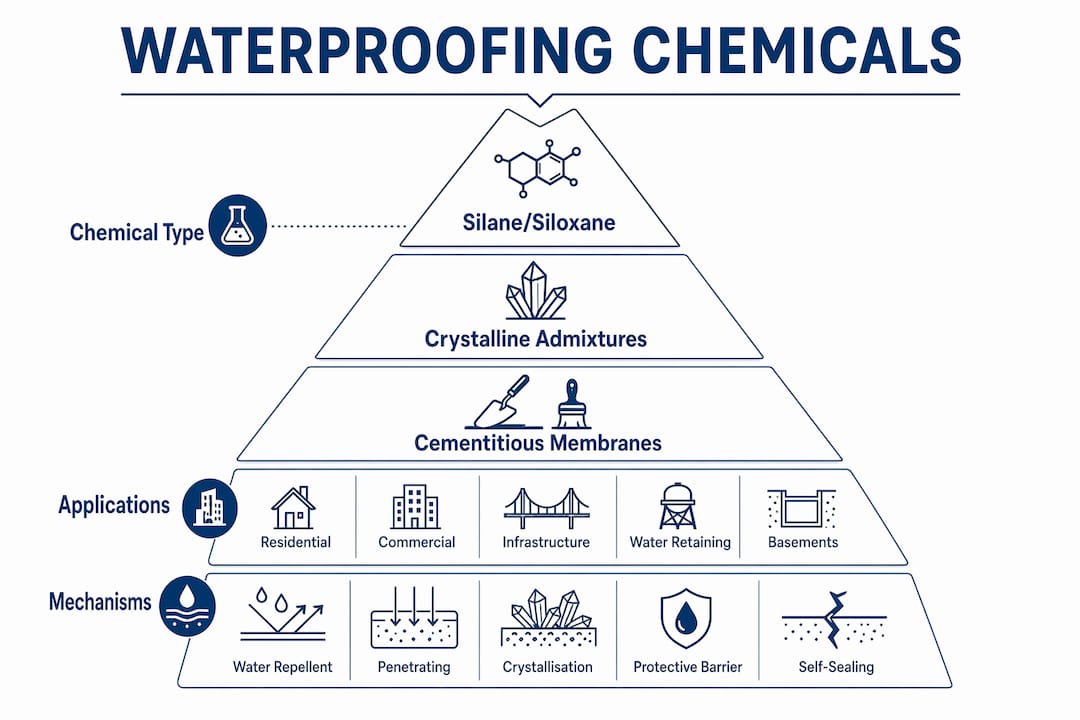
Three chemical families cover the vast majority of waterproofing needs: penetrating silane/siloxane repellents, crystalline admixtures, and cementitious membranes. Each works through a fundamentally different mechanism, and confusing them is the most common and costly mistake property owners and construction professionals make.
Penetrating silane and siloxane repellents
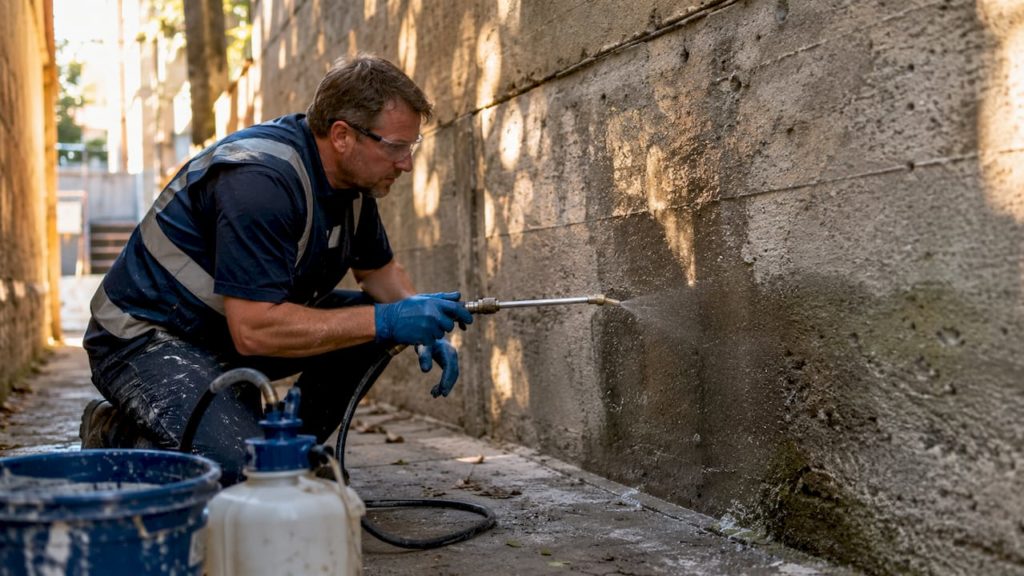
Silane repellents penetrate the concrete matrix and bond chemically to the pore walls, lining them with a water-repellent layer without forming a surface film. PROSOCO SL100 is invisible after application, maintains low volatility, and conforms to VOC limits. That invisibility matters on decorative or colour-sensitive surfaces where a glossy coating would ruin the appearance. Silane systems also preserve vapour permeability, meaning moisture trapped inside the substrate can still escape outward. This breathability prevents the blistering and rebar corrosion that film-forming coatings can cause when moisture is sealed in.
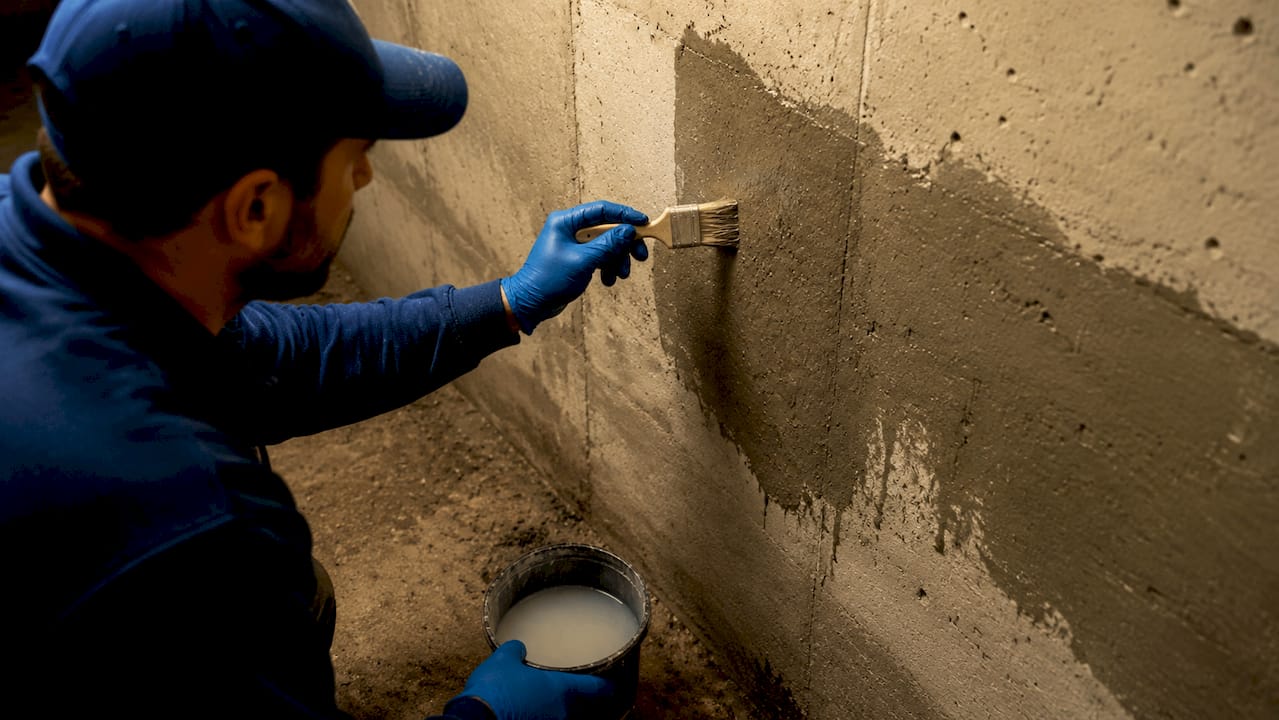
Pro Tip: Apply silane repellents to a clean, dry surface at the correct loading rate. Two applications on a poorly prepared substrate will underperform one application on a properly prepared one.
Crystalline waterproofing admixtures
Crystalline admixtures are mixed directly into concrete during batching. They react with water and cement particles to form insoluble crystals inside the pores and microcracks of the concrete matrix. Baumerk CRYSTAL PW 25 self-seals hairline cracks up to 0.5 mm and protects against hydrostatic pressure and corrosive chemicals. The concrete continues to breathe after treatment. The self-healing property is the key differentiator: when new microcracks form years later, residual chemicals reactivate in the presence of moisture and seal them again.
Cementitious waterproofing membranes
Cementitious membranes are applied to the surface as a coating or mortar layer. They create a physical barrier and, when polymer-modified, can bridge cracks caused by minor structural movement. DANOSA DANOCRET PROTECT 300 FLEX bridges cracks up to 1.26 mm and can be applied up to 3 mm thick. That crack-bridging capacity makes it suitable for terraces and swimming pools where thermal movement is constant. Flexibility and impermeability together define the best cementitious membranes. A rigid membrane that cannot flex will crack and fail at the same points the structure moves.
| Chemical type | Mechanism | Best application |
|---|---|---|
| Silane/siloxane repellent | Pore lining, vapour permeable | Exposed concrete, masonry facades |
| Crystalline admixture | Crystal growth in pores and cracks | Below-grade concrete, water-retaining structures |
| Cementitious membrane | Surface barrier with crack bridging | Terraces, pools, wet rooms |
How do waterproofing chemicals perform against common water ingress challenges?
Water enters structures through three main routes: hydrostatic pressure, capillary absorption, and cracks. The best waterproofing material for concrete addresses whichever of these dominates your specific situation.
Crystalline admixtures perform best under hydrostatic pressure because they work from within the concrete mass. Baumerk and Interbeton both confirm that crack self-sealing effectiveness reaches its practical limit at around 0.4–0.5 mm. Cracks wider than this will not self-seal reliably, regardless of what marketing language implies. That is a critical limit to understand before specifying a crystalline product for a structure with significant movement.
Silane repellents address capillary absorption directly. PROSOCO Concrete Silane WB 40 achieves high vapour transmission with no film formation, which reduces rebar corrosion risk in exposed structures. This makes silane the preferred choice for bridge decks, car park structures, and building facades where appearance and breathability are non-negotiable.
Cementitious membranes handle surface water and moderate crack movement. DANOSA’s 1.26 mm crack-bridging capacity is a real-world figure that outperforms most rigid coatings. For below-grade or high-pressure applications, no single chemical type is sufficient on its own. A system approach combining crystalline admixtures with dedicated joint sealing is the correct specification, because joints and construction details are where leakage most commonly originates.
Pro Tip: Never rely on a crystalline admixture alone for below-grade walls with construction joints. Joints need their own waterproofing detail, such as hydrophilic strips or injection hoses, to close the system.
What factors influence the choice of waterproofing chemical for your property?
Selecting the right waterproofing chemical requires answering four questions before you look at any product catalogue.
-
What is the primary water entry mechanism? Hydrostatic pressure demands crystalline admixtures or tanking systems. Capillary absorption in exposed masonry calls for silane repellents. Surface water on terraces or pools suits cementitious membranes.
-
What is the substrate? Concrete responds well to all three chemical families. Masonry and brick are best treated with silane or siloxane repellents. Colour-sensitive or decorative surfaces need a non-film-forming product like PROSOCO SL100 to preserve appearance.
-
How wide are the existing cracks, and how much movement is expected? Crystalline products handle microcracks up to 0.5 mm. Wider cracks or active movement require a flexible cementitious membrane or a combined repair and coating approach. Specifying a crystalline admixture for a structure with significant thermal movement is a common and expensive error.
-
What are the environmental conditions? Freeze-thaw cycling, chemical exposure, and UV radiation all affect product durability. Silane repellents perform well in freeze-thaw environments because they prevent water absorption rather than trapping it. Cementitious membranes in UV-exposed areas may need an additional protective finish.
The significance of concrete waterproofing goes beyond stopping leaks. Correct chemical selection protects structural steel, prevents carbonation, and extends the service life of the entire building. Getting this decision wrong at the specification stage costs far more to correct later than it does to get right the first time.
How to apply and maintain waterproofing chemicals for best results
Application quality determines whether a waterproofing chemical performs as specified or fails within a season. The chemistry is only half the equation.
- Surface preparation is non-negotiable. Concrete must be clean, sound, and free of laitance, oil, or previous coatings before any waterproofing chemical is applied. Contaminated surfaces prevent penetration of silane repellents and adhesion of cementitious membranes.
- Loading rate controls penetration depth. Application loading rate directly determines how deeply silane repellents penetrate and how long they last. Under-application produces a shallow, short-lived treatment. Follow the manufacturer’s specified coverage rate precisely.
- Shelf life and storage affect performance. PROSOCO SL100 carries a one-year shelf life. Using expired product risks reduced chemical activity and inconsistent results. Store waterproofing chemicals in cool, dry conditions away from direct sunlight.
- Reapplication timing depends on exposure. Silane repellents on heavily exposed facades typically need reapplication every 10–15 years, though this varies with substrate porosity and local climate. Schedule inspections every five years to catch early signs of water ingress before they become structural problems.
- Check compatibility before combining products. Applying a cementitious membrane over a silane-treated surface can cause adhesion failure. Always confirm compatibility with the manufacturer before using products from different systems together.
Pro Tip: For roof applications, the selection criteria shift significantly. The best waterproofing chemical for roofs must handle UV exposure and thermal movement that ground-level products are not designed for.
Key takeaways
The best waterproofing chemical is always the one matched to the specific water ingress mechanism, substrate type, and structural movement expected in your project.
| Point | Details |
|---|---|
| Match chemistry to water entry | Identify whether hydrostatic pressure, capillary action, or cracking drives water ingress before selecting any product. |
| Crystalline admixtures self-seal | Products like Baumerk CRYSTAL PW 25 seal cracks up to 0.5 mm but cannot reliably handle wider cracks or active movement. |
| Silane repellents preserve breathability | PROSOCO silane products prevent water absorption without trapping moisture, reducing rebar corrosion risk. |
| System approach for high-pressure zones | Below-grade and high-pressure applications require crystalline admixtures combined with dedicated joint sealing, not a single product. |
| Application quality is decisive | Loading rate, surface preparation, and storage conditions directly determine whether a waterproofing chemical performs or fails. |
What I have learned from specifying waterproofing chemicals on real projects
The most persistent mistake I see is property owners and construction professionals chasing a universal “best” product rather than diagnosing the actual water entry mechanism first. A crystalline admixture is a genuinely impressive technology, but specifying it for a terrace with 1.5 mm thermal cracks is a waste of money. A cementitious membrane on that same terrace, specified correctly, will outperform it by years.
The second mistake is treating waterproofing as a single-product solution. Below-grade waterproofing consistently fails at joints and construction details, not through the concrete mass itself. A system that addresses the mass, the joints, and the penetrations together is the only reliable approach for basements, water-retaining structures, and below-grade walls.
I have also seen well-specified products fail because of poor application. The chemistry in a silane repellent is sound, but if the applicator under-applies it on a damp substrate, the result is a shallow, short-lived treatment that gives the client false confidence. Verifying that your contractor understands application rates and surface preparation requirements is as important as the product choice itself. When selecting a contractor, ask specifically how they confirm loading rates on site. If they cannot answer that question, keep looking.
— Eben
Waterproofing chemical solutions from Prowaterproofing
Prowaterproofing works with property owners and construction professionals across South Africa to match the right waterproofing chemical system to each project’s specific water ingress challenge.
Whether you need silane repellents for an exposed facade, crystalline admixtures for a below-grade structure, or a flexible cementitious membrane for a terrace or pool, Prowaterproofing’s team can guide you through product selection, application requirements, and system detailing. Getting the specification right from the start protects your investment and avoids costly remediation later. Visit Prowaterproofing to request a consultation or get a quote for your residential or commercial project.
FAQ
What is the best waterproofing chemical for concrete?
No single chemical is universally best for concrete. Crystalline admixtures suit below-grade and water-retaining structures, silane repellents suit exposed facades, and cementitious membranes suit terraces and pools.
Can waterproofing chemicals self-repair cracks?
Crystalline admixtures like Baumerk CRYSTAL PW 25 self-seal cracks up to 0.5 mm by forming crystals inside the concrete matrix. Cracks wider than this require mechanical repair or a flexible membrane system.
How long do waterproofing chemicals last?
Durability varies by product type and exposure. Silane repellents typically require reapplication every 10–15 years on exposed surfaces. Crystalline admixtures become a permanent part of the concrete matrix and do not require reapplication.
Why waterproof concrete surfaces at all?
Water ingress causes rebar corrosion, carbonation, freeze-thaw damage, and structural deterioration. The significance of concrete waterproofing lies in extending service life and preventing repair costs that far exceed the original waterproofing investment.
How do I choose a reliable waterproofing contractor?
Ask contractors how they confirm application loading rates on site and what system detailing they use for joints and penetrations. Prowaterproofing’s guide on selecting a waterproofing contractor covers the key questions to ask before signing any agreement.