
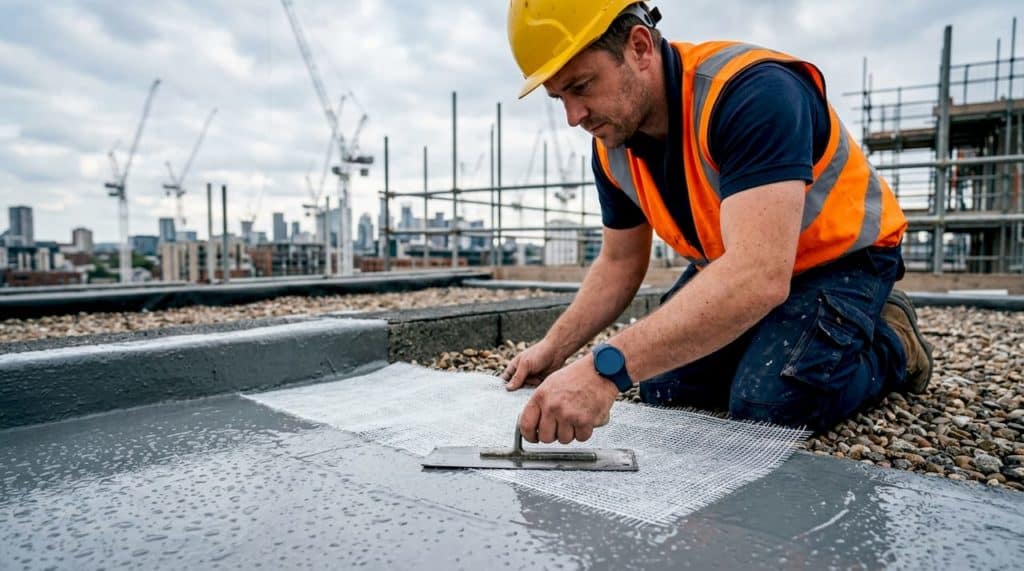
TL;DR:
- Reinforcement mats strengthen waterproofing membranes by distributing stress and preventing tearing at critical points. Proper installation, including embedding, overlapping, and critical location placement, is essential for system durability. Skipping or improperly applying reinforcement mats is a common cause of early waterproofing failure.
A reinforcement mat is defined as a mesh layer embedded within a waterproofing membrane to provide tensile strength, crack resistance, and structural continuity across a building envelope. The role of reinforcement mat in waterproofing is to prevent the membrane from tearing, delaminating, or cracking under the stresses that buildings experience daily. Without this layer, even high-quality liquid-applied or sheet membranes fail prematurely at joints, corners, and terminations. Fibreglass and polyester mesh types are the most widely used reinforcement materials in South Africa, and understanding how they work is the difference between a waterproofing system that lasts a decade and one that fails within two years.
How do reinforcement mats improve waterproofing system durability?
Reinforcement mats improve durability by distributing stress across the membrane rather than allowing it to concentrate at a single point. Buildings move. Thermal cycling, foundation settlement, and live loads all cause the substrate to shift. A membrane without reinforcement absorbs all of that movement at its weakest point, which is usually a joint, a corner, or a change in substrate material.
Reinforcement layers increase strength and reduce elasticity, which is critical for movement-prone areas. That reduction in elasticity sounds counterintuitive, but it means the membrane resists deformation rather than stretching until it tears. The mesh holds the membrane’s shape while the elastic components of the coating accommodate minor movement.
The practical benefits for construction professionals and property owners include:
- Crack isolation: The mesh bridges hairline cracks in the substrate, preventing them from propagating through the membrane.
- Puncture resistance: A reinforced membrane withstands foot traffic, falling debris, and tool contact far better than an unreinforced one.
- Thermal cycling resistance: Repeated expansion and contraction cycles do not cause the membrane to fatigue as quickly when a mat distributes the stress.
- Extended service life: Reinforced assemblies consistently outlast unreinforced systems, reducing the frequency of costly remedial work.
- Reduced maintenance costs: Fewer failures mean fewer call-outs, which matters significantly for commercial and industrial property owners managing large roof areas.
Pro Tip: Apply a full reinforcing layer at all upstands and horizontal-to-vertical transitions before completing the final membrane coat. These junctions carry the highest stress concentration in any waterproofing system.
Fibreglass mesh is embedded in liquid coatings and flashing details specifically to prevent the leak-causing failures that occur at these high-stress transitions.
What materials and designs are used for reinforcement mats in waterproofing?
The three dominant materials for reinforcement mats are fibreglass, polyester, and polyurethane-enhanced mesh. Each has distinct mechanical properties that suit different waterproofing systems and exposure conditions.
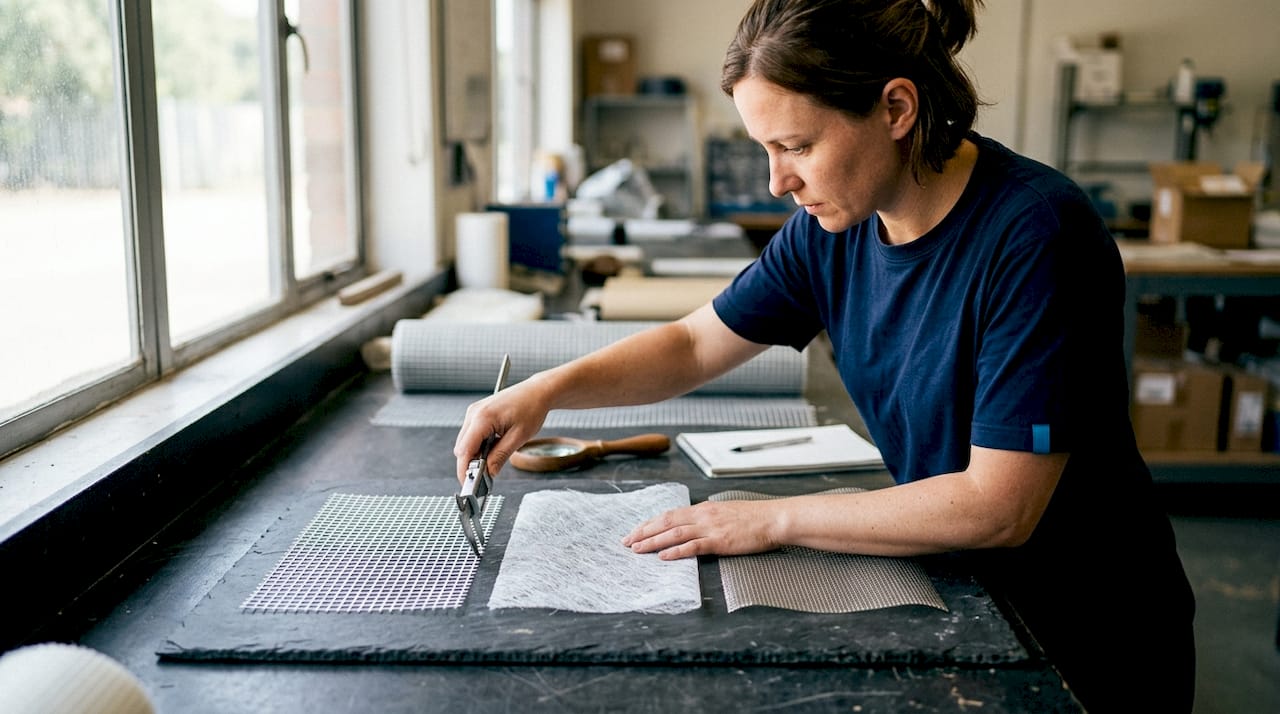
Fibreglass mesh is the most widely used option. It offers high tensile strength, dimensional stability, and good compatibility with cementitious and liquid-applied membranes. It does not stretch significantly, which makes it ideal for crack bridging over rigid substrates such as concrete and masonry.
Polyester mesh is more flexible than fibreglass. It suits applications where the substrate is expected to move more, such as timber decks or lightweight steel structures. Polyester mats work well with bituminous and polyurethane-based membranes because the flexibility of the mat matches the flexibility of the coating.
Polyurethane-enhanced mesh combines the dimensional stability of fibreglass with improved chemical and UV resistance. High tenacity polyester or polyurethane-enhanced mesh provides UV stability and chemical resistance, which is essential for membrane longevity on exposed roofs in South Africa’s high-UV climate.
| Material | Best suited for | Key advantage | Limitation |
|---|---|---|---|
| Fibreglass | Concrete, masonry, cementitious membranes | High tensile strength, crack bridging | Less flexible, can be brittle if mishandled |
| Polyester | Timber decks, steel structures, bituminous membranes | Flexibility, good elongation | Lower tensile strength than fibreglass |
| Polyurethane-enhanced | Exposed roofs, chemical environments | UV and chemical resistance | Higher cost |
Mesh weight also matters. Lightweight mats (around 50–80 g/m²) suit flat applications with low foot traffic. Heavy-duty mats (120 g/m² and above) are specified for trafficable decks, podium slabs, and areas subject to mechanical stress. Matching the mat weight to the application is as important as choosing the right material.
Where and how should reinforcement mats be installed for optimal waterproofing performance?
Correct installation determines whether a reinforcement mat performs as specified or becomes a liability. The location, embedding method, and overlap all affect the final result.
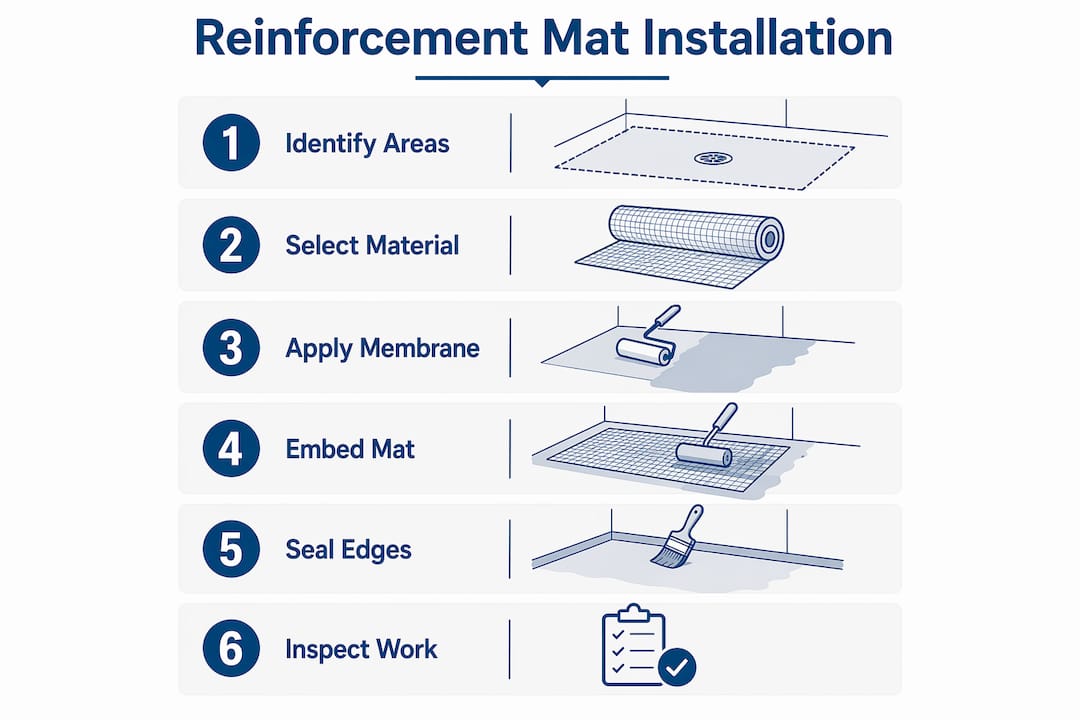
Identify the critical areas first
Reinforcement mats act as a hidden safeguard at critical terminations including plinths, parapets, and movement joints. These are the locations where cracking is statistically most likely to occur. Any waterproofing specification that omits reinforcement at these points is incomplete.
Follow the correct installation sequence
- Prepare the substrate. The surface must be clean, dry, and free of loose material. Any cracks wider than 0.5 mm should be filled before the membrane is applied.
- Apply the first coat of membrane. This wet coat acts as the bonding layer for the mat.
- Lay the reinforcement mat into the wet membrane. Work from the centre outward to avoid air pockets and wrinkles.
- Embed the mat fully. Mesh reinforcement must be fully embedded within the liquid waterproofing layer, not placed on the surface. Surface placement causes delamination and failure.
- Overlap adjacent mat sections by 75–100 mm. Professional assemblies mandate a 75–100 mm overlap to ensure continuous structural strength and prevent gaps in coverage.
- Apply the second coat of membrane over the embedded mat. This coat encapsulates the mesh and brings the system to the specified dry film thickness.
- Inspect before applying the final coat. Check for any areas where the mesh is visible through the membrane. These spots require additional material.
Pro Tip: At movement joints, use a mat that is wide enough to extend at least 150 mm on each side of the joint. Reinforcement at expansion joints allows membranes to maintain elasticity while gaining tensile strength, which is exactly what a moving joint demands.
For a broader view of how reinforcement fits within different waterproofing techniques used across South African properties, the choice of membrane system also dictates which mat type performs best.
What are the common challenges and mistakes when using reinforcement mats?
Poor installation of reinforcement mats is one of the leading causes of premature waterproofing failure. Incorrect reinforcement application, including insufficient overlap or incompatible mesh, leads directly to membrane failure and water ingress. The consequences range from cosmetic staining to structural damage, both of which are expensive to remediate.
The most common mistakes include:
- Insufficient overlap between mat sections. Gaps in coverage create weak lines where cracking initiates. The 75–100 mm overlap requirement exists precisely to prevent this.
- Placing the mat on top of the cured membrane. The mat must be embedded in a wet coat. Placing it on a cured surface means it bonds poorly and can peel away under stress.
- Using the wrong mat for the substrate. A rigid fibreglass mat on a flexible timber deck will crack because the mat cannot accommodate the substrate’s movement.
- Skipping reinforcement at corners and upstands. These are the highest-stress points in any system. Omitting the mat here guarantees early failure.
- Ignoring UV degradation during construction. If the mat is left exposed to sunlight for extended periods before the final coat is applied, UV damage reduces its mechanical properties before the system is even complete.
Regular inspection during and after installation catches most of these errors before they become expensive problems. A step-by-step approach to managing substrate movement during waterproofing work helps installers anticipate where reinforcement is most needed and apply it correctly the first time.
For property owners commissioning waterproofing work, ask your contractor to demonstrate how they embed the mat and what overlap they specify. A contractor who cannot answer these questions clearly is not following best practice. Reviewing waterproofing best practices before engaging a contractor gives you the knowledge to ask the right questions.
Key takeaways
Reinforcement mats are the structural backbone of any durable waterproofing system, and skipping or misapplying them at joints, plinths, and parapets is the single most common cause of early membrane failure.
| Point | Details |
|---|---|
| Embed, do not surface-place | The mat must sit within a wet membrane coat to bond correctly and prevent delamination. |
| Overlap by 75–100 mm | Adjacent mat sections need this minimum overlap to maintain continuous tensile strength. |
| Match material to substrate | Use fibreglass for rigid substrates and polyester or polyurethane-enhanced mesh for flexible ones. |
| Prioritise critical terminations | Joints, corners, plinths, and parapets carry the highest stress and always require reinforcement. |
| Inspect before the final coat | Check for exposed mesh or thin spots before applying the finishing membrane layer. |
Why I think most waterproofing failures start before the membrane is even applied
After years of working on waterproofing projects across South Africa, I have seen the same failure pattern repeat itself. The membrane gets blamed. The product gets blamed. The weather gets blamed. The reinforcement mat is almost never mentioned, and that is the problem.
The mat is invisible once the system is complete. That invisibility makes it easy to skip or cut corners on, especially under cost pressure. But I have seen roofs where the contractor used the correct membrane product at the correct thickness and still had failures within 18 months. In every one of those cases, the mat was either absent at the critical terminations or placed on top of a cured coat rather than embedded in a wet one.
South Africa’s climate makes this worse than it would be in a temperate environment. The temperature swings between a cold winter night and a midsummer afternoon in Gauteng or the Western Cape are significant. That thermal cycling is relentless, and an unreinforced membrane simply cannot absorb it indefinitely.
My honest advice to property owners is this: before you sign off on any waterproofing job, ask to see the mat being embedded. Watch the overlap being applied. If the contractor resists or dismisses the question, that tells you everything you need to know. The mat is not an optional extra. It is the part of the system that determines whether everything else holds together.
— Eben
Waterproofing solutions from Prowaterproofing
Prowaterproofing works with residential, commercial, and industrial property owners across South Africa to specify and install waterproofing systems that include correctly embedded reinforcement mats at every critical termination.
Whether you need a full roof membrane system, cold-applied membrane installation, or targeted repairs at joints and parapets, the team at Prowaterproofing brings the technical knowledge to get the specification right the first time. Contact Prowaterproofing for a quote and get a waterproofing system built to last.
FAQ
What is the role of a reinforcement mat in waterproofing?
A reinforcement mat provides tensile strength and crack resistance within a waterproofing membrane by distributing stress across the surface. It prevents the membrane from tearing at joints, corners, and other high-stress terminations.
What is the correct overlap for reinforcement mat sections?
Professional waterproofing assemblies require a 75–100 mm overlap between adjacent mat sections to maintain continuous structural strength and eliminate gaps in coverage.
Which reinforcement mat material is best for concrete roofs?
Fibreglass mesh is the preferred choice for concrete and masonry substrates because it offers high tensile strength and dimensional stability, which suits rigid surfaces that do not flex significantly.
Can reinforcement mats be used with all waterproofing membranes?
Most reinforcement mats are compatible with liquid-applied and sheet membranes, but the mat material must match the membrane’s flexibility. Polyester mats suit flexible membranes, while fibreglass suits rigid cementitious systems.
How do I know if a reinforcement mat has been installed correctly?
The mat should be invisible beneath the membrane with no raised edges or visible mesh. Before the final coat is applied, no mesh should be visible through the membrane layer.