

TL;DR:
- Weep holes are crucial for water drainage in masonry walls and retaining structures to prevent damage. Regular inspection and proper maintenance of weep holes ensure effective moisture management and compliance with building codes. Neglecting or blocking these openings can lead to structural failure and significant repair costs.
Weep holes are intentional openings built into masonry walls and retaining structures to allow trapped water to escape, and they form a critical part of any effective waterproofing system. Without them, moisture accumulates inside wall cavities and behind retaining structures, building pressure that causes cracking, bulging, damp, and mould. The role of weep holes in waterproofing is not cosmetic or incidental. It is structural and regulatory. South African building codes, including the Ngwathe Local Municipality’s 2026 building control bylaw, specifically prohibit blocking them. Property owners and building managers who understand how weep holes function are far better placed to protect their buildings from costly water damage.
How weep holes aid waterproofing in cavity walls
Cavity walls are designed with a deliberate air gap between the outer and inner leaf of masonry. Rain penetrates the outer leaf regularly. That water runs down the inside face of the outer leaf and collects at the base of the cavity. Without a drainage outlet, it has nowhere to go except inward, where it saturates insulation, promotes mould, and damages plaster and structural timbers.

Cavity trays are the first line of defence. These are sloped, waterproof membranes installed at key points in the cavity, such as above lintels and window openings, to catch descending water and direct it outward. Weep holes sit at the base of each cavity tray run, providing the exit point for that collected water. Water trapped in wall cavities without drainage exposes building components to damp, promoting structural damage and mould growth. That makes the cavity tray and weep hole a paired system, not two separate features.
Placement and sizing follow defined standards. NHBC Standards Chapter 6.1 and BS 5250 require weep holes to be spaced at maximum 450 mm centres, with a minimum of two vents per cavity tray run or lintel. The holes must penetrate at least 25 mm into the cavity and pass a water flow test, with water exiting within three seconds. These are not arbitrary numbers. They reflect the minimum drainage capacity needed to handle realistic rainfall conditions in masonry construction.
- Weep holes must align directly with the lowest point of the cavity tray to allow gravity drainage.
- Spacing at 450 mm centres prevents water from pooling between outlets.
- A minimum of two weep holes per tray run provides redundancy if one becomes blocked.
- Weep holes differ from airbricks. Airbricks ventilate the sub-floor void beneath suspended timber floors. Weep holes drain cavity moisture. Confusing the two leads to incorrect maintenance decisions.
Pro Tip: Fit purpose-made weep vents rather than leaving open perpend joints. Weep vents pass water flow tests and reduce blockage from pests and debris while maintaining free drainage.
Why weep holes matter in retaining walls
Retaining walls face a different and more severe challenge than cavity walls. Soil behind a retaining wall holds water after rain. That water exerts hydrostatic pressure, which is the lateral force that water applies to any surface containing it. Without relief, that pressure builds until the wall buckles, tilts, cracks, or collapses.

Blocked weep holes cause hydrostatic pressure buildup that can cause retaining walls to bulge, tilt, crack, or collapse during heavy rains. This is not a gradual cosmetic problem. Wall failure can happen suddenly and poses a direct safety risk to people and property. Retaining wall experts confirm that weep holes are integral for relieving hydrostatic pressure, not just moisture control, making their maintenance a safety imperative.
A properly specified drainage system behind a retaining wall includes four components working together. Standard drainage specification requires geotextile fabric to prevent soil migration, crushed stone as a free-draining backfill layer, a perforated drainage pipe to collect and channel water, and clear weep holes to release it. Remove any one of these components and the system fails. The weep holes are the final outlet. If they are blocked, the entire drainage assembly backs up.
| Drainage component | Function |
|---|---|
| Geotextile fabric | Prevents fine soil particles from clogging the drainage layer |
| Crushed stone backfill | Creates a free-draining zone behind the wall |
| Perforated drainage pipe | Collects and channels water along the base of the wall |
| Weep holes | Release collected water through the wall face |
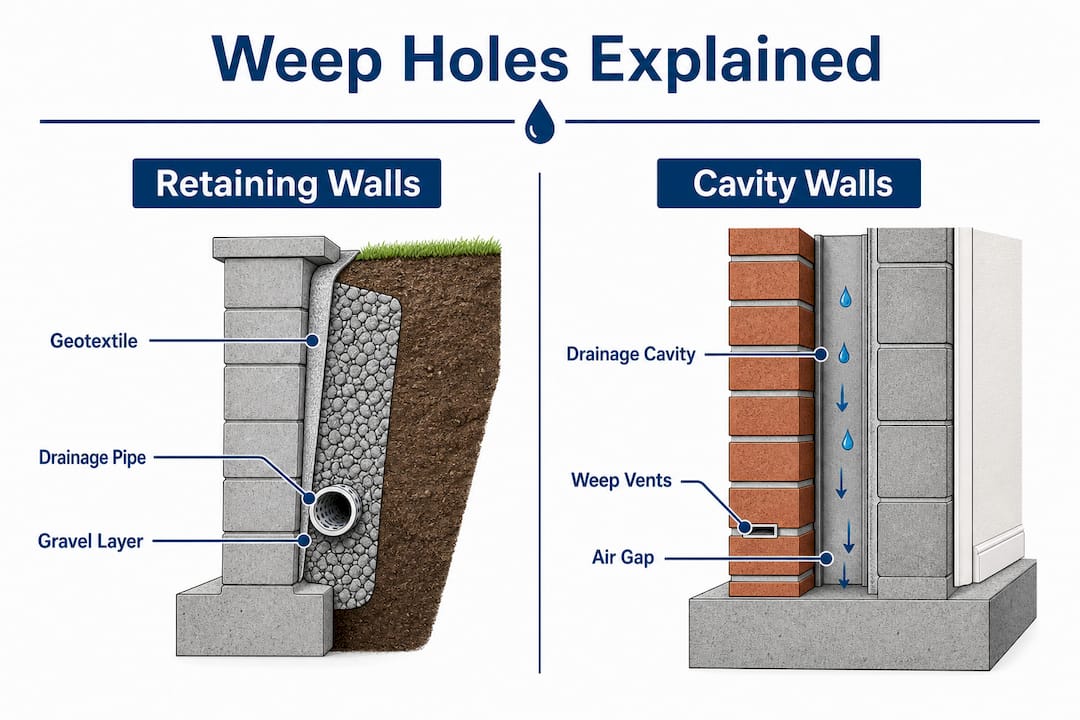
South African municipal regulations treat blocked weep holes as a compliance failure. The Ngwathe Local Municipality bylaw specifically prohibits obstructing weep holes in retaining walls. Plugging them is not a maintenance shortcut. It is a building code violation.
Pro Tip: Inspect retaining wall weep holes after every significant rainfall event. If no water exits during or after heavy rain, the drainage system is blocked and requires immediate investigation.
Common blockages and how to maintain weep holes
Weep holes fail most often because of blockages, and the most common cause is mortar. During construction, mortar droppings fall into the cavity and accumulate at the base, directly over the weep hole positions. Mortar droppings and debris inside wall cavities frequently block weep holes, rendering them ineffective, particularly when cavity trays are absent or damaged. This is a construction quality issue, not a design flaw.
Other common blockage sources include:
- Windblown dirt and dust, which compact over time into a solid plug.
- Insects and small animals nesting inside the open perpend joint or weep vent.
- Plant roots, particularly in retaining walls where vegetation grows close to the wall face.
- Paint applied over the wall face during redecoration, which seals the opening entirely.
Maintenance is straightforward once you know what to look for. Inspect weep holes visually at least twice a year, ideally in autumn before the rainy season and in spring after it. Use a thin wire or a small brush to clear any debris from the opening. For weep vents, remove the vent insert, clean it, and refit it. Testing weep vents regularly with simple water flow checks is a best practice to confirm ongoing drainage performance without compromising pest protection.
Neglecting this maintenance has compounding consequences. Blocked cavity wall weep holes allow moisture to migrate inward, causing interior damp conditions that damage plaster, insulation, and timber. Blocked retaining wall weep holes accelerate structural movement. Both outcomes are far more expensive to repair than a routine inspection costs. Avoiding common waterproofing mistakes starts with keeping these small but critical openings clear.
How weep holes compare with related waterproofing elements
Weep holes do not work in isolation. They are one component in a layered moisture management system. Understanding how each element differs helps you identify which part of the system has failed when problems appear.
A damp-proof course (DPC) is a horizontal moisture barrier, typically a polyethylene or bitumen membrane, built into the wall at low level to prevent ground moisture from rising through the masonry. It stops upward moisture movement but does nothing to manage water that enters the cavity from above. A cavity tray performs a similar barrier function but at higher levels in the wall, above openings and at roof abutments, directing water laterally toward the weep holes. The weep hole itself is purely a drainage outlet. It moves water out of the system once the tray has collected it.
Airbricks serve a ventilation function rather than a drainage one. They allow air to circulate beneath suspended timber floors, reducing condensation and rot. Fitting an airbrick where a weep hole is needed, or vice versa, produces a system that neither drains nor ventilates correctly. Each component has a defined position and purpose within the waterproofing methods used in South African construction.
When any one element is missing or faulty, the others cannot compensate fully. A cavity tray without weep holes collects water with no exit. Weep holes without a cavity tray drain nothing because there is no collection point. A DPC without a cavity tray above a lintel leaves the opening vulnerable to water ingress from above. The system only performs as designed when all components are present, correctly installed, and maintained.
Key takeaways
Weep holes are a non-negotiable drainage component in both cavity walls and retaining structures, and blocking or neglecting them causes water damage and structural failure.
| Point | Details |
|---|---|
| Weep hole function | Small openings that allow trapped water to exit cavity walls and retaining structures. |
| Standards compliance | NHBC and BS 5250 require 450 mm maximum spacing and a three-second water flow test. |
| Retaining wall safety | Blocked weep holes cause hydrostatic pressure buildup that can collapse a retaining wall. |
| Maintenance frequency | Inspect and clear weep holes at least twice a year, before and after the rainy season. |
| System integration | Weep holes only work correctly when paired with cavity trays, DPC, and proper backfill drainage. |
Weep holes are the detail most property owners get wrong
From what I have seen across residential and commercial properties in South Africa, weep holes are the single most overlooked detail in building maintenance. Property owners spend money on waterproofing membranes and sealants, then unknowingly block the very outlets that allow the system to drain. I have walked retaining walls where every weep hole had been painted over during a cosmetic refresh. The wall looked pristine. Six months later, it was cracking at the base.
The misconception I encounter most often is that weep holes are a sign of poor construction, as if water exiting the wall face indicates a leak. The opposite is true. Water exiting a weep hole means the drainage system is working exactly as designed. A wall with no water exiting its weep holes after heavy rain is the one that warrants concern.
Building managers who include weep hole inspection in their quarterly maintenance schedule catch problems before they become structural. A blocked weep hole costs almost nothing to clear. A retaining wall rebuilt after collapse, or a cavity wall stripped out because of mould and rot, costs tens of thousands of rands. The regulatory dimension matters too. South African building codes treat blocked weep holes as a violation, which means liability sits with the property owner if a wall fails and inspections reveal the drainage was obstructed.
My practical advice is this: treat weep holes as a first-line indicator of your waterproofing system’s health. If they are clear and draining, the system is working. If they are blocked, investigate immediately. Do not wait for visible damage to appear inside the building. By then, the repair bill is already significant.
— Eben
Prowaterproofing can help you protect your property
Water damage rarely announces itself until the repair bill is already large. Prowaterproofing specialises in comprehensive waterproofing solutions for residential, commercial, and industrial properties across South Africa, with services aligned to local building standards and climate conditions.

Whether you need a professional inspection of your weep holes and cavity drainage, advice on retaining wall waterproofing, or a full remediation of a damp-affected structure, the team at Prowaterproofing brings the technical knowledge to diagnose and resolve the problem correctly. Poorly maintained drainage systems are one of the most common causes of structural water damage in South African buildings. Getting expert eyes on your property before problems escalate is the most cost-effective decision you can make. Contact Prowaterproofing for a professional assessment and take the guesswork out of moisture management.
FAQ
What is the main function of a weep hole?
A weep hole is a small opening in a masonry wall or retaining structure that allows trapped water to drain out, relieving moisture build-up and hydrostatic pressure before they cause structural damage.
How often should weep holes be inspected?
Inspect weep holes at least twice a year, ideally before and after the rainy season, and clear any blockages with a thin wire or small brush to maintain free drainage.
Is it illegal to block weep holes in South Africa?
Blocking weep holes in retaining walls is a building code violation under South African municipal regulations. The Ngwathe Local Municipality’s 2026 building control bylaw specifically prohibits obstructing weep holes.
What is the difference between a weep hole and an airbrick?
A weep hole drains water from a wall cavity or retaining structure, while an airbrick ventilates the sub-floor void beneath suspended timber floors. They serve different functions and are not interchangeable.
What spacing do weep holes require in cavity walls?
NHBC Standards and BS 5250 require weep holes at maximum 450 mm centres, with a minimum of two vents per cavity tray run, and each hole must allow water to exit within three seconds under flow test conditions.