

The right terrace waterproofing method depends on your finish and your falls, not fashion: liquid-applied acrylics like TAL SUPERFLEX FIBRE 1K suit complex, seamless coverage; polyurethanes handle trafficable, movement-prone decks; torch-on bitumen needs mitigation before tiling; and 2K cementitious slurries such as TAL SUREPROOF or Derbigum’s dual-layer system are commonly used under-tile choices. None of it holds without correct falls, dry substrates, and proper movement joints.
TL;DR:
- Correct substrate curing, moisture limits, and falls are critical; skipping these steps causes early water intrusion and membrane failure.
- Acrylic systems with moisture limits of around 3%, or cementitious slurries with 6%, must be strictly adhered to for long-term durability.
- Installing movement joints, detailed drain upstands, and proper surface prep prevents cracking and ponding issues.
- Repairing leaks involves matching the defect to the correct system, with patching or re-coating generally preferable over full removal unless widespread.
- Choosing experienced applicators with written specifications, documented flood tests, and warranties significantly extends terrace waterproofing lifespan.
Table of Contents
- What are the main terrace waterproofing methods?
- Tiling over waterproofing: compatibility, screeds and adhesive choices
- Surface preparation, falls and drainage — the non-negotiables
- Detailing: drains, upstands, penetrations and movement joints
- Application steps, coats, cure times and on-site testing
- Diagnosing failures and choosing the right repair
- How to choose a contractor and what to ask before you sign
- Why cutting corners on prep always costs more later
- Pro Waterproofing: how we help and where to get a quote
- Sources
What are the main terrace waterproofing methods?
Six systems cover almost every terrace scenario you’ll encounter, and picking the wrong one for your finish is the single most common reason terraces leak within two years of a new installation.
Liquid-applied acrylic membranes go on cold, by brush or roller, and cure into a seamless elastic film that follows every upstand, corner, and pipe penetration without joints. TAL SUPERFLEX FIBRE 1K is a fibre-enriched version designed to bond with cement-based tile adhesives, and it often removes the need for a separate reinforcement fabric on low-movement terraces, provided the substrate moisture sits at or below the recommended 3%. Allow a curing window of approximately three days before light foot traffic. It’s a strong fit for terraces with lots of detailing, including balustrade bases, planters, and awkward drainage points.
Polyurethane liquid membranes behave similarly on application but cure into a tougher, more elastic film that copes better with thermal movement and structural flex, which matters on suspended slabs above habitable rooms. They cost more than acrylics but forgive minor substrate movement that would crack a stiffer coating.
Torch-on bitumen membranes are heat-welded sheet products, tough and genuinely waterproof, and they’ve been the default on flat roofs for decades. The catch is tiling directly onto them. Bituminous compounds flow slightly under load over time (viscoelastic creep) and can leach plasticisers into adhesive layers, which loosens tiles from beneath. If a client insists on a torch-on system with tiles above it, a screed of sufficient thickness or a compatible cementitious/acrylic overcoat is the standard mitigation, detailed clearly in TAL’s installation guideline for tiling onto torch-on bitumen.
Cementitious 2K slurries, like TAL SUREPROOF, are two-component systems mixing a powder with a liquid polymer. They bond directly to cement-based tile adhesives without an isolation layer in most cases, which is why they dominate residential under-tile terrace work. TAL SUREPROOF typically demands substrate moisture under the specified 6% and goes down in two coats to reach roughly 2mm thickness, finishing with a flood test.
Under-tile and sheet membranes (PVC or EPDM sheet products) sit between the slab and the tile bed as a fully bonded or loose-laid barrier. They’re durable and chemically resistant but need skilled welding at seams and detail work at penetrations, so labour quality matters more here than with liquid systems.
Here’s how they stack up when you’re deciding:
- Liquid acrylic (e.g. TAL SUPERFLEX FIBRE 1K): best for detailed terraces, tile-compatible, moderate cost, moisture limit around 3%.
- Polyurethane: best for movement-prone or trafficable decks, higher elasticity, higher cost.
- Torch-on bitumen: best for robust roof-only applications, poor direct tiling compatibility without a screed or overcoat.
- Cementitious 2K (e.g. TAL SUREPROOF): best for standard under-tile residential terraces, moisture limit around 6%, two-coat application.
- Sheet membranes (PVC/EPDM): best for large commercial terraces, needs specialist welding, excellent chemical resistance.
- Derbigum dual-layer specification: best for pedestrian trafficable terraces needing an isolation layer beneath tiles plus a protective top layer.
The recoat and moisture windows quoted by manufacturers aren’t guidelines you can round up. TAL specifies roughly 3% moisture for its acrylic system and roughly 6% for its 2K cementitious product, and going ahead above those figures is one of the most common causes of blistering months after installation.
Cost tends to track complexity rather than material price alone. A straightforward cementitious slurry job on a small balcony can be cheaper per square metre than a liquid acrylic system loaded with corner detailing, fabric reinforcement, and multiple penetrations, even though the raw materials cost less. Get a written specification before comparing quotes, because “waterproofing” without a named product and coat count isn’t a comparable line item.
Tiling over waterproofing: compatibility, screeds and adhesive choices
Tiling failures on terraces almost never come from bad tiles. They come from the wrong waterproofing sitting under a rigid tile bed, or a compatible waterproofing system installed with the wrong adhesive.
Torch-on bitumen is the biggest risk here. Its viscoelastic flow lets it creep slowly under the weight of tiles and traffic, and plasticiser migration can soften the adhesive bed above it, both of which eventually crack grout lines or lift tiles at the edges. If you’re stuck with an existing torch-on membrane and want tiles, TAL’s guidance is specific: install a screed of sufficient thickness above it or overcoat with a compatible cementitious or acrylic layer before tiles go down.
Adhesive selection matters just as much as the membrane underneath:
- Use an S2 deformable adhesive wherever the substrate has any expected movement, since it flexes with the slab instead of transferring stress straight into the grout.
- Choose a full-bed adhesive application for large-format tiles or pavers, so there’s no void beneath the tile that could trap water and freeze, crack, or drum hollow underfoot.
- Match adhesive chemistry to the membrane, since cementitious membranes generally take cementitious adhesives, while some acrylic systems need a specific bonding primer first.
Movement joints have to run through the tile layer and the adhesive bed, not stop at the screed. As a rule of thumb, joints every 3 to 4 metres in each direction, and always aligned with any structural joints below, keep thermal expansion from cracking tiles in a straight line across the terrace. A practical guide to under-tile membrane systems covers how these joints interact with different membrane types in more depth.
Pro Tip: When a terrace is cleaned or re-grouted years later, movement joint sealant gets scraped out and often never replaced properly. Ask your contractor to mark joint locations on the handover drawing so future maintenance doesn’t cut straight through your waterproofing.
Surface preparation, falls and drainage — the non-negotiables
No membrane, however good, survives standing water it was never designed to sit under permanently. Falls come before products.
New concrete typically needs 28 days to cure before any waterproofing goes on, and screeds carry their own curing windows depending on thickness and mix. Skipping this step traps moisture that later blisters the membrane from underneath, a failure that looks identical to bad workmanship but actually starts with an impatient schedule.
Moisture testing isn’t optional guesswork. Manufacturer limits vary by product, roughly 3% for some acrylic systems and up to 6% for certain 2K cementitious slurries, and a calibrated moisture meter reading before application saves a callback six months later. A detailed look at surface preparation walks through the testing methods contractors should be using.
Falls need to move water to drains and scuppers at a consistent gradient, generally a minimum of 1:80, with overflow provision in case a primary drain blocks. Ponding areas that develop after installation almost always trace back to a flat or reverse-falling section that was never corrected at screed stage. The fix is a tapered screed re-lay or an additional drain point, not more waterproofing coats layered over the problem.
Before priming, the surface needs to be free of laitance, dust, oil, curing compounds, and old coatings that won’t bond. A quick broom test tells you little; a proper mechanical prep or acid etch, followed by thorough rinsing and drying, is what most manufacturer datasheets actually specify. Skip this and even a premium membrane debonds within a season.
Detailing: drains, upstands, penetrations and movement joints
Terraces don’t usually fail across the open field of the slab. They fail at the edges, the drains, and the joints, because that’s where installers cut corners under time pressure.
Drain dressing is the classic weak point. The membrane needs to run down into the drain body and lock under a soaker flange, not just stop at the drain rim and get sealed with mastic as an afterthought. Derbigum’s balcony specification recommends the flange sit slightly below the finished screed level so water is guided directly into the outlet rather than pooling around a proud lip.
- Set the drain flange level fractionally below the surrounding screed to avoid a dam effect at the outlet.
- Turn the waterproofing membrane up all vertical surfaces, walls, upstands, and door thresholds, by a minimum of 100mm, so wind-driven rain or a blocked drain doesn’t push water straight over the top edge of the membrane.
- Seal pipe penetrations with a purpose-made boot or collar bonded into the membrane itself, never just caulked around the pipe afterwards.
- Install movement joints at wall/slab junctions and at regular intervals across large terraces, filled with a flexible, UV-stable sealant rather than rigid grout.
Sliding door thresholds deserve particular attention because they’re low points by design, and a membrane that doesn’t turn up correctly behind the track will leak the first time wind pushes rain against the glass. Derbigum’s approach for pedestrian terraces layers an isolation sheet beneath the tile bed specifically so these upstand and threshold details stay protected even after years of foot traffic, part of its dual-layer balcony specification.
Pro Tip: Ask to see the drain flange and upstand details photographed before the screed or tiles go over them. If your contractor can’t produce these photos later, that’s a red flag for the whole installation.
Application steps, coats, cure times and on-site testing
A competent installation follows a sequence, and knowing that sequence lets you spot when it’s being rushed.
For liquid and 2K cementitious systems, the typical build-up runs: substrate primer, first coat, reinforcing fabric embedded wet into corners and cove details, second coat, then a protective layer if the terrace won’t be tiled immediately. TAL’s own installation guidance for both SUPERFLEX FIBRE 1K and SUREPROOF confirms fabric reinforcement at corners as standard practice, not an optional upgrade.
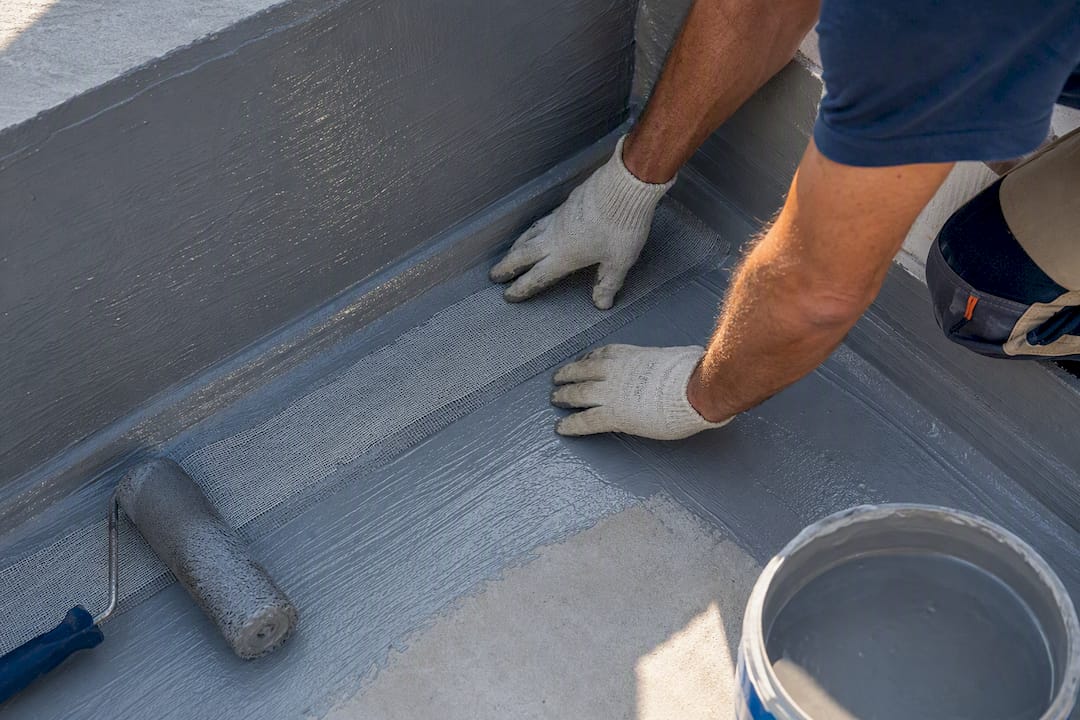
Drying and cure windows vary by manufacturer and product but commonly fall in the 24 to 72 hour range before foot traffic or tiling can proceed, and rushing this window is one of the most avoidable causes of early failure. A step-by-step guide to the application process sets out what a compliant site sequence looks like in practice.
Once the membrane is cured, flood testing is what actually proves the system works rather than assuming it does:
- Fill the terrace with water to a consistent depth, typically 25 to 50mm.
- Leave it standing for 48 to 72 hours, the window recommended in Derbigum’s balcony specification.
- Check the underside (ceiling below, if accessible) for any damp patches or drips during the test period.
- Confirm the drain and overflow both function under load, not just when dry.
A flood test that isn’t documented might as well not have happened. Insist on photographs, timestamps, and a signed certificate before you accept handover. A dedicated explainer on flood testing covers what that documentation should include and why some contractors try to skip it.
Diagnosing failures and choosing the right repair
Not every leak means ripping out the whole terrace. Matching the defect to the right fix saves money and disruption.
- Ponding after rain usually means the falls were never right; a localised tapered screed patch or an added drain point fixes it, not another coat of membrane.
- Blistering points to trapped moisture at installation, often from a substrate that exceeded its moisture limit; small blisters can sometimes be cut out and patched, but widespread blistering usually means recoating the whole area.
- Fishmouths (small lifted edges in sheet membranes) are typically a welding or bonding fault and can be reheated and resealed locally on torch-on or PVC systems.
- Cracked membranes at movement joints signal a joint that was never properly detailed or has failed with age; cutting back and reinstating the joint, rather than skimming over it, is the only durable fix.
Liquid systems generally recoat well as a maintenance measure every several years. Torch-on bitumen can be patched with a heat-welded overlay for isolated damage. PVC and EPDM sheet membranes need proper welding to repair, and a botched DIY patch on either often fails faster than the original defect. If more than roughly 20% of a terrace shows recurring defects, full system replacement is usually cheaper over its lifecycle than repeated spot repairs, a point covered in more detail in this troubleshooting guide to common flat roof problems.
How to choose a contractor and what to ask before you sign
The waterproofing system matters less than the person applying it. A premium membrane installed by an inexperienced crew fails faster than a mid-range product installed correctly.
Before hiring anyone, check they can demonstrate real experience with the specific system they’re proposing, not just waterproofing generally. Ask for references from jobs at least two years old, since that’s roughly when substrate-related failures start showing if the prep was skipped. Confirm the applicators on site are actually trained on that product, since manufacturer training varies by brand and system, and confirm what insurance and warranty terms back the work.
Insist on a written specification before work starts. It should name the exact products (not just “waterproofing membrane”), confirm substrate preparation steps, state expected cure times, and set out the flood-test plan and duration.
- Ask which specific product they’re proposing and request the manufacturer’s installation guideline for it.
- Ask how they’ll test and document substrate moisture before starting.
- Ask what the flood-test protocol will be and whether you’ll receive a signed certificate.
- Ask what the warranty covers, how long it runs, and whether it’s backed by the manufacturer or just the installer.
A proper handover pack includes a flood-test certificate with photographs, written maintenance instructions (how often to clear drains, what not to do when re-tiling later), and a signed warranty document naming the product and application date. If a contractor can’t produce these as standard, that tells you more about the quality of the underlying work than any sales pitch will.
Pro Tip: Get the specification in writing before comparing quotes. Two prices that look similar can represent completely different systems, coat counts, and warranty terms once you read the fine print.
Why cutting corners on prep always costs more later
Most terrace failures I’ve seen traced back to two decisions made in the first few hours of a job: rushing substrate preparation and skipping movement joints to save time. Neither shows up on the invoice, and neither shows up in the finished terrace, until eighteen months later when blistering or cracked grout lines appear.
Correct specification, matched to the finish and the movement the slab will actually experience, costs more upfront and considerably less over ten years. That trade is rarely explained clearly enough at quote stage.
— Eben
Pro Waterproofing: how we help and where to get a quote
If you’ve read this far, you already know that terrace waterproofing goes wrong at the details, not the headline product choice. That’s exactly where waterproofing specialists should focus: assessing your terrace’s falls and substrate condition, specifying the right system for your finish, whether that’s a liquid acrylic, a 2K cementitious slurry, or a dual-layer build-up, and carrying out installation with a documented flood test before handover.
This service connects you with vetted contractors who work to manufacturer installation standards rather than guesswork, and who’ll give you a written specification before any work starts, not a vague verbal quote. Before your site visit, it’s worth reading the flood-testing article so you know exactly what to ask for at handover. When you’re ready to move forward, request an assessment and quote through Pro Waterproofing and get a specification you can actually compare against other quotes.
Sources
TAL’s installation guidelines for SUPERFLEX FIBRE 1K and SUREPROOF set the moisture and coat standards referenced throughout. Derbigum’s balcony specification covers dual-layer detailing and flood-test protocol. For localised application detail, see Prowaterproofing’s guide to under-tile membrane systems and its concrete roof deck overview.
- TAL SUPERFLEX FIBRE 1K product installation guideline (12.2024)
- Derbigum — specifications for balconies
- Flat roof waterproofing problems and fixes (ServiceLinkSA)