
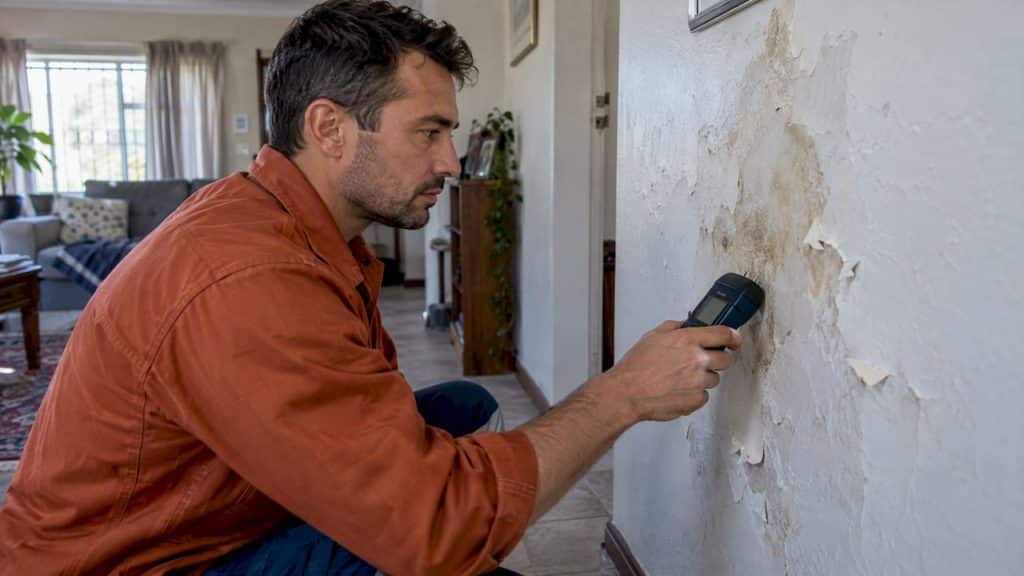
Paint peels because water, or the salts it carries, is pushing the film off the wall from behind. In most cases the paint is the symptom, not the cause. If a wall keeps blistering, flaking or lifting in sheets, the reliable answer is to find where the moisture comes from and stop it before anyone picks up a brush.
This guide explains what is happening inside the wall, how to tell the main types of damp apart, what to check yourself, and when it is time to call a waterproofing specialist.
TL;DR
- Moisture moving through a wall breaks the bond between paint and plaster, and dissolved salts crystallise under the paint and push it off.
- The pattern tells you the cause: low and tide-marked suggests rising damp, wind-side and patchy suggests penetrating damp, and cold corners and window areas suggest condensation.
- Repainting over a damp wall fails. Walls should be properly dry before painting, and the source of the water has to be stopped first.
- On older buildings, peeling paint can contain lead. Never dry-sand or dry-scrape it.
Table of Contents
- What is happening behind the paint
- Is the wall really supposed to stay dry?
- Four causes, four patterns
- A ten-minute check you can do before calling anyone
- Why you cannot just paint over it
- Peeling paint and lead: a warning for older homes
- What the repair looks like
- Our perspective
- Get the cause found, not just covered
- FAQ
- Sources
What is happening behind the paint
Paint is a thin protective film. It only holds if it stays stuck to a sound, dry surface. Water attacks that grip in three ways.
- Pressure from vapour. Moisture travelling through the wall evaporates at the surface. If the paint is in the way, the vapour pushes against it and forms blisters.
- Salt crystals. Water moving through brick, block or plaster dissolves salts and carries them outwards. When the water evaporates, the salts crystallise. That growth physically lifts the film. South Africa’s national standard on the waterproofing of buildings treats this white, powdery deposit, efflorescence, as a sign that moisture is moving through the wall, not as a paint defect.
- Loss of adhesion. A wall that is repeatedly wetted and dried swells and shrinks slightly. The paint cannot follow, so it cracks and lets in more water.
That is why scraping and repainting a damp patch usually gives you a few good months and then the same peeling again. Researchers at the CSIR make the same point: owners often put cosmetic fixes ahead of structural ones, and the new paint is ruined by the same moisture shortly after.
Is the wall really supposed to stay dry?
Yes. A building’s first job is keeping the weather out. Agrément South Africa’s performance criterion expects that no dampness should be visible on the internal face of external walls in normal weather. So a damp, peeling patch on an inside wall is not something to live with. It means part of the building’s moisture protection is not working.
The same document links moisture ingress to mould and mildew, which can reduce indoor air quality. Medical opinion on exactly how much harm follows varies, but the building requirement is clear.
Four causes, four patterns
The look and location of the peeling is your best clue. Use this table as a starting point, not a final diagnosis.
| Cause | Where it shows | What you see | Typical trigger |
|---|---|---|---|
| Rising damp | Lower wall, usually up to about a metre | Tide-line marks, white salt, blistered paint, crumbling plaster at skirting level | Missing or bridged damp-proof course, soil piled against the wall |
| Penetrating damp | Wind-facing walls, below windows, under gutters, around roof junctions | Patchy stains that darken after rain, peeling that follows the weather | Cracked plaster or paint, failed sealant, leaking gutters or flashing |
| Condensation | Cold corners, window reveals, behind furniture, bathrooms | Black mould specks, peeling in damp-prone corners, wet window sills | Poor ventilation, cold surfaces, steam |
| Plumbing or roof leak | Under or near the pipe, ceiling, or roof edge | Staining that spreads from one point, bubbles in ceilings | Leaking pipe, failed roof sheeting or flat-roof membrane |
Rising damp
Rising damp is groundwater drawn up through the masonry by capillary action, often because the damp-proof course is missing, damaged or bridged. Our guide on why walls get damp in South African homes explains the mechanism in more detail. The signature is a horizontal band of damage at low level with white salts above the skirting.

Penetrating damp
Penetrating damp is linked to the direction of wind and driving rain. Water gets through cracked or perforated cladding, paint or plaster. The wall also loses insulation value when wet, so rooms feel colder. On the exterior, moisture behind the paint film often traces back to failed sealant, roof or wall leaks, or ground that sits too close to the wall base. Coastal solid facebrick walls are especially prone to rain penetration, which is why Agrément’s technical supplement points owners to the manufacturers’ technical staff rather than a generic coating.
Condensation
In the wetter Western Cape winters, closed windows and high indoor humidity push moisture onto cold walls. The same Agrément supplement describes condensation as a widespread problem in the Southern Coastal Condensation Problem Area because of wet winters and shut windows. Condensation tends to cause surface mould and peeling in corners rather than a rising tide line.
Leaks
A burst or weeping pipe, a blocked gutter or a failing flat roof can wet one section of wall continuously. The peeling here starts at the leak and spreads outward, and it does not follow the weather pattern.
A ten-minute check you can do before calling anyone
This will not replace a professional assessment, but it helps you describe the problem accurately.
- Map the damage. Photograph it and note the height above the floor. Low and horizontal points to rising damp. High up or under a window points to penetration or a leak.
- Note the timing. Does it worsen after rain, or in winter mornings, or stay constant? Rain-linked suggests penetration. Winter and mornings suggest condensation.
- Look outside. Check cracked render, blocked or leaking gutters, failed sealant around windows, soil or paving above the damp-proof course line, and garden beds or taps against the wall.
- Check the white powder. Dry, brushable salts mean water is moving through the wall and evaporating. Wipe it off and watch whether it returns.
- Rule out plumbing. Look for a wet patch near pipes, a water meter that moves when everything is off, or stains below bathrooms and kitchens.
- Check the smell. A musty smell with dark spotting suggests long-term moisture and likely mould.
If mould is spreading, this article on mildew and mould and what causes them is a useful general read, though its advice comes from Canadian health guidance and its cleaning examples are for tile grout rather than damp walls. Large areas of mould on walls need the moisture source dealt with, not just cleaning.
Why you cannot just paint over it
There are two separate problems with painting over moisture.
The wall is too wet to hold paint. Specifications used on South African projects set a numeric limit. The CSIR’s architectural specification requires wall moisture measured with a hygrometer at 8% or less on the BD2 scale before primer goes on, and a public tender specification for a government building asks for moisture content not above 12% on painted surfaces. A wall that looks dry can still be above those limits. Contractors use a moisture meter, not their eyes.
A waterproof coating can make it worse. The CSIR’s research notes that sealing a wall that is already damp, especially behind panelling or in an enclosed space, can trap the water and push it higher up the wall. Choosing the wrong system can trap moisture instead of letting the wall breathe, which is the reason the Agrément guidance above recommends getting manufacturer technical advice for the specific wall type.
So the order matters:
- Find and stop the source of water.
- Let the wall dry out fully.
- Remove loose paint and contaminated plaster.
- Repair, prime and use a system suited to the wall.
- Only then repaint.
A government tender document for moisture repairs at a provincial office shows the same sequence in practice: a moisture assessment with meters and diagnostic tools comes before treatment and repainting.
Peeling paint and lead: a warning for older homes
If your house was painted before lead was phased out of paint, peeling coats may contain it. The South African Medical Research Council’s fact sheet explains that lead was added to enamel paints to fix pigment and speed up drying, and that peeling or disturbed old paint creates toxic dust. The fact sheet advises against dry-sanders, heat guns and dry scraping, and recommends wet cleaning methods such as wet-mopping with detergent. Test old paint before renovating, keep children and pregnant women away from the work area, and if you suspect lead ask a qualified occupational hygienist or your local health authority how to test.
This matters because the instinctive response to peeling paint is to scrape it. On an old house, wet methods and testing come first.

What the repair looks like
The fix depends on the cause.
- Rising damp: a professional assessment, a new or repaired damp-proof barrier where appropriate, lowering ground levels or fixing drainage, and breathable replastering. See our guide to damp proofing walls and these practical damp proofing tips.
- Penetrating damp: repair cracks, reseal joints, fix gutters and flashings, then apply a suitable exterior system. Our article on diagnosing moisture and then waterproofing exterior walls covers the sequence.
- Condensation: better ventilation, extraction in kitchens and bathrooms, and some heating or insulation of cold surfaces. Interior treatments are covered in waterproofing interior walls.
- Below-ground walls: basements and retaining walls need a different approach, from interior basement wall sealers to external membranes. Compare options in our piece on waterproofing methods for South African properties.
Once the wall is dry and sound, you can focus on finish. If the damp was on a garden or boundary wall, this overview of exterior paint colour ideas for 2026 may help with choosing a finish, although it is aimed at fences rather than masonry, so check the product suits your surface.
Our perspective
We see the same pattern again and again: an owner repaints twice, sometimes three times, and the peeling comes back each time because nobody asked where the water came from. Paint is the cheapest part of the job and the easiest to blame.
Our view is simple. Diagnose first, then treat, then paint. A good contractor will want to look at the outside of the building, the drainage, the roof and the ground levels, not only the damp patch you point to. They should explain what they found, which system they propose and why, what warranty stands behind it, and whether they are qualified and experienced for your type of building. Those are the questions we encourage every property owner to ask before signing anything, whether it is a house in Gauteng or a commercial building in the Western Cape.
Be wary of anyone who offers a quick fix of a coat of waterproof paint over a wet wall without a moisture reading. It might look good for one season. It can also hide a problem that gets more expensive each year.
— Eben
Get the cause found, not just covered
If you have peeling paint on a house, a commercial unit or an industrial building, Pro Waterproofing can connect you with waterproofing professionals who deal with roofs, walls, basements, foundations, bathrooms and concrete decks. Send a quote request describing what you see, where it is and when it gets worse, and photos if you have them. That detail helps the right specialist assess the problem faster.
FAQ
Does peeling paint always mean damp?
No. Poor surface preparation, painting over dust or grease, applying the wrong paint type or painting in very hot conditions can also cause peeling. But when it appears near the ground, around windows, under roofs or alongside salts, stains or mould, moisture is the likely cause and worth investigating.
Why is my paint peeling off due to moisture?
Water or vapour moving through the wall pushes against the paint from behind, and dissolved salts crystallise beneath it. Both break the bond between paint and plaster. The paint then blisters, cracks and lifts in flakes or sheets.
How do I fix peeling paint caused by moisture?
Find and stop the water source first, whether it is a leak, a failed damp-proof course, cracked render or poor ventilation. Let the wall dry fully, ideally confirmed with a moisture meter, then remove loose material, repair the plaster and apply a suitable system. On old paint, test for lead and avoid dry sanding.
Can I just use waterproof paint over damp walls?
Usually not. Coatings applied over a wall that is still wet can trap moisture and make the damage worse. A specialist should check moisture levels and choose a system suited to your wall type and the cause of the damp.
Should I call a professional?
Call one if the peeling is recurring, covers a large area, comes with mould or musty smells, follows a tide-line, or you cannot find the source. Early assessment is usually cheaper than repeated repainting.
Sources
- SANS 10021: The waterproofing of buildings (archive copy)
- CSIR ResearchSpace: sources of damp
- Agrément South Africa: performance criterion, water penetration and damp-proofing
- Agrément South Africa: technical supplement
- CSIR architectural project specification, Annexure E
- Legal Aid building architectural specifications (eTenders)
- NLC East London moisture repairs RFQ (eTenders)
- SAMRC fact sheet: reduce your family’s risk of lead exposure from paint