
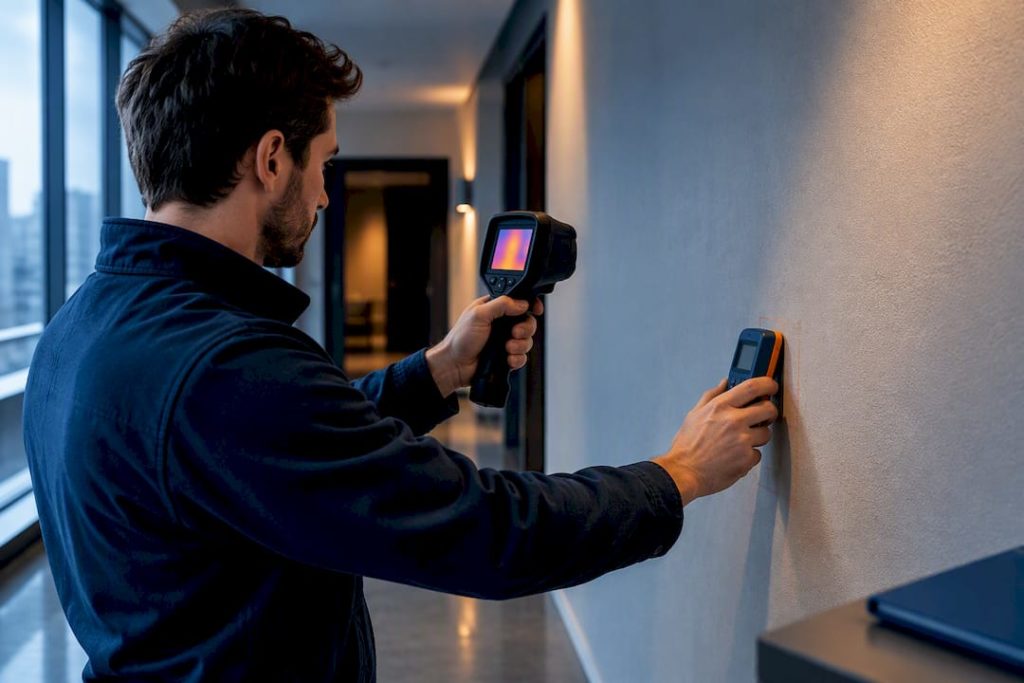
A building moisture audit is a whole-building survey that maps retained moisture, diagnoses the ingress mechanism and produces a prioritised repair schedule. It combines visual inspection, thermal imaging and moisture meter verification to identify exactly where water is entering a structure and how severe the damage is. Owners, property managers, insurers and asset managers commission audits to make repair decisions with evidence, rather than guesswork, behind them.
TL;DR:
- A comprehensive moisture audit covers the entire building envelope and prioritizes findings based on severity using calibrated instruments and verified methods.
- High-risk zones include roof penetrations, external facades, basements, wet areas, attics, and floor transitions, which are most likely to develop moisture problems.
- Thermal imaging must be followed by moisture meter verification to accurately identify active moisture, especially when scheduled during optimal temperature conditions.
- The final report should include mapped moisture extents, photographic evidence, a clear diagnosis, and a prioritized repair list with cost estimates for effective decision-making.
- Cost and duration vary with building size and complexity; a full audit typically costs less than repairs resulting from reactive, guesswork-based maintenance.
Table of Contents
- What does a building moisture audit involve?
- Why moisture audits protect your building and your budget
- Where inspectors look first: the high-risk zones
- How the audit process actually works
- What do the readings actually tell you?
- What a proper audit report contains
- What does an audit cost and how long does it take?
- Prowaterproofing’s take on commissioning an audit
- The gap between a good audit and a good-looking one
- Book a site survey with Prowaterproofing
- Sources
- FAQ
What does a building moisture audit involve?
A moisture audit differs from a quick call-out inspection in one important way: scope. A complaint-led visit responds to a single leak or a damp patch someone has already spotted. A full audit surveys the entire building envelope, roof to foundation, whether or not any problem has been reported yet.
The objectives are consistent across most audits:
- Locate every area of retained moisture, not just the obvious ones
- Diagnose the mechanism causing it (rising damp, condensation, roof penetration, plumbing failure)
- Scope the remedial works needed and estimate priority order
- Provide documented evidence for insurance claims or contractor tenders
Who should carry one out? Look for inspectors with recognised building diagnostics training and access to calibrated instruments, not just a moisture meter bought online. Membership of a relevant trade or professional body, and a track record of producing report-ready findings rather than a verbal opinion, separates a competent surveyor from someone doing a cursory walk-through. If a contractor cannot describe their verification process before you book them, that is worth noting before you sign anything.
Why moisture audits protect your building and your budget
Hidden moisture rarely announces itself until the damage is structural. Timber rots, steel corrodes, plaster delaminates, and by the time a stain appears on a ceiling, the moisture behind it may have been active for months. Left unchecked, these failures compound: a small roof penetration becomes a rafter replacement; a damp basement wall becomes a slab that needs underpinning.
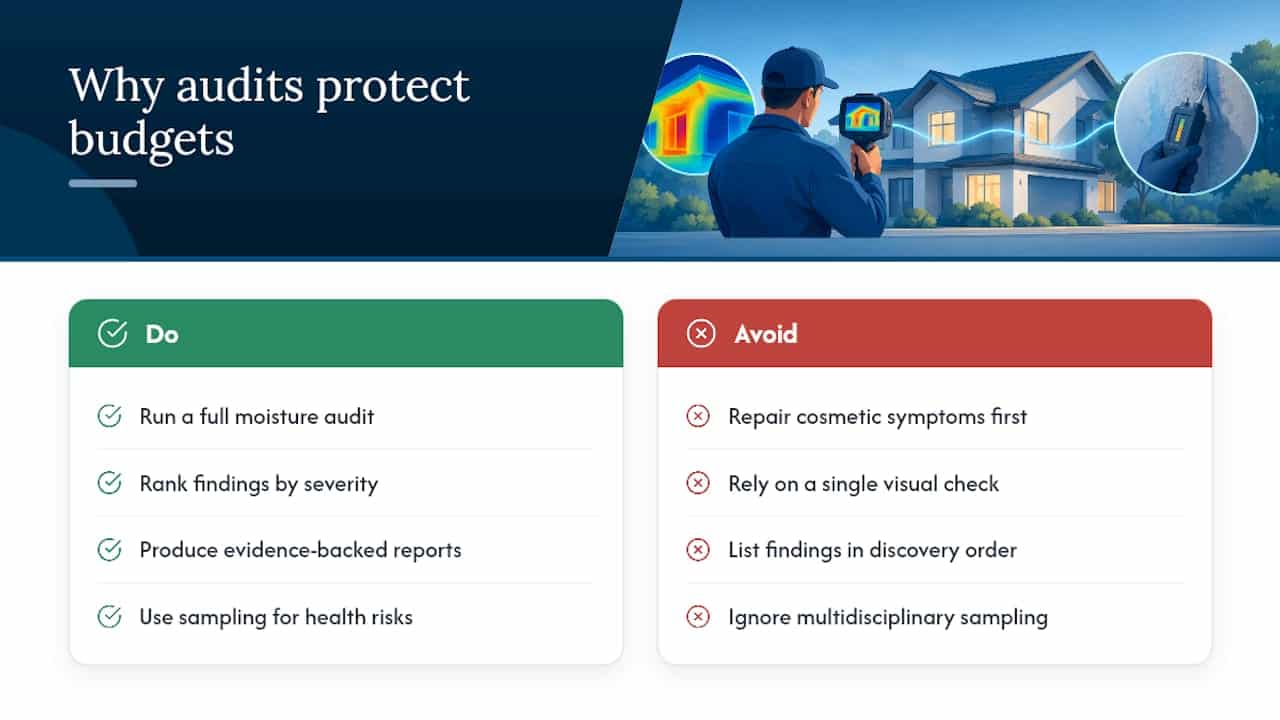
There’s a health dimension too. Investigations into occupational mould exposure show that linking symptoms to a specific moisture source is genuinely difficult and often needs multidisciplinary sampling rather than a single visual check. That complexity is exactly why an audit that produces a prioritised, evidence-backed report earns its cost quickly: it stops owners spending money reactively on cosmetic fixes while the actual source of moisture keeps working away behind the wall.
Pro Tip: A moisture audit report that ranks findings by severity, rather than listing them in the order they were found, is the difference between a maintenance budget that works and one that gets drained on the wrong repairs first.
Where inspectors look first: the high-risk zones
Not every square metre of a building carries equal risk. Experienced inspectors work through a consistent set of zones because these are where moisture problems originate most often, a pattern borne out in guidance on monitoring risk areas during construction and maintenance.
- Roof coverings, gutters, flashings and penetrations — the single most common entry point, especially around pipe penetrations and parapet flashings.
- External façades and cavity interfaces — cracked render, failed sealant joints and cavity wall bridging.
- Basements and the ground interface — rising damp, poor damp-proof course continuity, and hydrostatic pressure against below-grade walls.
- Wet rooms, service risers and plumbing routes — bathrooms, kitchens, and the vertical ducts carrying pipework between floors.
- Attics, insulation and HVAC plantrooms — condensation on cold surfaces and leaking condensate drains.
- Floor screeds, thresholds and transitions — junctions where different materials meet are where waterproofing membranes most often fail first.
Pro Tip: If an inspection report only covers the area where you reported a problem, ask what else was checked. A genuine audit walks every one of these zones, even the ones nobody complained about yet.
How the audit process actually works
The workflow follows a logical sequence, and skipping steps is where misdiagnosis creeps in. It starts with a visual survey and photographic record, the baseline against which every later reading gets compared.
Thermal (infrared) imaging comes next, scanning surfaces for temperature anomalies that can indicate retained moisture. Timing matters here: thermography needs an adequate temperature differential between inside and outside to work reliably, which is why surveys are often scheduled for early morning or specific seasonal windows. A cold patch on a thermal camera is a lead, not a diagnosis.
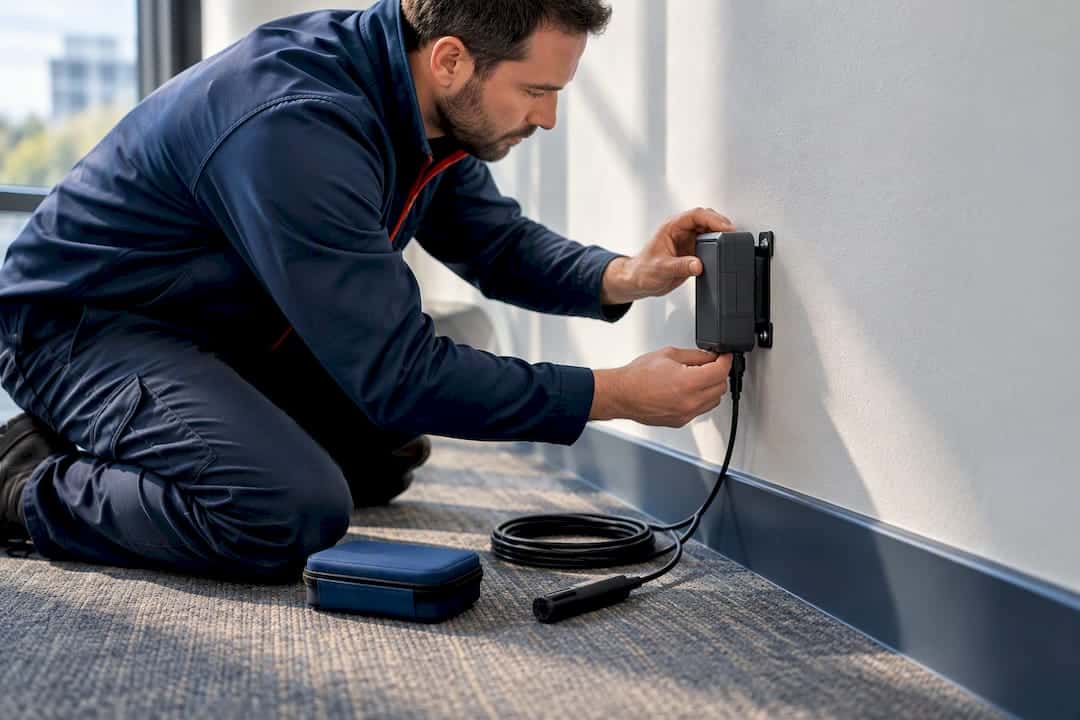
That’s exactly why the next step exists. Thermal anomalies must be verified with moisture meters or probes, because thermal imaging alone produces false positives from things like missing insulation or thermal bridging that have nothing to do with water. Non-invasive RF meters and pin meters do that verification job, alongside relative humidity probes for concrete, which measure equilibrium RH rather than surface dampness.
- Visual survey and photographic documentation
- Thermal imaging to flag candidate anomalies
- Non-invasive and pin meter readings to confirm moisture presence
- RH probes for concrete and data loggers for intermittent problems
- Sample analysis and salt testing where contamination is suspected
Multi-mode instruments have made this faster. A 4-in-1 system like the Protimeter MMS3 combines pin, non-invasive, hygrometry and surface temperature readings in one tool, which speeds up a full building survey considerably. Tramex meters serve a similar role as a category and are common on roof and flat-roof surveys specifically.
Pro Tip: Ask whether the surveyor’s workflow moves thermography to meter to probe, in that order. If they stop after the thermal scan, you have a heat map, not a diagnosis.
For intermittent problems, such as leaks that only appear after heavy rain, data loggers left in place for days or weeks catch what a single site visit will miss entirely.
What do the readings actually tell you?
Moisture meter output comes in two different currencies, and confusing them causes real problems. Relative, non-invasive readings give a comparative scale, useful for spotting where moisture is elevated relative to a dry reference area. Pin meters and lab analysis, by contrast, give moisture content by weight, a more precise figure used when a decision hinges on the exact number.
That distinction matters most before waterproofing work begins. Technical procurement specifications routinely set a maximum substrate moisture content by weight before a membrane can be applied, because coating over a substrate that is still too wet causes delamination within months.
- A thermal anomaly confirmed by an elevated meter reading points to active or retained moisture
- A thermal anomaly with a normal meter reading is more likely thermal bridging or an insulation gap
- Salt staining alongside elevated readings suggests rising damp or historic saturation
- Cold surfaces with high humidity but low material moisture point towards condensation, not ingress
An insight from thermal imaging practice worth remembering: a thermal hotspot is a starting point for investigation, never proof of a leak on its own. When combined readings show high moisture content plus visible material damage, that warrants immediate repair. Elevated but stable readings with no visible deterioration often just need monitoring over a few weeks before deciding whether to act.
What a proper audit report contains
A report is only as useful as its structure. Guidance on inspection deliverables consistently stresses clear documentation and photographic evidence as the baseline expectation, not an optional extra.
A report worth paying for should include:
- An executive summary stating the overall condition and top priorities
- Moisture extents mapped onto floor plans or elevations, not just described in text
- Photographic evidence for every flagged area
- Instrument logs with timestamps and calibration notes
- A clear diagnosis of the moisture mechanism for each finding
- A repair priority ranking with rough cost brackets
Property managers particularly value reports that link each finding to a recommended repair order and budget bracket, because it lets maintenance teams fund the highest-consequence defects first rather than whichever repair got requested loudest. That prioritised structure is also what tender documents and insurance claims need to move forward without further back and forth.
What does an audit cost and how long does it take?
Price depends on a handful of variables: building size and complexity, how accessible roofs and basements are, how much instrumentation the job needs, and whether ongoing monitoring or lab testing gets added.
- A single-storey house survey can often be completed in a day
- Commercial or multi-unit buildings may need several days on site
- Cases needing data-logger monitoring for intermittent leaks can extend to several weeks
- Lab-based salt or contamination testing adds turnaround time beyond the site visit itself
The upfront cost of a thorough audit is usually smaller than the cost of guessing wrong. A prioritised report stops owners paying to strip and re-tile a bathroom when the actual source was a flashing failure two floors up.
Prowaterproofing’s take on commissioning an audit
A whole-envelope survey is recommended over a spot-check every time, because moisture rarely stays confined to where it was first noticed. Verification matters just as much as the survey itself: thermal findings checked against meter readings, with a prioritised, budgeted repair list at the end.
Before hiring anyone, ask for a sample report, proof of instrument calibration, references from similar buildings, and clear warranty terms. A contractor who cannot produce a sample report before the job starts is unlikely to produce a useful one afterwards.
The gap between a good audit and a good-looking one
Plenty of moisture reports look thorough without being useful. A stack of thermal images with red and blue patches feels convincing, but if nobody followed up with a meter to confirm what those patches actually are, the report is a heat map wearing a diagnosis costume. That’s the single biggest weakness in the way many audits get sold: the impressive-looking tool becomes the deliverable, instead of the verified finding.
The conventional advice tells owners to “get a thermal scan.” That’s incomplete advice. A thermal scan without meter verification and, where needed, a moisture-content sample tells you where to look, not what you’re looking at. The audits worth paying for treat thermography as step one of three, never the whole answer.
If there’s one thing to prioritise when commissioning an audit, it’s asking to see the verification sequence before booking, not after receiving the invoice. A surveyor who can describe exactly how they move from thermal anomaly to confirmed diagnosis is worth more than one with the newest camera.
— Eben
Book a site survey with Prowaterproofing
Prowaterproofing is the alternative to guessing at a moisture problem and paying twice for the wrong repair. Where a generic contractor might patch the symptom, a site survey maps the actual extent of the issue and hands you a prioritised scope before any work begins.
When you request a survey, expect a site visit, a sample report showing how findings are documented, a recommended scope of remedial work, and warranty options for whatever repairs follow. Prowaterproofing’s waterproofing services cover residential, commercial and industrial properties, and every enquiry starts with the same questions this article recommends you ask: qualifications, calibration checks, and a clear report format. If you’ve spotted a damp patch, a musty smell, or you simply want peace of mind before a sale or renovation, request a site survey or quote through a waterproofing contact form and get a scoped answer instead of a guess.
Sources
For roof waterproofing compliance, see SANS 10400 Part L. For inspection method and reporting practice, Prowaterproofing’s waterproofing inspection checklist and this due diligence documentation guide are useful companions.
- Moisture infrared surveys | Enisave Solutions
FAQ
Do surveyors check every wall for damp?
A proper whole-building audit checks every high-risk zone, not just the walls that look suspect, including roofs, basements, wet rooms and floor transitions. A complaint-led inspection, by contrast, may only assess the specific area a client reported.
What is considered a high moisture reading under a house?
There’s no single universal number, because non-invasive meters give relative readings while pin meters and lab tests measure moisture content by weight. What matters is comparing the reading against a dry reference area on the same building and against the substrate moisture limits required before any waterproofing work proceeds.
How much does a moisture tester cost?
Handheld pin or non-invasive meters vary widely by brand and features, while multi-mode systems like the Protimeter MMS3 sit at the higher end because they combine four measurement modes in one unit. Most property owners hire a qualified surveyor with calibrated equipment rather than buying instruments outright; Prowaterproofing’s pricing for a site survey is available on request through its contact form.
Do home inspectors check for moisture in walls?
Standard home inspections often include a basic moisture check, but it’s rarely as thorough as a dedicated audit that maps extents across the whole envelope. If moisture is a specific concern, ask whether the inspector uses thermal imaging followed by meter verification, or whether they are commissioning a specialist for that part of the survey.