
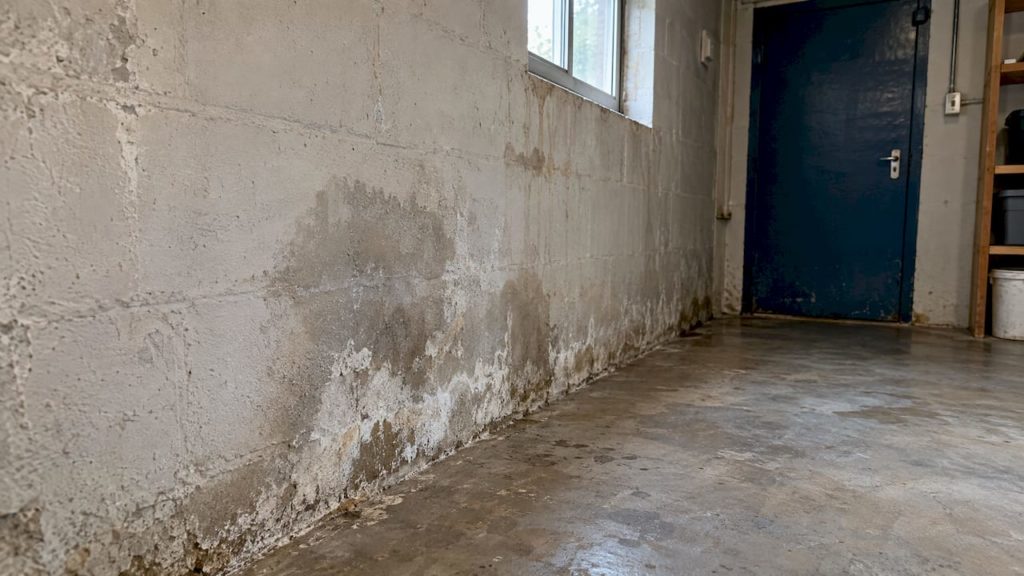
Basement moisture is water, in liquid or vapour form, getting into a below-ground space and staying there. In Gauteng, clay soils make that more likely in two ways. Clay can drain slowly and hold water against your walls, and some clays swell and shrink with the seasons and move the structure with them. The fix depends on which of these is happening, so the first job is to find the cause, not to buy a product. A contractor who can explain the cause and put a warranty on the work is the right person to start with.
This guide is for homeowners, building managers and owners of commercial or industrial property in Gauteng and the Western Cape who want to understand what they are looking at before they ask for quotes.
TL;DR
- Basement moisture can come from groundwater, rain, humid air, plumbing or poor drainage. Visible damp alone does not prove the soil is the cause.
- Clay can hold water near below-ground walls, and South Africa’s waterproofing standard, SANS 10021:2012, treats slow-draining clay as a design condition.
- Expansive clay swells when wet and shrinks when dry. Research names Gauteng among the provinces with these formations, and uneven movement can crack walls and floors.
- Condensation and leaks look alike but have different fixes. Work out which you have first.
- Ask for a site investigation, a stated cause and a written warranty before you sign anything.
Table of Contents
- What basement moisture actually is
- How moisture gets into a below-ground space
- Why clay soil matters in Gauteng
- Signs of basement moisture, and how to tell a leak from condensation
- What persistent moisture does to a building
- Find the cause before you choose a fix
- Solutions follow the cause
- What to ask before you hire a contractor
- Getting a quote from a vetted contractor
- Our view on clay and basements
- FAQ
- Sources
What basement moisture actually is
People use “damp basement” for several different problems. University of Minnesota Extension explains that moisture can come from rain or groundwater, from sources inside the building, or from humid outdoor air condensing on cool surfaces. It can show up as standing water, damp air, condensation, odour, mould, stains, white salt deposits (efflorescence) or finishes that peel and deteriorate.
The National Research Council Canada’s Construction Technology Update 69 lists the same range of causes: leakage, water or vapour moving from the soil, sump-pump failure, sewer backup, indoor humidity and plumbing leaks. These guides come from colder climates, but the physics of water moving through soil and masonry is the same in Johannesburg or Pretoria.
So “basement moisture” is not one fault. It is a symptom, and the same damp patch can have a dozen different origins.
How moisture gets into a below-ground space
University of Minnesota Extension describes four pathways from outdoors to indoors. Knowing them helps you read what a contractor tells you.
- Liquid water flow. Water collects outside the wall or floor and runs through a crack, a joint or a poorly sealed pipe penetration.
- Capillary suction. Water is drawn upwards and inwards through the tiny pores in concrete, brick and mortar, much as a paper towel draws up a spill.
- Vapour diffusion. Moisture in the soil passes through the wall as vapour, driven by the difference in moisture between the ground and the room.
- Air movement. Humid air is carried in through gaps and then condenses on cooler surfaces.
The point that surprises many owners comes from Lawrence Berkeley National Laboratory’s building-dampness guidance. Soil moisture can enter through basement walls or floors via cracks, pores, gravity, capillary action, or diffusion through concrete and concrete block. A wall with no visible crack is not automatically a dry wall.
Why clay soil matters in Gauteng
Clay does two things that sand and gravel do not, and they are separate problems.
Slow drainage keeps water against the wall
Clay particles are very fine, so water moves through them slowly. After heavy rain, water can sit in the soil around a below-ground wall for longer than it would in a free-draining soil. SANS 10021:2012, the South African national standard for waterproofing below-ground structures, addresses this directly. Where groundwater is normally high, can rise, or drains slowly on impervious clay, the horizontal waterproof membrane should sit above the maximum likely water level unless effective tanking is provided.
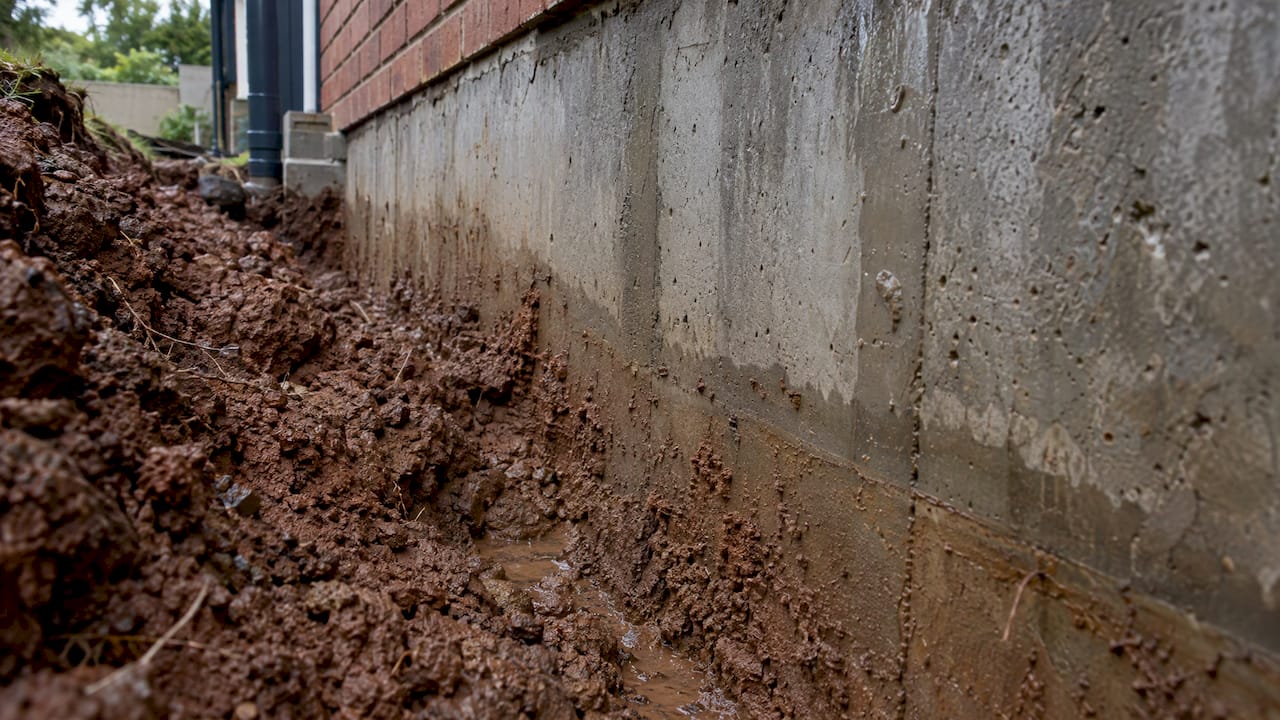
Tanking means waterproofing the below-ground structure as a continuous barrier. The standard’s wording tells you that slow-draining clay is a recognised design condition, not an exotic one.
Expansive clay moves, and takes the structure with it
Some clays change volume as their moisture content changes. The reference chapter Expansive soils, hosted by the Natural Environment Research Council, defines them as soils that shrink or swell as moisture changes. Wetting can cause heave, and prolonged drying can cause shrinkage and differential settlement. Differential means one part of a building settles more than another, and that uneven movement is more damaging than uniform movement.
A peer-reviewed 2024 South African conference paper reports that expansive clays in South Africa swell in wet seasons and shrink in dry seasons. It identifies Gauteng among the provinces with relevant expansive geological formations. The paper stresses that solutions must respond to local soil and building conditions rather than rely on one generic assumption.
That last point matters for you. Not every Gauteng property sits on expansive clay, and the risk varies from one site to the next. Your own ground has to be investigated, not guessed at from the postcode.
How the two problems link to moisture
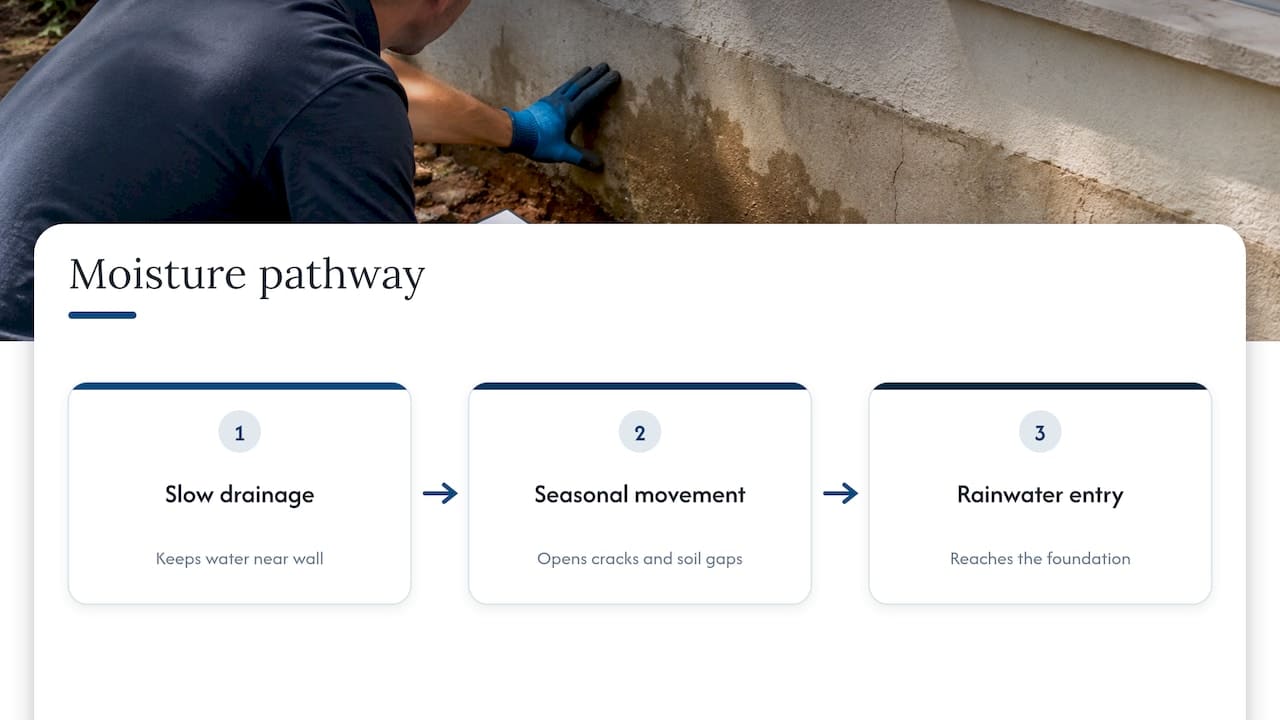
The two effects feed each other. Slow-draining ground keeps water near the wall, and seasonal movement can open cracks and joints that let that water in. Dry-season shrinkage can also leave a gap between soil and wall, which the next downpour will fill with water that has a direct route to the foundation. Trees close to the building add to this: the NERC reference notes that roots can disturb soil physically or remove water from it, which leads to settlement.
Signs of basement moisture, and how to tell a leak from condensation
The Canada Mortgage and Housing Corporation’s guide, Moisture and Air, lists the usual signs: wet or damp walls and floors, white powdery stains, stained carpet, a stuffy damp smell, mould, and condensation on windows or pipes. It also explains that condensation forms when warm, moist air meets a cold surface.
That gives you a practical way to separate the two main cases.
| What you see | More likely cause | Why |
|---|---|---|
| Damp patch low on a wall, worse after rain | Groundwater or surface water entering | Moisture tracks the wet weather and the ground outside |
| Droplets on cold pipes, windows or the inside face of an outer wall | Condensation | Warm, humid indoor air is meeting a cold surface |
| White powder on masonry | Water moving through the wall and leaving salts behind | Efflorescence is a deposit left as the water evaporates |
| Damp that continues in dry weather | Plumbing leak or high humidity | The source is not tied to rain |
| Cracks, sticking doors, uneven floors plus damp | Ground movement and water entry together | Shrink-swell movement can open paths for water |
A simple observation helps: note when the damp appears. If it follows rain by hours or days, think about water outside the wall. If it follows cooking, drying laundry indoors or cold mornings, think about condensation and ventilation. If it never changes, think about a leaking pipe.
The CMHC guide also shows why you should not jump to a conclusion about the soil. Water leaks through wall or floor cracks, high water tables, grading that slopes towards the house, blocked footing drains and malfunctioning sump pumps are all listed as possible causes, alongside indoor humidity and plumbing. Visible dampness alone does not establish a clay-soil cause.
What persistent moisture does to a building
Left alone, moisture does more than spoil the look of a room. Lawrence Berkeley National Laboratory notes that persistent dampness can damage building materials or lead to visible mould growth, and that dampness and mould can be visible in basements or hidden inside walls and building systems. Hidden damage is the expensive kind, because you find it late.
Where expansive clay is involved, the 2024 South African paper says heave can cause visible cracks, jammed doors, damaged floors and compromised structural integrity. The NERC reference adds that uneven shrink-swell movement can damage structures.
For a commercial or industrial owner, the practical consequences are stock and equipment stored below ground, damaged finishes and floor slabs, and a space you cannot let or use as planned. For a homeowner, they are a basement that cannot be used for living or storage, and a defect you may have to deal with when you sell. Property investors should treat a damp basement as something to understand before purchase, not after.
Find the cause before you choose a fix
The University of Minnesota Extension advises identifying the source and the entry mechanism before choosing a correction, instead of treating every damp basement as the same problem. SANS 10021:2012 goes further for below-ground work: a thorough site investigation should come before design, including testing water samples for sulfides and other aggressive chemicals.
Here is a sensible order of work.
- Record the pattern. Note where the damp is, when it appears, and whether it follows rain, season or household activity. Photograph it with dates.
- Check the obvious external factors. Look at where downpipes discharge, whether the ground slopes towards the building, and whether paving or soil has built up against the wall. The National Research Council Canada says surface water directed away from the building and adequate perimeter drainage can help prevent leakage where water accumulates next to a crack or defect.
- Rule out plumbing and humidity. A leaking pipe or an unventilated, humid room produces damp that no waterproofing will cure.
- Look for movement. Diagonal cracks, doors that have started to stick and floors that have shifted point to ground movement as well as moisture. This needs professional assessment.
- Get a site investigation. A qualified waterproofing contractor should inspect the structure, the surrounding ground and the drainage, and tell you in plain terms what they found and why.
- Match the solution to the cause. Only then compare quotes.
Steps 4 and 5 are where owners most often go wrong. A damp patch painted over with a sealant treats the symptom. If the cause is water pressure or ground movement, the sealant will fail.
Solutions follow the cause
SANS 10021:2012 points to controlling surface water and downpipe discharge away from the basement, providing appropriate land or French drains, and selecting a correctly designed membrane, water-resistant construction, or drained cavity-and-sump system according to site conditions and water pressure. A French drain is a perforated pipe in a gravel-filled trench that collects water and carries it away.
| Cause | Typical direction of solution |
|---|---|
| Surface water and poor grading | Re-grade the ground, redirect downpipes, improve paving falls |
| Slow-draining clay holding water at the wall | Perimeter drainage such as French drains, plus a membrane or tanking designed for the water level |
| Persistent high water or water pressure | Tanking, water-resistant construction or a drained cavity with a sump |
| Cracks and joints | Crack and joint repair, then a suitable waterproofing system |
| Condensation | Ventilation and humidity control, not waterproofing |
| Ground movement | Structural assessment before any waterproofing is specified |
We cover the main systems in more detail in our guides to basement waterproofing methods in South Africa, below-grade waterproofing and basement water drainage systems. If water is already coming in, our wet basement solutions guide is the place to start.
What to ask before you hire a contractor
Basement waterproofing on clay is not a job to hand to the cheapest bidder. The right questions are about quality, experience, licensing and warranties:
- Quality: What do you think is causing the moisture, and what did you inspect to reach that view?
- Experience: Have you worked on below-ground structures in clay or expansive soils, and in this area?
- Licensing: Are you properly registered, and can you show it?
- Warranty: What does the written warranty cover, for how long, and what does it require of me?
- Scope: Does the quote deal with the cause (drainage, water pressure, movement), or only the visible damp?
A contractor who answers the first question with a clear diagnosis is working the way the standards describe. One who quotes a product before looking at the site is not.
Getting a quote from a vetted contractor
We connect property owners and managers in South Africa with vetted waterproofing professionals who handle roof, basement, bathroom, foundation and concrete deck waterproofing for residential, commercial and industrial properties. If you have a damp basement and want a contractor to assess it, you can request a quote through Pro Waterproofing. Tell us where the damp appears, when it appears and what kind of property it is, so the conversation starts from your observations.

Our view on clay and basements
Most of the damp basements we hear about are described as “a leak”. Once you ask a few questions, the picture is rarely that simple. In clay country the water often has nowhere to go, so it waits at the wall until it finds a way in. Sometimes it is also the ground itself moving through the seasons.
That is why we put the diagnosis first. A property owner who understands whether the issue is groundwater, drainage, condensation or movement can judge any quote properly. It is also why our focus is on the questions that separate a reliable contractor from a hopeful one: quality of work, experience, licensing and warranties.
If you own or manage a property in Gauteng or the Western Cape, our advice is to have the cause identified by a qualified professional and to ask for a written warranty on the work. We exist to put you in front of vetted contractors who work that way.
Eben
FAQ
What is basement moisture in clay soil?
It is water or water vapour entering or collecting in a below-ground space where the surrounding ground is clay. Clay can drain slowly and keep water near the wall, and some clays swell and shrink with moisture. Both can contribute, though other causes such as plumbing or condensation can look identical.
Is all clay soil in Gauteng expansive?
No. A 2024 South African paper identifies Gauteng among the provinces with expansive geological formations, but the risk depends on the site. Soil conditions can differ from one plot to the next, so your property needs its own investigation.
Can a basement be damp if the walls have no cracks?
Yes. Lawrence Berkeley National Laboratory explains that moisture can pass through uncracked concrete and concrete block by capillary action and diffusion. This is why a visual check of the wall is not enough to rule out moisture.
How do I know if it is condensation or water coming through the wall?
Condensation forms when warm, moist air meets a cold surface, so it tends to appear on pipes, windows and cold outer walls and follows daily routines. Water ingress tends to follow rain and appear low on walls or at the floor edge. If you are unsure, a contractor’s site inspection will tell you which you have.
Should I waterproof first or fix the drainage first?
The standard and the building-science guidance both point to finding the source first. If surface water or downpipes are the cause, redirecting them may solve much of the problem. Where water pressure or slow-draining clay is the cause, drainage and a correctly designed membrane work together, and a qualified contractor can specify both.
Sources
- Moisture in basements: causes and solutions, University of Minnesota Extension
- Construction Technology Update Number 69, National Research Council Canada
- Nature and Causes of Building Dampness, Lawrence Berkeley National Laboratory
- SANS 10021:2012, The waterproofing of buildings
- Investigation into an adopted design procedure for raft foundations, ISSMGE 2024
- Expansive soils, Natural Environment Research Council
- Moisture and Air, Canada Mortgage and Housing Corporation