
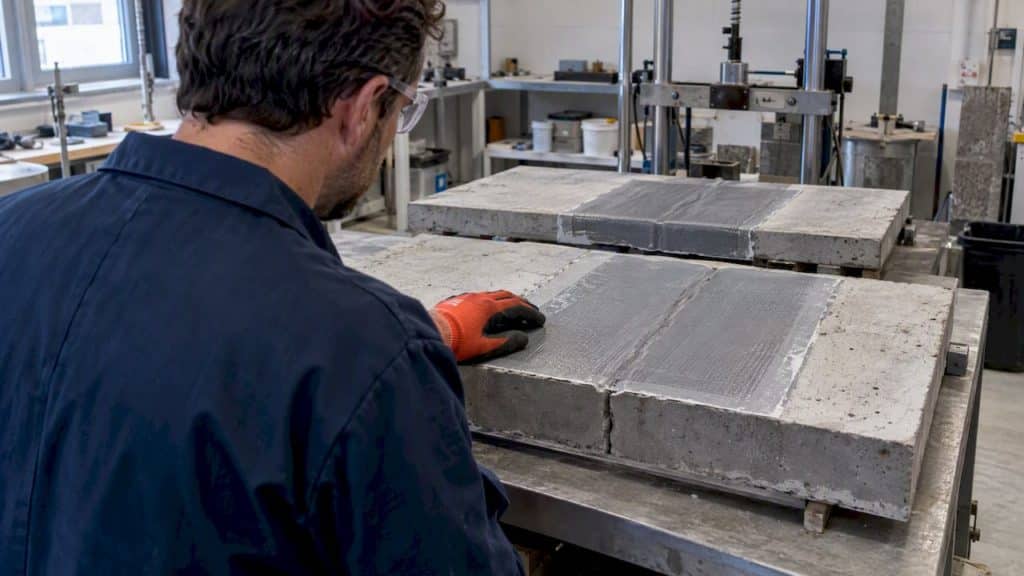
Crack bridging is a membrane’s capacity to stay watertight while spanning a crack that opens or moves in the substrate beneath it, and it is the single property that determines whether a waterproofing system survives normal building movement. We look at this because a membrane that cannot bridge a crack will leak the moment the slab or screed beneath it shifts. Technical professionals specifying membranes should check declared performance against ASTM C1305 and EN 14891 data before accepting a product on elongation figures alone.
TL;DR:
- Manufacturers should provide test results against standards like ASTM C1305 and EN 14891, not just rely on elongation figures to predict crack-bridging performance.
- Actual performance depends on proper site detailing, including substrate preparation, gusset strips at joints, and on-site testing, not only laboratory ratings.
- Elastomeric membranes rely on elastic stretch but lose effectiveness at low temperatures, while reinforced cementitious systems depend on embedded textiles for crack bridging.
- Common failure modes include adhesion loss from UV exposure and surface contamination, which can occur before leaks if proper checks are not performed.
- Specifiers must specify the bridging class in millimeters, the relevant test standard, and required site detailing practices to ensure declared performance translates to real-world durability.
Table of Contents
- Materials and mechanisms: how different membranes bridge a crack
- Standards and test methods: what to demand from manufacturers
- Detailing and installation practices that preserve bridging ability
- Failure modes and common specification pitfalls
- How to specify bridging performance in contracts and tenders
- Practitioner evidence and field observations
- Conclusion: a short specification checklist
- Author perspective: durability versus declared performance
- How we support specification, testing oversight and certified installation
- FAQ
- Sources
Materials and mechanisms: how different membranes bridge a crack
Different membrane families bridge cracks through different physical mechanisms, and the distinction matters when you are matching a product to a movement profile. Elastomeric liquid-applied membranes rely on elastic stretch: they adhere fully to the substrate and deform locally over the crack width without losing bond, though their performance drops sharply at low temperature as the polymer stiffens. Polymer-modified cementitious coatings behave differently. They are rigid by nature, so bridging depends almost entirely on embedded reinforcement textiles that carry the tensile load the cement paste cannot. Reinforced bitumen sheets and synthetic polymerized rubber gel (SPRG) systems used on trafficable decks combine a flexible carrier with surface reinforcement to resist both movement and point loads from foot or vehicle traffic.
- Elastomeric liquid-applied membranes bridge through elongation and adhesion, but low-temperature stiffening reduces effective movement capacity.
- Polymer-modified cementitious systems need a reinforcement textile or mesh to achieve any meaningful crack-bridging class.
- Reinforced bitumen and SPRG systems suit trafficable decks because they combine flexibility with wear resistance.
Peer-reviewed work on crack-bridging evaluation of polymer gels shows that quantifying the bridging limit of these materials requires controlled laboratory parameters rather than manufacturer elongation claims alone.
Standards and test methods: what to demand from manufacturers
Specifiers should ask for test reports against named standards, not marketing elongation percentages. ASTM C1305 casts five specimens over a pre-cracked substrate, ages them for 14 days, oven-ages them for 7 days at 70°C, then applies ten cycles of movement before inspecting for cracking, pinholes or splits. A pass means the membrane survives that cycling without a through-path for water.
European classification works differently. EN 14891 sets crack-bridging classes for cementitious systems, with thresholds such as ≥0.75 mm commonly used to separate standard from enhanced classes, according to a technical note on cementitious crack bridging. EN 14224 applies a parallel method to reinforced bitumen sheets used on bridge decks and vehicle-trafficable surfaces, as summarised in an EN 14224 standard overview.
- Elongation percentage alone does not predict crack-bridging performance under cyclic movement.
- Ask for post-cycling hydrostatic checks, not only visual pass/fail photographs.
- Request the actual specimen conditioning log, including ageing temperature and cycle count.
Commercial membranes are commonly rated at crack-bridging capabilities of ≥0.75 mm, and sometimes ≥1.2 mm, under standard test conditions, per a compilation of impermeable product standards, which gives you a benchmark to compare against a manufacturer’s own declared figures.
Detailing and installation practices that preserve bridging ability
Laboratory crack-bridging ratings mean little if site detailing undermines them. The sequence below reflects the junctions and checks that most often decide whether declared performance survives installation.
- Prepare and prime the substrate to the membrane manufacturer’s specification, since poor adhesion is the most common cause of early bridging failure.
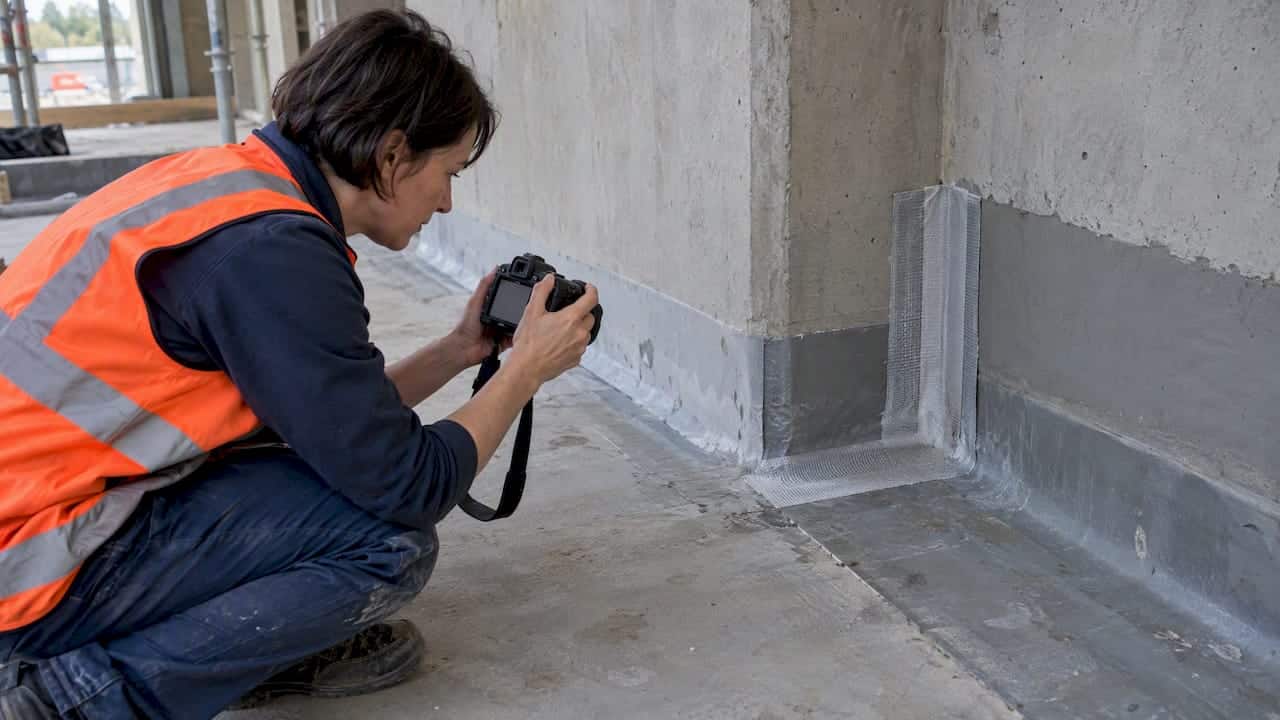
- Install gusset strips at wall-to-floor junctions and other changes of plane, where movement concentrates and flat sheet membrane alone cannot cope.
- Seal laps and overlaps fully, checking continuity rather than assuming factory-applied adhesive strips perform without pressure or heat welding.
- Treat movement joints with a low-modulus sealant and place reinforcement strips centrally over the joint, not offset to one side.
- Run on-site adhesion pull tests and flag any area with delamination for rework before the next trade covers the membrane.
Causes of cracking in the substrate itself, including shrinkage and thermal movement, are explained in more detail in our article on why concrete cracks let water in, which is worth reading alongside this detailing sequence.
Pro Tip: Photograph every gusset strip and lap before the next layer goes down: it is the cheapest quality record you will ever keep.
Failure modes and common specification pitfalls
Crack-bridging claims fail in service for reasons that rarely show up in a product data sheet. Adhesion loss from UV exposure, surface contamination or simple ageing is the most frequent cause, and it is detectable with pull-off tests before handover rather than after a leak appears. Thermal fatigue is a slower threat: membranes that pass a fresh cyclic test can lose effective bridging capacity after repeated seasonal expansion and contraction on site. Field experience suggests declared laboratory values should be treated with a safety margin rather than as a guaranteed service figure.
- Poor mixing or uneven reinforcement placement in polymer-modified cementitious systems creates weak points that bridge nothing.
- Relying on elongation data alone hides low-temperature stiffening and post-ageing brittleness.
- Skipping post-cycle hydrostatic checks risks missing micro-leakage paths that only become obvious under pressure in service.
How to specify bridging performance in contracts and tenders
A specification should name the required bridging figure in millimetres, the standard that defines it, and the conditioning protocol the product must pass, rather than leaving “crack bridging” as an unqualified marketing term.
- State the minimum crack-bridging class (for example ≥0.75 mm under EN 14891) and cite the exact standard and edition.
- Require laboratory certificates showing pass/fail against post-cycle hydrostatic pressure testing, not visual inspection alone.
- Define on-site acceptance thresholds, including the percentage of delaminated area that triggers rework before sign-off.
- Add substrate compatibility clauses and a written warranty period tied to the declared bridging class.
Our article on waterproofing standards for South African properties sets out how these clauses sit alongside local code requirements.
Practitioner evidence and field observations
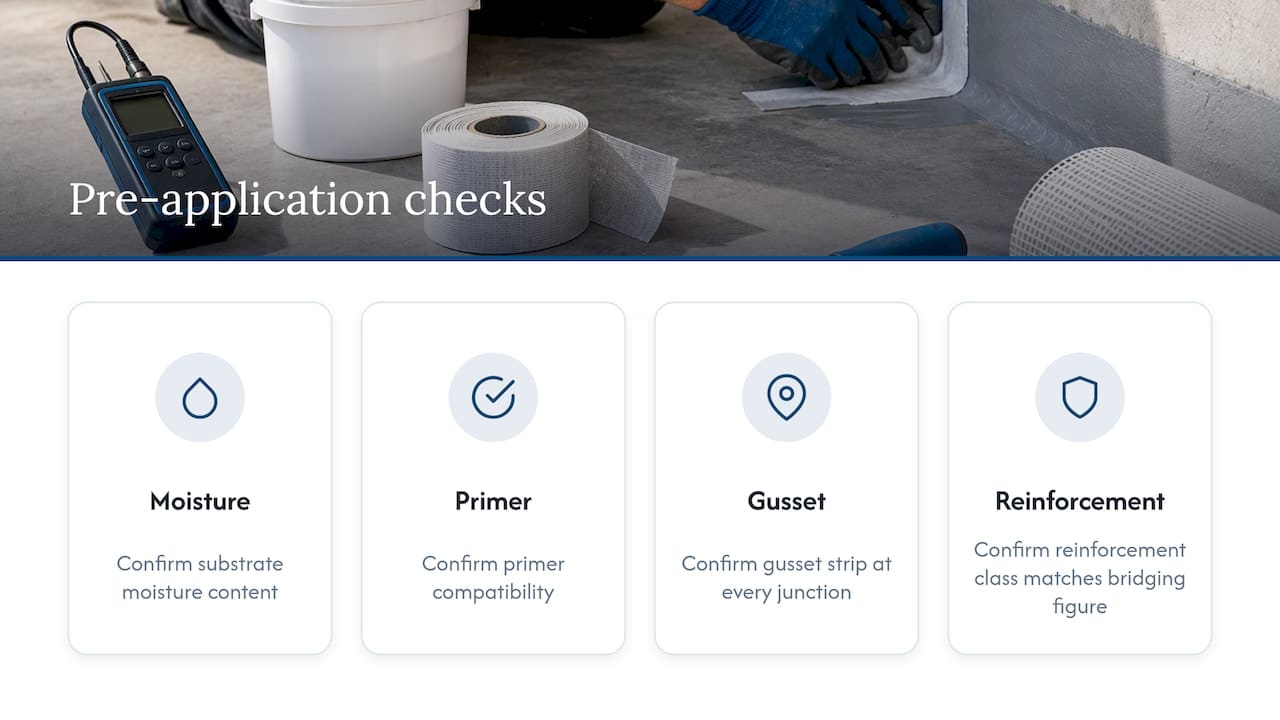
In practice, inspection regimes matter as much as the data sheet. We typically recommend removing and re-dressing any delaminated area once it exceeds a small proportion of the inspected panel, rather than patching in isolation, because adjacent bond is usually compromised too. A short pre-application checklist helps: confirm substrate moisture content, confirm primer compatibility, confirm gusset strip placement at every junction, and confirm the reinforcement class matches the specified bridging figure before the first coat goes on.
Conclusion: a short specification checklist
Choose a crack-bridging membrane where movement is expected but limited; where movement is substantial, design a structural joint instead of relying on membrane elasticity. For most projects, write three things into the specification: the required bridging figure in millimetres, the test standard that defines it, and the detailing items (gusset strips, lap sealing, movement joint treatment) that the contractor must demonstrate on site.
Author perspective: durability versus declared performance
Declared laboratory figures tell you what a membrane can do under controlled ageing, not what it will do after five winters of real movement. We think reinforced systems earn their extra cost wherever movement is cyclic rather than one-off, and any warranty worth signing should name the test standard, not just a number of years.
— Eben
How we support specification, testing oversight and certified installation
Choosing a crack-bridging class is only half the job. Getting it installed the way the test report assumes, with correct priming, gusset strips and lap sealing, is where most declared performance is actually won or lost on site. We offer pre-application inspection, specification review against the standards covered here, and support installation for waterproofing projects to help ensure the membrane you specify performs as expected.
If you are weighing membrane options against a movement joint or a cracked slab, request a quote through Pro Waterproofing and we will talk through the bridging class and detailing your project actually needs.
FAQ
What is crack bridging and how does it work?
Crack bridging is a membrane’s ability to remain watertight while spanning a crack that opens or moves in the substrate beneath it. It works through elastic stretch in liquid-applied coatings, or through embedded reinforcement textiles in rigid cementitious systems, confirmed by cyclic movement testing such as ASTM C1305.
What causes crack propagation in waterproofed substrates?
Cracks typically propagate from restrained shrinkage, thermal movement and structural loading, which create paths that water can follow once a crack reaches the membrane. Reflective cracking from an underlying joint or crack is a recognised cause, and stress-absorbing membranes are a common mitigation discussed in guidance on reflective cracking in asphalt.
What is a crack isolation membrane?
A crack isolation membrane is a system, often reinforced, installed specifically to decouple a tile, coating or topping layer from movement in the substrate below it, so a crack underneath does not transfer straight through. It is tested and classified using the same crack-bridging principles as other waterproofing membranes, typically against EN 14891 or ASTM C1305 criteria.
What does crack bridging mean in paint and coating systems?
In coatings, crack bridging describes a paint or coating film’s ability to stretch across a fine substrate crack without splitting, usually up to a modest movement tolerance far smaller than a dedicated waterproofing membrane. Elastomeric coatings achieve this through elongation, but, as with membranes, elongation figures alone do not confirm performance after ageing or cyclic movement.
What crack-bridging class should I specify for a waterproofing membrane?
The class depends on expected movement, but commercial membranes are commonly rated at ≥0.75 mm, and sometimes ≥1.2 mm, under standard test conditions, according to a compilation of impermeable product standards. Specify the exact figure, the standard that defines it, and the ageing or cycling protocol the product must pass, as covered in our guide to concrete waterproofing in South Africa.
Sources
- ASTM C1305/C1305M-16 (2023) – Standard Test Method for Crack Bridging Ability of Liquid-Applied Waterproofing Membrane
- Testing cementitious waterproofing: crack bridging beats elongation (Wacker technical note)
- Crack-bridging property evaluation of synthetic polymerized rubber gel (PMC article)