
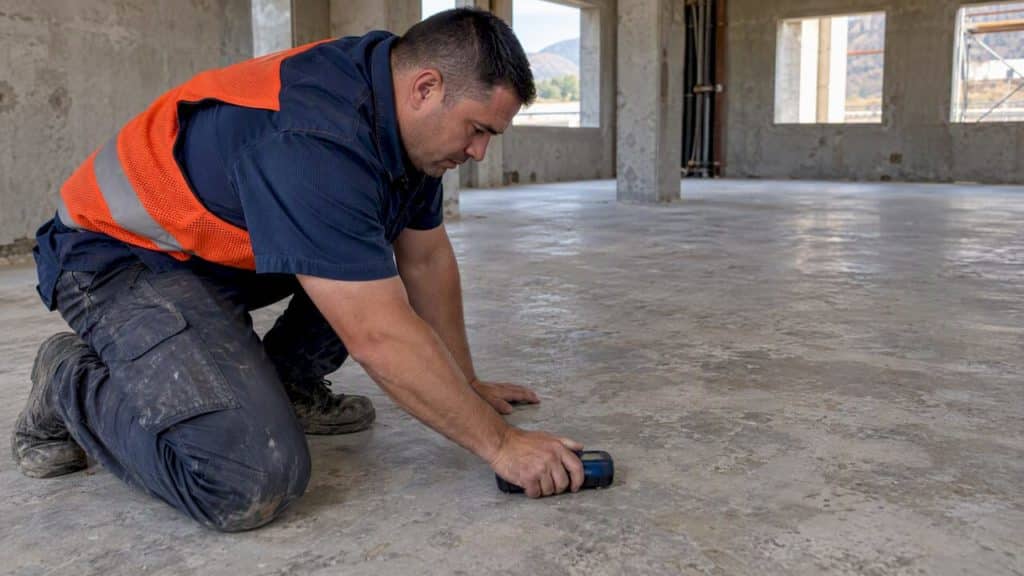
Substrate moisture content testing measures how much water is held in the surface or body of a concrete slab, screed, roof deck or wall before a coating, membrane or floor system goes on top. The result, usually a percentage or a relative humidity reading, tells you whether the substrate is dry enough for the product you plan to apply. If it is not, the waterproofing can blister, lose adhesion or cure badly, and you pay twice for the same job.
This guide explains what is measured, the main test methods, what the numbers mean, and the mistakes we see on South African sites. It is written for owners, managers and builders who want to judge a contractor’s preparation, not for DIY application.
TL;DR
- Substrate moisture testing measures the water in concrete, screed or masonry so you know if it is ready for waterproofing, coatings or flooring.
- A surface moisture meter gives a fast screening reading. Relative humidity probes and calcium chloride kits give deeper, more reliable answers for floors.
- A substrate that looks dry is not necessarily dry. Test several points, including poorly ventilated areas, and retest after removing old floor coverings.
- Each product has its own moisture threshold. Ask your contractor which limit applies and to show you the readings in writing.
- Skipping the test is one of the commonest causes of failed coatings and floors.
Table of Contents
- What a substrate is, and what “moisture content” means
- Why it matters before waterproofing
- The main ways substrates are tested
- How to read the results
- Mistakes that ruin a moisture test
- Where it applies in waterproofing projects
- What we think
- Questions to ask your contractor
- Get a vetted contractor who tests first
- FAQ
- Sources
What a substrate is, and what “moisture content” means
The substrate is whatever the waterproofing system bonds to: a cast concrete roof slab, a cement screed in a bathroom, a basement floor, a plastered wall or a concrete deck. Moisture content is the amount of water in that material. Depending on the method, it is expressed as a percentage of mass, as a percentage of relative humidity inside the concrete, or as a rate of vapour leaving the surface.
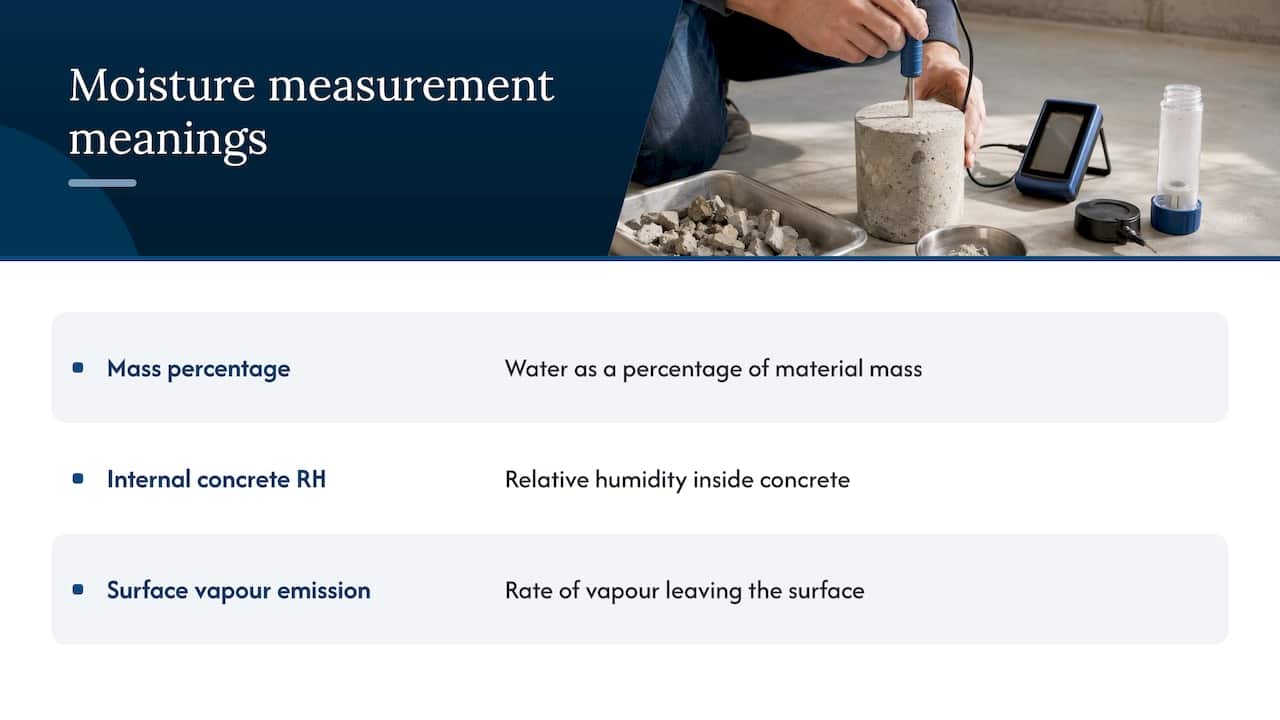
These are not interchangeable numbers. A meter reading of 4% and a probe reading of 75% relative humidity describe the same slab in different languages. That is why a contractor should always state the method alongside the figure.
Note that the phrase also appears in other fields. Searches on this topic return results about mushroom growing, timber flooring and soil science, where moisture content means something different. Here we mean building substrates that receive waterproofing, screeds, coatings or floor finishes.
Why it matters before waterproofing
Water trapped in a slab looks for a way out. When a membrane or sealed floor covers it, the vapour pushes against the new layer. According to a field testing guide from the International Institute of Building Enclosure Consultants, a substrate with high moisture content or poor preparation has a high potential for failure when coated, and moisture can cause delamination and improper curing of the material.
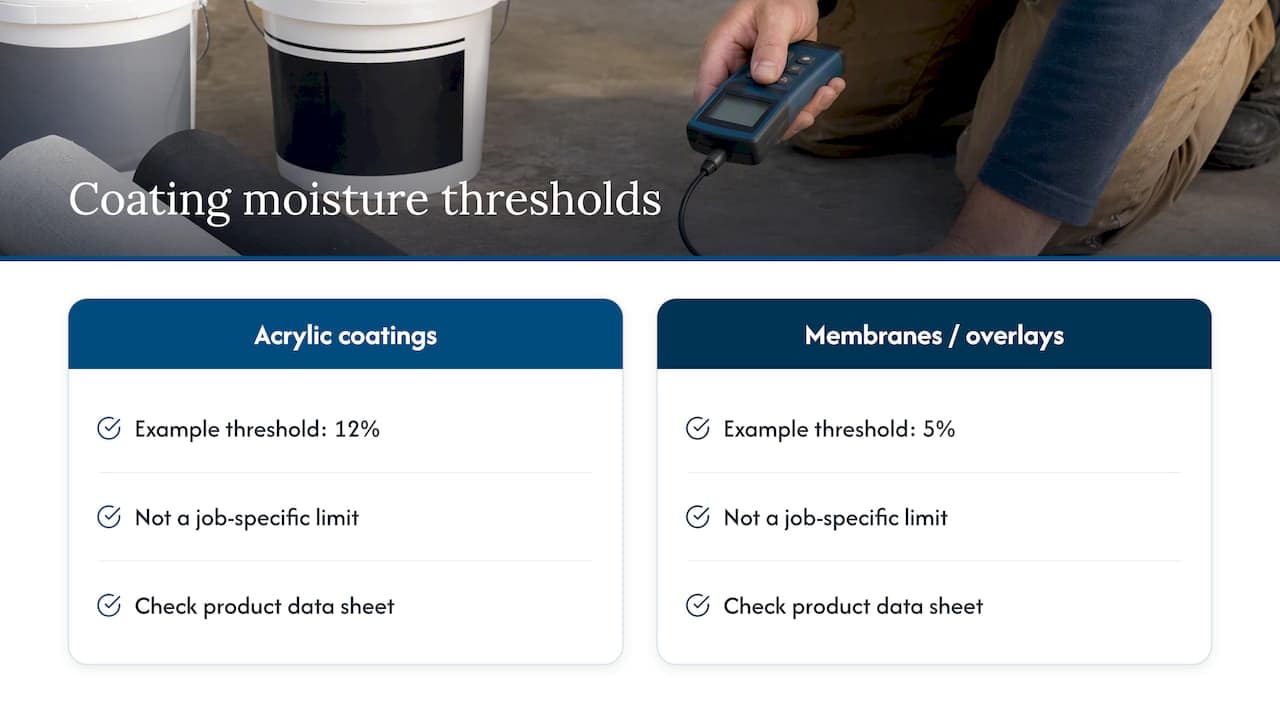
The same source notes that manufacturers publish their own surface moisture thresholds, typically somewhere between 12% for some acrylic coatings and sealers and 5% for non-permeable membranes and overlays. Treat these as examples of the range, not as a limit for your job. Your product’s data sheet decides.
South African industry commentary agrees on the importance. Building & Decor reports that industry experts see moisture testing neglected by contractors even though it remains one of the most significant failure points in flooring installations. For a deeper look at how preparation affects the finished result, see our guide on the four roles of substrate preparation.
The main ways substrates are tested
There is no single test that suits every situation. Contractors usually combine a fast screening tool with a more rigorous method where the risk is higher.
| Method | What it measures | Speed | Best for |
|---|---|---|---|
| Visual check and tapping | Obvious damp, staining, hollow sounds | Minutes | First walk-over, never the only test |
| Electronic surface moisture meter | Moisture in the upper layer, as a percentage or relative reading | Seconds per point | Screening roofs, screeds and walls |
| In-situ relative humidity probe | Humidity inside a drilled hole in the slab | Hours to a day for equilibrium | Floors, thick slabs, high-risk jobs |
| Calcium chloride test | Rate of vapour leaving the surface | About three days | Floors under sealed finishes |
| Oven-dry (gravimetric) test | True water content by weighing a sample before and after drying | Lab time | Disputes and calibration |
Visual assessment and tapping
Every proper assessment starts here. Building & Decor lists a visual assessment of the floor space and tapping with hammers or rods to find hollow sounds among the standard first steps, alongside moisture meters, rebound hammers for compressive strength and pull-off testers for bond quality. Visual checks find efflorescence, dark patches, cracks and delaminated areas. They cannot tell you how much water is inside the slab.
Electronic moisture meters
A surface moisture meter is quick and relatively cheap. The IIBEC guide points to ASTM F2659 as the standard guide for preliminary, comparative evaluation of concrete moisture with such meters. The key word is comparative: the meter shows where a slab is wetter or drier than other spots, and whether it is in the right region. It reads mainly the upper layer, so it is a screening tool.
In South Africa, one flooring specification sets a practical benchmark: after the standard 28-day cure, residual moisture should generally not exceed 4% on an electronic meter, unless the flooring system tolerates more. That figure belongs to flooring. Your waterproofing product may ask for a different one.
Relative humidity probes
Probe testing places a humidity sensor in a drilled hole in the slab, connected to a hand-held meter. The method was adopted as ASTM F2170 after experience in Scandinavia and England, where relative humidity measurement in floors has been used for decades. It reads the moisture deep in the slab, so it is less fooled by a dry-looking surface. The trade-off is time, because the hole must be allowed to reach equilibrium before reading.
Calcium chloride testing
This method seals a small dish of calcium chloride on clean concrete under a plastic dome and weighs how much moisture the salt absorbs over a set period. It measures the vapour leaving the surface, not the water inside the slab. The same patent text describes ASTM F1869 as a widely used but flawed method with many interferences, which is one reason probes became popular.
Oven-dry testing
The laboratory reference is to weigh a sample, dry it in an oven and weigh it again. The difference is the water content. It is accurate but slow, and it destroys a sample, so it is used for calibration or disputes rather than routine site work. Research at the University of Cape Town on drying concrete specimens found that oven drying removes most of the moisture within a few days, but reaching constant mass takes longer, which tells you how patient a true laboratory result has to be.
How to read the results
A number alone is meaningless without three pieces of context.
- The method. State whether it was a surface meter, probe or calcium chloride kit.
- The product limit. Check the data sheet for the primer, membrane or adhesive. Cementitious systems often tolerate damper substrates than epoxy or polyurethane systems, which is a reason to choose the system after testing, not before. Our article on cementitious waterproofing explains where each type fits.
- The location. One reading says little. Take a grid of readings and record the highest.
If the highest reading exceeds the limit, the answer is not to coat anyway. Options include waiting and retesting, improving ventilation, removing the source of water, or choosing a moisture-tolerant system or a vapour barrier. Whichever route is taken, it should be agreed in writing.
Dry is not the same as cured
Two separate questions are often mixed up: is the substrate dry enough, and has the applied material cured? A surface can pass a moisture check and the new coating can still be damaged by rain or early traffic. We cover this in why dry does not mean cured.
Mistakes that ruin a moisture test
Trusting your eyes
A common site mistake is assuming a substrate is dry because it looks dry. Surface beds can have high and fluctuating moisture from water tables even when they appear dry. That matters in coastal and low-lying areas of the Western Cape and on ground-bearing slabs in parts of Gauteng with a seasonal high water table.
Testing one spot
The same source advises testing throughout the slab, particularly where airflow is limited, such as doorways to the outside, where moisture tends to accumulate. A single reading in the middle of a ventilated room will flatter the slab.
Forgetting old floor coverings
A floor that appears dry may still be emitting vapour if it was covered by a breathable material such as carpet. Removing it changes conditions, and previously trapped moisture can be drawn back to the surface. Retest after stripping the covering and before installing the new system.
Over-wetting on purpose
Moisture preparation is not only about dryness. In concrete repair, many contractors insist on a saturated surface dry state before applying overlays. A University of Cape Town study on overlay bond strength found experimental evidence that an overly wet surface can dilute the overlay mix or bond poorly, challenging that common practice. The lesson is to follow the product specification and the engineer, not habit.
Mixing up moisture and strength
Moisture is one of several substrate checks. Strength, flatness and cleanliness matter as well. The flooring specification cited earlier, for example, also sets a flatness tolerance of 5 mm under a 3 m straight edge. A slab can be dry and still unfit if it is weak or uneven.
Where it applies in waterproofing projects
- Flat roofs and terraces. Slabs exposed to rain and sun can hold water in the upper layer and release it as vapour under a membrane. Our guides to terrace waterproofing and flat concrete roof waterproofing cover the moisture limits and method choices for these decks.
- Basements and below-ground slabs. Constant hydrostatic pressure means the slab may never be fully dry. Here the right membrane matters more than waiting. See cementitious waterproofing membranes for basements and interior concrete waterproofing. For below-ground structures, SANS 10021 calls for a thorough site investigation before design starts.
- Bathrooms and wet rooms. New screeds hold water for weeks. Testing before tiling and membranes avoids debonded tiles and damp ceilings below.
- Industrial floors and decks. Large slabs dry unevenly, so a grid of readings is essential, and moisture-sensitive resin systems need a probe or equivalent test.
What we think
Most waterproofing failures we hear about are traced back to the first day of work, not the product. A membrane is only as good as the surface under it, and the surface is only as good as the checks that were done. When we guide property owners towards contractors, the questions that separate careful professionals from the rest are about preparation: Did you test the substrate? With what? What was the reading, and what does the product require?
Our advice is simple. Ask for the moisture readings in writing, with the method, the number of test points and the product limit next to them. A contractor who measures will hand that over in minutes. One who shrugs and says the slab looks dry has told you something important about the rest of the job. A mock-up on a small area is a useful second check, and we describe it in our waterproofing mock-up guide.
We would rather a job start a week late on a dry slab than a month early on a damp one.
— Eben
Questions to ask your contractor
- Which moisture test will you use, and why is it suitable for this slab?
- How many test points will you take, and where?
- What is the maximum moisture the chosen product allows, according to its data sheet?
- What happens if the readings are too high: wait, dry, ventilate or change system?
- Will you retest after removing old floor coverings or after heavy rain?
- Is the warranty conditional on the preparation and testing being documented?
Get a vetted contractor who tests first
If you are planning roof, basement, bathroom, foundation or concrete deck waterproofing in Gauteng or the Western Cape, we connect property owners with vetted waterproofing professionals. Send one request through Pro Waterproofing and ask each contractor the questions above before you sign.
FAQ
Can moisture content be greater than 100%?
Yes, when it is measured as water mass divided by dry mass, as in timber or soil testing. Relative humidity readings in concrete, however, cannot exceed 100%. This is another reason to know which measure and method are being quoted.
What is a moisture tester?
It is a hand-held electronic meter that reads moisture in a surface, usually as a percentage or on a relative scale. It is a quick screening tool, and deeper floor checks use probes or calcium chloride kits. Results from different meters are comparable only when the same method is used.
How long must new concrete dry before waterproofing?
The standard curing period is 28 days, and one South African flooring specification expects residual moisture of generally no more than 4% on a meter after that. Thick slabs, wet weather and poor ventilation can extend the time. Follow the data sheet of your product, and retest rather than counting days.
Can I test the substrate myself?
You can buy a surface meter, but interpreting the readings against a product’s limit takes experience, and a wrong call can void a warranty. We recommend asking the contractor to test and to share the written results.
Sources
- Using Proper Field Testing for Waterproof Coatings, IIBEC
- Industry insights: Substrate preparation, Building & Decor
- Sub-base requirements for flooring (PDF)
- Relative humidity probe for concrete (patent text referencing ASTM F1869 and F2170)
- Influence of substrate moisture preparation on concrete overlay bond strength, University of Cape Town
- Drying of concrete specimens, University of Cape Town
- SANS 10021: The waterproofing of buildings