
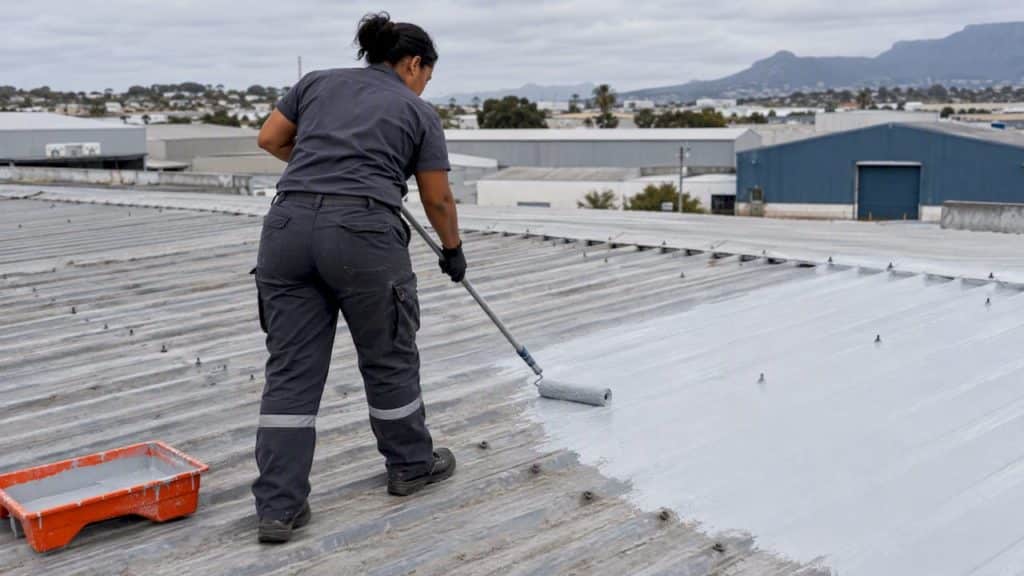
A roof coating is a liquid-applied protective layer that cures into a continuous membrane over an existing roof. In Cape industrial maintenance it does three jobs: it keeps water out, it shields the substrate from salt, UV and weathering, and it can cut heat load. It cannot rescue a roof that has structurally failed. Used at the right time, it is usually the cheapest way to add years to a warehouse or factory roof without shutting down operations.
This guide is for building managers and owners of industrial and commercial property in the Western Cape, with notes for Gauteng industrial parks where conditions differ. It explains where coatings fit in a maintenance plan, which types suit which roofs, and what to check before you sign.
TL;DR
- A coating is a maintenance tool for roofs that are still sound. It extends service life, seals minor defects and reduces heat, but it does not replace structural repair.
- Coastal Cape sites face salt, wind and UV, so the substrate and coating thickness matter as much as the product name.
- Match the coating to the roof: metal sheeting, concrete deck, fibre-cement and flat membranes each need different preparation and chemistry.
- Asbestos-cement roofs can be coated, but only by a contractor legally equipped to work with asbestos.
- Ask for a written scope, surface-preparation details and a warranty before work starts.
Table of Contents
- Why Cape industrial roofs need planned maintenance
- What a roof coating actually does
- Types of roof coating and where each fits
- Cape coastal sites versus Gauteng industrial parks
- Cool roof coatings, energy and the EPC rules
- Coating an asbestos-cement roof
- A practical maintenance routine
- Questions to ask before you hire a contractor
- When to coat, and when to replace
- Our perspective
- Get your roof assessed
- FAQ
- Sources
Why Cape industrial roofs need planned maintenance
Industrial roofs are large, flat or low-pitched, and rarely visited until something leaks. That is the opposite of how they should be treated. A leak above stock, switchgear or a production line costs far more than the repair, and the interruption often costs more again.
The Western Cape adds its own pressures. Sites near the coast sit in salt-laden air, and strong south-easterly winds drive that salt, along with dust, onto roof surfaces. We explain the corrosion mechanism in more detail in our article on how salt air and south-easterly winds corrode Western Cape industrial roofs. Winter rain then tests every weak fastener, lap and penetration.
The national building rules already assume that roofs are exposed to harsh conditions. SANS 10400-L requires roof coverings to resist rainwater penetration, UV degradation and chemical attack, including saline marine environments. It expects them to keep those properties for at least 10 years where the system is easily replaced and 20 years where it is difficult to replace. A coating is one of the ways owners help an ageing roof keep meeting that expectation.
What a roof coating actually does
Think of a coating as a protective skin rather than a new roof. Applied properly, it does the following:
- Seals. It bridges hairline cracks, pinholes, laps and fixing points, creating a seamless surface with fewer joints for water to find.
- Shields. It takes the UV, rain and abrasion that would otherwise attack the underlying sheet, deck or membrane.
- Slows corrosion. On metal roofs, a well-prepared coating over treated steel keeps moisture and salt away from the surface.
- Reflects heat. Light-coloured or reflective coatings lower roof surface temperature, which matters for buildings with large cooling loads.
- Defers capital spend. Recoating at the right moment postpones full replacement.
What it does not do is equally important. A coating will not fix rotten insulation, sagging purlins, failed drainage or sheets that have rusted through. It will not hold if applied over wet, dirty or poorly prepared surfaces. Those limits are why inspection comes first, and why the contractor you choose matters more than the brand on the tin.
Types of roof coating and where each fits
There is no single best coating. The right choice depends on the substrate, the slope, whether water ponds, how much foot traffic the roof sees and how much heat or UV the building takes. The table gives a practical starting point. Always confirm the detail with the manufacturer’s data sheet and your contractor’s specification.
| Coating type | Typically suits | Strengths | Watch out for |
|---|---|---|---|
| Acrylic elastomeric | Metal, concrete and fibre-cement roofs with good drainage | Flexible, reflective finishes, easy to maintain and recoat | Not designed for areas where water stands for long periods |
| Polyurethane | Flat or low-slope roofs, concrete decks, areas with some traffic | Tough, good abrasion resistance, strong adhesion | Needs careful surface preparation and correct curing conditions |
| Silicone | Low-slope roofs where ponding occurs | Handles standing water well, stable under UV | Few things bond to it later, so plan future recoats with your contractor |
| Cementitious polymer | Concrete decks, parapets, plant rooms | Forms a rigid barrier to water and moisture | Less suited to roofs that move a lot |
| Bituminous | Flat roofs, as a repair or base layer | Familiar, economical for localised waterproofing | Can degrade faster in direct sun unless protected |
| Anti-corrosive primer plus topcoat system | Rusted or ageing steel sheeting | Treats the corrosion before sealing | Only as good as the rust removal beneath it |
For a wider look at the options, our guides to choosing the best roof waterproofing type in South Africa and comparing waterproofing methods set coatings next to membranes and other systems. Flat roofs have their own failure patterns, covered in our flat roof waterproofing guide for South African owners.
Metal sheeting
Metal is the most common industrial roof, and the coastal Cape is hard on it. SANS 10400-L sets minimum coating levels for the metal sheet itself: AZ150 or Z275 for coastal sites within 5 km of the sea and other aggressive environments, and AZ100 or Z200 elsewhere, according to the same standard. That is the factory protective layer on the sheet. A maintenance coating goes on top once that layer has worn or weathered.
The key step is preparation. Loose rust is removed, the surface is cleaned and degreased, rusted areas are treated and primed, and fasteners and laps are sealed before the topcoat goes on. Skip that and the coating peels within a few seasons.
Concrete decks and flat roofs
On concrete, the questions are cracks, movement and drainage. Cracks must be routed and sealed, ponding areas corrected where possible, and upstands and penetrations detailed properly. Many failures that owners blame on the coating are actually detailing failures around pipes, parapets and outlets. Our roof waterproofing basics guide walks through those details.
Cape coastal sites versus Gauteng industrial parks
The role of a coating is the same everywhere, but the stress it takes is not. Different conditions push you toward different priorities.
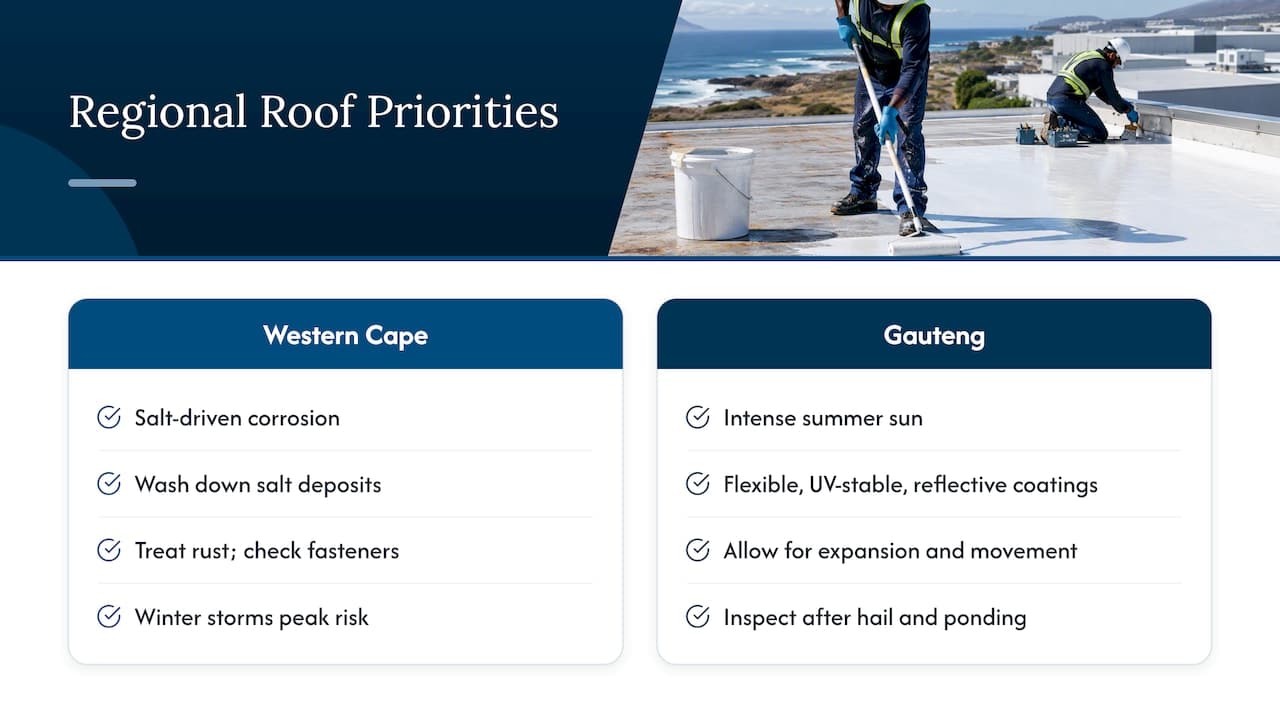
Western Cape coast. Salt is the main enemy. Coatings here work as a corrosion barrier as much as a waterproofing layer. Wash-downs to remove salt deposits, early rust treatment and fastener checks carry the most weight. Winter storms are the peak risk period, so work is best planned for the drier summer months.
Gauteng industrial parks. Inland sites see intense summer sun, thunderstorms and large day-night temperature swings. That favours flexible, UV-stable and reflective coatings, and careful attention to expansion and movement. Hail and ponding after storms are common reasons for inspection. A Gauteng contractor will publish similar guidance: one local waterproofer, for instance, says it works on flat, low-pitch, tiled and metal roofs across commercial and industrial properties in the region, which matches the mix of roof types you will find in most industrial parks.
If you manage a portfolio across both provinces, do not apply one specification everywhere. Write the scope per site, based on its roof type, age, exposure and drainage.
Cool roof coatings, energy and the EPC rules
Coatings are no longer only about keeping water out. A reflective coating can reduce the heat a roof absorbs, and that matters for large warehouses, cold storage, factories and offices that run air conditioning.
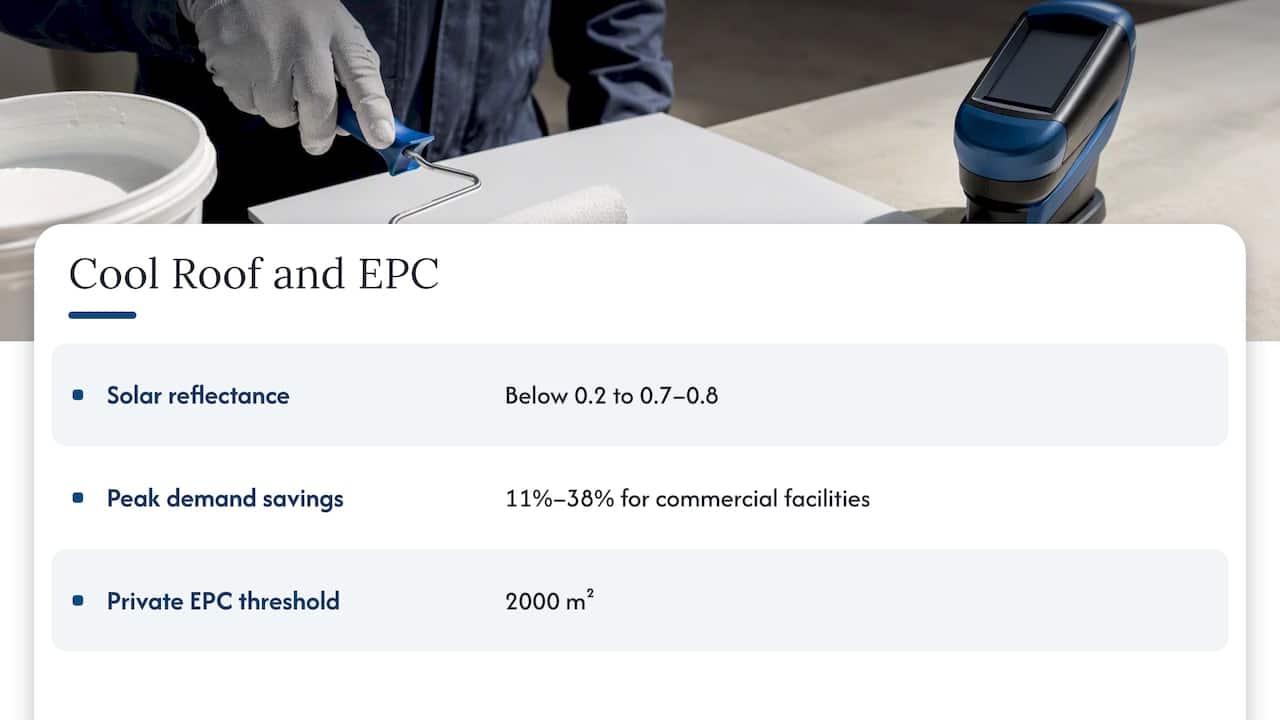
Research from the University of Johannesburg notes that raising roof solar reflectance, often from below 0.2 on dark roofs to 0.7 to 0.8 on new reflective surfaces, can significantly reduce cooling loads. The same work reports peak energy demand savings of 11% to 38% for commercial facilities, depending on climate and building configuration. Treat that as a range from studies, not a promise for your building. Results depend on insulation, ventilation, occupancy and how much of your load is cooling.
There is also a regulatory angle. South Africa’s Energy Performance Certificate rules require larger buildings to obtain and display a certificate, and the SANEDI EPC guideline sets the threshold for private buildings at 2000 m². The guideline measures performance in kWh/m² per year, and reflective coatings are one recognised way to reduce the energy a building uses. If your building is near or above that size, ask your contractor whether a reflective system fits the roof, and speak to an accredited EPC inspector about how it affects your rating. SANEDI’s Cool Surfaces project gives background on the national programme behind cool roofing.
Coating an asbestos-cement roof
Many older industrial buildings still carry asbestos-cement sheeting. Owners often assume it must come off. Under the Department of Employment and Labour’s Asbestos Abatement Regulations, material in good condition generally has to be managed, recorded in an inventory and monitored, rather than removed automatically. Encapsulating it with a coating can be a valid maintenance approach.
However, this is not work for a general painter. The Department’s asbestos FAQ.pdf) advises that if you are unsure whether asbestos is present, you should not start maintenance or repair work, and that a bulk sample can be taken for laboratory confirmation. Depending on the type of work, regulations require an approved plan of work and risk assessment, and the Department’s list of approved inspection authorities shows which regulations those inspections cover.
Before anyone touches an asbestos roof, appoint a competent person or approved inspection authority to assess it, and make sure your contractor can show it is legally equipped for asbestos work. Do not allow dry brushing, high-pressure washing or sanding of the surface, which can release fibres. If you have any doubt, ask the Department of Employment and Labour or an approved asbestos inspector before you proceed.
A practical maintenance routine
Coating works best as one element of a routine, not an emergency response. A sensible programme for an industrial roof looks like this:
- Inspect twice a year. Do it once before the winter rains and once after, and after any severe storm or hail. Photograph problem areas and keep the records.
- Clear drainage. Gutters, downpipes, outlets and sumps should be free of debris. Ponding water shortens the life of any coating.
- Clean the surface. On coastal sites, remove salt and dirt deposits regularly so they do not sit on the coating.
- Fix small defects early. Reseal laps, replace failed fasteners and patch cracks before they spread.
- Recoat on condition. When the existing coating chalks, thins or loses adhesion, but the substrate is sound, recoat before rust or leaks develop.
- Keep a roof file. Record the date, product, thickness, contractor and warranty for every job.
Structured, documented care also puts you in a better position with insurers and tenants, and it supports the standards you are expected to meet. Our overview of South African waterproofing standards and the guide to waterproofing regulations explain what applies to your property.
Questions to ask before you hire a contractor
The product matters less than who applies it and how. Put these questions to every contractor you consider:
- What is the surface-preparation plan? Look for detail on cleaning, rust treatment, priming and crack repair, not just the topcoat.
- What is the specification? You want the product name, number of coats, coverage rate or dry-film thickness, and curing requirements in writing.
- What experience do they have with your roof type? Metal, concrete deck and asbestos-cement are different jobs.
- Are they licensed and insured for work at height? Ask for proof, and for a safety plan covering fall protection on fragile roofs.
- What warranty is offered, and what does it cover? Check whether it covers materials, workmanship or both, its length, and what maintenance it requires of you.
- Will they inspect the roof first? Be cautious of any quote given without a site visit.
- Can they give references from similar industrial sites? Ask to see completed work.
These questions sit at the core of how we help owners choose. Our guide to industry standards in waterproofing is a useful checklist to take into those conversations.
When to coat, and when to replace
Coating is the right call when the roof sheets or deck are structurally sound, leaks are localised, corrosion is surface-level and the insulation underneath is dry. Replacement or partial replacement is the better call when sheets are rusted through, large sections of insulation are saturated, the structure is compromised, or earlier coating layers have failed so badly that they cannot be stripped back to a sound base.
A good contractor will tell you which situation you are in, even if that means a smaller coating job or no coating at all. Be wary of anyone who quotes a coating for every roof they see.
Our perspective
We see the same pattern on industrial roofs again and again. The coating gets the blame when the real problem was preparation, drainage or a leak that was ignored for two winters. Owners who treat roofing as a scheduled maintenance line, with twice-yearly inspections and early repairs, rarely face the emergency recoat at a premium price.
For the Cape, we would put salt and wind at the top of every specification. For inland parks, we would put movement, UV and ponding first. In both, we would insist on a written scope, a site inspection and a warranty you have actually read. Choosing a contractor on the lowest square-metre rate is the quickest way to pay for the same roof twice.
We built our service around helping you ask the right questions about quality, experience, licensing and warranties before work begins, because a coating is only as good as the hands that apply it.
— Eben
Get your roof assessed
If you manage an industrial or commercial building in the Western Cape or Gauteng and want to know whether a coating, a repair or a replacement makes sense, request a quote through Pro Waterproofing. Tell us the roof type, approximate age, location and any leak history, and we will connect you with a vetted waterproofing professional who can inspect and specify the work.
FAQ
What is a roof coating?
A roof coating is a liquid product applied over an existing roof that cures into a seamless protective layer. It seals minor defects, resists UV and weather, and can reflect heat. It is a maintenance measure for sound roofs, not a replacement for structural repairs.
How often should an industrial roof be inspected?
Twice a year is a sensible baseline: before and after the wet season, plus after severe storms or hail. Coastal Cape sites may justify more frequent checks of fasteners, laps and corrosion because of salt exposure. Keep dated photographs so you can track changes.
Can I coat an asbestos roof?
In many cases yes, because encapsulating good-condition asbestos-cement can be safer than removal. It must, however, be done by a contractor legally equipped for asbestos work, following the Asbestos Abatement Regulations. Have the roof assessed first, and never allow dry brushing or high-pressure washing.
Which coating is best for a Gauteng industrial roof?
There is no single answer. Flexible, UV-stable and reflective coatings generally suit sun-exposed inland roofs, while ponding areas may call for a different chemistry. Your contractor should choose based on the substrate, slope, drainage and heat load of your specific building.
Sources
- SANS 10400-L: National Building Regulations Part L, Roofs
- University of Johannesburg research on cool roofs
- SANEDI Energy Performance Certificate Guideline
- SANEDI Cool Surfaces project
- Department of Employment and Labour asbestos FAQ.pdf)
- Department of Employment and Labour approved inspection authorities, April 2026
- Industrial waterproofing solutions for Gauteng facilities