
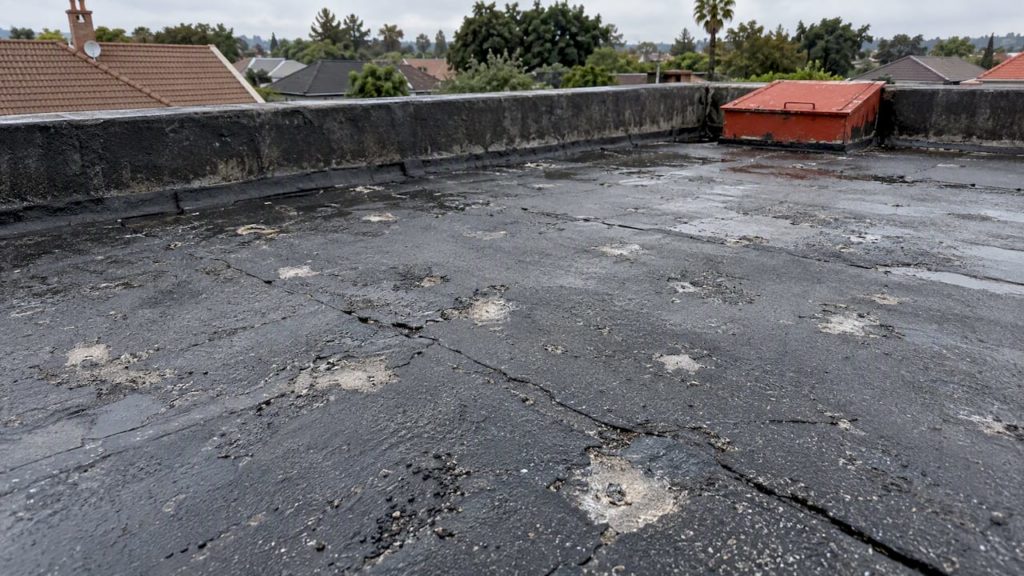
Hail cracks roof waterproofing because a falling ice stone delivers a sharp, concentrated impact to a membrane that has often been weakened by years of sun, heat and movement. The impact may not leave a visible hole. It can fracture the reinforcement, break the bond between layers or open fine cracks that only leak weeks later. After a Highveld storm, a professional waterproofing inspection is the only reliable way to tell whether your roof is still sealed.
TL;DR
- Hail damages waterproofing by impact. It can crack the surface, fracture the reinforcement inside a membrane or loosen the layers from each other.
- Roofs that are already blistered, cracked, brittle or near the end of their service life are far more vulnerable, even to small hail.
- Damage is often hidden from the ground and shows up first at seams, edges, drains, flashings and penetrations.
- Inspect after every serious hailstorm, and photograph everything before any repair work begins.
- Have a competent, qualified person assess the roof rather than judging it from the garden or the ceiling stain.
Table of Contents
- How hail actually damages roof waterproofing
- Why old and tired membranes crack first
- Why Gauteng roofs are exposed
- Signs that hail has damaged your waterproofing
- What a post-hail waterproofing inspection should cover
- What to do in the first days after hail
- Repair or replace: what the inspection decides
- Get your roof assessed
- Perspective
- FAQ
- Sources
How hail actually damages roof waterproofing
Hail is a mechanical attack. Different roof coverings fail in different ways, and it helps to know what each one looks like.
On bituminous roofing, a technical bulletin on hail damage notes that hail can crack asphalt shingles and break or weaken the bond between the granules and the asphalt. The same document adds that long exposure to UV can speed up oxidation and premature ageing. Granules are the sun shield of a bituminous surface. Once they are knocked off, the bitumen underneath is exposed and degrades faster.
On modified-bitumen systems, a public-sector risk-management checklist explains that hail can displace granules or fracture the reinforcement, and can create cracks where water collects beneath the surface. It also warns that softer coverings such as PVC, and weathered patch compounds, can be punctured or cracked outright.
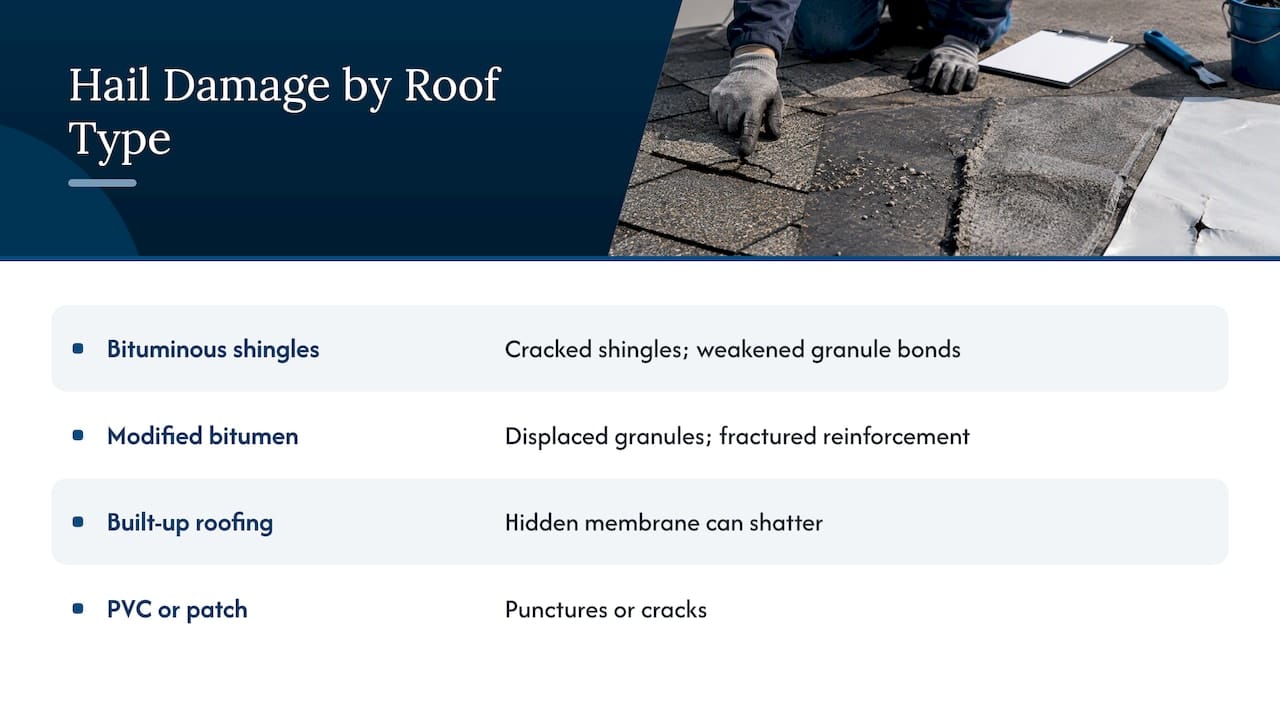
Built-up roofs behave differently again. One manufacturer’s guidance on hail remediation says that hail can shatter the membrane hidden underneath the surface. This may not be visible at first. Later, fine dirt collects in spider-web cracks and gives the damage away.
The practical point is that the top surface can look acceptable while the layer doing the waterproofing is already fractured. That is why a roof can pass a quick glance and still leak at the next heavy downpour.
Why old and tired membranes crack first
Hail does not meet every roof on equal terms. The engineering view from FM, a property insurer’s research arm, is that hail resistance depends strongly on what condition the waterproofing was in beforehand. Its data sheet states that roofs with visible deficiencies such as deterioration, blisters, cracks or embrittlement are very susceptible to damage from even small hail. It also explains that as asphalt ages, solvents leave the material, which makes it brittle and reduces adhesion to the reinforcing felts.
A second FM document on inspection and maintenance makes a related point. Membranes can become brittle through UV, heat and moisture, so smaller hail than they were originally tested against can damage them. It also advises that embrittled, deteriorating or widely deficient roofs be re-roofed or re-covered, and notes these conditions become more likely near the end of a roof’s service life or warranty.
For a Gauteng owner this translates into a simple checklist of vulnerability:
- Blisters or bubbles in the membrane
- Hairline cracking or a crazed, alligator-skin surface
- Exposed reinforcement mesh or scrim
- Lifting seams and edges
- A roof that has not been inspected or maintained for several years
- A system close to or beyond its guarantee period
If several of these apply, hail does not need to be large to cause trouble.
Existing defects versus hail damage
Not every crack after a storm is hail damage. Nebraska’s Department of Insurance points out that weathering can cause craze cracks, shrinkage cracks and blisters, while hail typically leaves random strike marks, so these defects should not automatically be blamed on hail. Researchers writing for IIBEC go further and say that telling hail fractures from weather, stress or thermal-movement cracking is a complex task that often needs professional test cuts and analysis.
This matters because the cause of a crack affects the repair, and sometimes who pays for it. It is a job for a trained eye, not a guess.
Why Gauteng roofs are exposed
Gauteng’s summer weather is a harsh combination. Intense afternoon thunderstorms arrive after hot, dry days, so roofing is baked by strong sun and then hit by sudden hail and heavy rain. A membrane expands in the heat, contracts at night and ages under UV long before any hailstone lands on it. Over the seasons, that cycle opens the hairline cracks and weak seams that hail then exploits.
Many Gauteng homes also have flat or low-pitch concrete roof slabs, which rely entirely on the waterproofing layer to keep water out. When water cannot drain quickly, even a small crack becomes a leak. Our guide to why flat-roof homes flood in Gauteng explains how ponding makes things worse, and our piece on why Gauteng summer storms damage roofs covers the wind side of the same storms.
The same logic applies in the Western Cape, although the weather pattern differs: the principle that a weathered membrane is the vulnerable one holds anywhere hail falls.
Signs that hail has damaged your waterproofing
Start from the ground and the gutters, then move indoors. The checklist mentioned earlier lists the following possible signs of hail damage and water entry:
- Loose granules collecting in gutters and downpipes
- Dark or bruised spots on the surface
- Cracked or missing shingles, or cracked slate and clay tiles
- Punctured soft roofing
- Dented vents and flashings
- Interior leaks, ceiling stains, mould or wet insulation
The same checklist describes cracks, crow’s-foot patterns and concentric semi-circular marks in thermoplastic polyolefin membranes as possible storm damage.
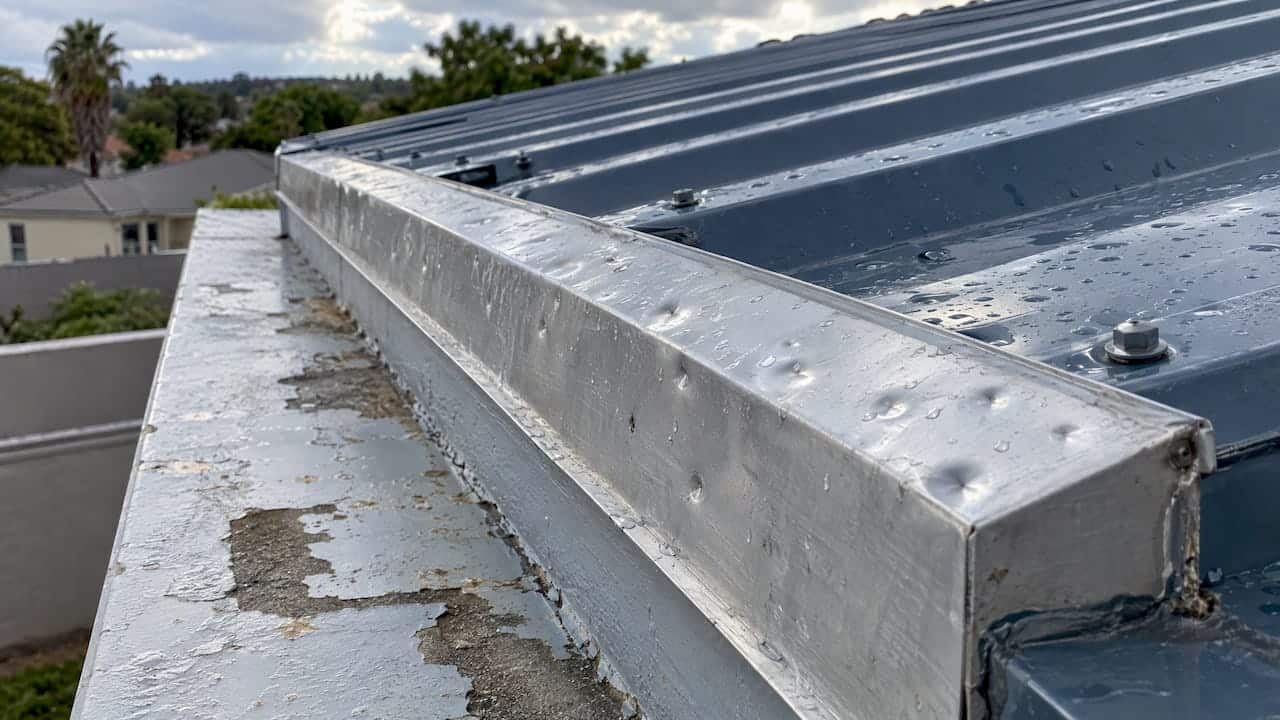
In Gauteng, add a few local observations. Look for dents in aluminium or painted metal flashings and roof sheeting, chipped paint on a coated slab, and fresh pale marks on a dark bituminous surface. Indoors, check ceilings below the roof after the first heavy rain following the storm, not only on the day itself. Water often tracks along the slab before it appears.
A stain that appears days later is still a hail symptom if the fracture was there from the storm. Do not wait for dripping before acting.
What a post-hail waterproofing inspection should cover
A walk across the middle of the roof is not an inspection. Intertek, a testing and inspection company, explains that hail damage may be concealed from ground level and can affect field membranes, seams, flashings, penetrations, drains, roof edges, skylights and roof-mounted equipment. Its view is that the most consequential water-entry paths are often at seams, penetrations, edges, drainage points and transitions, where concealed impact or seal failure can develop.
A thorough post-hail inspection should therefore include:
- The field of the membrane. Surface cracks, bruising, blistering, exposed reinforcement and lost granules.
- Seams and laps. Any lifting, open edges or hairline separation.
- Upstands and flashings. Parapet walls, wall junctions, vents, pipes and skylights, where dents or cracked sealant let water behind the membrane.
- Drainage. Outlets, gutters, downpipes and the fall of the slab. Hail debris and stripped granules can block drains and cause ponding.
- Edges and transitions. Roof perimeters and changes of material.
- The underside. Ceilings, slab soffits and walls for damp, staining or efflorescence.
- Test cuts or testing where needed. When the cause of a crack is unclear, professionals may need to open the layers to see what is happening.
FM recommends semi-annual roof inspections plus specific checks before and after storms, focusing on flashings, drains and signs of membrane brittleness. In a hail-prone region such as Gauteng, that rhythm is sensible: one check before the summer storm season and one after any serious hailstorm.
Flood testing after repairs
After repair work, the waterproofing should be proved, not assumed. South Africa’s Department of Public Works general specification describes formal testing before surface finishes go on, with flood tests of 48 hours or spark and vacuum testing, depending on the surface. The same specification says systems go onto dry, stable, clean substrates, and that cracks up to 0.3 mm in cementitious surfaces are acceptable but larger defects invite failure. Our article on flood testing waterproofing explains how this works on a typical home.
Who should do the inspection
Ask who is actually assessing your roof. A South African installation quality guide for roof structures states that inspections should be carried out by a competent person who is ITC-SA accredited or SAQA-registered. Ask for credentials, experience with your type of roof, and a written report with photographs. Our piece on the role of waterproofing consultants describes what a good assessment looks like.
What to do in the first days after hail
You do not need to climb onto the roof. Wet, hail-covered surfaces are slippery and a cracked membrane or slab edge is dangerous to step on. Work from the ground and from inside.
- Photograph first. Take dated photos of the hailstones if you can, damaged gutters, dented metal, debris and any interior stains. Keep everything as it was until the inspection is done.
- Clear what you can reach safely. Remove hail and leaves from drains and gutters from a ladder-free position, so water does not pond on the roof.
- Control water indoors. Move furniture, place buckets, and lift wet insulation or carpets where safe.
- Book an assessment promptly. Small fractures let water in slowly, and damp that sits in a slab or ceiling gets worse each storm.
- Avoid cosmetic over-coating. Painting or coating over cracks you have not diagnosed can trap water and hide the evidence.
- Keep records. Note the date of the storm, the date you noticed each sign and every report or quote you receive. If your property is insured, check your policy wording and speak to your insurer or broker about their requirements for reporting storm damage.
If you manage a commercial or industrial building, put the inspection in your storm-response plan so it happens after every event without anyone having to remember.
Repair or replace: what the inspection decides
The report should give you a clear answer between three outcomes. Localised damage, such as a few punctures or open seams, can usually be repaired with compatible materials. Widespread cracking on a roof in reasonable condition may justify a liquid membrane over a properly prepared surface. Our guide to liquid membrane waterproofing explains where that fits. A roof that is brittle throughout, or at the end of its life, is better re-covered than patched, in line with the FM advice above.
If you are comparing options, our overview of roof waterproofing types in South Africa sets out the main systems, and assessing your waterproofing needs helps you prepare questions before you speak to a contractor.
Get your roof assessed
If a storm has just passed over your property, or your roof is ageing and showing blisters or cracks, ask us for a quote request. We connect homeowners, building managers and commercial and industrial owners in Gauteng and the Western Cape with vetted waterproofing professionals, and we help you ask the right questions about quality, experience, licensing and warranties before you commit.

Request a waterproofing quote from Pro Waterproofing and describe the damage you can see. A qualified contractor can then inspect, diagnose and propose the right repair.
Perspective
Most of the hail-related leaks we hear about are not caused by one dramatic hole. They come from a roof that was already ageing: a membrane with hairline cracks, a seam that had started to lift, a drain that did not clear well. Hail simply finds the weakest point.
That is why we push owners to treat inspection as part of ownership, not as an emergency measure. A trained person who checks seams, upstands, drains and the underside of the slab after a storm will catch the small fracture before it becomes a stained ceiling and a damp wall.
It is also why we focus on helping you choose the right contractor. Ask about licensing, experience with your roof type, the written scope of work and the warranty on the repair. A good contractor will explain the cause of the damage, show you photographs and prove the result with a flood test where it applies.
Our aim is simple: you get matched with a waterproofing professional who can tell you honestly what the storm did to your roof and what it takes to make it watertight again.
Eben
FAQ
Can hail damage waterproofing without leaving a visible hole?
Yes. Hail can fracture the reinforcement inside a membrane or loosen its bond while the surface still looks intact. Guidance on built-up roofs describes hidden shattering that is only identified later when fine dirt collects in spider-web cracks. That is why a professional check is worth having even when nothing drips.
How soon should I have my roof inspected after hail?
As soon as it is safe, ideally before the next heavy rain. FM’s guidance calls for specific checks after storms as well as regular scheduled inspections. Early inspection also gives you fresh photographs and a clear record of the damage you found.
Is every crack on my roof caused by hail?
No. Sun, heat, shrinkage and movement all cause cracks, and hail leaves random strike marks rather than a uniform pattern. Separating the two can be difficult and sometimes needs test cuts, so ask your inspector to explain what they found and why.
Do I need to go onto the roof to check for damage?
No, and you should not. Wet roofs are slippery and damaged surfaces can be unsafe. Look at gutters, downpipes, ceilings and visible flashings from the ground and inside, photograph what you see and leave the roof itself to a qualified person.
What should I look for in a contractor after hail damage?
Look for relevant credentials, experience with your roof type, a written report with photographs, a clear scope of work and a warranty on the repair. A South African installation guide says inspections should be done by a competent person who is ITC-SA accredited or SAQA-registered.
Sources
- Hail Damage Technical Bulletin (February 2025)
- FM DS 1-34 Hail Damage data sheet
- Checklist to Spot Roof Hail Damage (2022)
- Understanding Hail Remediation
- FM DS 1-32 Inspection and Maintenance of Roof Assemblies
- Hail Damage: Does My Roof Need Repair? (Nebraska Department of Insurance)
- Not All It’s Cracked Up to Be? Surface Fracturing of PVC and KEE Membranes (IIBEC)
- Hail Damage and Commercial Roof Inspections (Intertek)
- Public Works General Specification (South Africa, 2014)
- Installation Quality Guide for roof structures in South Africa (2025)