
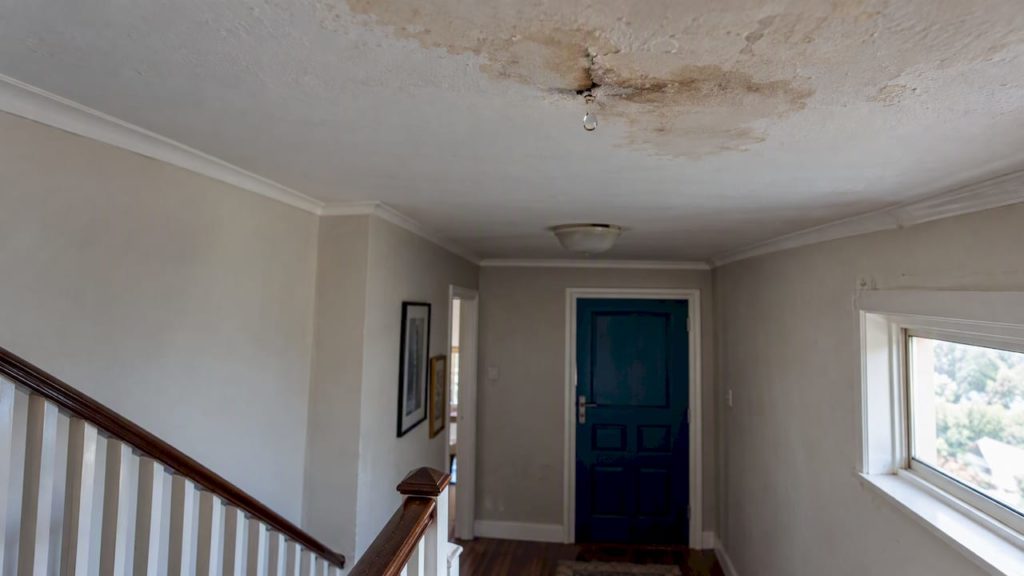
Ceiling leaks come from three places: water getting in through the roof, water escaping from pipes or fittings above the ceiling, and condensation that only looks like a leak. The quickest way to tell them apart is to ask when the stain appears. Water that shows up only after rain points to the roof. Water that shows up after a shower, a flush or a washing cycle points to plumbing. A damp patch that returns in cold or humid weather with no rain and no running taps is often condensation.
This guide walks through each cause, the clues that give it away, why the stain is often nowhere near the real entry point, and what to do in the first hour. It also explains why leaks so often appear during or after thunderstorms.
TL;DR
- Most ceiling leaks come from the roof (damaged coverings, flashing, gutters, vents), from plumbing (pipes, drains, toilets, showers) or from condensation.
- Timing is your best clue: a leak after a weather event suggests the roof, while a constant leak suggests plumbing.
- The stain is rarely directly below the entry point, because water travels along timbers, slabs and insulation before it drops.
- After a storm, wind-driven rain forces its way past damaged or lifted roof coverings and vent components, then soaks the insulation above.
- Stop the water, protect the room and electrics, and get the source found before repairing the plaster, otherwise the stain will come back.
Table of Contents
- The three families of ceiling leak
- Roof-related causes
- Plumbing causes
- Condensation that looks like a leak
- Reading the clues: timing and location
- Why ceilings leak after thunderstorms
- Water through a light fitting or ceiling fan
- Is a leaking ceiling an emergency?
- What to do in the first hour
- Drying and repairing the ceiling itself
- Perspective: why we push for the cause, not the patch
- Get the cause found and fixed properly
- FAQ
- Sources
The three families of ceiling leak
Almost every wet ceiling falls into one of three groups. Knowing which group you are in saves money, because the people who fix them are different: a roofer or waterproofing specialist for the roof, a plumber for pipes, and a ventilation or insulation fix for condensation.
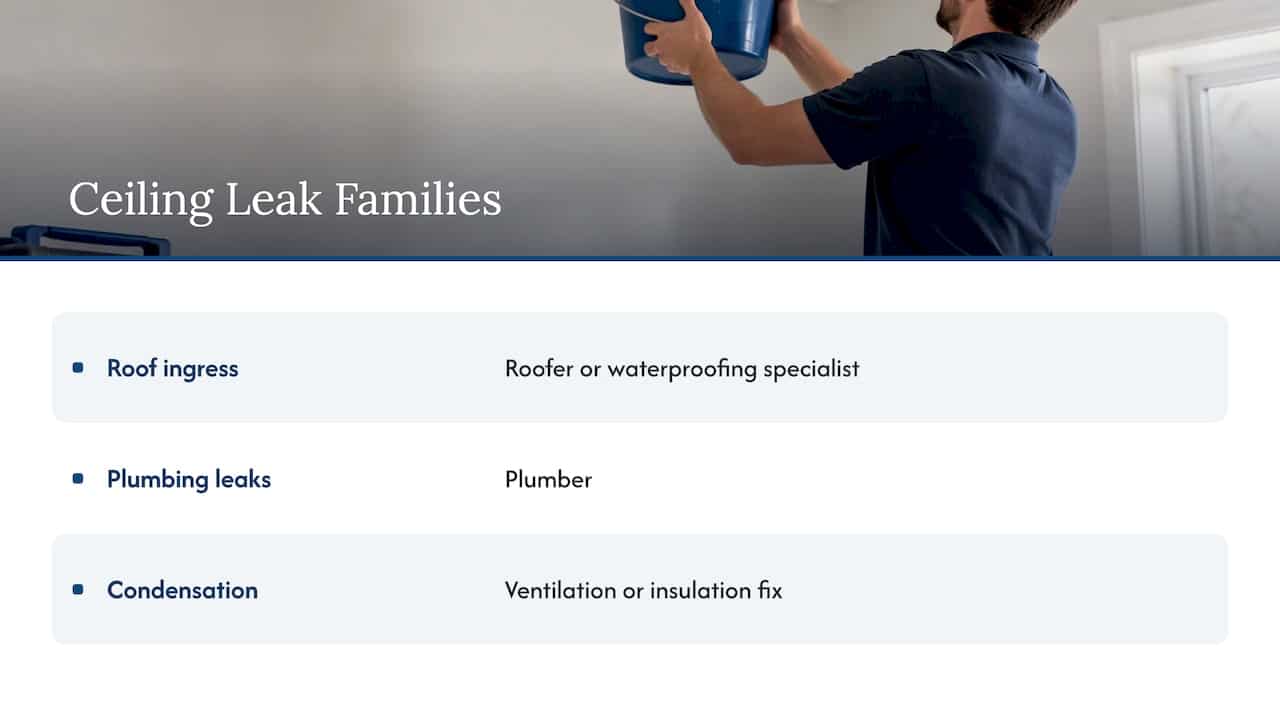
A general troubleshooting guide from The Spruce lists plumbing problems and roof problems as the likely causes. On the plumbing side that means damaged pipes, supply and drain lines, toilets, showers and bathtubs. On the roof side it means overflowing gutters, damaged shingles or tiles and failed flashing. It also warns that condensation, often from poorly ventilated bathrooms, kitchens or laundry rooms, can be mistaken for a leak.
Roof-related causes
If you have a pitched roof, a flat roof or a concrete deck above the room, water will find the weakest point. The usual weak points are the same in every climate.
Damaged or aged roof coverings
Cracked, slipped or missing tiles and shingles let rain reach the underlay and then the timbers. GAF, a roofing manufacturer in the United States, lists aging or cracked shingles among the common roof-leak causes. On a flat roof or concrete deck the equivalent is a membrane or screed that has split, blistered or lost adhesion at the edges.
Flashing, chimneys, skylights and vents
Anything that pokes through the roof is a joint that has to stay sealed for decades. The Canadian Roofing Contractors Association notes that roof leaks commonly occur at penetrations such as anchors, exhaust vents and drains. It also points to deteriorated parapets or sidewalls and curbs with missing flashing. SERVPRO adds cracked chimneys, skylights, vent boots, valleys and flashing to its list of roof-related sources.
Sealant is the quiet culprit here. Mastic, caulk and flashing compounds age, shrink and crack. If a ceiling stain sits beneath a chimney, a skylight, a soil vent or an extractor duct, start your search there.
Blocked gutters and drains
Gutters and outlets that cannot clear water make it back up under the roof edge or pool on a flat roof. GAF includes clogged gutters and, in cold climates, ice dams in its causes. In warmer places the same thing happens with leaves, debris and silted-up outlets on a flat roof, where standing water finds every pinhole.
If you want a closer look at how these failures look from the outside, our guide to common roof issues and our piece on what causes roof leaks in South African homes go through them in more detail.
Plumbing causes
Plumbing leaks happen when a pipe, joint or fitting above the ceiling lets go, or when a fixture in an upstairs room leaks into the floor below.
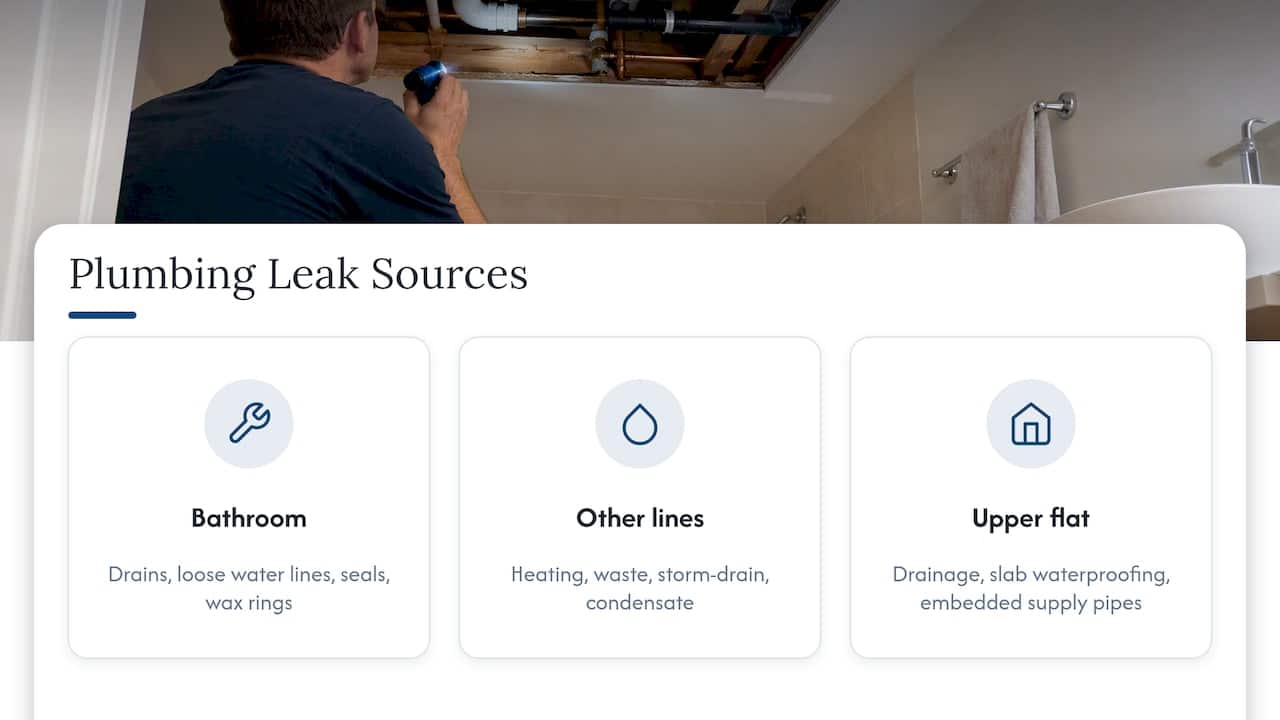
American Family Insurance says bathroom-ceiling leaks commonly come from leaking drain pipes, loose water-line connections, shower or bathtub drains, failed caulk seals and toilet wax rings. Heating, waste, storm-drain and condensate lines can also be the source, according to Facilities Management Insights.
In flats and multi-storey buildings, the leak may not be your plumbing at all. Hong Kong’s Food and Environmental Hygiene Department says ceiling seepage can result from defective drainage pipes, failed waterproofing of the upper-floor slab, or leaking water-supply pipes embedded in that slab. The practical lesson applies anywhere: a wet ceiling in a lower flat can come from the floor of the flat above, from its bathroom waterproofing as much as from its pipes.
Condensation that looks like a leak
Condensation forms when warm, moist air meets a cold surface. SERVPRO names poor ventilation, inadequate insulation and excessive humidifier settings as causes. Bathrooms, kitchens and laundry rooms are the usual places, because they make steam.
Signs that point to condensation rather than a leak:
- Droplets or a damp film across a wide area, rather than one dripping point.
- It appears in cold or humid weather, and dries when the room warms up or is ventilated.
- Black speckled mould in corners or along the cold edge of the ceiling.
- No link to rain and no link to any appliance being used.
If the patch is spreading and is obviously wet at one spot, assume a leak until you have proved otherwise.
Reading the clues: timing and location
When does it appear?
The timing of the leak narrows the field fast.
| When the ceiling is wet | Likely source |
|---|---|
| During or after rain only | Roof covering, flashing, gutters, vents, skylight |
| Constant, regardless of weather | Supply, waste, heating or condensate pipework |
| After showering | Shower or bath drain, or failed caulk seal |
| After flushing | Toilet wax ring or waste connection |
| After using a sink | Sink drain or supply pipes |
| Cold, humid mornings, no water use | Condensation |
The shower, flush and sink pointers come from American Family’s guidance on bathroom ceiling leaks. The weather versus constant split comes from Facilities Management Insights, which says a leak that occurs only after a weather event is more suggestive of a weather-related source, while a constant leak is more suggestive of plumbing.
The Canadian Roofing Contractors Association recommends using the timing of the leak, the weather conditions, the wind direction and whether it persists after the rain stops to narrow the source. Keep a simple note on your phone: date, weather, what was running in the house, and where the stain is. After two or three events a pattern usually shows.
Where is the stain, and where is the entry point?
The stain is a clue, not a map reference. New Zealand’s Department of Building and Housing warns that the visible moisture may be remote from the source because water can travel through framing and other building elements. Water runs along a rafter, a pipe, a slab edge or the underside of a membrane until it finds a gap in the plasterboard, then drops.
So when you go looking, work uphill and outward from the stain. Check the roof or slab above and to the sides, particularly any penetration, junction or gutter within a few metres. Our guide on how to identify roof leaks covers the steps, and finding a roof leak safely explains how to do it without climbing onto a wet roof.
Why ceilings leak after thunderstorms
If your ceiling only drips after a storm, the roof is the main suspect, and the nature of a thunderstorm explains why. Storms bring heavy rain, gusts and often debris. Rain arrives sideways rather than down, so it reaches places a normal shower never wets: under the lap of a tile, behind flashing, up into a vent.
FEMA’s 2019 advisory says wind damage to roof coverings and ventilation components can cause extensive water intrusion, and that water can saturate attic insulation during storms. That wet insulation matters. It acts like a sponge, holds the water and releases it slowly, which is why a ceiling can start dripping hours after the rain has stopped.
The usual storm-related causes are:
- Lifted or displaced coverings. Wind loosens tiles, sheets or membrane edges, and rain follows.
- Overwhelmed drainage. Gutters, downpipes and flat-roof outlets cannot keep up, so water backs up under edges and over upstands.
- Debris blockages. Leaves, hail residue and windblown litter clog outlets and valleys.
- Weak penetrations. Old sealant around vents, skylights and chimneys fails under wind-driven water.
- Pre-existing small defects. A hairline crack that never showed in light rain opens up under a deluge.
For the immediate steps once the rain has started, see our guide on what to do right now when your roof is leaking.
Water through a light fitting or ceiling fan
This is the version that worries people most, and rightly. Rain can enter through an exterior bathroom vent and run down into the fan housing or light. American Family’s advice is to turn off the vent’s breaker, put a bucket below, avoid touching a wet fan and have an electrician check the wiring and the fan.
In practice that means:
- Switch the circuit off at the consumer unit before anything else, and do not use the switch.
- Keep people and pets out from under the fixture, and catch the water in a bucket.
- Do not switch the power back on until a qualified electrician has checked the circuit.
The same logic applies to a downlight, since wiring and water must never meet.
Is a leaking ceiling an emergency?
Treat it as urgent if any of these apply:
- Water is near lights, sockets or a fan. Isolate the power first.
- The ceiling is sagging, bulging or has water pooling above it. Plasterboard full of water can fall, so stay out from beneath it and make a small drainage hole to release water only if you can do so safely from a distance.
- Signs of structural movement. The US Department of Energy advises consulting a professional engineer where damage compromises structural integrity. Signs include shifted foundations, slanted walls and floors that are not level. Our piece on identifying structural water damage explains why early action matters, and it is worth knowing the signs of serious structural damage that persistent leaks cause.
- The water might be sewage. Sewer back-up water may contain infectious viruses, bacteria and parasites, and the University of Florida’s guidance is to restrict occupancy of affected areas until the problem is dealt with and cleaned. Keep people out and call a plumber or drainage specialist.
A small, slow stain after rain is less urgent, but it should not wait for the next storm. Water you cannot see keeps working on timber, insulation and plaster.
What to do in the first hour
- Make it safe. Turn off power to the affected circuit if water is near any electrics.
- Catch the water. Use buckets and move furniture, rugs and electronics out of the way.
- Stop plumbing at the source. If the leak is constant, turn off the water at the stopcock and see whether it stops.
- Photograph it. Take dated photos of the stain and any damage. They help with any insurance claim, and with the contractor.
- Protect the structure. If it is the roof, a temporary covering can limit the damage. Gold Key Roofs, a US roofing company, notes that emergency stabilisation such as tarping an active roof leak is a common covered expense under commercial insurance policies. Read your own policy, since cover differs from one insurer and country to another.
- Get the source found. Patching the stain without finding the cause just delays the next leak.
Our guide to how to stop the damage and fix a wet ceiling takes you through the rest of the sequence.
Drying and repairing the ceiling itself
Do not paint over a damp ceiling. The US Department of Energy says that before covering, wood should have a moisture content below 20%, and drywall and plaster below 2%. It also says ceiling drywall that has been wet only by clean rainwater can stay if it is not sagging or mildewing and has not lost its smooth texture, while wet insulation should come out so the ceiling can dry properly.
That gives you a simple order of work:
- Find and fix the source of the water.
- Remove wet insulation and let the structure dry fully.
- Check the moisture level rather than judging by eye.
- Only then repair, prime and repaint.
Once the surface is dry, these four checks before patching ceiling plaster help you decide whether a patch will hold or whether a section needs replacing. If a stain bleeds through the paint again, moisture is still getting in.
Perspective: why we push for the cause, not the patch
In our experience, the most expensive ceiling leak is the one that has been repaired three times. Each time the stain is painted over, the water keeps travelling through the roof or slab above, and the damage grows where nobody is looking.
That is why our approach starts with a question rather than a quote: where is the water really coming from? A stain on the ceiling is only where the water gave up. The entry point is often a flashing, a penetration, a drainage outlet or a failing waterproofing layer metres away.
We built Pro Waterproofing around helping property owners ask the right questions of contractors: about experience, licensing, warranties and how the cause will be diagnosed. A contractor who can explain the leak path, and put a repair of the actual source in writing, is worth more than a quick patch. That is what we want every homeowner, building manager and commercial owner we work with to get.
Eben
Get the cause found and fixed properly
If your leak follows the rain, or comes from a roof, deck, balcony, bathroom or basement, it is a waterproofing problem and needs a specialist to trace and repair it. Through Pro Waterproofing you can send a quote request and be connected with vetted waterproofing professionals for residential, commercial and industrial properties, covering roof, basement, bathroom, foundation and concrete deck waterproofing in South Africa.

When you speak to any contractor, ask how they will find the source, what the work comes with in writing, and whether they are licensed and insured. Our roofing repair tips for avoiding full replacement show what a proportionate repair looks like.
FAQ
Why is rain water leaking from my ceiling fan?
Rain can enter through the exterior vent or ducting that serves the fan, then run down into the housing. Switch the circuit off at the breaker, put a bucket underneath and do not touch the wet fan. Have an electrician check the wiring and the fan, and have the vent cover and roof penetration repaired.
Is it an emergency if my ceiling is leaking?
It is an emergency when water is near electrics, the ceiling is sagging, the water may be sewage, or you see signs of structural movement. Isolate the power, keep people clear and call the right professional. A slow stain after rain is less urgent, but it should still be investigated before the next storm.
How can I tell a roof leak from a plumbing leak?
Check the timing. A leak that appears only after rain or wind suggests the roof, while one that is constant or follows showering, flushing or using a sink suggests plumbing. Remember that water can travel before it drops, so the stain may sit some distance from the real entry point.
Can condensation make a ceiling drip?
Yes. Warm, humid air condenses on cold ceilings, especially in poorly ventilated bathrooms, kitchens and laundry rooms, and where insulation is thin. Condensation tends to cover a wide area, appears in cold or humid conditions and often comes with mould. A single wet spot that grows is more likely a leak.
Why does my ceiling leak after thunderstorms but not in normal rain?
Storm rain is heavier and wind-driven, so it reaches gaps that normal rain does not: lifted coverings, worn flashing, and blocked or overwhelmed gutters and outlets. Wet insulation can also release water hours after the storm ends. Have the roof inspected for the specific entry point rather than only repairing the stain.
Sources
- How to Troubleshoot and Repair a Leaking Ceiling, The Spruce
- Water Seepage Investigation, Food and Environmental Hygiene Department, Hong Kong
- Locate the Problem Area, Canadian Roofing Contractors Association
- How to Identify and Repair Roof Leaks, GAF
- How to deal with bathroom ceiling leaks, American Family Insurance
- Water-Damaged Ceiling Warning Signs and Repair Tips, SERVPRO
- Weathertightness: Guide to the Diagnosis of Leaky Buildings, New Zealand Department of Building and Housing
- How to Perform a Leak Investigation, Facilities Management Insights
- Best Practices for Minimizing Wind and Water Infiltration, FEMA
- Repairing Roofs and Ceilings, US Department of Energy
- Water Intrusion Problems, University of Florida Environmental Health and Safety
- Commercial Roof Storm Damage Restoration, Gold Key Roofs