

Verifying a contractor’s licence is the one check that turns a sales pitch into something you can test against an official record. It tells you whether the business is entitled to do the work, whether it is in good standing, and whether you keep the protections that depend on hiring someone licensed. For waterproofing, where a failed job often shows itself only after the next heavy rain, that check belongs before you sign anything or pay a deposit.
This guide explains what verification does and does not prove, how the main official registers work, what to check in South Africa, including Gauteng and the Western Cape, and how to combine the licence check with the questions that separate a reliable contractor from a merely registered one.
TL;DR
- A licence or registration check confirms status, authorised work and any disciplinary history, and it can decide whether statutory protections apply to you.
- Do it before you sign a contract or pay a deposit, using the official register and not a certificate the contractor hands you.
- A valid licence is not the whole picture: check insurance, the scope the licence covers, references and a written contract too.
- Rules differ by country and by type of work, so confirm what applies to your property and your job.
- In South Africa, the CIDB register of contractors lets you filter by status and grade; ask your contractor which registrations apply to their work.
Table of Contents
- What licence verification actually does for you
- What verification does not prove
- How the official registers work
- The South African picture
- A step-by-step verification routine
- Red flags that verification catches
- Why waterproofing makes this more important
- Our perspective
- Get a quote from a vetted waterproofing professional
- FAQ
- Sources
What licence verification actually does for you
A licence is not a mark of quality. It is a regulator’s statement that a person or company has met entry requirements and is currently allowed to carry out a defined type of work. Verification is how you confirm that statement is still true today.
Three things follow from that.
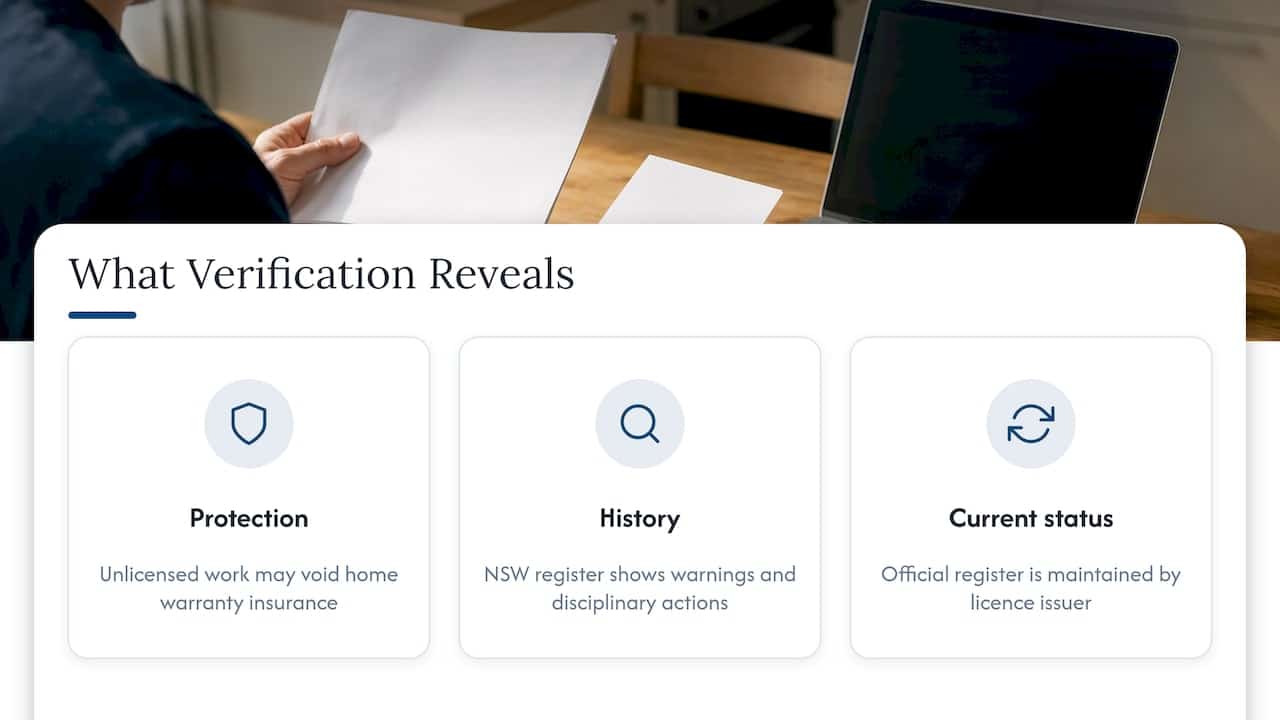
It protects your legal and financial position. Queensland’s building regulator warns that unlicensed work increases the risk of defective or unfinished work and may void access to the state’s home warranty insurance. The lesson travels well: in many systems, hiring the wrong kind of contractor does not just risk poor work, it can remove the safety net that would have paid for putting it right.
It surfaces history you cannot see from a quote. New South Wales explains that its public register shows authorised work categories, licence dates, warnings, disciplinary actions, suspensions or cancellations, and certain statutory insurance claims. A glossy brochure shows none of that.
It stops you relying on paper the contractor controls. A photocopied certificate can be out of date. An official register is maintained by the body that issues the licence.
What verification does not prove
A clean register entry tells you the contractor is allowed to work. It does not tell you the quality of the work, whether the quote is fair, or whether the person who turns up is the one who was licensed. New Zealand’s consumer checklist makes this point clearly: competence and insurance checks do not replace consent requirements or licensed supervision for higher-risk work. Treat the licence check as the first gate, not the last.
How the official registers work
The wording differs, but the pattern is consistent across jurisdictions: look the contractor up in the issuing body’s register, confirm the record matches the business in front of you, and read what it says.
| Jurisdiction | What you can check | Source |
|---|---|---|
| South Africa (CIDB) | Contractor search with status filters: active, deregistered, expired, suspended, and contractor designation ranges | CIDB register of contractors |
| New South Wales, Australia | Licence by name or number, authorised work, disciplinary actions | NSW step-by-step guide |
| California, US | Licence status online or by phone, by licence number, business or contractor name | CSLB guidance |
| Washington State, US | Active registration, workers’ compensation account status, safety citations, bond lawsuits | Labor & Industries tool |
| Québec, Canada | Licence validity and subclasses for the contracted work | RBQ guidance |
A few details worth copying wherever you are:
- Search by more than one identifier. California’s regulator says owners can search by licence number, business name or contractor name and should check the address of record against the business you are dealing with.
- Check the expiry date. The US emergency management agency FEMA advises asking for a licence copy, checking its expiry date and contacting the issuing authority to confirm good standing.
- A digital licence counts. Queensland says a digital licence has the same legal standing as a physical card, so a phone screen is acceptable, as long as you then confirm it on the register.
The South African picture
South Africa does not work like a single state licensing board. Different registrations apply to different kinds of work, and a few are worth knowing for waterproofing projects.
CIDB registration. The Construction Industry Development Board keeps a public register of contractors. Its contractor search offers status filters for active, deregistered, expired and suspended contractors, as well as designation ranges. For a commercial or industrial roof or deck, where the contract value may be substantial, a contractor’s status and grading on this register is a sensible first look. Ask the contractor for their CIDB registration number and find them on the portal yourself.
Specialist registrations. Some work carries its own rules. For instance, the Department of Employment and Labour’s published list notes that type 2 and 3 asbestos work requires registration with the chief inspector. This matters in practice because older roofs and sheeting on industrial and commercial buildings in Gauteng and the Western Cape may contain asbestos-cement. If your waterproofing job touches such material, ask who is registered to handle it before anyone starts.
Provincial and municipal requirements. Building plans, approvals and trade requirements are set partly at municipal level, and they can differ between a City of Cape Town property and one in Johannesburg or Tshwane. Confirm with your local municipality whether your project needs approval, and ask your contractor to explain how they handle it.
Because registration systems differ by country and by type of work, never assume that a rule you read about elsewhere applies at home. Queensland, for example, requires a licence for building work valued over A$3,300, while Hawaii sets its threshold at US$1,500 in labour and materials or any project needing a building, electrical or plumbing permit. Thresholds, trades and consequences all vary. FEMA also notes that licensing may be state, county or city based and may not exist in every jurisdiction, so a lack of a licensing board does not mean there is nothing to check; it means you rely more heavily on the other checks below.
A step-by-step verification routine
1. Ask for registration details in writing
Request the business’s registered name, registration or licence numbers, and the physical address. A contractor who is properly registered gives these without hesitation.
2. Look them up on the official register
Use the issuing body’s own site, not a link or PDF sent by the contractor. In South Africa, start with the CIDB portal. Match the name, number and address, and read the status.
3. Check status, expiry and standing
An expired, suspended or deregistered entry is a stop sign. Where a register shows warnings or disciplinary action, as New South Wales’s does, read them. The Connecticut consumer agency’s 2026 checklist goes further and notes that a home-improvement registration card is valid for one year, a reminder that registrations lapse and need renewing.
4. Match the licence to the job
Arizona’s regulator advises checking the licence class against the work in the contract and confirming that the person negotiating is an authorised representative. A contractor licensed for one trade is not automatically covered for another. Waterproofing a basement, a roof deck or a foundation can involve concrete, drainage or plumbing elements, so ask exactly which parts of the job the registration covers.
5. Check insurance separately
A licence and insurance are different things. FEMA advises requesting a certificate of general liability insurance, checking its expiry and confirming it with the issuer. Washington’s verification tool also shows workers’ compensation account status, because uninsured workers on your roof can become your problem. In South Africa, ask for proof of public liability cover and of cover for the workers on site.
6. Check references and past work
The register can’t tell you whether a roof stayed dry for five years. For that you need people who have lived with the work. We cover this in questions to ask a reference for a contractor and, specifically for our trade, top questions to ask contractor references for waterproofing.
7. Put it all in a written contract
New South Wales advises owners to confirm insurance, ask for references and who will supervise the work, and use a written contract setting out costs, timelines, scope and payment schedule. Add the warranty terms: how long it runs, what it covers and who honours it.
Red flags that verification catches
- The contractor cannot give a registration number, or gives one that does not match the business name on the quote.
- The register shows the registration as expired, suspended or deregistered.
- The registration exists but covers a different type of work from the one you want done.
- The person you meet is not the registered business’s representative.
- Pressure to pay a large deposit before any of the above is confirmed. In New South Wales, contractors must obtain insurance cover before starting work or accepting any payment, including deposits on projects above A$20,000. Whatever the local rule, paying before verifying removes your leverage.
If a check fails, do not sign. Queensland’s guidance is to ask to see the licence and confirm authorisation before signing a contract or handing over money. If something is missing, ask the contractor to fix it in writing, or move on.
Why waterproofing makes this more important
Waterproofing failures are rarely visible on handover. Membranes, screeds and flashings are covered by finishes, and leaks appear later, often after the contractor has moved on. That makes the paper trail the main protection you have: a verified registration, insurance, a defined scope and a warranty you can enforce.
It also makes the questions you ask as important as the register. Our guides on the questions to ask a contractor, interviewing a contractor and a contractor assessment checklist for waterproofing take you through quality, experience, licensing and warranties in the order a decision needs them. For general hiring habits, see 7 tips for hiring contractors in South Africa.
Our perspective
We built our guidance around one idea: a property owner should never have to guess whether a contractor is the right one. Licensing, experience, quality of workmanship and warranties are the four things we ask owners to look at, and licensing comes first because it is the only one you can check against an official record in minutes.
For homeowners in Gauteng and the Western Cape, a leaking roof or damp basement feels urgent, and urgency is when people skip checks. For building managers and industrial owners, the cost of a failed deck or roof membrane is far larger than the time a verification takes. In both cases the routine is the same: ask for the details, confirm them at source, match them to the work, and get everything in writing.
Our aim is to connect owners with vetted waterproofing professionals, and to give you the questions that let you judge any contractor with confidence.
Eben
Get a quote from a vetted waterproofing professional
If you have a roof, basement, bathroom, foundation or concrete deck that needs waterproofing, we connect property owners, building managers and investors across South Africa with vetted waterproofing professionals. Send us your request through the contact form on our site and we will take it from there.
Start your request on the Pro Waterproofing site, then use the routine above to confirm the registrations and cover of whoever quotes.
FAQ
Is a licence the same as a guarantee of good work?
No. A licence confirms that a contractor is entitled to do a type of work and is in good standing. It does not measure workmanship. Combine it with insurance proof, references and a written warranty.
Where do I verify a contractor in South Africa?
For construction contractors, the CIDB’s online register lets you search and filter by status, such as active, expired or suspended, and by designation range. Ask your contractor which other registrations apply to the work, such as specialist registrations for hazardous materials, and confirm those with the issuing body.
When should I do the check?
Before you sign the contract and before you pay any deposit. Regulators in Queensland and New South Wales both stress checking first, because protections and insurance can depend on the contractor being properly licensed and covered from the start.
What if the contractor’s licence covers different work from my job?
Treat it as a mismatch and ask for written confirmation of what is covered. Regulators such as Arizona’s advise checking the licence class against the contract’s work. If the contractor cannot show cover for the work you need, find one who can.
Do I need to check again if I have used the contractor before?
Yes. Registrations expire and can be suspended, and insurance certificates have end dates. Repeat the check for each new contract.
Sources
- Queensland Building and Construction Commission: who must hold a licence
- NSW public register facts
- NSW step-by-step guide to choosing a tradesperson or builder
- CSLB: finding the right licensed contractor
- Washington L&I: verify a contractor
- FEMA checklist to ask your general contractor
- Connecticut DCP consumer checklist: hiring a contractor
- New Zealand MBIE consumer protection checklist
- Hawaii DCCA: hire a licensed contractor
- Régie du bâtiment du Québec: choosing a contractor
- Arizona Registrar of Contractors: before you hire
- CIDB register of contractors
- South Africa list of registered asbestos contractors 2022 to 2025