

Basement car parks in Gauteng flood for four main reasons. Summer storms deliver more water than the surrounding drainage can carry. That water runs downhill to the lowest point, which is usually the ramp. Drains and sumps that nobody has serviced cannot cope with the load. And waterproofing that was badly applied or has aged lets groundwater in from the walls and slab. Most floods are a combination of these. Finding which one applies to your building is the first step towards a lasting repair, and a qualified waterproofing contractor can help with that. We connect property owners and managers with vetted waterproofing professionals through a quote request on our site.
TL;DR
- Gauteng’s summer rain falls in short, intense bursts, and runoff arrives faster than drainage can accommodate. A basement ramp is a natural collection point.
- New paving, extensions and changed levels send more water to old drains than they were designed for.
- Flooding only in big storms usually points to blocked flow paths, drains or sumps. Damp that persists after rain points to failed waterproofing.
- Visible leaks rarely sit where the failure is, so a proper inspection beats patching the wet spot.
- Body corporates and owners have maintenance duties for drains and pumps, and neglect can carry legal liability.
Table of Contents
- How a Gauteng storm becomes a flooded car park
- Five causes, and how to tell them apart
- Why the wet patch is not where the problem is
- A practical way to work out which problem you have
- What to do when the car park is flooding
- Fixing it properly
- Questions to put to any contractor
- Perspective
- Get your car park assessed
- FAQ
- Sources
How a Gauteng storm becomes a flooded car park
The Highveld gets most of its rain in summer, and much of it comes as afternoon thunderstorms. Architecture SA, writing for South African building professionals, notes that these short, intense downpours produce runoff faster than drainage systems can accommodate, particularly over large roofs, roads and paved areas. Low points such as basement entrances and below-ground parking collect that water.
Think of your site as a catchment. Every square metre of roof, driveway and paving sheds almost all the rain that lands on it. In a storm, that water leaves the surface within minutes. If the route it takes leads to a ramp that dips below the street, the ramp becomes the drain.
The Gauteng City Region Observatory’s official manual on sustainable drainage in the province explains the wider problem. Urban paving cuts the amount of water soaking into the ground, so sustainable drainage systems aim to reduce runoff volume and increase response time. Detention and retention can be designed to manage flood peaks. Where a building was designed before such thinking, the car park often takes the peak.
The same pattern shows up in the news. Reports from Turffontein in Johannesburg described residents blocking drainage systems by building ramps over them and filling them with soil, which made flooding worse. A small change to a surface can have a large effect downstream.
Five causes, and how to tell them apart
The table below links what you see to the likely cause. It is a starting point for the conversation with a contractor, not a diagnosis.
| What you see | Likely cause | What it usually needs |
|---|---|---|
| Water pours down the ramp during a storm, then drains away | Runoff reaching the ramp faster than the grate or drain can take it | Better drainage at the ramp entry, regrading, clearing inlets |
| Water rises from floor drains or the sump area | Overloaded or blocked drainage, failed pumps, or surcharged sewers | Drain clearing, pump servicing, backup power |
| Water sheets down walls after rain, staining and efflorescence | Groundwater pressure beating the waterproofing | Waterproofing investigation and repair |
| Damp at the wall and slab junction, hours or days after rain | Failed joints or cracks | Joint and crack treatment |
| Rust stains, flaking concrete | Long-term leaks reaching the reinforcing steel | Assessment of the concrete, then repair |
1. Too much water arrives at the ramp
When a site slopes toward a ramp, the ramp collects water from a far larger area than its own footprint. A grate at the top or bottom takes only so much. Beyond that, water goes over the grate and down.
FEMA’s fact sheet on urban flooding, written for building owners in the United States, makes the same point about the hazard: stormwater can flow into subgrade parking garages and trap people and vehicles. It advises owners to check whether driveways or garage ramps slope below the surrounding ground level. That check applies to any basement entrance in Gauteng.
2. Surfaces and levels have changed
A drainage system that coped for years can start failing after changes on site. Architecture SA points out that new driveways, extensions or paved entertainment areas increase the volume of water reaching an existing drain. A neighbouring development, a raised pavement or a new wall can also redirect water towards your entrance.
This matters for investors and managers taking over an older building. Ask what has been added since the original drawings. The flooding may not be a defect in the original design at all.
3. Drains, grates and sumps are not maintained
Leaves, litter and silt collect at ramp grates and in pits. Many underground car parks sit below the municipal sewer line, so they rely on sump pumps to lift water out. Cader & Co, a South African law firm writing for body corporates, states that such basements depend on dual automated sump pumps, and that trustees are advised to budget for backup pumps and generator connections in their long-term maintenance plans. That matters in Gauteng, where storms and power cuts often arrive together.
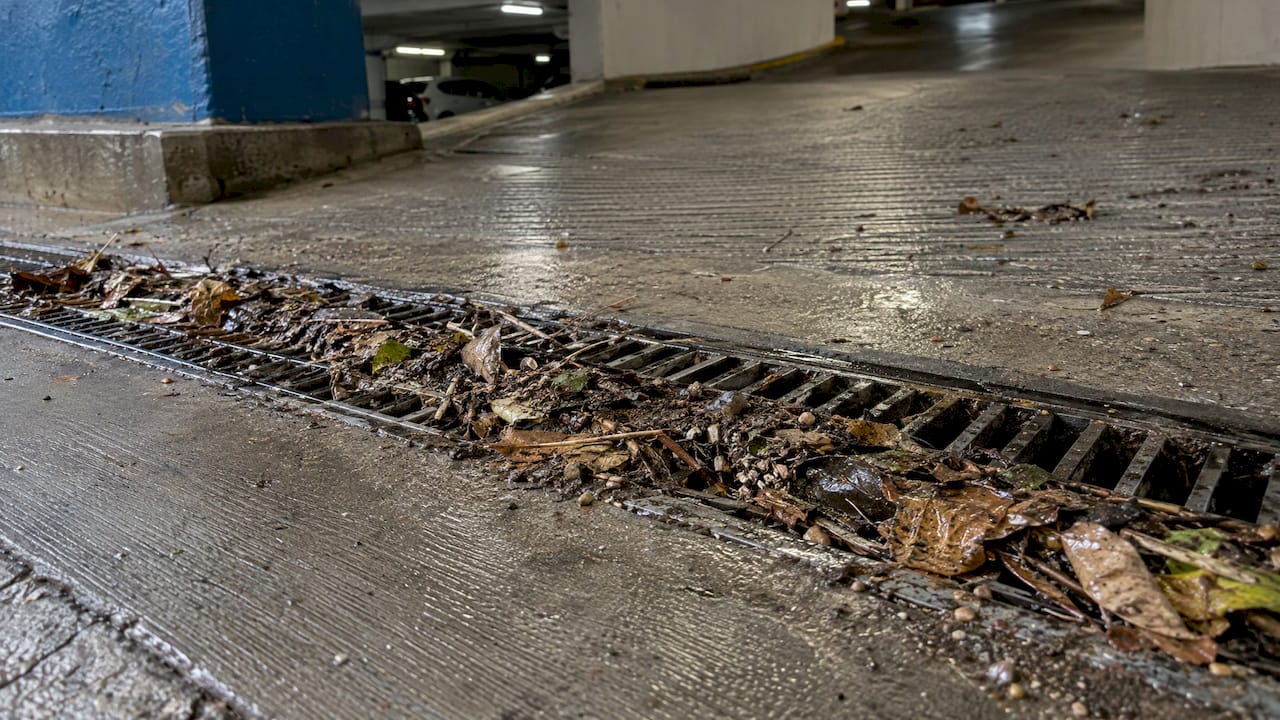
The same article says negligent failure to clear blocked common-property stormwater drains that damages neighbouring properties can expose a body corporate to common-law delictual liability. In plain terms: if you manage the drains and ignore them, you may be answerable for the damage.
The draft South African loading standard SANS 10160-5, published for public comment by the civil engineering community, goes in the same direction for design. Where a structure’s safety depends on a drainage system, the consequences of its failure must be considered, and a maintenance programme specified. A drain is part of the building’s protection, not an accessory.
4. Municipal systems are overwhelmed
A car park can also flood from below and from the sewer, not only from the surface. A study in the journal Frontiers in Water by Sandink and Binns documents that when stormwater systems are overwhelmed, surcharged municipal storm and wastewater sewers can back up through foundation drains and floor drains. The study also describes overland flow entering basements through openings above ground and seeping through backfill against foundation walls.
If your floor drains bubble up while the street is also running, the problem may start outside your boundary. Our own piece on how municipal strain leads to drainage failures in Gauteng goes into this for commercial properties.
5. Waterproofing has failed or was never right
This is the cause most owners miss, because it looks like a drainage problem. Below-ground walls and slabs take groundwater pressure. The draft SANS 10160-5 classifies water pressure below a structure from a long-term water table as a permanent action. It also says that for low- and medium-permeability soils such as silts and clays, water pressure should be assumed to act behind retaining walls unless reliable drainage is in place. Much of Gauteng’s ground is clay-rich, so that assumption is a sensible one.
The UK’s Property Care Association, in its guidance on below-ground waterproofing, says it should be assumed that water will bear against the full height of a below-ground structure at some time in its life. It also notes that a water table that rises briefly after heavy rain poses less penetration risk than one that stays high for long periods. The principle carries over: a Gauteng storm can lift the water table around a basement for days, and a wall that was never properly protected will show it.
Workmanship matters as much as design. South Africa’s National Home Builders Registration Council (NHBRC) published a forensic engineering report in June 2025 on a building with water ingress. It concluded the cause was incorrect application of waterproofing membranes and insufficient waterproofing in areas, rather than inadequate structural design. A second NHBRC report on another building recorded a degraded concrete roof slab and run-down waterproofing against upstand beams, which let water into the levels below.
Why the wet patch is not where the problem is
Water that gets past a membrane does not stay where it entered. It travels along the structure until it finds a way through, often a crack, a cold joint where the slab meets the wall, or a penetration. The patch you can see on the wall may be metres from the real failure.
That is why patching the wettest spot often fails by the next storm. A useful inspection tracks the pattern over time, ideally during or after heavy rain in the wet season, and follows the water back to its path in.
Long-term leaks also do slow damage. Water reaching the reinforcing steel causes it to rust and swell, which eventually pushes the concrete off in flakes. If you see rust-brown streaks or spalling, treat it as a structural question as well as a water one, and have an engineer look at the affected slab or wall.
A practical way to work out which problem you have
- Note when it floods. Water only in the heaviest storms points to blocked flow paths or exceeded drainage capacity. Damp that shows up in moderate rain, or lingers for days, points to groundwater and the waterproofing.
- Walk the site during or just after rain. Where does water run? Does it head toward the ramp? Has anything been built across its path, such as a wall, a raised bed or new paving?
- Check the ramp. Does it dip below the surrounding ground? Are grates clear and intact?
- Check pumps and sumps. Do both pumps run? Is there backup power? When were they last serviced?
- Look at walls and joints. Staining, white salt deposits, cracks, and damp at the wall and floor junction all matter.
- Record everything. Photograph water levels, dates and rainfall. A dated record helps a contractor and, for body corporates, supports your maintenance file.
The FEMA fact sheet also suggests checking for cracks between the building and the pavement, which let water run down the outside of basement walls. Those cracks are cheap to find and often overlooked.
What to do when the car park is flooding
Safety comes first. FEMA warns that people and vehicles can be trapped in flooded garages. Keep people out of the basement once water is rising, do not try to retrieve vehicles through deep or moving water, and switch off electricity to the area only if you can do so safely from a dry place. Call the emergency services and your electrician if water has reached electrical equipment.
Once the area is safe:
- Tell your insurer and your managing agent or trustees and record the damage with photographs.
- Have the pumps and drains checked as soon as it is safe.
- Arrange an inspection after the storm, while the water paths are still visible.
FEMA also mentions temporary barriers such as sandbags with plastic sheeting for emergency blocking. They buy time at an entrance. They are not a repair.
Fixing it properly
The right fix follows the cause.
For surface water at the ramp: restore the natural flow path, clear and repair grates, and look at levels and falls so water is directed away from the entrance rather than into it. Where the ramp collects runoff from a large area, a contractor may add drainage at the entry.
For drains and pumps: clear and service them on a schedule, test both pumps, and plan backup power. Make sure any attenuation or detention system on your title is maintained, since these often carry legal maintenance obligations.
For groundwater and waterproofing: this is specialist work. Depending on the findings, it can involve treating cracks and joints, restoring membranes and adding drainage behind walls. Our guides on stopping hydrostatic pressure without excavation and basement waterproofing techniques explain the methods and when each applies. For a broader view, see our practical guide to basement flooding solutions.

If the building is a commercial or industrial property, water may also be getting in higher up. Our article on storms, SANS and hidden damage in Gauteng commercial interiors shows how leaks from roofs and facades end up in lower levels.
Questions to put to any contractor
Because a car park repair is both a structural and a water problem, hire carefully. Ask about:
- Licensing and registration: who is legally responsible for the work?
- Experience: have they worked on below-ground car parks, not only roofs or bathrooms?
- Diagnosis: will they find the path of the water before quoting, rather than just treating the visible wet area?
- Warranty: what is covered, for how long, and what must you do to keep it valid?
- Maintenance: what do they recommend you inspect and service afterwards?
These are the questions we encourage every property owner to ask.
Perspective
A flooded car park rarely has a single cause, and that is why quick fixes disappoint. We see the pattern described in the evidence above as a chain: heavy Highveld rain, a ramp that collects it, a drain that is not coping and a wall that was never properly sealed. If one link is repaired and the others ignored, the next big storm finds the weak one.
Our approach is to help you hire well. Quality, experience, licensing and warranties are the questions that separate a lasting repair from an expensive patch. We provide region-specific guidance for Gauteng and Western Cape property owners and connect you with vetted waterproofing professionals, so the person who looks at your car park is someone who can diagnose it properly.
If your basement has flooded once, treat it as information. The building has told you where the water goes.
Eben
Get your car park assessed
If your basement car park has flooded, or shows damp, staining or rust after rain, send us a quote request. We connect homeowners, building managers and commercial and industrial owners in Gauteng with vetted waterproofing contractors. Start with our waterproofing service page and tell us what you are seeing.
The more detail you give, the better: when it floods, how deep, how long it takes to clear, and what repairs have been tried.
FAQ
Why does my basement car park flood only during very heavy storms?
Flooding only in large storms often means water is arriving faster than the drainage can remove it. Typical causes are a blocked route for water across the site, silted grates or an overloaded sump. Clearing and servicing the drainage and restoring the water’s path is usually the first step, with a capacity upgrade considered if it keeps happening.
Can new paving or an extension make a basement flood?
Yes. New driveways, extensions and paved areas increase the volume of water reaching an existing drain, so a system that once worked may no longer cope. If flooding began after building work, mention it when you ask for an inspection.
Who is responsible for drains and pumps in a sectional title building?
Common-property drains and pumps normally fall to the body corporate. Cader & Co notes that negligent failure to clear blocked common drains can expose a body corporate to delictual liability for damage to neighbours. Trustees should check their governing documents and take legal advice on their own position.
Is a leak at the wall a waterproofing failure or a drainage problem?
It can be either, and sometimes both. Water that is on the surface during storms points to drainage. Damp that appears at walls and joints, and lingers after rain, points to groundwater pressure beating the waterproofing. A proper inspection traces the water to its entry point before anything is repaired.
When is the best time to inspect for leaks?
During or soon after heavy rain in the summer rainy season, when soil water is at its highest. Repeat the check over time so changes in moisture show up, and keep dated photographs for your contractor.
Sources
- Summer Stormwater Planning for Buildings and Sites, Architecture SA
- Implementation Manual: SuDS in Gauteng, Gauteng City Region Observatory
- Reducing Urban Flood Risk Through Building- and Property-Level Flood Protection, Frontiers in Water
- Forensic Engineering Assessment Report, NHBRC, June 2025
- Investigation and Concept Report, NHBRC, April 2025
- Best Practice Guidance: Type A Waterproofing Systems, Property Care Association
- Draft SANS 10160-5, South African Institution of Civil Engineering
- Stormwater Reticulation: Attenuation Ponds, Sump Pumps, and Subterranean Systems, Cader & Co
- What Building Owners and Tenants Should Know About Urban Flooding, FEMA