
TL;DR:
- Choosing the right waterproofing cement is crucial for the long-term durability of structures, with product type, substrate condition, and pressure side considerations guiding selection. Crystalline admixtures offer permanent waterproofing by reacting within concrete, while surface sealers require periodic reapplications, and densifiers strengthen porous old concrete before coating. Proper surface preparation and matching the product to specific project conditions are essential to prevent failure and ensure lasting moisture protection.
Water is the single most destructive force acting on any building. Whether you are managing a damp basement in Cape Town or waterproofing a new concrete slab in Johannesburg, choosing the best waterproofing cement is one of the most consequential decisions you will make for the long-term health of that structure. The market is crowded with options, and the differences between them are not always obvious from the label. This guide cuts through the noise with clear criteria, detailed product profiles, and practical guidance to help you choose correctly the first time.
Table of Contents
- Key takeaways
- 1. What makes the best waterproofing cement: key criteria
- 2. One-component (1K) cementitious waterproofing coatings
- 3. Crystalline waterproofing admixtures
- 4. Silane and siloxane penetrating sealers
- 5. Lithium silicate concrete densifiers
- 6. Polymer-modified cementitious coatings (2K systems)
- 7. Comparison of leading waterproofing cement types
- 8. How to choose the best waterproofing cement for your project
- What I have learned from years of waterproofing decisions
- Get the right waterproofing solution with Prowaterproofing
- FAQ
Key takeaways
| Point | Details |
|---|---|
| Product type determines longevity | Crystalline admixtures are permanent and self-healing; surface sealers need reapplication every 5 to 10 years. |
| Surface preparation is non-negotiable | Even the best waterproofing cement will fail if applied to a contaminated or poorly prepared substrate. |
| Older concrete needs two steps | Aged or porous concrete performs best with a densifier applied first, then a hydrophobic sealer on top. |
| Breathability matters as much as impermeability | A good waterproofing cement manages moisture vapour as well as liquid water to prevent trapped moisture damage. |
| Match the product to the pressure side | Positive-side and negative-side applications demand different product formulations and service-life expectations. |
1. What makes the best waterproofing cement: key criteria
Before you compare brands, you need a framework for evaluation. The product that works brilliantly on a new reinforced basement slab may be entirely wrong for a 40-year-old garden retaining wall. These are the criteria that actually matter.
Durability under pressure. A 1K cementitious system delivers 15 to 20 years of service life under positive-side water pressure and 10 to 15 years on the negative side. Any product you consider should have a clearly stated service life backed by third-party test data, not just marketing copy.
Breathability. A waterproofing layer that traps moisture vapour causes almost as much damage as water ingress itself. Silane water repellents penetrate the substrate, form chemical bonds, and allow concrete to remain vapour permeable. Not all sealers offer this. Check whether the product is film-forming or penetrating before you commit.
Adhesion and crack resistance. Concrete moves. It shrinks as it cures, expands with heat, and settles over time. A waterproofing cement that cannot accommodate minor movement will crack and fail. Look for products with documented adhesion values and flexibility ratings.
Application method. Some products are brush applied, others are trowelled, sprayed, or added at the batching plant. The right choice depends on your access, skill level, and available equipment.
Compatibility. Admixtures must be compatible with your existing cement mix proportions. Coatings must adhere reliably to the specific substrate, whether that is concrete block, poured concrete, or masonry.
Environmental and safety profile. For occupied buildings or water-contact structures such as potable water tanks, check that the product carries the relevant certifications for VOC content and health safety.
Cost and regional availability. A product that performs exceptionally but is unavailable in your province, or requires specialist equipment to apply, is impractical regardless of its test results.
Pro Tip: Always request the full product data sheet, not just the brochure. Pay attention to the substrate preparation requirements. If a manufacturer does not publish detailed surface prep guidance, treat that as a red flag.
2. One-component (1K) cementitious waterproofing coatings
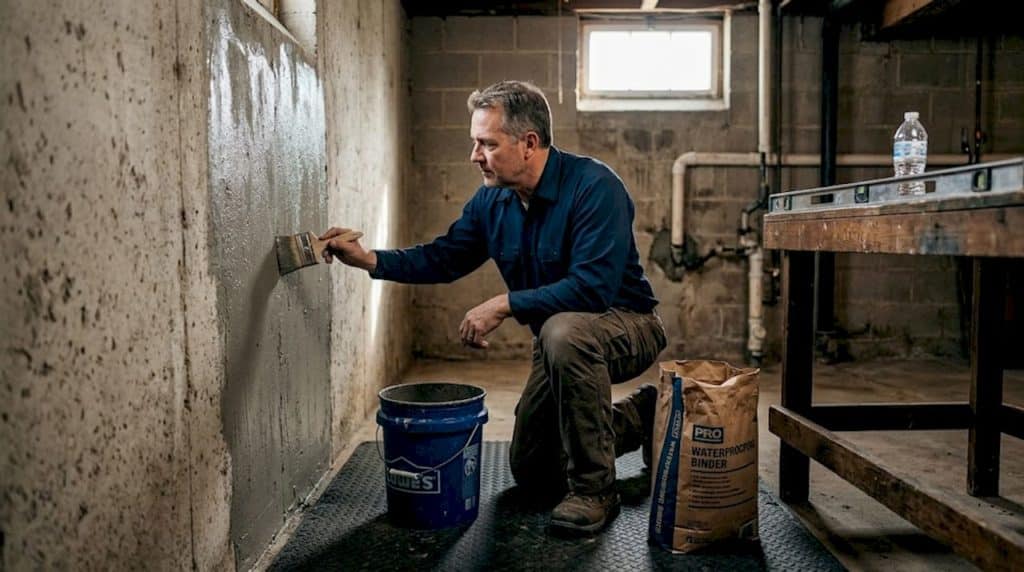
1K cementitious coatings are pre-blended powders that require only water to activate. They form a hard, breathable barrier that resists hydrostatic pressure, has strong adhesion to concrete and masonry, and provides good resistance to carbonation.
Key features:
- Pre-blended, requiring only water on site
- Suitable for positive and negative pressure applications
- Bridges hairline cracks up to 0.2mm
- Compatible with masonry, concrete block, and poured concrete
- Paintable once cured
These products are workhorses for basement walls, water tanks, swimming pools, and retaining walls. The trade-off is that they are rigid once set, so they are less suited to structures with significant ongoing movement. Service life on the positive side reaches 20 years with correct application. Cementitious membranes for basements offer an excellent starting point for understanding how these coatings perform in practice.
3. Crystalline waterproofing admixtures
Crystalline technology is one of the most significant advances in concrete waterproofing. When added to the concrete mix at the batching stage, crystalline admixtures react with water and cement particles to grow insoluble crystals within the capillary pores of the concrete. These crystals block water migration permanently.
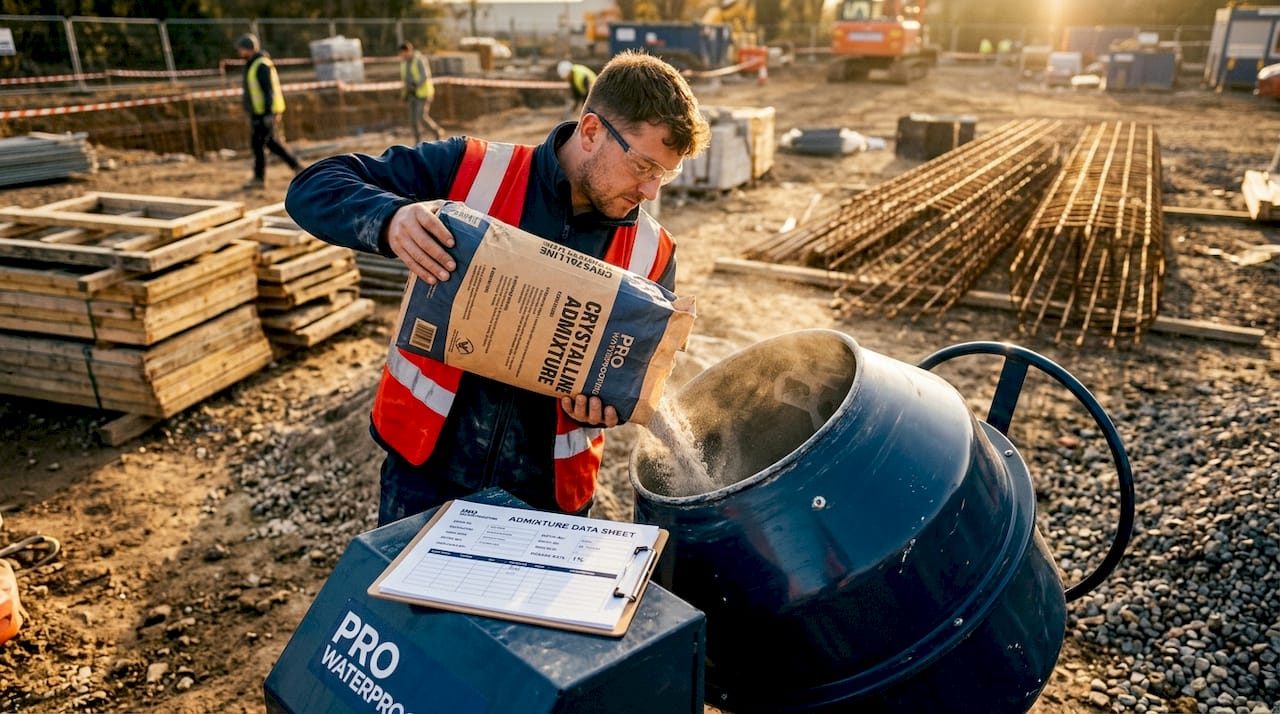
The most important distinction: crystalline admixtures are permanent and integral to the concrete for the life of the structure. If the concrete cracks and water re-enters, the dormant crystals reactivate and self-seal the new crack. Surface sealers cannot do this.
Pro Tip: Crystalline admixtures must be added during the batching window, within strictly controlled timing, to achieve uniform distribution before the concrete sets. Missing this window means uneven protection and potential failure zones.
Key features:
- Becomes an integral part of the concrete matrix
- Self-healing in response to new cracks
- No reapplication required over the structure’s lifetime
- Suitable for water-retaining and water-excluding structures
- Works on both positive and negative pressure sides
These are the best waterproofing admixtures for concrete that will be poured in situ, particularly for new-build basements, water tanks, and subterranean structures.
4. Silane and siloxane penetrating sealers
Penetrating sealers based on silane or siloxane chemistry represent a different philosophy. Rather than forming a surface film or adding material to the concrete mix, they penetrate the substrate and chemically bond with the silica in the concrete matrix. The result is a hydrophobic zone within the concrete that repels liquid water while allowing vapour transmission.
High-grade silane repellents outperform film-forming sealers in exposed environments because they cannot peel, blister, or delaminate. There is nothing on the surface to fail. This makes them particularly effective for bridges, facades, retaining walls, and any above-grade structure subject to driving rain, freeze-thaw cycling, or UV exposure.
Surface sealers of this type require reapplication every 5 to 10 years depending on exposure conditions, which is a meaningful maintenance consideration over the life of a structure.
5. Lithium silicate concrete densifiers
Densifiers are often overlooked in waterproofing discussions, but they play a critical role, especially for older or porous concrete. When applied to a concrete surface, lithium silicate reacts with free calcium hydroxide in the concrete to form additional calcium silicate hydrate. This fills the pore structure, increases surface hardness, and reduces water absorption.
Lithium silicate densifiers outperform sodium and potassium silicate alternatives because they deliver higher water resistance and carry a significantly lower risk of alkali-silica reaction, which is a genuine concern with the other silicate types in reactive aggregate concretes.
For older or worn concrete slabs, applying a lithium silicate densifier before a topical sealer is not optional, it is the correct sequence. This two-step approach is well supported by the evidence and is increasingly standard practice among experienced contractors. Read more about the concrete waterproofing process to understand how densifiers fit into a broader waterproofing plan.
6. Polymer-modified cementitious coatings (2K systems)
Two-component (2K) systems combine a cementitious powder with a liquid polymer component, typically an acrylic or SBR (styrene-butadiene rubber) emulsion. The polymer component dramatically improves flexibility, adhesion, and crack-bridging performance compared to 1K systems.
Research shows that amphiphilic polymer modification extends concrete cracking time significantly, improving the long-term durability of the waterproofing layer. In practical terms, this means 2K systems are better suited to structures subject to vibration, settlement, or thermal cycling. Swimming pools, balconies, and podium decks are classic applications.
The trade-off is complexity. 2K systems require accurate mixing ratios, and errors in mixing lead to product failure. They are more expensive per square metre than 1K systems and require a more controlled application environment.
7. Comparison of leading waterproofing cement types
| Product type | Service life | Application method | Breathable | Best suited for | Maintenance needed |
|---|---|---|---|---|---|
| 1K cementitious coating | 15 to 20 years | Brush or trowel | Yes | Basements, tanks, pools | Minimal |
| 2K polymer-modified coating | 15 to 25 years | Brush or trowel | Partially | Balconies, pools, podiums | Low |
| Crystalline admixture | Lifetime of structure | Added at batching | Yes | New concrete pours, tanks | None |
| Silane/siloxane sealer | 5 to 10 years | Spray or roller | Yes | Facades, bridges, retaining walls | Reapply every 5 to 10 years |
| Lithium silicate densifier | 10 to 15 years | Spray or roller | Yes | Older or porous slabs | Low |
8. How to choose the best waterproofing cement for your project
Choosing the right product comes down to matching the waterproofing solution to the specific demands of your project. There is no single answer. Use this decision sequence:
- Assess the structure type. Is it a new concrete pour, an existing structure, or masonry? New pours open up crystalline admixture options. Existing structures require surface-applied solutions.
- Identify the water pressure direction. Positive-side applications (water pressing towards the coated face) and negative-side applications (water pressing through from behind) require different product formulations.
- Evaluate water exposure intensity. Hydrostatic pressure from a water table demands a higher-performance product than occasional surface moisture from rain.
- Consider the substrate age and condition. Aged or porous concrete needs a densifier applied first, then a hydrophobic sealer. Skipping the densifier step leads to premature failure of the sealer.
- Account for climate. Coastal or high-humidity environments in South Africa, such as the Western Cape or KwaZulu-Natal, introduce additional chloride and moisture loading. Products must be rated for these conditions.
- Review maintenance appetite. If long-term maintenance is a concern, crystalline admixtures or high-quality 2K coatings are the better investment over silane sealers that need periodic reapplication.
- Check compatibility with finishes. If the waterproofed surface will be tiled, painted, or overlaid, confirm that the waterproofing layer is compatible with the adhesive or paint system you plan to use.
Pro Tip: For any project involving subterranean structures, structural water tanks, or high-value assets, do not rely solely on product data sheets. Consult a qualified waterproofing contractor who can assess the specific conditions on site. The right product applied incorrectly still fails.
For a broader view of your options, the best waterproofing materials guide covers the full spectrum beyond cement-based solutions.
What I have learned from years of waterproofing decisions
I have watched more waterproofing failures traced back to product selection than to poor application, and that continues to surprise people. The assumption is that if you apply a well-known product correctly, you will get a good result. What I have found is that the more important variable is whether the product was the right choice for the specific set of conditions in the first place.
The area where I see the most consistent errors is on existing concrete. Contractors reach for a surface-applied cementitious coating without first dealing with the substrate’s porosity. The coating cures on top of a weak, absorptive layer and delamination follows within two years. Using a lithium silicate densifier first costs almost nothing extra and changes the outcome entirely.
My other strong opinion: stop undervaluing crystalline technology. Many contractors still default to coatings because they are more tangible. You brush them on, you see them. Crystalline admixtures disappear into the mix and that invisibility makes people nervous. But the self-healing mechanism is real, the permanence is real, and the long-term value is substantially better for most below-grade applications.
The trend I expect to continue through 2026 and beyond is the growth of hybrid systems, products that combine crystalline chemistry with polymer modification. Early results from these formulations are genuinely strong. Watch that space.
— Eben
Get the right waterproofing solution with Prowaterproofing
Knowing which product type suits your project is half the battle. The other half is getting the specification, surface preparation, and application right. At Prowaterproofing, we work with homeowners, contractors, and project managers across South Africa to identify the most effective waterproofing cement solution for each specific structure. Whether you need guidance on product selection or a fully managed waterproofing application, our team brings the experience to get it right. Contact us for a quote, and we will assess your structure and recommend a solution backed by real-world performance, not just product brochures. Explore our advice on waterproofing basement walls to see our approach in detail.
FAQ
What is the best waterproofing cement for basements?
For new-build basements, a crystalline admixture added at the batching stage offers the best long-term protection due to its permanent, self-healing properties. For existing basements, a 1K or 2K cementitious coating applied to properly prepared surfaces is the most practical and effective option.
How long does waterproofing cement last?
Service life depends on the product type. Crystalline admixtures last the lifetime of the structure. A quality 1K cementitious coating lasts 15 to 20 years on the positive side. Silane sealers typically require reapplication every 5 to 10 years depending on exposure.
What is the best waterproofing admixture for concrete?
Crystalline admixtures are widely regarded as the best waterproofing admixture for concrete poured in situ. They integrate permanently into the concrete matrix, self-seal cracks, and eliminate the need for surface maintenance over the structure’s lifetime.
Do I need a special cement for damp areas?
Yes. Standard cement provides no reliable water resistance for permanently damp or submerged conditions. The best cement for damp areas is either a crystalline-admixture-treated concrete for new pours, or a cementitious waterproofing coating for existing masonry and concrete surfaces.
Can I waterproof old concrete with cement-based products?
You can, but older or porous concrete requires a two-step approach. Apply a lithium silicate densifier first to consolidate the substrate, then follow with a hydrophobic sealer or cementitious coating for effective and lasting waterproofing.