
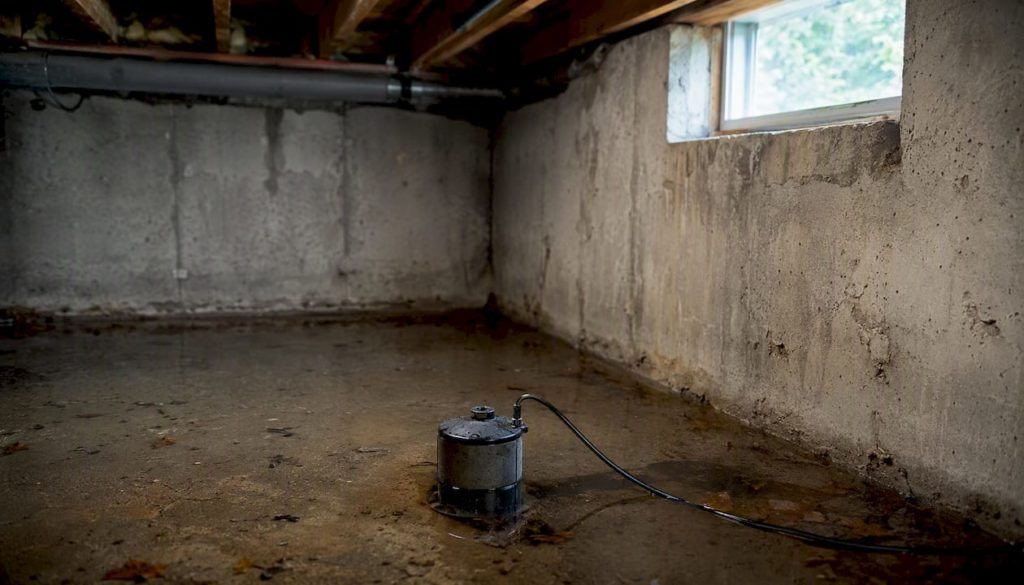
If your basement is flooding right now, use a submersible pump for standing water over 5cm deep, or a puddle pump for shallow puddles, but switch off electricity at the mains before you touch anything. Contaminated water (sewage backup, grey water) demands extra caution, not just a mop and a prayer. For lasting protection, the fix most waterproofing professionals recommend is a submersible sump pump installed in a purpose-built pit, wired with a battery backup so a power cut during a storm doesn’t undo all your work.
- Cut power to affected circuits before entering standing water
- Never use a plug-in pump on an ungrounded or damaged circuit
- Assume any water touching a floor drain or toilet connection could carry sewage
Pro Tip: A typical 0.5 to 1 HP household submersible pump moves roughly 3,000 to 8,500 litres per hour, which is enough for most domestic flooding but not for a sustained groundwater inflow after days of rain.
Key Takeaways
Removing water from a flooded basement safely requires cutting power first, then matching pump type and capacity to the water’s depth, contamination level, and your property’s drainage conditions.
| Point | Details |
|---|---|
| Safety comes first | Isolate electricity and check for sewage contamination before touching any standing water. |
| Match pump to the job | Use puddle pumps for shallow residual water and submersible pumps for deeper, ongoing flooding. |
| Size for your head and flow | A 0.5 to 1 HP pump moves roughly 3,000 to 8,500 litres per hour, fitting most domestic basements. |
| Backup power prevents failure | Battery backups or generators stop pumps failing during the storms that cause flooding in the first place. |
| Get a professional survey | Prowaterproofing connects homeowners with contractors who assess pit siting, pump sizing, and long-term drainage. |
Table of Contents
- How to pump basement water out safely right now
- Which pump type actually suits your basement?
- How do you size a sump pump correctly?
- What backup power keeps a pump running in a storm?
- What matters when installing and routing the discharge?
- How often should you check and maintain a sump pump?
- When should you call a waterproofing professional?
- What should you do before you start pumping?
- How do you dry and clean a basement after pumping it out?
- How much does a sump pump cost to buy and run?
- Are there rules about where pumped water can go?
- Does sewage water need different handling than clean water?
- Get a professional survey before the next storm catches you out
- Frequently asked questions
- Sources
How to pump basement water out safely right now
Water rising in a basement doesn’t wait for you to read a manual, so here’s the order that actually works.
- Kill the power. Switch off the breaker feeding any basement outlets or fixed appliances. If the panel itself is wet or partially submerged, don’t touch it. Call an electrician or your utility provider first.
- Suit up. Rubber boots, waterproof gloves, and if the water smells foul or looks grey/brown, a mask. Keep children and pets out of the area entirely.
- Check for contamination. If sewage, a septic backup, or floodwater from outside has entered, treat everything the water touched as contaminated. Block or plug any open sewage connections before pumping.
- Move belongings first. Clear anything salvageable to higher ground before you start pumping. It’s faster to move boxes now than to dry them out later.
- Set up your pump. A puddle or transfer pump handles shallow residual water (under 5cm); a submersible pump handles deeper flooding. Run your extension lead through an RCD/GFCI adapter, always, no exceptions. If mains power is out, a generator becomes essential.
- Pump in stages. Lower the water level gradually rather than trying to empty everything in one go. Watch the pump for clogging from debris, leaves, or grit.
- Never let the pump run dry. Most burn out within minutes without water to cool the motor.
Quick fixes for common snags:
- Pump won’t start: check the breaker, the plug, and the RCD trip switch first.
- Float switch stuck: gently free it from the pit wall or debris; it may just need clearance to swing.
- Clogged intake: unplug, lift the pump, clear the strainer of grit or leaves, then restart.
Which pump type actually suits your basement?
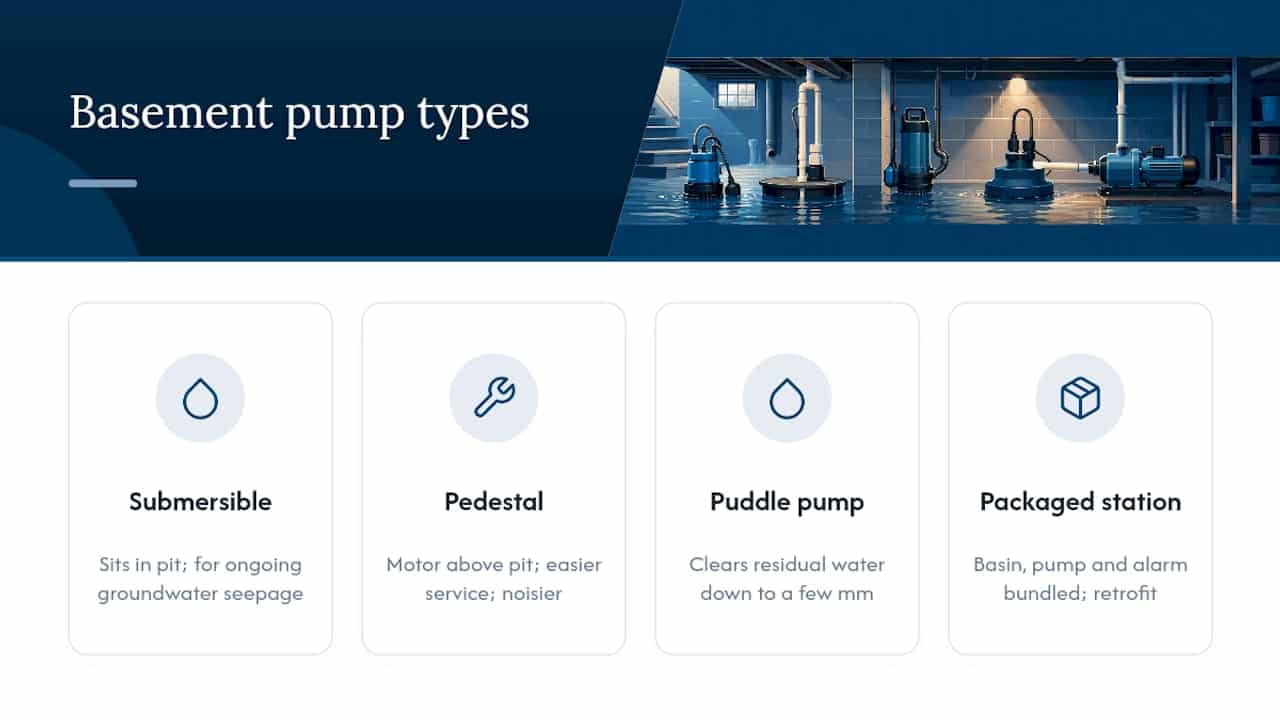
Not every flooded basement needs the same tool, and buying the wrong one wastes money and time. A submersible sump pump sits directly in a water-filled pit and is the standard fix for ongoing groundwater seepage. A pedestal pump keeps its motor above the pit, out of the water, which makes it easier to service but noisier and generally lower-capacity. A puddle or transfer pump is designed for shallow residual water once the bulk has gone, typically clearing water down to a few millimetres. A packaged pumping station bundles a basin, pump, and alarm into one enclosed retrofit unit, a solid option where you want a tidy installation without excavating a separate pit, as Newton’s waterproofing range demonstrates.
Sewage or blackwater always needs a sewage-rated pump built to handle solids, not a standard clean-water submersible. Using the wrong pump on contaminated water risks clogging the impeller and spreading contamination when you least expect it. For occasional light leaks after a heavy storm, a puddle pump might be all you need. For a basement that floods every winter, a submersible sump pump with backup power earns its cost within a season or two.
How do you size a sump pump correctly?
Flow rate is how much water the pump moves per minute or hour; head is the vertical distance it has to lift that water, from the pit to the discharge point outside. Get either wrong and the pump either can’t keep up or burns out trying.
- Estimate your basement’s typical inflow during heavy rain (a rough guide, not a lab measurement) and compare it against pump capacity.
- Measure the vertical distance from your sump pit to where the discharge pipe exits above ground. That’s your static head.
- Choose a pump rated for slightly more than your measured head, since output drops as head increases. A 0.5 to 1 HP unit generally suits most domestic setups but check the manufacturer’s performance curve, not just the headline flow figure.
- Build in a safety margin of roughly 20 to 30% above your estimated inflow.
If your basement floods faster than a domestic pump can handle, or your head exceeds 7 to 8 metres, you’re likely dealing with either a serious groundwater problem or a job for rental-grade dewatering equipment, not a hardware-store pump.
What backup power keeps a pump running in a storm?
Power cuts and heavy storms tend to arrive together, which is exactly when your sump pump matters most. Losing mains power during a downpour is one of the most common reasons sump pumps fail when homeowners need them most.
- Battery backup units kick in automatically and typically run a pump for several hours, useful for short outages but not a multi-day storm.
- Generators give you far longer runtime but need fuel, ventilation, and someone present to manage them.
- Water-powered backups use mains water pressure instead of electricity, a clever workaround if your municipal supply stays on during outages.
- High-level float alarms or wireless alarms won’t pump water themselves, but they’ll wake you up before a slow leak becomes a flooded basement.
Pro Tip: Size your battery backup for the longest outage your area has realistically had in the past five years, not just an average storm.
What matters when installing and routing the discharge?
Where you put the pit and how you route the outflow decides whether your pump actually protects the basement or just moves the problem outside your front door.
- Site the sump basin at least 14 inches (about 35cm) from the foundation footing, never tight against it.
- Bed the basin on 5 to 6 inches of compacted coarse aggregate so it drains properly and doesn’t shift over time.
- Fit a check valve (non-return valve) on the discharge line in the correct orientation, otherwise water flows back into the pit every time the pump stops.
- Route the discharge well away from the foundation, ideally to a storm drain or a point that won’t just seep back underground, and check local rules before connecting to a public sewer.
- In colder regions, insulate or bury discharge pipes below frost depth to stop them freezing solid mid-storm.
Pro Tip: If your discharge line runs slow or backs up even with a working pump, the blockage is often downstream, not in the pit; hydro-jetting services can clear a clogged discharge line that a plunger simply can’t reach.
How often should you check and maintain a sump pump?
A pump you never test is a pump you can’t trust when it matters. Once a month, confirm the power connection is solid, manually lift the float switch to check it moves freely, and clear any debris from the inlet screen. Once a year, test the battery backup under load, inspect the check valve for wear, and have the seals serviced if the pump sounds strained or runs hotter than usual.
- Motor runs hot or won’t start: check the breaker, then the capacitor if you’re comfortable doing so, otherwise call an electrician.
- Float stuck: clear debris around the pit walls.
- Flow dropping off: check for a clogged impeller or partially blocked discharge line.
- Unusual noise: often a sign of a worn bearing or debris caught in the impeller.
When should you call a waterproofing professional?
Some situations are beyond a hardware-store pump and a Saturday afternoon. Call a professional if sewage is involved, if you spot structural cracks alongside water ingress, if the same area keeps flooding despite a working pump, or if your drainage problem seems to involve groundwater pressure across the whole foundation rather than one weak spot.
- Professionals typically start with a site survey, checking soil conditions and existing drainage before recommending a fix.
- For chronic ingress, a cavity drain membrane paired with an internal perimeter drain and a reliable sump pump is often the most durable retrofit.
- A proper quote should specify pump capacity, battery backup runtime, warranty length, and what happens if the pump fails within that warranty period.
What should you do before you start pumping?
Rushing straight in with a pump can make things worse if you skip a few checks first. Before you switch anything on, look at what kind of water you’re dealing with. Clean rainwater seeping through a foundation crack is a different job from water that’s backed up through a floor drain or toilet, which likely carries sewage. If the smell is foul, the colour is brown or grey, or it’s anywhere near a sewage line, assume contamination and handle it accordingly.
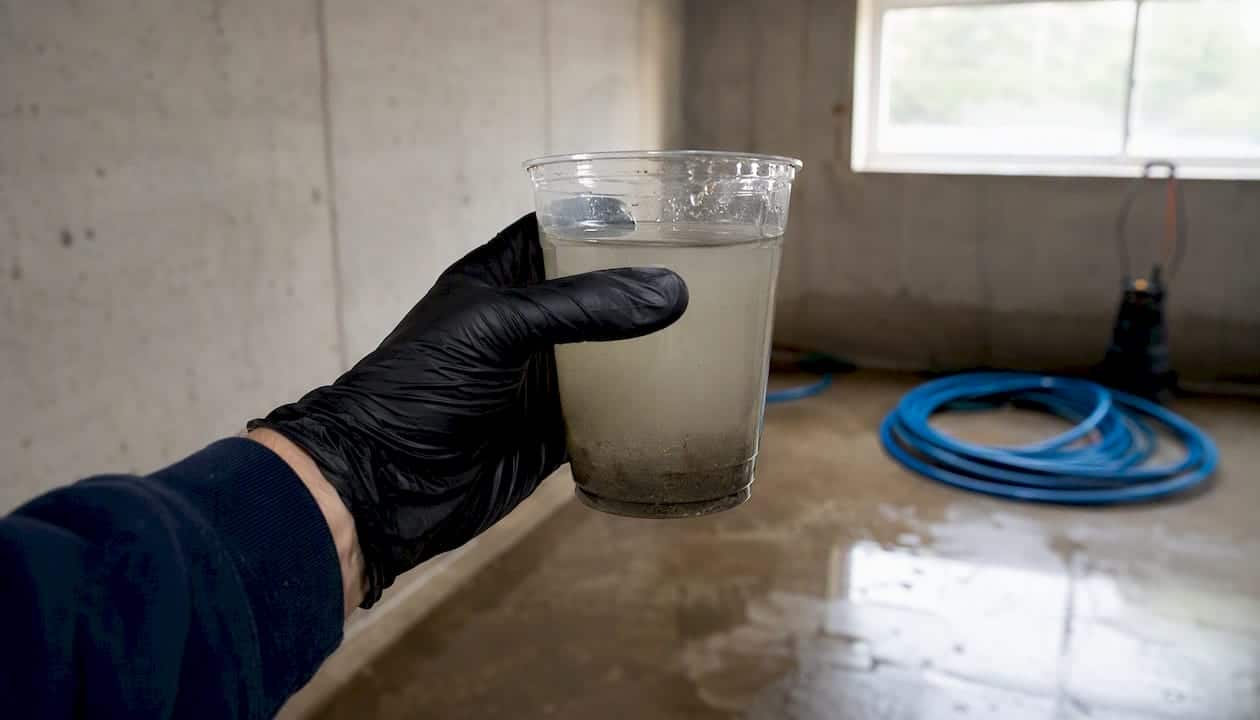
Containment matters more than people expect. If you suspect sewage contamination, avoid walking contaminated water into unaffected parts of the basement or tracking it upstairs on your boots. Change footwear before leaving the affected area, and keep a designated “clean” exit route if possible. If you have pets, keep them entirely out of the space until it’s been pumped and disinfected.
Photograph the damage before you start, for insurance purposes, then move electronics, furniture, and stored items to higher ground or out of the basement altogether. Anything porous that’s been sitting in contaminated water for more than 48 hours, such as carpet, upholstered furniture, or cardboard boxes, is usually not worth trying to save.
Check your circuit breaker panel and any basement outlets for water damage before you plug anything in. If you’re not confident the electrics are safe, wait for an electrician rather than risk it. A wet basement is bad. A wet basement with a live electrical fault is dangerous.
How do you dry and clean a basement after pumping it out?
Getting the standing water out is only half the job. What happens in the next 24 to 48 hours decides whether you end up with mould colonising your drywall in a fortnight.
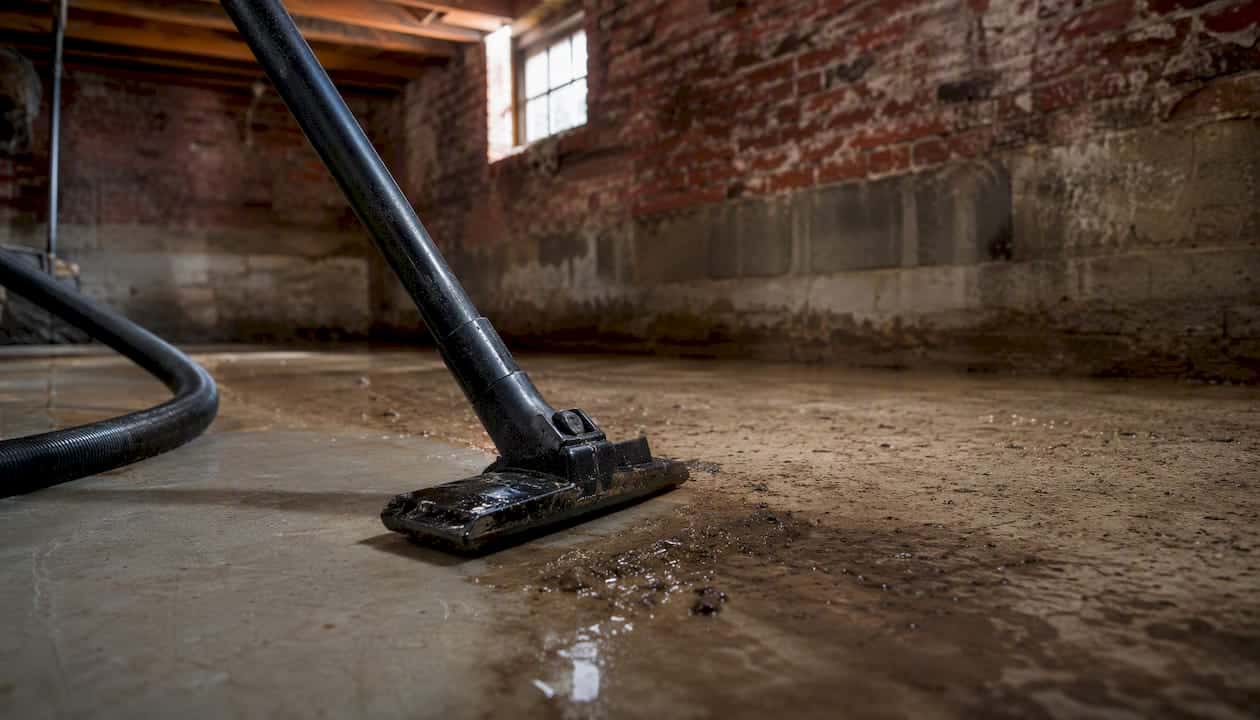
Start by removing any remaining debris, silt, or sediment left behind once the bulk of the water is gone; a wet/dry shop vacuum handles this well. Wipe down hard surfaces (concrete, tile, sealed masonry) with a disinfectant solution, particularly if the water was contaminated. Anything softer, such as drywall that’s absorbed water, usually needs to be cut out at least 30cm above the visible waterline, since moisture wicks upward through the material.
Ventilation is your best tool after that. Open windows if the weather allows, and run fans and a dehumidifier continuously for several days, not just overnight. Basements are naturally humid and poorly ventilated, which is exactly the environment mould needs to establish itself within 24 to 48 hours of water exposure.
Check flooring carefully. Laminate and carpet padding rarely survive a proper soaking and are often cheaper to replace than to dry and hope for the best. If you’re planning to refinish the space, waterproof basement flooring options built for damp-prone environments hold up far better than standard materials.
Keep monitoring humidity levels with a simple hygrometer for a week or two after the initial dry-out. A reading consistently above 60% indoors means your basement is still retaining moisture somewhere, often behind a wall or under flooring you can’t see.
How much does a sump pump cost to buy and run?
Costs vary considerably depending on pump type, installation complexity, and whether you’re retrofitting an existing basement or building in during construction. A basic pedestal or puddle pump sits at the lower end of the price range and suits occasional, light water intrusion. A submersible sump pump with a proper basin costs more upfront but handles ongoing groundwater far better, and a packaged pumping station with an integrated alarm sits at the premium end, reflecting the convenience of an all-in-one enclosed unit.
Installation complexity drives cost more than the pump itself in most cases. A straightforward swap of an existing pump into an existing pit is quick and inexpensive. Digging a new pit, fitting a discharge line to code, and adding a check valve is a bigger job, particularly if the concrete floor needs breaking and re-pouring around the basin.
Running costs are modest for the pump itself, since sump pumps only draw power when actively pumping, but battery backup units add an ongoing cost for battery replacement every few years, and generators require fuel during actual use. Factor in occasional maintenance, a seal replacement here, a float switch there, rather than treating the pump as a fit-and-forget appliance.
For a full picture of what long-term drainage protection costs versus a reactive pump purchase, it’s worth comparing basement drainage solutions side by side before committing to one approach. Renting high-capacity dewatering equipment for a single severe flood event, rather than buying it outright, is often the more sensible move financially, since professional dewatering services can be more cost-effective than owning equipment you’ll rarely need again.
Are there rules about where pumped water can go?
Where your discharge water ends up isn’t just a drainage question, it’s often a legal one. Many municipalities restrict connecting a sump pump discharge directly into the public sewer system, partly because it overloads treatment plants during storms when everyone’s pump is running simultaneously. Check your local bylaws before routing a discharge pipe to a municipal drain, since fines for unauthorised connections do exist in some areas.
Discharging onto a neighbour’s property, even accidentally through poor routing, can create a dispute and, in some jurisdictions, a liability issue if it causes damage. Route discharge pipes to a storm drain, a designated soakaway, or a point on your own property well clear of neighbouring boundaries and building foundations.
If the water you’re pumping is contaminated, sewage backup or anything that’s been in contact with waste, it cannot simply be discharged onto the ground or into a stormwater system.
Environmentally, repeatedly discharging groundwater onto the same patch of soil near your foundation can simply recirculate the problem, the water seeps back down and re-enters your basement within days. Routing discharge well away from the property, ideally toward a natural drainage point or municipal stormwater system, actually solves the underlying issue rather than moving it a few metres.
Does sewage water need different handling than clean water?
Not all basement flooding carries the same risk, and treating sewage water the same way you’d treat clean rainwater is a genuine health hazard. Clean water, from a burst pipe or light rainwater seepage, poses minimal health risk beyond the usual slip hazards and equipment damage. You can generally pump it out with standard precautions: gloves, boots, and care around electrics.
Sewage or greywater backup is an entirely different situation. It can carry bacteria, viruses, and parasites, so direct skin contact should be avoided entirely, not just minimised. Wear waterproof gloves, boots, and ideally a respirator mask if the smell is strong or you’re spending extended time in the space. Anything the water touched (porous materials especially) should be treated as contaminated and likely discarded rather than cleaned and reused.
Floodwater from outside, storm surge or river overflow, sits somewhere in between and can carry chemical contaminants, fuel residue, or agricultural runoff depending on where it came from, so the same precautions as sewage generally apply. Never assume floodwater is “just rainwater” simply because it entered through a window rather than a drain.
In every contaminated-water scenario, disinfect surfaces thoroughly after pumping and drying, and wash any clothing or equipment that made contact separately from your regular laundry. If you’re at all uncertain what you’re dealing with, treat it as contaminated. That caution costs you nothing; getting it wrong can cost your health.
A practical note on priorities
Get the power off and the people safe before you worry about the water itself; a pump can wait thirty seconds, a live circuit can’t. This guide leans hard into what to do in the first hour, because that’s where basements are won or lost, but the sizing and backup sections matter just as much for the next flood.
Get a professional survey before the next storm catches you out
Buying the right pump matters, but knowing exactly what your basement needs, pit depth, discharge routing, backup capacity, is where most DIY installs fall short. Prowaterproofing connects you with vetted waterproofing contractors across South Africa who assess your specific site rather than sell you a generic solution.

A typical quote includes a proper site survey, a recommendation on sump pump or packaged station sizing, battery backup and alarm options suited to your area’s power reliability, and a written warranty covering the installation. Before you request a quote, have your basement’s approximate size, a few photos of the affected area, and a brief description of when and how the flooding happens. That’s usually enough for a contractor to give you a realistic first estimate. If you’re weighing up a DIY pump install against professional basement waterproofing solutions, a survey costs you little and tells you exactly where you stand. Start by requesting a quote through Prowaterproofing and get a clear picture of what your basement actually needs.
Frequently asked questions
How quickly should I pump water out of a flooded basement?
As soon as it’s electrically safe to do so. Standing water encourages mould growth within 24 to 48 hours, so speed matters, but never at the expense of checking the power supply first.
Can I use a regular submersible pump for sewage water?
No. Standard clean-water pumps clog and fail on solids-laden sewage. Use a sewage-rated pump or call a professional if sewage contamination is present.
How long does a battery backup sump pump run during a power cut?
It varies by battery capacity and pump load, but most units run for several hours, enough for a typical storm outage rather than a multi-day power failure.
Do I need a check valve on my sump pump?
Yes. Without one, water flows back into the pit every time the pump switches off, forcing it to work harder and shortening its lifespan.
Is it legal to discharge sump pump water into the street or storm drain?
Rules vary by municipality. Check local bylaws before connecting to a public sewer or storm drain, since some areas restrict or prohibit direct sump discharge connections.
Sources
- How Submersible Pumps Help Manage Flooded Basements? | Cosmos Pumps
- Floodwater drainage pumps and water management | Xylem
- Newton waterproofing systems | Basetec