
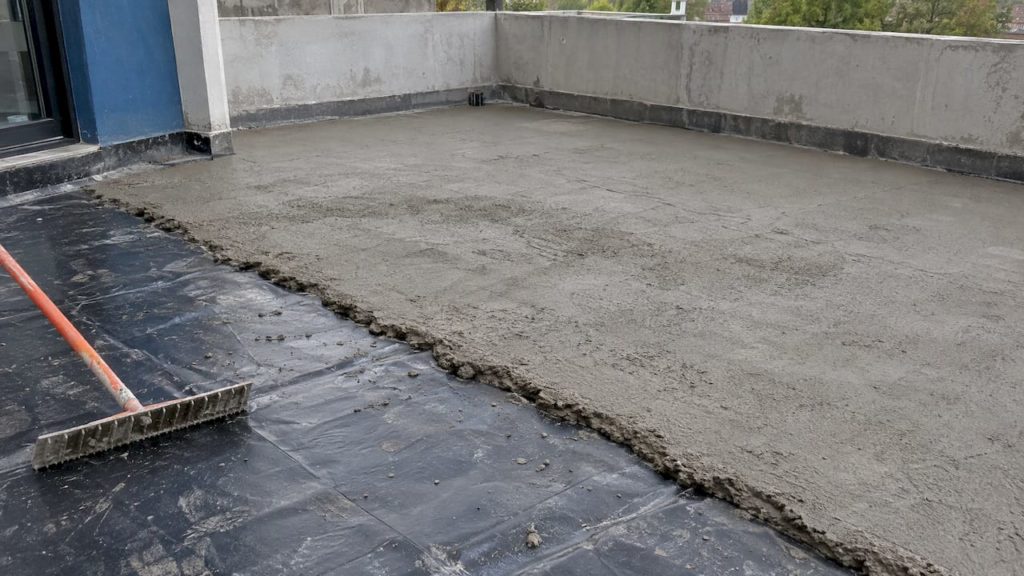
A protection screed is a layer of cement-based material laid over a finished waterproofing membrane so the membrane survives everything that happens next: foot traffic, barrows, other trades, sun and movement. It does not add to the waterproofing. Its whole value is that the membrane underneath is still intact in ten years. If you are specifying or paying for a roof, terrace, basement slab or podium deck, the screed is the cheapest insurance on the job, and the way it is laid decides whether it protects the membrane or damages it. We built this guide for South African owners and managers who want to ask the right questions of any contractor, and you can send your project details through our quote request to be connected with a vetted waterproofing contractor.
TL;DR
- A membrane is thin and made to stop water, not to resist traffic, tools, heat swings or UV. The screed is its mechanical shield.
- The screed also forms the falls to the drains and carries the tile or paving finish.
- Unbonded screeds sit on a slip sheet so they move independently of the membrane. Bonded screeds are only for compatible membranes.
- Typical thicknesses run from 25 mm to 50 mm or more, depending on the membrane, the load and the standard followed, with movement joints and a minimum 1 in 100 fall.
- Damage is invisible until water finds it, so protection should go on promptly after the membrane has cured and been tested.
Table of Contents
- What the protection screed actually does
- When you need one
- Screed versus protection board
- Bonded and unbonded screeds
- Thickness, joints and falls: the numbers to check
- How a protection screed is installed, step by step
- What goes wrong
- Does the membrane under a screed stop water from above?
- Questions to put to any contractor
- Get the system specified once
- FAQ
- Sources
What the protection screed actually does
A protection layer adds nothing to the performance of the element it protects. A reference entry on protection layers makes the point well: because its value lies in preventing damage, its absence goes unnoticed until the membrane fails, often years later and somewhere buried. That is why it is so often cut from a budget, and why it should not be.
In practice a screed over a membrane does five jobs:
- Mechanical protection. It takes the foot traffic, wheelbarrows, ladders and dropped tools that would otherwise scratch or puncture the membrane.
- Sun and weather shielding. Exposed coatings age. One Indian terrace guide notes that unprotected bituminous coatings can turn brittle and crack within three to five years in strong sun, and the same logic applies to a Highveld roof in summer.
- Falls to drainage. Water must run to the outlets rather than pool. The membrane should not be used to make the falls; the substrate or a screed does that.
- A base for the finish. Tiles or pavers need a firm, even bed that spreads the load.
- Absorbing later abuse. Furniture feet, plant stands and cleaning equipment act on the screed, not on the membrane.
The membrane remains the waterproofing. The screed is what lets it do that job for its full design life.
When you need one
Protection of a horizontal membrane after installation and testing is treated as mandatory in the IIBEC’s guidance on plaza waterproofing, which goes further for trafficked areas: where vehicles drive on the deck, it calls for a reinforced concrete protection slab of at least 76 mm to resist braking and turning loads. For South African owners that is the relevant lesson for loading bays, parking decks and podiums. We cover the floor side of that in our guide to waterproofing loading bay floors.
Typical places a protection screed appears:
- Flat roofs and concrete roof slabs that will be walked on or tiled. See our owner’s guide to flat roof slab waterproofing.
- Terraces and balconies with a tile or paver finish. Our page on terrace waterproofing methods covers the moisture limits to insist on.
- Basement slabs and podium decks above habitable space.
- Wet areas such as bathrooms, where the screed forms the falls before tiling.
Not every system takes a screed. Some membranes are designed to bond directly to structural concrete, and one UK manufacturer’s application manual instructs that no protection screed be placed over its pre-applied product. The rule is simple: follow the membrane’s own specification, and have the contractor confirm in writing what goes over it.
Screed versus protection board
A screed is not the only protection. The Property Care Association’s guidance on Type A waterproofing lists a 50 mm screed on horizontal surfaces or rot-proof protection boards as options, and notes boards can be preferred where they remove a wet trade and let following work continue straight away. Screeds, in turn, add weight, take time to lay and cure, and, if they crack and move, can abrade the membrane beneath, as one protection board guide points out.
The choice is a design decision about two timescales: short-term construction damage and long-term service loads. A screed suits trafficked decks that will carry a tiled finish and need falls. Where the main risk is six weeks of site work above the membrane, a board may suit better. Ask your contractor to explain which risk they have designed for.
Bonded and unbonded screeds
This is the detail that most often goes wrong.
Unbonded screeds sit on a slip sheet, typically polythene, so the screed and membrane move independently when the slab expands and contracts. Ardex’s technical bulletin TB243 specifies a double layer of plastic sheet of about 200 microns each, with the top layer laid at right angles to the lower. A bonded screed over a membrane that is moving beneath it will shear. An unbonded one simply rides over it.
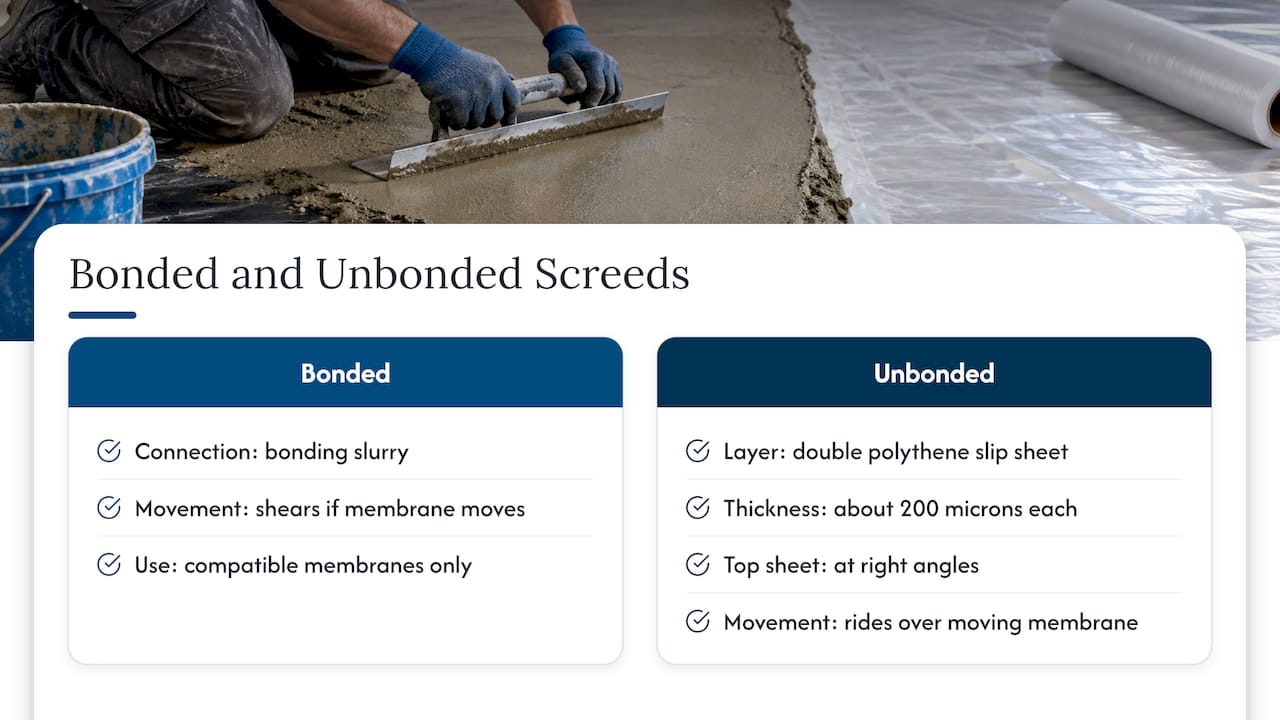
Bonded screeds are fixed to the membrane with a bonding slurry. The same bulletin states they only suit certain membranes, such as fleece-faced sheets, and that liquid-applied membranes need an approved screed type. Many polyurethane systems are not compatible with a bonded cementitious topping. Compatibility is a question for the membrane manufacturer’s data sheet, never a guess on site.
If you are choosing the membrane too, our guides to liquid waterproofing membranes for concrete and bituminous membrane contractor checks will help you match system to screed.
Thickness, joints and falls: the numbers to check
No single figure applies everywhere. The published figures vary with the standard, the membrane and the load, which is itself a reason to have the specification written down.
| Item | Published figure | Source |
|---|---|---|
| Minimum screed over horizontal bituminous sheet | 25 mm screed or protection board, vertical sheet 200 mm above the screed top | SCP Bitusheet installation guide, South Africa |
| Unbonded structural screed | Minimum 50 mm, lightweight mesh, double slip sheet | AS 4654.2-2012, Australia |
| Falls | No flatter than 1 in 100, no water retained on the surface | AS 4654.2-2012 |
| Movement joints in bonded screeds | Minimum 10 mm wide at 4.5 m intervals | AS 4654.2-2012 |
| Concrete screed over a PUR membrane | M20 grade, minimum 50 mm, 1:100 slope, 160 GSM geotextile beneath, control joints in 3 m by 3 m panels | Weber technical data |
| Vehicle-trafficked plaza | Reinforced concrete protection slab, at least 76 mm | IIBEC |
These are reference points from other markets and manufacturers, not a South African rulebook. Use them to test a quotation, and expect your contractor to follow the membrane manufacturer’s specification and the relevant local standard.
Why falls belong in the screed, not the membrane
The New Zealand code of practice for internal wet areas requires falls to be formed in the substrate or in a screed, not by the membrane, and says a cementitious fall screed should cure for at least seven days, per the manufacturer, before the membrane goes on. The principle is useful anywhere: a bathroom or terrace that ponds is usually a screed problem, not a membrane problem.
How a protection screed is installed, step by step
- Let the membrane cure and test it. The screed should only go on once the membrane is fully cured and has passed a flood or ponding test. IIBEC advises that a qualified person confirms the flood test passed before protection is installed. A leak found now costs a repair patch. A leak found after the tiles cost a demolition.
- Cover it promptly. Visqueen’s datasheet says a membrane should be covered immediately to prevent damage from following trades and UV. The gap between membrane and protection is when most site damage happens: scaffold poles, stacked masonry, reinforcing bars, welding rods and loose aggregate.
- Lay the separation layer. Polythene, or a geotextile where the specification calls for it, so the screed does not bond where it should not and aggregate cannot puncture the membrane.
- Form the falls. Set levels to the outlets before pouring, with the minimum fall allowed for in the design.
- Place and compact the screed. Ardex’s bulletin stresses compaction, especially above 40 mm. Poorly compacted screed is weak and cracks early.
- Cut or form movement joints. Carry them through to the finish, and at every upstand junction. A terrace guide uses joints at 3 m centres.
- Cure it. Keep it damp for the period the specification sets. One guide uses at least seven days of water-spray curing.
- Finish and seal details. Check the upstands: SCP’s guide requires the vertical membrane to overlap the horizontal by at least 100 mm and rise 200 mm above the top of the screed.
Where the slab has reinforcement above the membrane, take extra care. Visqueen warns that wire and spacers can puncture the membrane, and requires protection before reinforcement is positioned where there is risk. Our guide to the role of reinforcement mats explains the detailing.
What goes wrong
Damage that nobody sees. A scratch or a pinhole stays hidden until the first heavy rain, and the stain downstairs may be nowhere near the breach. Our summaries of waterproofing failure causes and real failure examples show how often the root cause is a site operation rather than the membrane.
Trapped moisture. If rain soaks a screed and a membrane goes over it before it dries, ScreedPro warns that the trapped moisture can make the membrane bubble or emulsify. AS 4654.2 sets substrate moisture content at 8.0% or less for mortar toppings and concrete, unless the membrane suits otherwise.
The wrong screed for the membrane. Bonded cement screed over an incompatible liquid membrane is a common cause of delamination. Confirm compatibility in writing, and ask that it is passed to the tiler and screeders. As one Australian trades article argues, poor communication between waterproofer and following trades is a major issue.
Blocked drainage. In cavity drainage systems, the Property Care Association’s Type C guidance advises checking all channels during and after screeding because fluid self-levelling screeds can block cavities. See also our explainer on drainage board orientation.
Unplanned cracking. Without joints, a screed cracks, and an unbonded screed that moves in cracks can abrade the thin membrane below. Joints and slip sheets prevent exactly this.
Does the membrane under a screed stop water from above?
A membrane under a screed does protect the slab from water coming through the screed. Ardex’s bulletin distinguishes a membrane, which resists water from above, from a moisture barrier, which resists water from below, such as rising damp. So the product under your screed must be the right one for the direction the water comes from. On roofs, ScreedPro notes the screed itself is porous, so an additional membrane over it is sometimes used to protect both screed and slab.
Questions to put to any contractor
- Which membrane, and does its data sheet allow a bonded or unbonded screed?
- What slip or separation layer is specified, and what thickness of screed?
- How soon after the flood test will the screed go on, and who protects the membrane in between?
- Where are the movement joints, and what falls are you building to?
- What written warranty covers membrane and screed together, and who holds the licence and insurance?
We built our content around exactly these questions of quality, experience, licensing and warranties, because the owner who asks them gets the better job.
Our view
Most waterproofing disputes we read about start with a screed that was added late, laid thin, or put on without a slip sheet. The membrane gets the blame, but the cause is the protection above it.
We think owners should treat the screed as part of the waterproofing system, specified and warranted with it, not as a screeding trade that arrives afterwards. That means one written specification covering membrane, separation layer, screed, joints and falls, and a contractor who stays accountable until the finish goes down.
That is why we focus on helping owners choose contractors on licensing, experience and warranty terms. A good membrane under a careless screed is a wasted membrane.
Eben
Get the system specified once
If you have a roof, terrace, basement or deck to waterproof in Gauteng or the Western Cape, Pro Waterproofing lets you send a quote request and be connected with a vetted waterproofing contractor for residential, commercial or industrial properties. Bring your drawings or photos, and the points above to put to them.

FAQ
Do I need a protection screed over every waterproofing membrane?
No. Most horizontal membranes that will be walked on, tiled or loaded need protection, but some systems are designed to bond to structural concrete and must not be screeded. The membrane’s own specification decides, so have your contractor confirm it in writing.
How thick should a protection screed be?
There is no single figure. Published guidance ranges from a 25 mm minimum over a bituminous sheet to 50 mm or more for unbonded structural screeds, and at least 76 mm of reinforced concrete under vehicles. Your contractor should state the thickness against the membrane manufacturer’s specification.
Why is a slip sheet used between the screed and the membrane?
It lets the screed and membrane move independently as the slab expands and contracts, and it stops aggregate puncturing the membrane. Without it, a screed that cracks or shifts can tear or abrade the layer beneath.
How soon after the membrane should the screed go on?
Once the membrane has cured and passed its flood test, protection should follow promptly. The longer the membrane is exposed, the greater the chance that following trades or sun will damage it.
Sources
- Protection Layer, Build Design Hub
- Terrace Waterproofing Guide, Prisci Constructions
- Principles of Designing Plaza Waterproofing Systems, IIBEC
- Application Manual, GCP Preprufe Plus
- Best Practice Guidance Type A Waterproofing, Property Care Association
- Best Practice Guidance Type C Waterproofing, Property Care Association
- Protection Board Waterproofing, Ofixotech
- Technical bulletin TB243, Ardex Australia
- Bitusheet Installation Guide, SCP
- AS 4654.2-2012 Waterproofing membranes for external above-ground use
- weberdry PUR basic technical data
- Code of practice for internal wet area membrane systems, New Zealand
- Visqueen DPM Technical Datasheet
- Waterproofing compatibility, Building Connection
- Why is it important to waterproof a screed? ScreedPro