A latent defect in waterproofing is a hidden fault present in the waterproofing system at the time of completion that does not reveal itself until later, often years after handover. Under the JBCC Principal Building Agreement, the latent-defect liability period runs for a multi-year period from the certified date of final completion. Once a defect is discovered within that window, the Prescription Act, No. 68 of 1969 gives the owner three years from the date of discovery to enforce the claim. The deciding test is not when the problem appeared, but whether it was discoverable by a reasonable inspection at final completion.
Table of Contents
- What does a latent defect look like in a waterproofing system?
- How do you tell a latent defect from a patent one?
- How do you identify a suspected latent waterproofing defect?
- How do South African contracts and courts treat latent waterproofing defects?
- Who is liable, and what remedies are available?
- How do you prevent latent waterproofing defects during design and construction?
- What should you do the moment you suspect a latent waterproofing defect?
- Key takeaways
- The part of latent defects most owners get wrong
- Useful sources and further reading
What does a latent defect look like in a waterproofing system?
Most waterproofing failures that qualify as latent share one characteristic: the fault was concealed beneath a finish, behind a structure, or within a system layer that a normal handover inspection would not penetrate. The JBCC advisory note on latent defects gives misplaced reinforcement in concrete as a classic example of a defect that takes years to surface, and the same principle applies directly to waterproofing.
Common latent waterproofing defects include membrane failure beneath floor tiles that may only become visible some time after occupation due to hidden issues like inadequate lap joints or missed seams.
- Improper sealing at structural joints. Movement joints between slabs or at wall-to-floor junctions are sealed with an incompatible product. The seal holds initially, then cracks under thermal cycling, allowing water to track behind linings.
- Failed pipe and service penetrations. Where plumbing or conduits pass through a waterproofed deck or basement wall, collars are omitted or incorrectly detailed. The penetration looks finished from above but is open to water below.
- Insufficient membrane thickness on flat roofs. A torch-on or liquid-applied membrane applied below specification thickness passes visual inspection but fails under sustained ponding, typically after the first heavy rainy season.
- Concealed delamination in below-ground tanking. A cementitious or sheet membrane applied to a basement wall debonds from the substrate behind render or plasterboard. The wall appears dry until hydrostatic pressure builds sufficiently to push moisture through.
Progressive water ingress from any of these sources causes structural decay, corrosion of reinforcement, and mould growth, all of which compound the longer the defect goes undetected. Understanding why waterproofing fails in the first place is the first step towards catching these problems early.
How do you tell a latent defect from a patent one?
The core test, stated in the JBCC advisory note on defects before and after final completion, is whether the fault was discoverable by a reasonable inspection at final completion. Timing of discovery is not the test. A defect that only shows itself three years later is not automatically latent; if a competent inspector would have spotted it at handover, it is patent.
Master Builders KwaZulu-Natal emphasise this distinction: the focus is on discoverability at completion, not on when the owner noticed the problem.
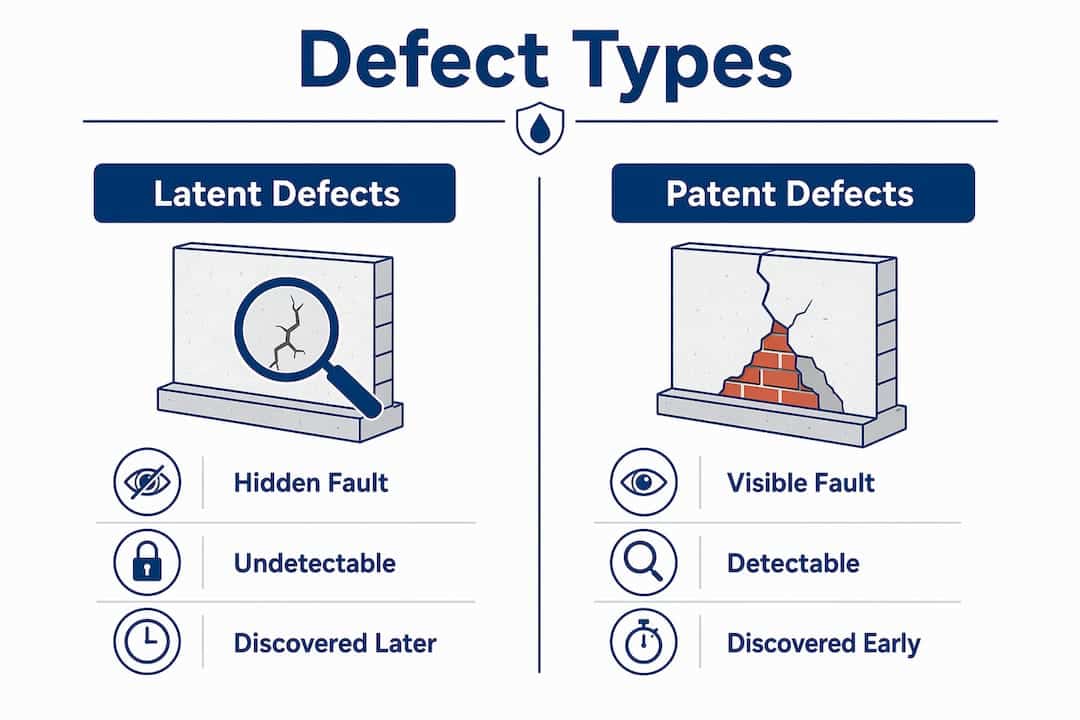
Patent scenario. A roof membrane is visibly blistered and has open laps at the parapet edge. A principal agent walking the roof at final completion would see this immediately. The contractor’s obligation to fix it falls within the patent-defect period, which ends at the issue of the final completion certificate.
Latent scenario. The same roof membrane appears intact and fully adhered. Beneath it, a lap joint was sealed with the wrong primer, creating a bond that holds for eighteen months before failing under thermal movement. No reasonable inspection at completion would have revealed the primer error. This is a latent defect.

One practical complication: maintenance failures can look identical to latent defects. If an owner fails to clear roof drainage channels and ponding accelerates membrane degradation, that is a maintenance issue, not a latent defect. Industry commentary consistently warns that insurers and courts will scrutinise maintenance records to make exactly this distinction.
Pro Tip: Keep a dated maintenance log from day one of occupation. A single entry showing you cleared drains and inspected the membrane annually is worth more in a discoverability dispute than any amount of retrospective argument.
How do you identify a suspected latent waterproofing defect?
Signs that should prompt suspicion
- Damp patches or tide marks on ceilings or internal walls with no obvious plumbing source
- Efflorescence (white salt deposits) on masonry or concrete surfaces
- Recurring leaks in the same location despite previous repairs
- Unexplained mould growth at wall-floor junctions or behind fitted joinery
- Hollow-sounding tiles or lifting floor finishes in wet areas
Inspection and testing techniques
- Moisture mapping. A calibrated moisture meter surveys the affected area to establish the extent and gradient of moisture, helping to locate the source without opening up.
- Infrared thermography. Thermal imaging identifies temperature differentials caused by trapped moisture or delaminated membranes, particularly useful on flat roofs and below-ground walls.
- Flood testing. Controlled ponding of a defined area for a set period confirms whether a membrane is breached; appropriate for flat roofs, balconies, and wet rooms before finishes are disturbed.
- Adhesive pull tests. Used to check membrane bond strength where delamination is suspected but not yet visible.
- Targeted opening-up. When non-destructive methods point to a specific location, minimal invasive exposure confirms the defect and secures physical evidence.
Escalate to an independent specialist when recurring repairs fail, when the source cannot be located by visual inspection, or when a contractor disputes liability. At that point, an independent consultant’s report becomes the foundation of any claim. Document everything: dated photographs, written notes, and maintenance logs, because discoverability disputes almost always turn on the contemporaneous record.
Pro Tip: Agree in writing with the contractor before any invasive testing on who funds the opening-up pending a liability determination. This avoids a dispute about costs before the main question of liability is even resolved.
How do South African contracts and courts treat latent waterproofing defects?
The JBCC framework
Under the JBCC Principal Building Agreement (Edition 6.2), the latent-defect liability period commences at the start of the construction project and ends five years from the certified date of final completion. This contractually limits what would otherwise be an open-ended common-law liability. The final completion certificate does not extinguish the contractor’s obligation for latent defects; it simply marks the start of the five-year countdown.
The Prescription Act interface
Once a latent defect is discovered within the five-year period, the owner must enforce the claim within three years of discovery under the Prescription Act, No. 68 of 1969. The enforcement clock runs from discovery, not from the expiry of the five-year period. Miss that three-year window and the debt prescribes, regardless of how clear-cut the defect may be.
Case law
The Supreme Court of Appeal in Holmdene Brickworks (Pty) Ltd v Roberts Construction Co Ltd defined a latent defect as “an abnormal quality or attribute which destroys or substantially impairs the utility or effectiveness of the res vendita … such a defect is latent when it is one which is not visible or discoverable upon an inspection.” This remains the primary judicial test applied to waterproofing claims in South Africa.
In Odendaal v Ferraris [2008] ZASCA 85, the court extended the concept to include non-physical defects, holding that the absence of statutory approval for building alterations constitutes a latent defect. For building managers, this means a waterproofing installation lacking the required municipal approval or compliance certificate can itself be a latent defect, even if the membrane is physically intact.
| Dimension | Contract latent-defect period | Prescription from discovery | Practical responsibility |
|---|---|---|---|
| Timeframe | 5 years from final completion certificate | 3 years from date of discovery | Runs concurrently with contract period |
| Who bears liability | Contractor (primary) | Contractor, subcontractor, or manufacturer depending on cause | Determined by specialist report and contract flow-down |
| Remedy options | Repair and reinstatement; retention draw | Cost recovery; damages claim | Insurance claim; manufacturer guarantee |
| Key risk | Defect appears after 5-year period | Owner delays enforcement after discovery | Maintenance failure attributed to owner |
For a fuller picture of the regulatory context, the waterproofing regulations guide for South Africa covers compliance obligations that intersect with latent-defect liability.
Who is liable, and what remedies are available?
Liability
- Contractor (primary). Responsible for defective workmanship and materials under the JBCC agreement; liable to remedy any latent defect appearing within the five-year period.
- Subcontractor or specialist supplier. Liability flows down through contractual arrangements; the main contractor typically remains the owner’s primary point of contact, then recovers from the subcontractor.
- Manufacturer. Product warranties cover material failures; these run independently of the JBCC period and may offer recourse after the contract period expires.
- Seller under a sale agreement. A voetstoots clause can bar a buyer’s claim for latent defects unless the seller intentionally concealed the defect. Odendaal v Ferraris confirms that non-physical defects, including missing statutory approvals, fall within the voetstoots concept.
Claim process
- Document the defect immediately with dated photographs and written notes.
- Notify the contractor in writing, stating the location, nature, and date of discovery.
- Commission an independent specialist report confirming the defect and its likely cause.
- Obtain repair tenders and submit a formal cost-recovery claim to the contractor or insurer.
- If the contractor disputes liability or fails to respond, engage a legal adviser and consider drawing on retention or performance security held under the contract.
Common-law rights can survive the JBCC contract period in limited circumstances, but proving a defect existed at completion after five years requires a compelling independent expert report. The waterproofing defect liability guide covers owner actions in more detail.
How do you prevent latent waterproofing defects during design and construction?
Prevention is far cheaper than litigation. The following measures, applied at specification and on-site stages, substantially reduce the risk of hidden failures.
- Specify waterproofing systems with full manufacturer technical data sheets and ensure compatibility between primers, membranes, and overlying finishes.
- Require factory-issued warranties tied to correct installation, not just product supply.
- Detail all seams, laps, upstands, and penetrations explicitly in the contract drawings; generic notes are not sufficient.
- Conduct flood tests on all horizontal waterproofed surfaces before finishes are applied, and record results with photographs and dated sign-off sheets.
- Check membrane lap widths and continuity at every stage; do not allow finishes to proceed until the waterproofing layer has been inspected and approved.
- Compile a handover quality-control pack including as-built drawings, test records, manufacturer warranties, and a maintenance schedule.
Contractual safeguards matter equally. Ensure the contract includes clear latent-defect clauses, a retention or performance guarantee, and a requirement for the contractor to provide a maintenance manual. Periodic maintenance in line with that manual is what distinguishes a latent defect from owner-caused deterioration.
Pro Tip: Specify independent flood testing and photographic QA at critical stages as a contract requirement, not a courtesy. If a discoverability dispute arises later, a signed flood-test record showing the membrane passed at handover shifts the burden of proof significantly.
A complete waterproofing checklist for South African owners provides a practical template for both handover and periodic inspections.
What should you do the moment you suspect a latent waterproofing defect?
- Secure the area. Prevent further damage and protect occupants; place buckets, seal off affected rooms, and stop any activity that could disturb evidence.
- Take dated photographs immediately. Capture the visible manifestation, the surrounding context, and any existing repair attempts.
- Check handover and maintenance records. Locate the QA pack, maintenance log, and any previous repair correspondence before contacting anyone.
- Notify the contractor in writing without delay. The notice should state: the property address, the date the defect was first observed, a description of the visible symptoms, the location on the building, and a request for the contractor to inspect within a specified period.
- Commission an independent specialist inspection. Do not rely solely on the original contractor’s assessment where liability is disputed.
- Notify your insurer. Check your policy wording; some policies require notification within a defined period of discovery.
- Seek legal advice if the contractor disputes liability, fails to respond, or if the five-year JBCC period is close to expiry.
Do not carry out permanent repairs before the contractor has had a reasonable opportunity to inspect. Premature remedial work can complicate cost recovery and may be used to argue that the owner altered the evidence. Emergency stabilisation, such as temporary waterproofing to stop active ingress, is acceptable, but document every step and notify the contractor before work begins.
Regarding maintenance records: industry guidance is clear that where maintenance obligations were not followed, insurers or courts may treat the problem as maintenance-related rather than a latent defect. Your records are your defence.

Key takeaways
A latent defect in waterproofing is a hidden fault present at completion that the JBCC holds contractors liable for up to five years, with a further three-year prescription window from discovery under the Prescription Act.
| Point | Details |
|---|---|
| Core definition | A hidden waterproofing fault present at completion but not discoverable by reasonable inspection at that time. |
| JBCC liability period | Five years from the certified date of final completion; the contractor must remedy defects appearing within this window. |
| Prescription Act window | Three years from the date of discovery to enforce the claim; missing this deadline extinguishes the right. |
| Immediate priority | Document with dated photographs and notify the contractor in writing before any permanent repairs are made. |
| Prevention lever | A handover QA pack with flood-test records and a maintenance schedule is the single most effective defence against disputed claims. |
The part of latent defects most owners get wrong
The legal framework around latent waterproofing defects is well-documented, but the practical reality on South African sites is messier than any advisory note suggests. The disputes I see most often do not hinge on whether a defect existed. They hinge on whether the owner can prove it was not caused by their own neglect.
Contractors are sophisticated at pointing to missing maintenance records, blocked drains, or an owner-installed fitting that penetrated the membrane. Without a contemporaneous QA pack and a maintenance log, the owner is arguing from memory against a contractor arguing from contract. That is a difficult position.
The other underappreciated issue is the non-physical latent defect confirmed in Odendaal v Ferraris. Building managers routinely focus on leaks and ignore the possibility that a waterproofing installation lacks the required municipal compliance certificate. That absence is itself a latent defect, and it can affect insurability, resale, and liability in ways that a physical repair cannot fix.
The practical advice is simple: treat the QA pack as a legal document from the moment of handover, commission independent flood tests before finishes go down, and never assume that because a roof looks dry it is watertight. The defects that cost the most are always the ones nobody thought to check.
Useful sources and further reading
- JBCC Advisory Note 21.0: Defects before and after final completion (Edition 6.2) — the primary JBCC guidance on patent and latent defect definitions and the five-year liability period.
- JBCC Advisory Note 22.0: Change in ownership (Edition 6.2) — explains how latent-defect obligations transfer on property sale and confirms the five-year contractual period.
- Prescription Act, No. 68 of 1969 (gov.za) — the statutory basis for the three-year enforcement window from discovery.
- Master Builders KZN: Managing a construction contract — the defects liability period — industry guidance on the discoverability test and handover QA expectations.
- Master Builders KZN: Unearthing the contractual landscape for latent defects — practical commentary on maintenance failures, QA packs, and claim preservation.
- Odendaal v Ferraris [2008] ZASCA 85 — Supreme Court of Appeal judgment extending latent defects to non-physical faults including missing statutory approvals.
- Voetstoots clause guidance (ABGross) — explains when a voetstoots clause bars buyer claims and when intentional concealment overrides it.
- Latent defects: the dark horse in the JBCC PBA (Roloff Law) — detailed legal commentary on how the Prescription Act interacts with the JBCC five-year period.
- TT Waterproofing — contractor resources — additional contractor guidance for readers seeking specialist waterproofing services.
- Sealtek Cape — waterproofing resources — further external reference for waterproofing products and contractor information.
For professional assessment of a suspected latent waterproofing defect, or to commission an independent inspection and remedial report, contact Prowaterproofing — specialists in residential, commercial, and industrial waterproofing across South Africa.