

Selecting the right roof waterproofing system is one of the most critical decisions for South African property owners facing diverse climate extremes, from intense UV radiation to seasonal heavy rains. Making an informed choice prevents costly water damage and ensures long-term structural integrity. This article guides you through waterproofing types suited to various roofs and budgets, helping you confidently protect your property investment with solutions tailored to South Africa’s unique conditions.
Table of Contents
- Key Selection Criteria For Roof Waterproofing
- Liquid Waterproofing Membranes
- Bituminous Membrane Waterproofing
- Comparing Roof Waterproofing Types: Durability, Cost And Suitability
- Situational Recommendations For South African Roofs
- Protect Your South African Property With Expert Waterproofing Solutions
- Frequently Asked Questions
Key takeaways
| Point | Details |
|---|---|
| Climate compatibility | Match waterproofing to South Africa’s UV intensity, rainfall patterns, and temperature fluctuations for optimal performance. |
| Roof type suitability | Flat roofs need flexible membranes, whilst pitched or metal roofs may require different systems. |
| Durability versus cost | Balance upfront investment with lifespan expectations, ranging from 8 years for liquid membranes to over 20 years for EPDM rubber. |
| Professional installation | Adherence to SANS 10400-L standards ensures warranty compliance and quality application. |
| Maintenance requirements | Different systems demand varying upkeep levels, affecting total cost of ownership over time. |
Key selection criteria for roof waterproofing
Selecting appropriate roof waterproofing for South African properties demands careful evaluation of multiple factors working together. Your choice must account for local environmental stresses that differ significantly from European or North American conditions.
South Africa’s climate presents unique challenges. Intense UV radiation degrades materials faster than in temperate zones, whilst seasonal rainfall patterns create dramatic wet-dry cycles. Temperature variations between day and night cause expansion and contraction that can compromise inferior waterproofing systems. Your waterproofing must withstand these specific stresses to deliver promised longevity.
Roof design fundamentally influences which waterproofing works best. Flat roofs with minimal drainage require seamless, flexible membranes that accommodate pooling water. Pitched roofs, concrete slabs, metal sheeting, and tiled surfaces each demand compatible systems. Understanding your roof waterproofing basics helps narrow suitable options before comparing costs.
Durability benchmarks vary dramatically between waterproofing types. Basic coatings may last 5 to 8 years, whilst premium membranes exceed 20 years under identical conditions. Assessing expected lifespan against your budget horizon prevents premature replacement costs. Consider total lifecycle value rather than just upfront price.
Cost analysis must balance immediate expenditure with protection duration. Waterproofing costs in South Africa range from R75 to over R500 per m² depending on system complexity and material quality. Cheaper solutions often require earlier replacement, increasing total cost over a decade.
Pro Tip: Always verify that installers follow SANS 10400-L compliance requirements. Professional application and adherence to South African National Standards (SANS 10400-L) are essential for ensuring waterproofing quality and warranty compliance. Non-compliant work voids manufacturer warranties and may fail building inspections.
- Climate impact assessment determines material UV and moisture resistance needs
- Roof geometry dictates application method and material flexibility requirements
- Expected service life balanced against budget constraints guides system selection
- Professional certification ensures regulatory compliance and warranty validity
Liquid waterproofing membranes
Liquid-applied membranes offer exceptional versatility for complex roof geometries common in South African residential and light commercial buildings. These systems create seamless barriers that adapt to irregular surfaces without joints or seams that could leak.
Application involves rolling or spraying liquid polymer compounds directly onto prepared roof surfaces. The material cures into a continuous elastic membrane that moves with substrate expansion and contraction. This flexibility makes liquid membranes ideal for roofs with penetrations, parapets, or unusual shapes where sheet systems struggle.
Performance characteristics suit South African conditions well. The seamless elastic barrier offers UV and weather resistance with an 8 to 12 year lifespan when properly applied. Elasticity accommodates thermal movement without cracking, whilst reflective formulations reduce heat absorption in hot climates.
Pricing positions liquid membranes in the mid-range category. Expect costs between R140 and R200 per m² for quality systems with professional installation. This represents good value for complex roofs where sheet membrane installation would require extensive cutting and sealing.
Retrofit applications particularly benefit from liquid membrane properties. Applying over existing waterproofing extends roof life without full replacement. The system bonds to prepared substrates including concrete, metal, and aged bitumen surfaces. Explore detailed waterproofing solutions to understand application scenarios.
Pro Tip: Surface preparation determines liquid membrane success. Thoroughly clean and prime substrates before application. Any contamination, loose material, or moisture prevents proper adhesion and causes premature failure.
- Seamless application eliminates leak-prone joints on complex geometries
- Flexible membrane accommodates thermal movement without cracking
- UV-resistant formulations withstand South African sun exposure
- Mid-range pricing offers value for retrofit and irregular roof shapes
- Requires skilled application and proper curing for optimal performance
Bituminous membrane waterproofing
Bituminous torch-on membranes represent the commercial standard for flat and low-slope roofs throughout South Africa. These multi-layer systems deliver exceptional durability under harsh conditions and heavy use.
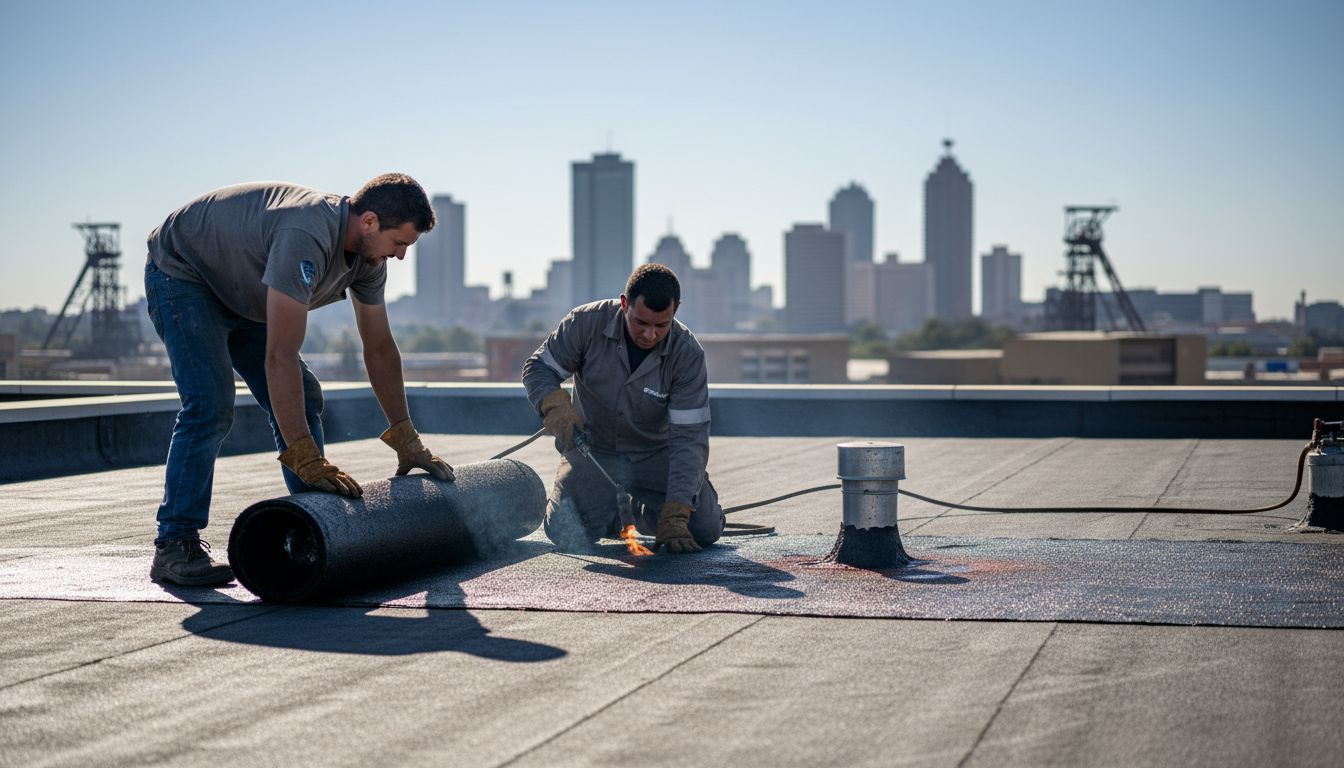
Installation involves heat-welding reinforced bitumen sheets directly to prepared substrates using propane torches. The heat melts the underside bitumen layer, creating permanent adhesion as it cools. Overlapping seams receive the same heat treatment, forming completely watertight joints. This application method demands skilled technicians and strict safety protocols.
Durability exceeds most alternatives in demanding environments. Torch-on bitumen membranes offer a 10 to 15 year lifespan with resistance to water penetration, UV degradation, and physical damage. Reinforcement fabrics, typically polyester or fibreglass, provide tear resistance crucial for roofs with foot traffic or maintenance access.
Commercial applications particularly favour bituminous systems. Shopping centres, warehouses, and office buildings benefit from the robust protection against punctures and weathering. The system handles thermal extremes without softening or becoming brittle, maintaining integrity through South African seasonal variations.
Cost reflects superior performance characteristics. Pricing ranges from R180 to R240 per m² for quality torch-on installations. Whilst higher than basic coatings, the extended lifespan and minimal maintenance reduce total ownership costs. Review bituminous roofing details for technical specifications.
- Torch-applied installation creates permanent, watertight bonds
- Reinforced construction resists tears and punctures from foot traffic
- Extended 10 to 15 year lifespan reduces replacement frequency
- Superior UV and thermal resistance suits harsh South African conditions
- Higher upfront cost justified by durability and low maintenance needs
Comparing roof waterproofing types: durability, cost and suitability
Understanding how different waterproofing systems compare helps you match solutions to specific requirements. Each type offers distinct advantages depending on roof characteristics, budget constraints, and performance expectations.
Durability varies significantly across waterproofing categories. EPDM rubber membranes top longevity charts, often exceeding 20 years in South African installations. Bituminous systems follow at 10 to 15 years, whilst liquid membranes typically deliver 8 to 12 years. Cementitious coatings show shorter lifespans, particularly on flexible substrates where cracking accelerates failure.
Cost analysis reveals the value equation differs by application. Waterproofing costs in South Africa vary from R75 to over R500 per m² depending on system complexity. Basic cementitious coatings start around R75 per m², liquid membranes range R140 to R200 per m², bituminous systems cost R180 to R240 per m², whilst premium EPDM and polyurethane exceed R300 per m².
Suitability depends on roof configuration and usage. Flat roofs with complex penetrations benefit from liquid membranes. Commercial buildings with regular maintenance access suit bituminous systems. Internal waterproofing and wet areas work well with cementitious coatings. Green roof installations require specialised layering with drainage components.
| Waterproofing type | Lifespan | Cost per m² | Best suited for | Maintenance needs |
|---|---|---|---|---|
| Liquid membranes | 8 to 12 years | R140 to R200 | Complex shapes, retrofits | Recoat every 8 years |
| Bituminous torch-on | 10 to 15 years | R180 to R240 | Flat commercial roofs | Minimal inspection |
| Cementitious coatings | 5 to 8 years | R75 to R120 | Internal wet areas | Frequent reapplication |
| EPDM rubber | 20+ years | R300 to R400 | UV-heavy zones | Very low maintenance |
| Polyurethane foam | 15 to 20 years | R350 to R500 | Insulation priority | Protective recoat |
| Green roof systems | Variable | R400 to R600 | Urban eco-buildings | Regular plant care |
Maintenance requirements influence total ownership costs. Low-maintenance systems like EPDM and bituminous membranes require only periodic inspections. Liquid membranes need recoating after 8 to 10 years. Cementitious coatings demand frequent touch-ups as cracks develop. Green roofs require ongoing irrigation and plant management.
Explore comprehensive waterproofing comparisons to understand technical specifications beyond this overview. Your specific roof conditions may favour options not immediately obvious from general guidelines.
- Match system lifespan expectations with your property ownership timeline
- Calculate total cost including installation, maintenance, and replacement cycles
- Prioritise UV and thermal resistance for exposed South African roofs
- Consider foot traffic and roof access needs when selecting durability levels
Situational recommendations for South African roofs
Different roof scenarios demand tailored waterproofing approaches. Matching system characteristics to your specific situation maximises protection whilst optimising budget allocation.
Flat residential roofs with complex geometries benefit most from liquid membrane systems. The seamless application handles parapets, skylights, and penetrations without creating vulnerable seams. Flexibility accommodates thermal movement common in concrete slab construction. Mid-range pricing suits residential budgets whilst delivering reliable 10 year protection.
Commercial buildings with high foot traffic require robust bituminous membranes. The reinforced construction withstands regular maintenance access without puncturing. Extended 15 year lifespan reduces business disruption from frequent replacements. Higher upfront cost proves economical when spread across large roof areas and long service intervals.
Internal wet areas including bathrooms and balconies work well with cementitious coatings. These areas experience minimal UV exposure and thermal stress, extending coating lifespan. Lower costs suit smaller waterproofing projects. Ensure proper surface preparation and use flexible variants for substrates prone to movement.
Hot, UV-intensive regions like the Northern Cape and Limpopo provinces demand EPDM rubber membranes. The exceptional UV resistance prevents premature degradation common with lesser materials. Over 20 year lifespan justifies premium pricing in harsh climates. Minimal maintenance requirements suit remote properties with limited access.
Eco-conscious urban properties gain multiple benefits from green roof systems. Vegetation layers provide natural waterproofing whilst reducing stormwater runoff and improving insulation. These systems require substantial structural support and ongoing plant maintenance. Initial costs exceed conventional waterproofing, but environmental and energy benefits accumulate over decades.
Pro Tip: Request site-specific assessments before finalising waterproofing choices. Professional evaluations identify unique conditions affecting system performance, from drainage issues to substrate compatibility. Visit custom waterproofing advice for guidance.
- Assess your roof’s geometric complexity and select systems handling penetrations effectively
- Evaluate expected foot traffic and choose reinforcement levels accordingly
- Consider your region’s UV intensity and prioritise resistant formulations
- Calculate total lifecycle costs including maintenance over expected ownership period
- Verify installer experience with your chosen system and compliance certifications
Protect your South African property with expert waterproofing solutions
Professional-grade waterproofing tailored to South Africa’s demanding climate protects your property investment for decades. Understanding your options empowers informed decisions, but implementation quality determines actual performance.
Pro Waterproofing specialises in matching waterproofing systems to South African roof conditions and client requirements. Our certified technicians ensure SANS 10400-L compliance whilst delivering installations that meet manufacturer warranty standards. We guide you through choosing waterproofing solutions that balance performance with budget realities.
Extended roof life, prevented water damage, and regulatory compliance stem from expert application. Our residential waterproofing solutions combine quality materials with proven techniques developed across thousands of South African installations. Visit Pro Waterproofing to explore services and secure your property’s future with reliable protection.
Frequently asked questions
What factors should I consider when choosing roof waterproofing?
Prioritise climate compatibility, ensuring your system withstands local UV intensity and rainfall patterns. Match waterproofing type to your roof configuration, whether flat, pitched, or complex geometry. Evaluate durability expectations against budget constraints, calculating total lifecycle costs including maintenance. Verify professional installation credentials and SANS 10400-L compliance for warranty protection.
How long do different roof waterproofing types typically last in South Africa?
Liquid membranes deliver 8 to 12 years under South African conditions with proper application. Bituminous torch-on systems extend to 10 to 15 years with minimal maintenance. EPDM rubber membranes exceed 20 years in UV-intensive environments. Cementitious coatings show shorter 5 to 8 year lifespans, particularly on flexible substrates prone to cracking.
Can I apply roof waterproofing myself or should I hire a professional?
Professional application ensures SANS 10400-L compliance and maintains manufacturer warranty eligibility. Trained technicians apply materials at correct temperatures, thicknesses, and curing conditions that DIY approaches rarely achieve. Improper installation causes premature failure, leaks, and costly repairs exceeding professional installation savings. Always engage certified waterproofing specialists for reliable protection.
Are green roof systems suitable for all types of roofs in South Africa?
Green roofs require substantial structural support to carry soil, vegetation, and water weight. They work best on flat or low-slope roofs with adequate load capacity. These systems enhance insulation and manage stormwater runoff effectively in urban areas. Regular maintenance including irrigation, fertilisation, and plant replacement proves essential for continued waterproofing performance.