
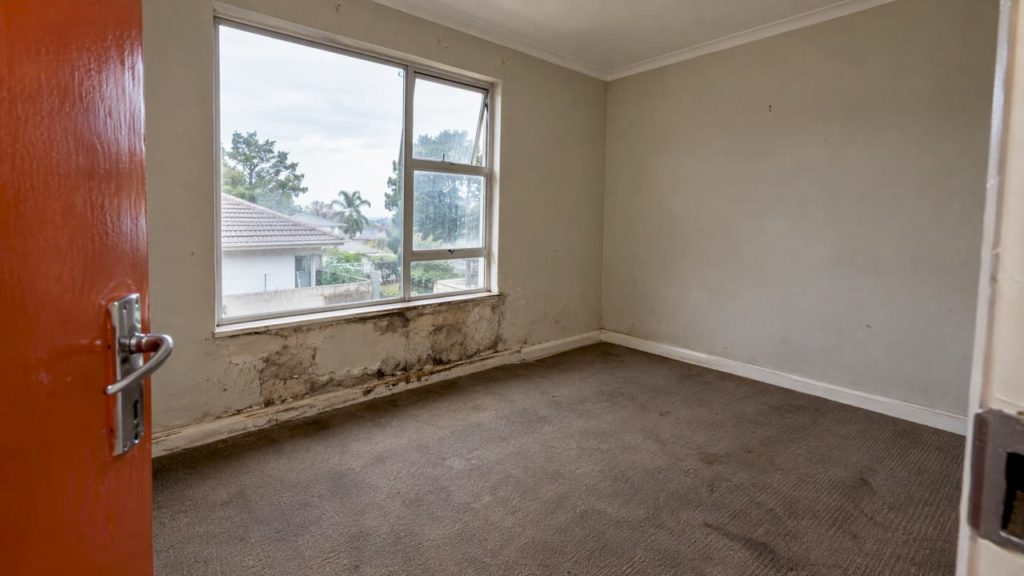
Damp reduces rental yield in four ways at once: it adds repair and remediation costs, it creates void weeks when no rent comes in, it pushes achievable rent down, and it exposes you to compensation and enforcement. Yield is simply annual rent divided by property value, so every pound of lost rent or extra cost eats into the return you thought you were buying. Below we show where the money goes, with sourced figures, a worked example and the steps that stop the leak before it reaches your income.
TL;DR
- Reactive damp and mould repairs are reported to cost landlords roughly £3,000 to £10,000 per property, and remediation voids can cost £250 to £500 a week in lost rent.
- Visible damp puts off prospective occupiers, lengthens vacancies and invites rent discounts, which hits the income side of the yield formula.
- Gross yield hides all of this. Net yield must budget for voids, repairs and capital spend.
- Fixing the cause (water getting in, not just the stain) early is far cheaper than repainting and hoping.
- Landlord duties on damp are tightening, so ignoring it carries growing financial and legal risk.
Table of Contents
- How yield works, and where damp enters the sum
- The direct costs: repairs and remediation
- The income hit: voids, longer lettings and lower rent
- The legal and compensation layer
- A worked example: a 6% yield that falls below 3%
- Why gross yield hides the problem
- What actually stops the losses
- Our perspective
- Need a damp problem assessed and fixed properly?
- FAQ
- Sources
How yield works, and where damp enters the sum
Gross yield is annual rent divided by the property’s value. Net yield takes off what it costs to run the property. Damp attacks both sides: it lowers the rent you collect and raises the costs you pay, and it can also depress the value of the building itself.
The official guidance for landlords from a local authority sums up the exposure neatly: damp and mould can damage a property, affect rental income and property value, harm tenants’ health and prompt them to move out, which adds re-letting costs (Torbay Council landlord guidance). Each of those is a line in your yield calculation.
It is also not a rare problem. Academic work reviewing the evidence reports that dampness and indoor mould indicators affect up to 21% of European homes (peer-reviewed review on dampness prevalence and impacts). If you own several properties, you should plan on meeting it at some point rather than hoping you never will.
The direct costs: repairs and remediation
The first hit is the invoice. Industry guidance published in 2025 puts reactive damp and mould repairs at between £3,000 and £10,000 per property (ResiSure). A letting agency’s 2025 figures give a wider range, £500 to £10,000 per property for remediation, plus an average of £5,000 per case for legal disrepair claims (Harringtons).
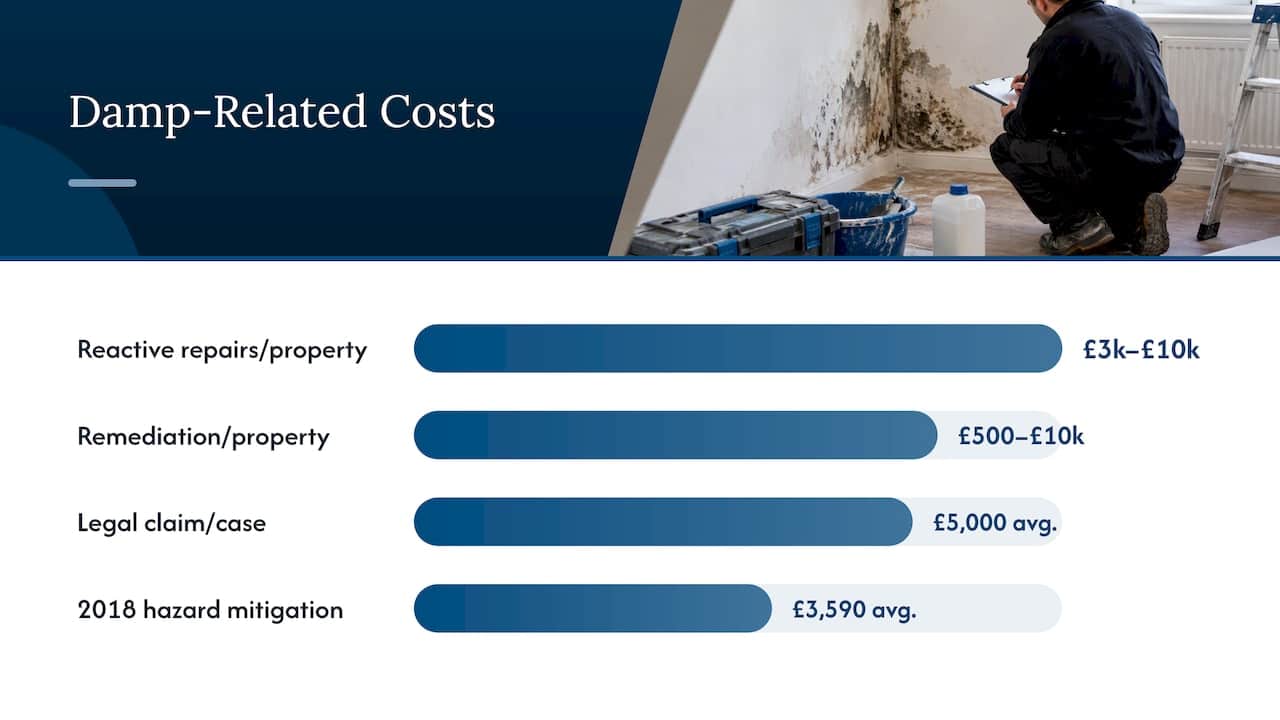
The spread is wide because the cause matters. A blocked gutter and a failed damp-proof course are very different jobs. The Building Research Establishment (BRE) estimated the average cost of mitigating a category 1 dampness hazard in England at £3,590 per dwelling, using 2018 prices (BRE, The cost of poor housing in England). Prices have moved since 2018, so treat that as a floor for a typical hazard, not a quote.
There is also a compounding effect. Prolonged moisture exposure reduces the efficiency of insulation, raises energy consumption and shortens the life of building materials (same academic review). A cheap cosmetic fix that leaves the water source in place means you pay for the repair, then pay again when the damage returns and has spread.
Why repeat repairs cost more than one proper one
A stain-block and a coat of paint costs little. It also does nothing about the leak, the failed seal or the cracked render behind it. Managers describe a pattern of repeated “band-aid” repairs that push maintenance spending up while vacancies lengthen (Drexel Properties, a US source, but the mechanism is universal). The same guide gives a hypothetical in which a slow leak behind a vanity unit costs $4,900 to $5,400 if left, against $500 for the correct fix at the start. It is an illustration, not a UK statistic, but the ratio is the point.
The income hit: voids, longer lettings and lower rent
Repairs are only half of the damage. The other half is rent you never receive.
Void weeks while work is done
If a room or the whole home cannot be occupied during remediation, you lose rent. The 2025 ResiSure figures put this at £250 to £500 per week for remediation voids. Add the time to find a new tenant if the old one leaves, plus referencing, marketing and agent fees, and a single serious case can swallow a large part of a year’s rent.
Slower lettings
Visible damp is a deal-breaker for many people. One report cites that around 60% of British buyers would walk out of a viewing on seeing obvious damp patches or mould (Property Reporter). That figure concerns buyers rather than renters, but renters view homes the same way, and the same article quotes the chairman of the AIIC saying poorly handled mould properties take longer to let. Each extra week on the market is a week of void.
Pressure on the rent itself
When a property does let with known defects, the rent tends to be negotiated down. A US management guide estimates a poor maintenance review could add about 7 days on the market, cost about $511 in lost rent and force a 1% rent reduction (Drexel Properties). Those numbers are American and indicative, so use them for direction, not for your own forecast.
Tribunals show the same logic in practice. In a Welsh rent determination, the tenant proposed a 20% reduction for damp, mould and disrepair, and the tribunal settled on £700 per calendar month after weighing damp around a chimney breast and other condition issues (Residential Property Tribunal Wales decision). The specifics differ by case, but it shows rent is something a third party can cut when the condition is poor.
The legal and compensation layer
Damp now carries a regulatory price tag as well.
The Housing Ombudsman’s 2021 Spotlight report on damp and mould recorded over £123,000 in compensation ordered across 222 investigated cases (Housing Ombudsman). That is social housing, but it shows how slow responses are judged. In one 2025 case, a landlord that failed to address a leak and the resulting damp for over a year ended up offering £1,700 in compensation (Housing Ombudsman decision).
For private landlords, a September 2024 industry report noted £36,629.30 awarded in 2023 in dispute resolution contexts relating to mould and damp (TPOS report). The same report says landlords and agents should address damp and mould caused by building deficiencies, and that the Government had committed to extending Awaab’s Law to the private rented sector, though timescales were not then finalised.
Awaab’s Law is reported to have come into force in October 2025, requiring investigation and repair of damp and mould within strict timeframes, which raises the operational and financial risk of delay (South East Online). The direction is clear, so check the current scope for your own tenancy type on GOV.UK. If you are unsure whether a duty applies to you, speak to a housing solicitor or your letting agent’s compliance team.

A worked example: a 6% yield that falls below 3%
This is an illustration with round numbers, not a forecast.
You buy a flat for £200,000 and let it at £1,000 a month. Gross yield is £12,000 ÷ £200,000 = 6%.
A hidden leak causes damp. Over the year:
| Item | Effect |
|---|---|
| Rent at full occupancy | £12,000 |
| Void of 6 weeks at £1,000 a month (about £231 a week) | -£1,385 |
| Remediation (mid-range of the reported £3,000 to £10,000) | -£5,000 |
| Income left before other running costs | £5,615 |
| Yield on £200,000 before management, insurance and other costs | about 2.8% |
The headline 6% never changed on the listing, yet the real return for that year is under half. Add a rent reduction at renewal and the damage lasts into the next year too.
Why gross yield hides the problem
Most listings quote gross yield, which ignores voids and repairs. A better method starts with effective gross income (gross annual rent minus void loss), then subtracts operating expenses and budgeted capital expenditure (Amazing Real Estate). Build a damp line into that budget, especially for older stock, solid-wall homes, flat roofs and ground-floor or below-ground rooms.
A practical rule: when you evaluate a purchase, treat unexplained staining, a musty smell or recent fresh paint on one wall as a cost to price in, not a cosmetic detail.
What actually stops the losses
The approach that protects yield is simple: find the cause, fix it properly, and keep checking.
- Inspect regularly. Look at ceilings, window reveals, external walls, bathrooms and under sinks between tenancies and at routine visits.
- Identify the source. Torbay Council’s guidance for landlords lists fixing the cause of damp, repairing leaks promptly, checking ventilation and advising tenants on heating and moisture reduction (Torbay Council).
- Respond fast. The Housing Ombudsman’s findings show that poor response times and inadequate remediation are what turn a repair into a complaint and a compensation order.
- Consider monitoring. Humidity and temperature sensors can alert you to conditions that lead to mould so you can step in early (ResiSure).
- Deal with water outside the walls. Many damp problems start in the garden or at the roofline. Keeping gutters clear and ground sloping away from the building is the cheapest layer of protection, as explained in this guide to fixing gutters and grading first. Where water collects at foundations, it is also worth knowing the signs of drain tile problems before they become a costly dig.
For more on telling damp types apart, our guides on signs of damp walls and their solutions and how to prevent moisture in walls walk through what to look for. If the source is outside, exterior waterproofing repairs explains the diagnose-first approach, and how waterproofing prevents mould covers the link to indoor air.
Condensation or penetrating damp?
The two need different cures. Condensation comes from humidity, cold surfaces and poor ventilation, and typically shows on cold walls and in corners. Penetrating or rising damp comes from water entering through the structure. Treating a structural leak with a dehumidifier wastes money, and treating condensation with a membrane does too. Get the diagnosis right first, ideally from a qualified surveyor or specialist, before you commit to a spend.
Our perspective
We see the same pattern again and again: an owner treats damp as a decorating job, repaints, and is back in the same position a season later with a bigger wall to repair. What we tell owners is to spend the first money on a proper site survey, because the survey tells you whether you have a ventilation problem, a failed membrane, a cracked slab or a drainage fault. Those need very different answers and very different budgets.
When you do hire, ask who will do the work, what licence and experience they hold, and what written warranty comes with it. A 5 to 10 year warranty on the waterproofing work is a reasonable thing to ask for, and a contractor who cannot explain the cause in plain words has not understood the problem. We built our approach around these questions because a repair that fails costs the owner twice: once in the job, again in lost rent.
Our work is in South Africa, so local rules and prices differ from the UK, but the physics of water in buildings does not. Water finds the weak point, and yield follows it.
— Eben
Need a damp problem assessed and fixed properly?
If you own or manage property in South Africa and want the cause of damp found and fixed, Pro Waterproofing connects you with vetted waterproofing professionals for roofs, basements, bathrooms, foundations and concrete decks. Send a quote request through the site and describe what you see. Our guide on why concrete cracks let water in is a useful way to prepare before the contractor visits.
FAQ
Does the landlord have to fix damp?
Generally yes, where the damp comes from the building itself, such as leaks, rising damp or faulty ventilation. A 2024 industry report says landlords and agents should address damp and mould caused by building deficiencies (TPOS). Responsibility can differ where a tenant’s own behaviour is the cause, so the first step is a proper diagnosis.
How much does damp cost a landlord?
Reported figures vary with the cause, from £500 to £10,000 per property for remediation, with an average of around £5,000 per legal disrepair claim (Harringtons). Void weeks add to that. A survey tells you which end of the range you are on.
Does damp lower the rent you can charge?
It can. Properties with poorly handled mould are reported to take longer to let, and tribunals can reduce rent where damp and disrepair are proven. Fixing the cause before marketing the property protects your asking rent.
How should I include damp in my yield calculation?
Use net yield, not gross. Start with annual rent less void loss, then subtract running costs and a budget for repairs and capital spending. For older or higher-risk properties, set aside a specific damp contingency each year.
Sources
- Managing damp and mould, Torbay Council
- How to Prevent Damp and Mould in Rental Properties, ResiSure
- The Hidden Costs of Damp and Mould, Harringtons
- The cost of poor housing in England, BRE
- Prevalence, Risk Factors and Impacts Related to Dampness
- Cost of Not Making Repairs, Drexel Properties
- Mould: A growing issue for landlords and tenants, Property Reporter
- Residential Property Tribunal Wales rent determination
- Housing Ombudsman Spotlight report on damp and mould
- Housing Ombudsman decision, Notting Hill Genesis
- Mould, Damp and Condensation in the Private Rented Sector, TPOS
- UK landlords warned of five threats heading into 2026, South East Online
- True ROI of a UK rental property, Amazing Real Estate
- Fix gutters and grade first to stop standing water
- 3 checks to spot drain tile problems