

Property owners across South Africa often believe waterproofing concerns only roofs, yet national building regulations mandate comprehensive protection for walls, floors, and foundations. Understanding SANS 10400-Part L requirements prevents costly structural damage, legal penalties, and health risks. This guide clarifies certification standards, material selection, compliance obligations, and maintenance practices essential for protecting your investment.
Table of Contents
- South African National Building Regulations And Waterproofing Standards
- Certification And Qualification Of Waterproofing Contractors
- Material Standards And Application Methods For Various South African Climates
- Legal Implications And Consequences Of Non-Compliance
- Common Misconceptions About Waterproofing In South Africa
- Practical Steps For Property Owners And Building Managers
- Protect Your Property With Expert Waterproofing Services
Key takeaways
| Point | Details |
|---|---|
| SANS 10400-Part L legally mandates waterproofing for roofs, walls, and floors across all South African buildings | Non-compliance triggers government penalties, repair costs, and potential insurance invalidation |
| Certified contractors through WTASA or PRAWA reduce waterproofing defects by 70% compared to uncertified installers | Always verify membership directly with certification bodies before hiring |
| Material selection must match regional climate zones, from high-rainfall coastal areas to arid inland regions | Membranes certified under SANS standards ensure durability and regulatory compliance |
| Regular inspections every 3-5 years extend waterproofing effectiveness and prevent catastrophic failures | Maintenance records support warranty claims and demonstrate legal compliance |
South African national building regulations and waterproofing standards
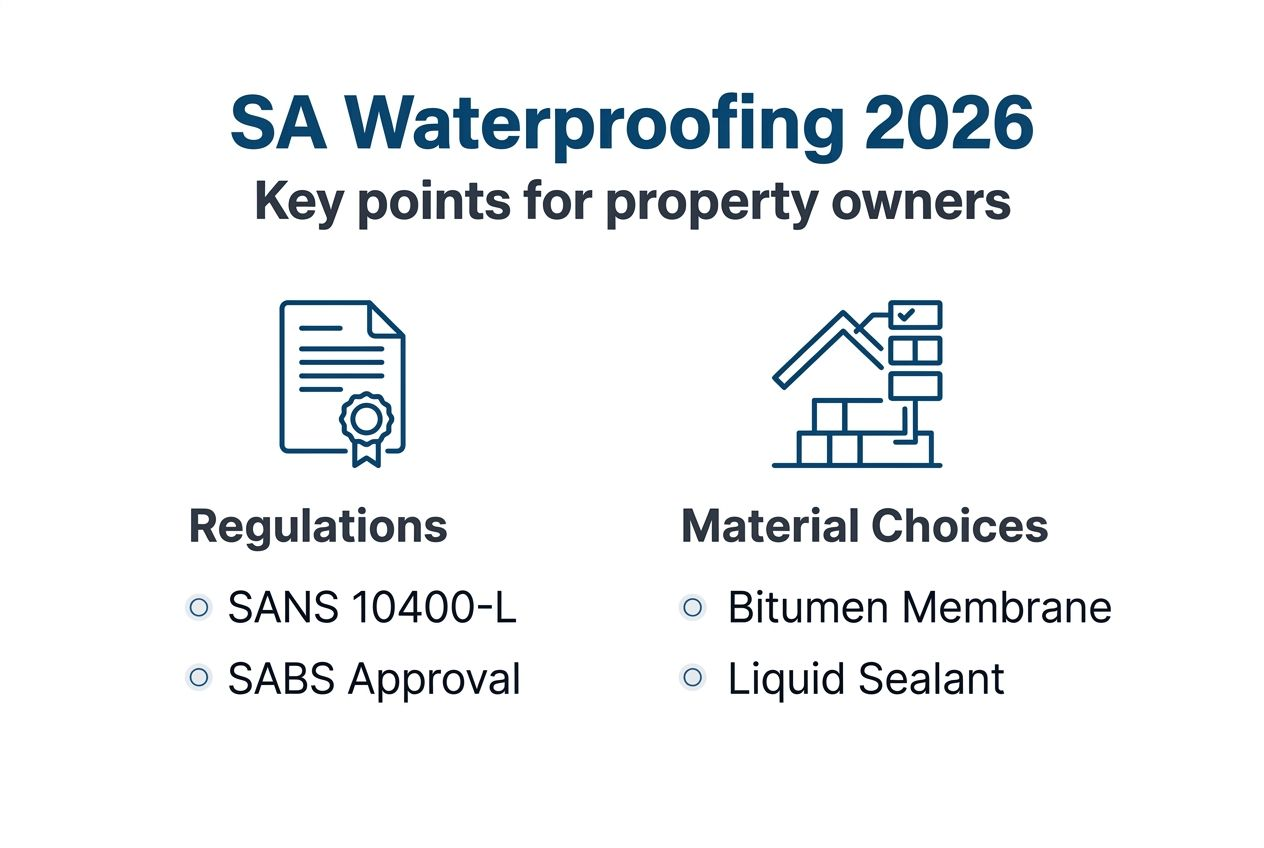
The National Building Regulations establish mandatory waterproofing requirements through two critical standards. SANS 10021 specifies technical requirements for waterproofing materials, ensuring products meet minimum performance thresholds for durability and water resistance. SANS 10400-Part L legally mandates standards addressing roofs, walls, and floors, emphasising prevention of water ingress throughout building envelopes.
The South African Bureau of Standards (SABS) develops and maintains these technical standards, whilst local municipalities enforce compliance through building inspections and approval processes. The National Home Builders Registration Council (NHBRC) oversees residential construction quality, requiring waterproofing adherence in enrolled projects. Together, these bodies create a comprehensive regulatory framework protecting property owners from substandard construction.
Property owners face significant consequences when builders ignore these standards. Legal penalties include stop-work orders, mandatory remediation at owner expense, and potential prosecution for severe violations. Structural damage from water ingress accelerates deterioration of concrete, steel reinforcement, and timber components, often requiring repairs costing 10 times more than proper initial waterproofing.
| Building Component | SANS 10400-Part L Requirement | Primary Protection Goal |
|---|---|---|
| Roofs | Impermeable membrane with minimum 15-year lifespan | Prevent rainwater penetration and ponding |
| External walls | Damp-proof course at foundation level plus weather-resistant coating | Block rising damp and wind-driven rain |
| Floors on ground | Moisture barrier beneath slab with minimum 250-micron thickness | Stop ground moisture migration |
| Basements | Tanked waterproofing system with drainage provision | Manage hydrostatic pressure and seepage |
Understanding applicable waterproofing regulations in South Africa empowers owners to verify contractor proposals against legal minimums, ensuring proposed systems meet mandatory standards rather than cost-cutting alternatives.
Certification and qualification of waterproofing contractors
Selecting certified professionals dramatically reduces waterproofing failures and ensures regulatory compliance. The Waterproofing Association of South Africa (WTASA) and the Paint and Waterproofing Association (PRAWA) establish strict certification standards requiring technical training, proven experience, and ongoing professional development. Contractors certified by trade associations deliver higher quality work aligned with industry best practices.
Certified contractors provide multiple advantages beyond technical competence. They offer workmanship warranties typically extending 10-15 years, backed by association guarantees protecting property owners if contractors cease trading. Their familiarity with SANS standards ensures installations meet regulatory requirements, preventing costly rectification during municipal inspections. Insurance coverage through professional indemnity policies protects owners from liability if waterproofing failures cause damage to neighbouring properties.
Verifying contractor credentials requires direct confirmation with certification bodies:
- Request the contractor’s WTASA or PRAWA membership number and verify current status on association websites
- Ask for copies of relevant training certificates and check expiry dates for time-limited qualifications
- Confirm insurance coverage by requesting certificates of currency showing public liability and professional indemnity policies
- Review previous project references and contact property owners to assess satisfaction and long-term performance
- Check business registration with the Companies and Intellectual Property Commission to verify legal operating status
Uncertified contractors present substantial risks despite lower initial quotes. Industry data shows uncertified installers experience failure rates exceeding 40% within five years, compared to certified contractors averaging below 10%. These failures typically stem from incorrect material selection, inadequate surface preparation, or improper application techniques that certified training specifically addresses.
Pro Tip: Always verify certification directly with WTASA or PRAWA rather than relying solely on contractor claims, as fraudulent certificates occasionally circulate in the market.
When evaluating waterproofing contractors in South Africa, prioritise those answering critical vetting questions transparently, including detailed methodology explanations and comprehensive warranty terms.
Material standards and application methods for various South African climates
South Africa’s diverse climate zones demand tailored waterproofing approaches matching regional environmental stresses. Coastal properties endure high rainfall, salt-laden winds, and elevated humidity requiring materials with superior UV resistance and salt tolerance. Inland arid regions face extreme temperature fluctuations and minimal rainfall, necessitating membranes maintaining flexibility across temperature extremes without brittleness.
Three primary membrane categories dominate South African waterproofing applications, each suited to specific conditions:
| Membrane Type | Durability (Years) | Flexibility Rating | Best Applications | Climate Suitability |
|---|---|---|---|---|
| Bituminous (torch-on) | 15-20 | Moderate | Flat roofs, foundations | Inland, stable temperatures |
| Liquid-applied (polyurethane) | 10-15 | Excellent | Complex details, vertical surfaces | All zones, especially coastal |
| PVC sheet membranes | 20-25 | Good | Large flat areas, basements | Universal, premium option |
| Cementitious coatings | 8-12 | Limited | Water tanks, wet rooms | Protected internal areas |
Proper membrane selection adapted to climate significantly reduces structural damage from water ingress. Coastal installations benefit from liquid-applied systems offering seamless coverage resistant to salt crystallisation and wind-driven rain. Highveld properties experiencing frost cycles require membranes maintaining elasticity at sub-zero temperatures whilst resisting thermal expansion cracking during summer peaks.
Key material features varying by climate zone include:
- UV stabilisation levels matching regional solar radiation intensity, with coastal areas requiring maximum protection
- Elongation capacity accommodating substrate movement from thermal cycling and structural settlement
- Vapour permeability allowing moisture escape from substrates whilst blocking liquid water ingress
- Adhesion strength suitable for substrate types, with higher requirements for smooth concrete versus rough masonry
- Chemical resistance appropriate for local environmental exposures, including industrial pollution or agricultural chemicals
Pro Tip: Select membranes displaying SABS certification marks confirming compliance with SANS standards, and verify suitability for your specific climate zone through manufacturer technical datasheets.
Implementing essential waterproofing methods matched to regional conditions ensures optimal performance and longevity, preventing premature failures common with generic one-size-fits-all approaches.
Legal implications and consequences of non-compliance
Ignoring waterproofing standards triggers cascading legal, financial, and health consequences affecting property value and owner liability. Understanding these risks emphasises why compliance represents prudent investment rather than optional expense.
Legal and financial penalties include:
- Municipal fines ranging from R5,000 to R50,000 for non-compliant construction discovered during inspections
- Mandatory remediation orders requiring complete removal and replacement of substandard waterproofing at owner expense
- Insurance claim rejections when damage stems from non-compliant installations, leaving owners fully liable for repair costs
- Property sale complications as building certification defects deter buyers and reduce market value by 15-25%
- NHBRC warranty invalidation for enrolled homes failing to meet prescribed standards
Health risks from inadequate waterproofing create serious liability exposure. Mould growth from persistent dampness triggers respiratory conditions, allergic reactions, and asthma exacerbation, particularly affecting children and elderly occupants. Property owners face potential civil claims from tenants or occupants suffering health consequences attributable to preventable water ingress and mould proliferation.
“The National Building Regulations legally require waterproofing compliance, and failures trigger government enforcement actions including penalties and costly mandatory repairs that often exceed ten times the cost of proper initial installation.” Complete waterproofing regulations guide
Municipal building inspectors conduct random compliance audits and investigate complaints from neighbours or occupants. Inspectors assess waterproofing installations against approved plans and SANS standards, issuing non-compliance notices requiring rectification within specified timeframes. Failure to address violations escalates to legal proceedings potentially including building condemnation in extreme cases.
Government enforcement intensity has increased following high-profile building failures linked to water damage. Municipalities now require detailed waterproofing specifications in building plan submissions, with inspectors verifying installations during construction phases. This proactive approach prevents substandard work proceeding undetected until failure occurs.
Understanding waterproofing regulations helps owners recognise compliance obligations and avoid penalties through proper planning and certified contractor selection.
Common misconceptions about waterproofing in South Africa
Widespread misunderstandings about waterproofing scope and requirements lead property owners to underinvest in protection, creating vulnerability to damage and non-compliance.
Myth-busting reveals critical truths:
- Waterproofing only applies to roofs: SANS 10400-Part L mandates protection for walls, floors, and foundations, not just roof structures. External walls require damp-proof courses and weather-resistant coatings preventing rising damp and rain penetration. Ground-floor slabs need moisture barriers blocking ground water migration. Basements demand comprehensive tanking systems managing hydrostatic pressure.
- Any contractor can install waterproofing adequately: Generic builders lack specialised training in membrane selection, surface preparation, and application techniques. Certified contractors reduce defects by 70% through proper methodology and quality materials. Certification ensures contractors understand substrate compatibility, primer requirements, and detail treatment at penetrations and junctions.
- Maintenance is unnecessary after installation: Waterproofing systems degrade over time from UV exposure, thermal cycling, and mechanical damage. Regular inspections identify minor issues before catastrophic failures develop. Neglected systems fail prematurely, often within 5-8 years versus 15-20 year expected lifespans with proper maintenance.
- All waterproofing products perform identically: Material chemistry, application methods, and performance characteristics vary dramatically between product types. Bituminous membranes excel in specific applications but fail in others where liquid-applied systems perform better. Climate suitability differs substantially, with coastal environments demanding different solutions than inland regions.
- Waterproofing represents unnecessary expense: Water damage repair costs typically exceed proper waterproofing investment by factors of 10-15. Structural deterioration from prolonged water ingress compromises building integrity, requiring extensive remediation including concrete replacement, steel reinforcement repair, and finishes renewal. Prevention through compliant waterproofing costs substantially less than cure.
These misconceptions often stem from cost-cutting pressures during construction or renovation. Property owners prioritising visible finishes over hidden protection systems create long-term vulnerability. Understanding true waterproofing scope and requirements enables informed decisions balancing initial investment against lifecycle costs and risk mitigation.
Practical steps for property owners and building managers
Implementing compliant waterproofing requires systematic planning, contractor vetting, and ongoing maintenance. Following structured steps ensures regulatory adherence and optimal system performance.
-
Review applicable standards and site requirements: Obtain copies of SANS 10400-Part L and SANS 10021 from the SABS website or technical libraries. Assess your property’s specific needs based on building type, climate zone, and exposure conditions. Identify critical waterproofing areas including roofs, external walls, bathrooms, and basements.
-
Hire certified contractors with verified credentials: Request WTASA or PRAWA membership confirmation directly from associations rather than accepting contractor claims. Verify insurance coverage through certificates of currency showing current policies. Review contractor track records through reference checks with previous clients, focusing on long-term performance rather than just initial installation quality.
-
Select climate-appropriate materials meeting SANS standards: Work with contractors to specify membranes suited to regional environmental stresses. Verify products display SABS certification marks confirming compliance with relevant standards. Request manufacturer technical datasheets confirming suitability for intended applications and climate conditions.
-
Schedule regular inspections and maintenance: Arrange professional inspections every 3-5 years to assess waterproofing condition and identify emerging issues. Routine maintenance extends effectiveness and prevents minor problems escalating to major failures. Address identified defects promptly before water ingress causes structural damage.
-
Maintain comprehensive documentation: Keep detailed records including contractor certifications, material specifications, installation photographs, warranty documents, and inspection reports. Documentation supports insurance claims, demonstrates compliance during property sales, and guides future maintenance planning.
-
Verify municipal compliance during construction: Ensure contractors notify municipal building inspectors at required hold points during waterproofing installation. Obtain signed-off inspection certificates confirming work meets approved plans and regulatory standards. Address inspector concerns immediately to prevent project delays and non-compliance notices.
Pro Tip: Maintain detailed maintenance logs recording inspection dates, findings, and remedial actions taken, as these records substantiate warranty claims and demonstrate due diligence in compliance efforts.
Property managers should integrate waterproofing into broader maintenance programmes, scheduling inspections alongside other building system reviews. This systematic approach ensures waterproofing receives appropriate attention rather than neglect until failures occur.
Understanding waterproofing’s role in property maintenance helps owners recognise protection systems as critical infrastructure requiring ongoing investment, not one-time installations.
Protect your property with expert waterproofing services
Navigating waterproofing standards and contractor selection demands expertise most property owners lack. Engaging certified professionals ensures compliance with SANS requirements whilst protecting your investment from water damage risks.
Pro Waterproofing connects property owners with qualified specialists delivering compliant installations tailored to South African climate zones. Our network includes WTASA and PRAWA certified contractors experienced in residential, commercial, and industrial applications. Whether planning new construction waterproofing or addressing existing building deficiencies, professional guidance ensures regulatory adherence and optimal material selection. Contact us today for expert assessment and quotations from certified waterproofing contractors committed to protecting your property through standards-compliant installations.
FAQ
What are the key waterproofing regulations in South Africa?
SANS 10021 establishes technical requirements for waterproofing materials and application methods. SANS 10400-Part L legally mandates comprehensive protection covering roofs, external walls, floors on ground, and basement structures. Both standards apply to residential, commercial, and industrial buildings throughout South Africa.
How can I verify if a waterproofing contractor is certified?
Check membership directly with WTASA or PRAWA by contacting associations and providing the contractor’s claimed membership number. Request copies of training certificates, insurance policies, and business registration documents. Contact previous clients to verify work quality and long-term performance outcomes.
What maintenance is required after waterproofing installation?
Schedule professional inspections every 3-5 years to assess membrane condition, identify damage, and verify drainage system functionality. Regular maintenance includes cleaning drainage outlets, repairing minor damage, and resealing penetrations. Neglecting maintenance accelerates system degradation, often causing failures within 5-8 years versus 15-20 year potential lifespans.
What are the consequences of poor waterproofing compliance?
Legal penalties include municipal fines from R5,000 to R50,000, mandatory remediation orders, and potential prosecution for severe violations. Health risks include mould growth triggering respiratory conditions and allergic reactions. Non-compliance invalidates insurance coverage and reduces property value by 15-25% due to certification defects deterring buyers.