

TL;DR:
- Early signs of damp include peeling paint, mould, salt deposits, and musty odours.
- Identifying the type of damp—rising, penetrating, or condensation—is crucial for effective treatment.
- Professional diagnosis and external repairs are essential for lasting prevention and proper damp management.
Strange dark patches creeping up your skirting boards. A musty smell you can’t quite place. Paint that bubbles for no obvious reason. These are not quirks of an older home — they are your walls telling you something is wrong. Many South African homeowners and property managers overlook these subtle signals until the damage becomes serious and expensive to fix. Damp walls are one of the most common structural problems in local properties, yet they remain widely misunderstood. This guide will help you spot the key warning signs early, understand which type of damp you are dealing with, and explore solutions that actually work for South African conditions.
Table of Contents
- How to spot the early signs of damp walls
- Different types of damp and why they matter
- Waterproofing and repair solutions for South African homes
- How to prevent future damp damage
- A fresh perspective on damp: Why knowledge beats DIY guesswork
- Get expert help for damp in your home
- Frequently asked questions
Key Takeaways
| Point | Details |
|---|---|
| Early identification matters | Spotting subtle damp signs early prevents bigger, costlier problems later on. |
| Type of damp is crucial | Understanding which kind of damp you have ensures you choose the right repair solution for your property. |
| Comply with local regulations | Always use solutions and materials that meet South African standards for lasting results and insurance peace of mind. |
| Preventative action saves money | Regular maintenance and good ventilation drastically cut future damp risk. |
| Expert advice beats DIY guesswork | Professional diagnosis and repair offer the best long-term outcomes and compliance. |
How to spot the early signs of damp walls
Acting early on damp can save you thousands in repairs. The challenge is knowing what to look for before the problem becomes obvious. Damp rarely announces itself dramatically at first — it creeps in quietly and shows up in small, easy-to-dismiss ways.
Physical warning signs are usually the first clues:
- Peeling or bubbling paint on interior walls
- Swollen or warped skirting boards and door frames
- Flaking or crumbling plaster
- White powdery deposits on brick or plaster (known as efflorescence, which is salt left behind as water evaporates)
- Black or green mould patches, particularly in corners
- Tide marks or yellowish staining on lower walls
Sensory signs matter just as much as what you can see. A persistent musty odour, even in a room that appears dry, is a strong indicator of hidden moisture. Rooms that feel consistently humid despite good weather can also signal a damp problem behind the walls.
As common warning signs include peeling paint, musty smells, salt deposits, and black mould patches, it pays to know exactly what you are looking at rather than assuming surface issues are cosmetic.
For tricky cases, a moisture meter is an inexpensive tool that measures water content in walls. Infrared thermal imaging, used by professionals, can reveal hidden moisture pockets that are invisible to the naked eye. Both tools take the guesswork out of diagnosis.
“Mistaking condensation for rising damp is one of the most common errors we see. The treatments are completely different, and applying the wrong one wastes money while the real problem continues.”
Pro Tip: Always investigate sudden blisters or bubbling under paint immediately. This is rarely a painting defect — it almost always points to moisture trapped behind the surface.
Make a habit of checking hidden spots: inside built-in cupboards, behind furniture pushed against external walls, and along window sills. These are the places where damp hides longest before becoming visible. Professional damp diagnosis is always worth considering when you are unsure what you are dealing with.
Different types of damp and why they matter
Identifying a symptom is just the first step — understanding the type of damp is critical for choosing the right solution. Treating the wrong type is one of the most expensive mistakes a property owner can make.
There are three main types of damp found in South African homes:
Rising damp occurs when ground moisture travels upward through the foundation and lower walls by capillary action. It typically appears on ground-floor walls, starting at floor level and rising to about one metre high. Look for tide marks, efflorescence, and damp patches that are worst in winter.
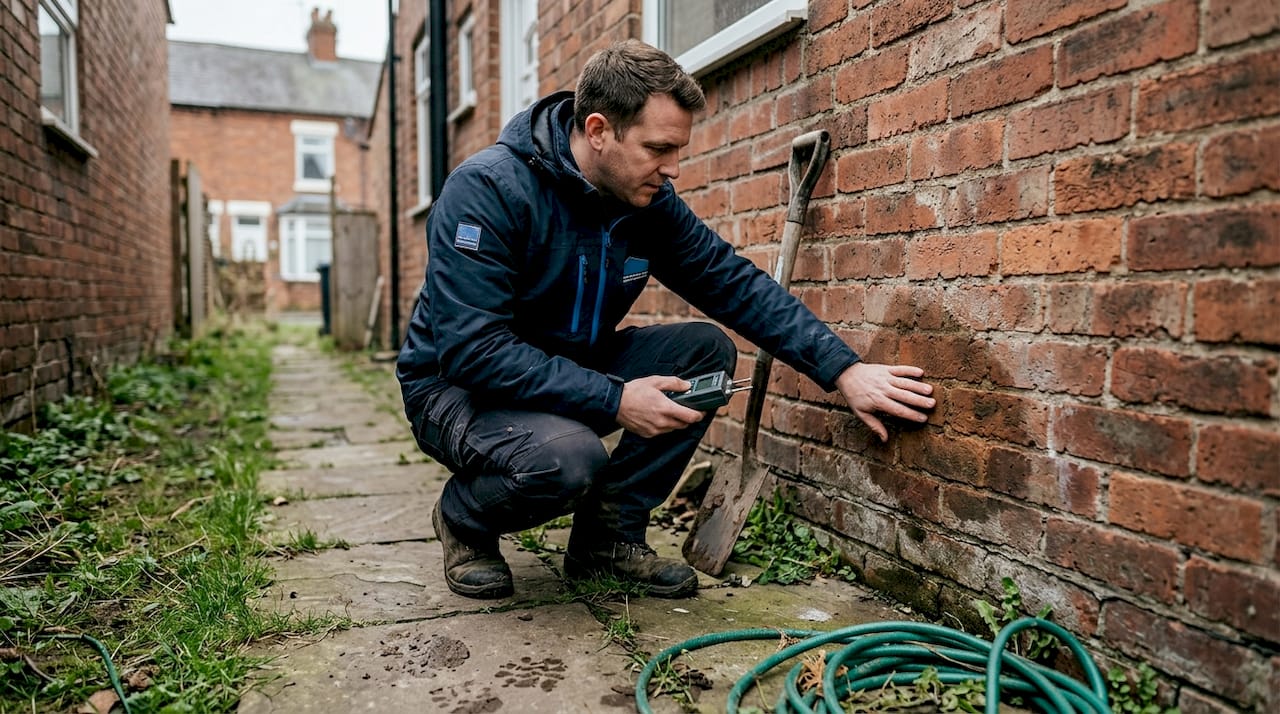
Penetrating damp enters from outside at any level, usually through cracks in walls, failed pointing, damaged roofing, or faulty guttering. It tends to appear on upper walls or ceilings and worsens after heavy rain.
Condensation is caused by warm, moist air meeting cold surfaces inside the home. It is most common in bathrooms, kitchens, and poorly ventilated rooms. Unlike the other types, it does not come from outside or below — it is generated indoors.
| Type | Origin | Where it appears | Worst time |
|---|---|---|---|
| Rising damp | Ground moisture | Lower walls, floor level | Winter/wet season |
| Penetrating damp | External water ingress | Upper walls, ceilings | After rain |
| Condensation | Indoor humidity | Bathrooms, corners, cold surfaces | Winter, poor ventilation |
As rising damp starts at floor level while penetrating damp appears on upper walls and ceilings, the location of the problem is your first diagnostic clue. Addressing external sources before any internal treatment is always the correct sequence.
Understanding the causes of damp in your specific property type matters enormously. Chemical damp proof course (DPC) injection for rising damp typically costs between R300 and R800 per linear metre in South Africa, depending on wall thickness and accessibility. Spending that money on the wrong problem solves nothing.
Waterproofing and repair solutions for South African homes
With a clear idea of the problem, let’s look at how to solve damp for good using proven, locally appropriate methods.
Step-by-step approach after spotting damp:
- Commission a professional survey to confirm the damp type and source
- Address all external causes first — fix leaks, repair guttering, improve drainage
- Allow walls to dry out fully before any internal treatment
- Apply the correct waterproofing system for the confirmed damp type
- Replaster with salt-resistant plaster where required
- Redecorate only once walls are fully dry and treated
For rising damp, chemical DPC injection remains the most widely used solution in South Africa. French drains around the building perimeter can also help redirect ground water away from foundations. For penetrating damp, external waterproofing creams and sealants are most effective, along with repairing any cracks, failed pointing, or roof damage. For condensation, improving ventilation through extractor fans, trickle vents, or positive pressure ventilation units resolves the problem without any chemical treatment.
| Solution | Best for | Estimated cost band | Notes |
|---|---|---|---|
| Chemical DPC injection | Rising damp | R300–R800/linear metre | Requires replastering after |
| External sealant/cream | Penetrating damp | R80–R200/m² | Must fix cracks first |
| French drain | Rising damp | R500–R1,500/metre | Site-specific |
| Ventilation upgrade | Condensation | R1,500–R8,000 | Fans, vents, or systems |
For facebrick homes, waterproofing without plaster requires breathable, penetrating sealants rather than surface coatings. Breathable systems are increasingly preferred under NHBRC and SANS 10400 guidelines because they allow moisture vapour to escape while blocking liquid water ingress. You can explore indoor waterproofing solutions and waterproofing exterior walls for detailed guidance on each approach.
Pro Tip: Salt-resistant replastering is not optional after major damp treatment. Standard plaster will fail quickly if salts from the original damp problem are still present in the wall.
How to prevent future damp damage
Having fixed existing damp issues, taking proactive steps can prevent future headaches and costly repairs.
A structured maintenance routine is your best defence. Here is a practical checklist every South African homeowner or property manager should follow:
- Inspect the roof annually for cracked tiles, failed flashing, and blocked valleys
- Clear gutters and downpipes before and after the rainy season
- Check that ground level around the building slopes away from the walls, not towards them
- Inspect external wall surfaces for new cracks or failed pointing every six months
- Ensure all bathroom and kitchen extractor fans are working correctly
- Check window and door seals for deterioration annually
- Look inside built-in cupboards and under sinks for early moisture signs after heavy rain
Proper drainage and breathable wall systems, not just surface treatments, are what deliver lasting prevention. Surface-only fixes will always fail if the underlying water pathway is not addressed.
For larger or older buildings, a professional building maintenance waterproofing plan is worth the investment. Scheduled inspections by a qualified waterproofing contractor catch problems before they become structural. Any new waterproofing work should also comply with SA waterproofing standards under SANS 10400 to ensure lasting protection and avoid disputes with insurers or future buyers.
If you have experienced a leak indoors, drying wet carpets quickly is important to prevent secondary mould growth while you arrange proper wall repairs.
Pro Tip: After heavy rains, always inspect basements and ground-floor corners within 24 hours. Early moisture spotted at this stage is far cheaper to address than damp that has been sitting for weeks.
A fresh perspective on damp: Why knowledge beats DIY guesswork
Here is something most property guides will not tell you plainly: the biggest driver of repeat damp repairs in South Africa is not poor products — it is wrong diagnosis. Homeowners scrub off mould, slap on a waterproofing paint, and consider the job done. Six months later, the problem is back, often worse.
International DIY advice rarely accounts for South African conditions. Local soil types, seasonal rainfall patterns, and the prevalence of older homes without original damp proof courses all change the equation significantly. What works in a modern UK terrace does not automatically translate to a 1970s Johannesburg double-storey.
South African regulations, specifically NHBRC registration requirements and SANS 10400 compliance, also mean that certain waterproofing work must meet defined standards. Ignoring these does not just risk structural failure — it can affect your insurance cover and property resale value.
“The hidden cost of wrong solutions doesn’t just show up in your walls, but your insurance claims.”
We strongly advocate for a survey-first approach. As professional diagnosis and addressing external causes first is the recommended sequence, even experienced property managers benefit from an expert second opinion. Understanding preventative waterproofing in maintenance as an ongoing discipline, rather than a one-off fix, is what separates properties that hold their value from those that do not.
Get expert help for damp in your home
If you have spotted any of the warning signs covered in this guide, the smartest next step is a professional assessment before committing to any treatment. Guessing the wrong damp type is a costly mistake that a qualified inspection easily avoids.

Pro Waterproofing specialists use modern diagnostic tools, including moisture meters and thermal imaging, to accurately identify damp sources across all property types. Every solution is aligned with SANS 10400 and NHBRC requirements, giving you lasting protection and full compliance. From once-off repairs to ongoing maintenance contracts, the team is equipped to handle damp at every scale. Explore expert solutions for damp or get in touch today for a professional site assessment.
Frequently asked questions
What is the most common cause of damp walls in South Africa?
Rising damp caused by moisture moving upward through foundation walls is especially prevalent, particularly in older homes without a proper damp proof course. It is typically treated with chemical DPC injection.
What does black mould on a wall mean?
Black mould signals persistent moisture inside the wall, most often from condensation or penetrating damp, and is a clear sign to act quickly. Ignoring it risks health and structural damage that worsens over time.
Is it safe to paint over damp patches on walls?
No — painting over damp traps moisture beneath the surface, worsening the problem and causing further structural damage. Proper diagnosis and repair must always come before any redecorating.
How much does it cost to fix rising damp?
Expect to pay around R300 to R800 per linear metre for chemical DPC injection, with additional costs for salt-resistant replastering and finishing work depending on the extent of the damage.
What standards should waterproofing solutions meet in South Africa?
All waterproofing work should comply with NHBRC and SANS 10400 standards to ensure lasting protection, legal compliance, and protection of your property’s insurance and resale value.