
TL;DR:
- Water damage severely damages South African properties by weakening structures and fostering mould growth, often unnoticed early. Choosing a reliable waterproofing contractor requires thorough vetting through questions about certifications, insurance, site surveys, warranties, and references to prevent costly failures. Proper due diligence, including site visits and detailed contracts, ensures lasting results, protects your investment, and avoids common pitfalls like price-based decisions and inadequate scope definitions.
Water damage is one of the most destructive forces acting on South African properties, quietly eroding structural integrity, encouraging mould growth, and slashing resale value long before most owners notice the signs. Whether you own a sectional title flat in Cape Town, a commercial warehouse in Johannesburg, or a family home in Durban, the contractor you choose to waterproof your building will either protect your investment for a decade or send you back to square one within months. This guide gives you a clear, practical framework for vetting contractors, asking the right questions, and securing results that actually last.
Table of Contents
- Why asking the right questions matters
- Essential criteria for choosing reliable waterproofing contractors
- Key questions to ask your waterproofing contractor
- Warning signs and common mistakes to avoid
- How to verify your contractor and what to expect next
- Our perspective: Cutting through confusion in the contractor selection process
- Need a waterproofing specialist? Start with Pro Waterproofing
- Frequently asked questions
Key Takeaways
| Point | Details |
|---|---|
| Always ask for credentials | Verify CWP/CIDB registration, public liability insurance, and references to avoid unreliable contractors. |
| Insist on a site survey | Proper quotes and solutions require a thorough property assessment—never accept a price without one. |
| Beware of red flags | Avoid contractors who demand large upfront payments, avoid paperwork, or cannot provide a warranty. |
| Get everything in writing | Insist on a formal contract, staged payments, and a written workmanship warranty for your protection. |
| Protect property value | The right contractor ensures lasting waterproofing results and boosts your property’s longevity. |
Why asking the right questions matters
Most property owners treat waterproofing as a commodity. They collect three quotes, pick the middle price, and assume the job is done. That approach is costly. Hiring an unreliable waterproofing contractor can lead to significant water damage costs and decreased property longevity, according to industry guidance for South African property owners.
The consequences of inadequate vetting go well beyond a leaking roof:
- Structural decay in beams, slabs, and foundations
- Mould and mildew that create serious health risks for occupants
- Electrical faults caused by water ingress near wiring
- Dispute costs and legal fees when a contractor disappears after the job
- Complete redo costs when substandard membranes fail within two years
For commercial property owners, there is an additional layer of risk. A warehouse or retail centre with persistent damp can face tenant disputes, stock losses, and reputational damage that far exceeds the original waterproofing bill.
“Spending an extra day asking the right questions before you sign a contract can save you tens of thousands of rands in remedial work.”
The flipside is equally clear. Property owners who take time to vet contractors properly report fewer call-backs, longer-lasting results, and genuine peace of mind. Knowing exactly who is working on your building, what materials they are using, and what recourse you have if something goes wrong is not a luxury. It is the baseline for any sensible property decision.
The right questions, as explored through our questions for waterproofing contractors resource, provide that baseline in a structured, repeatable way.
Essential criteria for choosing reliable waterproofing contractors
To choose confidently, focus on these non-negotiable requirements. Before you schedule a single meeting or request a quote, understand what separates a professional contractor from someone with a bakkie and a spray gun.
Core selection criteria
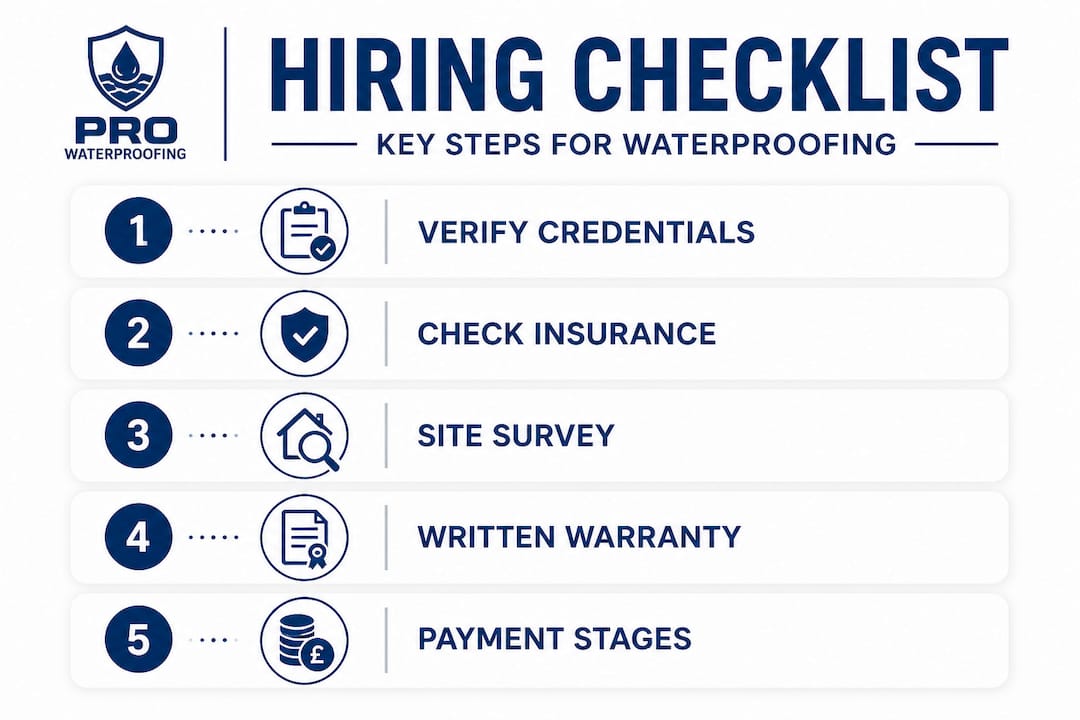
Key selection criteria for reliable waterproofing contractors include CWP or CIDB registration, public liability insurance of at least R1 million, a site survey before quoting, a five to ten year workmanship warranty, and verifiable references from similar completed projects.
Let us unpack each one:
CWP registration stands for Contractor Waterproofing Professional, a specialist designation that confirms the contractor has demonstrated competence specifically in waterproofing systems. CIDB stands for Construction Industry Development Board, a South African government body that grades contractors by their capacity and track record. Both forms of registration mean the contractor can be held accountable through a formal process if something goes wrong.
Public liability insurance is your financial safety net. If a contractor’s worker falls through a skylight, or their machinery damages your neighbour’s property, you could be held liable without proper insurance in place. Always ask for the actual certificate, not just a verbal confirmation.
A free site survey before quoting is non-negotiable. No contractor can accurately price a waterproofing job from photos or descriptions alone. Every roof, basement, or retaining wall has unique conditions that affect material choice, surface preparation, and application method.
| Criterion | What to look for | Why it matters |
|---|---|---|
| CWP or CIDB registration | Certificate with current date | Formal accountability and professional standards |
| Public liability insurance | Minimum R1 million cover | Protects you from third-party claims |
| Site survey | Offered free before quoting | Ensures accurate scope and pricing |
| Workmanship warranty | Written, five to ten years | Gives you recourse if the system fails |
| Project references | Similar scope and property type | Proof of real-world performance |
Before you go any further, review our full guide on essential questions for contractors and cross-reference it with what waterproofing contractors in SA are typically expected to provide.
Key questions to ask your waterproofing contractor
Armed with the criteria above, it is time to structure your contractor interviews. Use these sample questions to dig deeper and separate serious professionals from those who simply talk a good job.
- Are you registered with the CIDB or do you hold CWP certification? Can you show me the certificate?
- Do you carry public liability insurance, and can you provide proof of current cover?
- Will you conduct a free site survey before providing a written quote?
- What waterproofing system do you recommend for my specific situation, and why?
- Who manufactures the products you use, and do they carry their own product warranty?
- What workmanship warranty do you offer, and is it in writing?
- What are your payment terms, and do you require a large upfront deposit?
- Can you provide references from three similar projects completed in the last two years?
These interview questions for waterproofing give you a structured way to compare contractors on substance rather than sales patter.
Strong versus weak contractor responses
| Question | Strong answer | Weak answer |
|---|---|---|
| Registration | “Here is my current CIDB certificate.” | “I’ve been doing this for years, trust me.” |
| Insurance | “I’ll email you the certificate today.” | “Yes, I have insurance.” (no proof offered) |
| Site survey | “I’ll visit before I quote, no charge.” | “Send me some photos and measurements.” |
| Warranty | “Five years, in writing, included in the contract.” | “We stand behind our work.” |
| Deposit | “We require a 30% deposit and staged payments.” | “We need 70% upfront to buy materials.” |
Red flags are often found in the details of how contractors respond rather than what they say outright. Quotes without a site visit, no insurance proof, cash-only requests, no written warranty, vague credentials, and large upfront deposits are all warning signs that experienced property owners learn to recognise quickly.
Pro Tip: When checking references, ask the previous client specifically whether the contractor returned to address any issues after project completion. A contractor who disappears after sign-off is far more common than one who proactively follows up. That single question tells you more than a dozen glowing testimonials.
For a broader framework, our guide on questions before hiring contractors covers the full scope of due diligence beyond waterproofing specifically.
Warning signs and common mistakes to avoid
Even with a solid interview, it is easy to fall into some common traps. Be alert to these warning signs and pitfalls that catch out even experienced property owners.
Warning signs to watch for
- Refusing or avoiding a site inspection before quoting
- Requesting more than 30 to 40% upfront before any work begins
- Unable or unwilling to provide proof of insurance
- No references, or references who cannot be reached
- Prices significantly lower than all other quotes (usually means corner-cutting on materials)
- Vague or verbal-only descriptions of the scope of work
- Pressure tactics such as “this price is only valid today”
Common mistakes property owners make
Choosing purely on price is the most frequent error. Waterproofing is a system. The membrane, primer, application technique, and surface preparation must all work together. A contractor who cuts the price usually cuts one of these steps. You will not know which one until the system fails.
Skipping reference checks is equally dangerous. It takes fifteen minutes to call two previous clients and ask straightforward questions. Most people skip this step and rely on online reviews, which can be manipulated or simply lack the detail needed to make an informed decision.
Accepting a vague scope of work is a contractual trap. If the written quote says “waterproof flat roof” without specifying the membrane system, the primer, the number of coats, and the treatment of all joints and penetrations, the contractor has room to cut corners everywhere.
“The cheapest quote is almost never the best value. In waterproofing, you are not just paying for labour. You are paying for the system, the products, and the accountability.”
Red flags including cash-only payment requests, large upfront deposits, and no written warranty are well-documented patterns that consistently lead to costly remedial work.
Our resource on critical questions for contractors goes into greater depth on how to structure your written contract to close these loopholes before work begins.
Pro Tip: Structure your payments in stages tied to project milestones, such as 30% on signing, 40% on material delivery and application, and 30% on sign-off after your inspection. This protects you and gives a reputable contractor no reason to object, since they will be confident in their ability to deliver each milestone.
How to verify your contractor and what to expect next
Once you find a promising contractor, here is how to seal the deal with confidence and ensure the project runs smoothly from start to finish.
-
Request all documents before signing. Ask for the CIDB or CWP certificate, public liability insurance certificate, and a copy of the contractor’s company registration. Verify that the insurance is current and the policy limit meets at least R1 million.
-
Call at least two references. Ask specifically about the scope of work, whether it matched the quote, how the contractor handled any problems, and whether they would hire them again. Note how quickly the references respond and how specific their answers are.
-
Confirm the written scope of work. Every line item in the contract should specify the product by manufacturer name, the application method, the number of coats, and the areas covered. Ambiguity is always the contractor’s friend, not yours.
-
Agree on a project timeline with milestones. Good contractors plan their schedules. Knowing roughly when each phase of the work will be complete gives you inspection opportunities and payment trigger points.
-
Conduct a mid-project inspection. You have the right to inspect the work as it progresses. Check that materials on-site match what was specified in the contract. Reputable contractors welcome this.
-
Complete a formal sign-off. Before releasing the final payment, walk the completed work with the contractor, note any outstanding items in writing, and confirm the warranty document is included in your handover pack.
Key selection criteria emphasise that your workmanship warranty should run for five to ten years and be provided in writing as part of the handover documentation, not simply a verbal promise at the end of the job.
For a detailed checklist of what to confirm at each stage, see our resources on top questions for your waterproofing contractor and the related guide covering essential waterproofing questions that every property owner should work through before project commencement.
Our perspective: Cutting through confusion in the contractor selection process
After working with property owners across South Africa, one pattern becomes very clear. The people who get burned are not naive or careless. They are busy. They trust surface-level signals, a professional-looking quote, a confident handshake, a handful of Google reviews, and they move on to the next item on their to-do list. The vetting process feels tedious precisely when it matters most.
Here is the uncomfortable truth: most waterproofing failures we encounter are not material failures. They are process failures. The right product was specified, but the primer was skipped to save time. The membrane was applied, but penetrations around pipes were left untreated because that detail was never written into the scope. These are not random events. They are predictable consequences of not having a written contract that specifies every step.
The other thing most advice misses is the value of direct reference checks. Not just reading reviews. Actually calling a previous client and asking, “Did water come back within two years?” That question alone filters out a surprising proportion of contractors who present impressive portfolios of first-day photos.
We also see property owners underestimate the importance of the site survey. A contractor who quotes without visiting your property is not just being lazy. They are telling you they are not interested in the details. Waterproofing is almost entirely about details: the angle of a parapet, the condition of an existing membrane, the precise location of a water ingress point. You cannot price those from a description.
Finally, on the question of price, our experience is consistent with what our questions for waterproofing contractors resource reflects. “Cheap and fast” in waterproofing is a pattern, and it nearly always leads to a second project within three years that costs more than the first one done correctly. Budget for quality the first time. Ask about the system, not just the price.
Need a waterproofing specialist? Start with Pro Waterproofing
Knowing what to ask is the first step. Finding a contractor who actually meets every standard is the second, and that is where many property owners get stuck.
Pro Waterproofing connects South African residential and commercial property owners with vetted waterproofing specialists who carry the right certifications, provide full documentation, and back their work with written warranties. You can request a quote directly through the website, and our team will guide you through the process from the initial site survey to final sign-off. There is no obligation and no guesswork. Just transparent, expert service from professionals who understand that a properly waterproofed property is a protected investment.
Frequently asked questions
Why is a site survey important before getting a quote?
A site survey before quoting allows contractors to assess your property’s unique needs and ensures accurate, fair pricing rather than a guess based on vague descriptions.
What does CWP or CIDB registration mean for a contractor?
CWP or CIDB registration shows the contractor meets recognised industry standards and can be held accountable through a formal process if their work falls short.
What is a fair workmanship warranty for waterproofing?
Reliable contractors offer a written workmanship warranty of five to ten years, giving you documented recourse if the system fails prematurely.
Should I accept a large upfront deposit for waterproofing work?
No. Large upfront deposits are a red flag, and reputable contractors will structure payments in stages tied to project milestones rather than demanding most of the money before work begins.
Is public liability insurance really necessary for waterproofing contractors?
Yes. Public liability insurance of at least R1 million protects you financially if something goes wrong on-site, so always request and verify the actual insurance certificate before work commences.