

TL;DR:
- South African waterproofing compliance involves multiple layered certifications, not a single license.
- Proper licensing and documentation protect against insurance voidance, legal liabilities, and structural damage.
- Verify contractor credentials through official registers, association memberships, and manufacturer accreditations before hiring.
Hiring a waterproofing contractor feels straightforward until you realise that South African law wraps the process in several overlapping compliance layers that most property owners have never heard of. There is no single “waterproofing licence” you can simply verify and move on. Instead, you need to check CIDB registrations, NHBRC enrolments, PRAWA Certificates of Compliance, SANS alignment, and manufacturer accreditations, each applying to different job types and settings. Get it wrong and you face voided insurance, structural liability, and repair bills that dwarf the original project cost. This guide cuts through that complexity so you can hire with confidence.
Table of Contents
- Why licensing and compliance matter in waterproofing
- Which licences, certificates and registrations are needed?
- Compliance versus quality: What really protects your project?
- How to verify waterproofing contractor credentials
- A pragmatic perspective: Why process beats paper every time
- Partner with experts for peace of mind
- Frequently asked questions
Key Takeaways
| Point | Details |
|---|---|
| Multiple compliance layers | Waterproofing contractors must meet CIDB, NHBRC, PRAWA and often manufacturer standards for legal work. |
| COC and insurance matter | Certificates of Compliance and valid insurance safeguard against structural damage and legal claims. |
| Quality is more than paperwork | Ongoing audits, warranty enforcement, and references show real commitment to quality. |
| Always verify credentials | Check paperwork, memberships, warranties and SANS compliance yourself—never rely on verbal claims. |
| Process protects your project | Regular site checks and audit trails defend against costly failures more effectively than documents alone. |
Why licensing and compliance matter in waterproofing
Most property managers treat contractor paperwork as a formality. It is not. When a waterproofing system fails on your building, the first question your insurer asks is whether the work was carried out by a compliant contractor. Non-compliance risks structural damage, legal liabilities, and insurance invalidation simultaneously, which means a single unlicensed appointment can turn a R50,000 repair into a R500,000 dispute.
South African law is explicit about this. Public sector projects above a certain value require CIDB-registered contractors. Residential developments require NHBRC enrolment. And Certificates of Compliance, COCs, are increasingly demanded by conveyancers, insurers, and body corporates alike. Understanding the industry standards for waterproofing that govern these requirements is the first step toward protecting your investment.
The scale of the problem is telling. More than 40% of defects in new South African buildings relate directly to water ingress, making it the single largest category of building defect by volume. That figure is not an accident. It reflects how often waterproofing is treated as a low-skill commodity trade rather than a specialist discipline.
“The systemic cost of ignoring waterproofing compliance is not just measured in rand. It accumulates in structural corrosion, mould-related health claims, devalued assets, and protracted legal battles that could have been avoided by checking three documents before signing a contract.” — Industry compliance specialist, South Africa.
Here are the five most immediate risks of appointing an unlicensed waterproofing contractor:
- Voided insurance: Most property insurance policies exclude damage caused by non-compliant workmanship.
- Legal liability: If water ingress from your building damages a neighbouring property, you carry personal liability.
- No warranty recourse: Unlicensed contractors cannot issue enforceable COC-backed warranties.
- Structural degradation: Water penetration left unresolved accelerates concrete carbonation and steel corrosion.
- Resale complications: Conveyancers increasingly require compliance documentation before transfer of property.
With the stakes established, the next section explores exactly which licences and certifications are required.
Which licences, certificates and registrations are needed?
Here is where the confusion starts for most property owners. South Africa does not have a single government-issued “waterproofing licence.” What exists instead is a layered system of registrations, certifications, and accreditations that collectively confirm a contractor’s legal standing and technical competence.
CIDB (Construction Industry Development Board) registration is required for public tenders above R200,000, with waterproofing falling under the General Building (GB) contractor class. The CIDB grades contractors from 1 to 9 based on financial capacity and track record. A Grade 1 contractor can only bid on work below R200,000, while Grade 9 is uncapped. If your project involves any government or municipal infrastructure, CIDB registration is non-negotiable.
NHBRC (National Home Builders Registration Council) registration is mandatory for home builders, and the technical manager of the contractor company must pass a formal assessment before registration is granted. This applies to any new residential construction. If a waterproofing contractor is working as part of a new home build, the principal contractor must be NHBRC-registered, and specialist subcontractors should be enrolled under that registration.
PRAWA (Professional Roof and Waterproofing Association) is a voluntary industry body, but its COC carries real weight. A PRAWA COC requires NQF Level 2 certification, audited workmanship, and a five-day rectification window for any identified failures. This is not a rubber stamp. Contractors are audited on-site, and non-conforming work triggers a formal corrective process.
WTASA and DWASA (Waterproofing Trades Association of South Africa and Dampproofing and Waterproofing Association of South Africa) are additional voluntary associations that signal a contractor’s commitment to ongoing professional development and ethics.
Manufacturer accreditations matter too. Many waterproofing system manufacturers only extend product warranties when their systems are installed by contractors they have formally approved and trained. If an unapproved contractor uses a manufacturer’s product and it fails, neither the manufacturer nor the contractor will cover your claim.
Here is how the requirements map across project types:
| Project type | CIDB required | NHBRC required | PRAWA COC | Manufacturer accreditation |
|---|---|---|---|---|
| Public/municipal | Yes (GB class) | No | Recommended | Recommended |
| New residential build | Yes (if >R200k) | Yes | Recommended | Recommended |
| Commercial building | Yes (if >R200k) | No | Strongly recommended | Strongly recommended |
| Private home repair | No | No | Best practice | Best practice |
Use this numbered checklist when vetting any contractor’s paperwork before appointing them to your project:
- Confirm CIDB registration number and grade via the CIDB online portal.
- Request proof of NHBRC registration if the project involves new residential construction.
- Ask for the contractor’s current PRAWA COC and check the issue and expiry dates.
- Verify association membership directly on the PRAWA, WTASA, or DWASA website.
- Request proof of manufacturer accreditation for the specific waterproofing system proposed.
- Confirm that the technical manager listed on registrations is actually supervising your project.
Pro Tip: Always request the original COC document, not a photocopy or scan. COCs have reference numbers you can verify directly with the issuing association.
For a step-by-step contractor vetting process tailored to South African conditions, additional practical guidance is available to help you work through each checkpoint efficiently.
Compliance versus quality: What really protects your project?
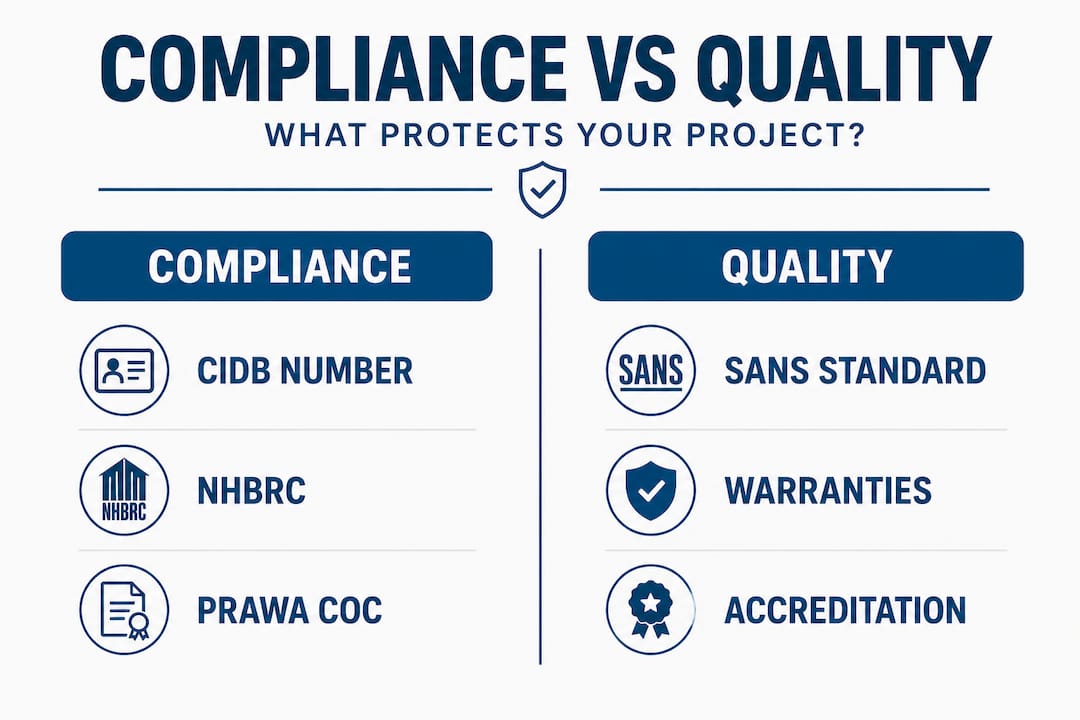
Compliance is the floor. Quality is what you actually need. These are not the same thing, and conflating them is one of the most expensive mistakes a property manager can make.
SANS (South African National Standards) sets the technical baseline for waterproofing systems in South Africa. SANS 10400-W covers waterproofing of buildings specifically, outlining material performance, application methods, and system durability requirements. A contractor who references SANS compliance is telling you they understand the technical minimum. That is good. It is not enough on its own.
Manufacturer accreditations and association memberships signal quality beyond the minimum, because they attach ongoing accountability to the contractor’s name. When a contractor holds a manufacturer’s accreditation, that manufacturer has trained them, vetted their application methods, and staked their own product warranty on the outcome. That is a far stronger incentive for quality than a registration certificate sitting in a filing cabinet.
Here is how the key quality indicators compare in practical terms:
| Quality indicator | What it promises | Who enforces it |
|---|---|---|
| SANS compliance | Meets national technical minimum | Local authority/engineer |
| PRAWA COC | Audited workmanship, 5-year watertightness guarantee | PRAWA association |
| Manufacturer accreditation | System installed correctly by trained applicator | Manufacturer |
| Liability insurance | Financial cover if work fails | Insurer |
| 5-year warranty | Contractor returns to rectify defects | Contractor/association |
Empirical benchmarks from the industry confirm that waterproofing systems should guarantee a minimum of five years of watertightness, and PRAWA audits provide the accountability mechanism to back that up. Without an audit trail, a warranty is just a promise on paper with no enforcement mechanism.
The compliance benchmarks used in professional engineering practice make clear that documentation alone does not drive quality. Ongoing site supervision, post-application inspection, and audit systems are what separate genuine quality from box-ticking.
Be alert to these warning signs when assessing a contractor:
- No verifiable association membership: Claims membership but cannot provide a membership number.
- Vague or verbal warranties only: Refuses to put warranty terms in writing or cannot provide a COC.
- No public liability insurance: Cannot provide a current certificate of insurance naming your property.
- Unlisted manufacturer relationship: Claims to use a specific product brand but is not on the manufacturer’s approved applicator list.
- Resistance to inspection: Declines third-party inspection or post-application audit requests.
Learning more about waterproofing warranties and the qualities of good waterproofing contractors will help you distinguish genuine quality from superficial compliance.
Pro Tip: Ask contractors for two or three references from projects completed in the past two years. Then actually call those references and ask specifically whether the waterproofing has held up without callbacks or repairs.
How to verify waterproofing contractor credentials
Knowing what to look for and knowing how to actually verify it are two different skills. Here is a practical six-step process you can use before signing any waterproofing contract.
-
Check CIDB registration online. Visit the CIDB’s official contractor register and search by company name or registration number. Confirm the grade matches the project value and that the registration is current, not expired.
-
Verify NHBRC enrolment if the project is part of a new home build. The NHBRC also has an online register. Confirm the technical manager named in the registration is actually involved in your project.
-
Request and verify the PRAWA COC. Association membership verification, COC reference numbers, and expiry dates should all be confirmed directly with the association, not just accepted from the contractor’s paperwork.
-
Confirm SANS alignment. Ask the contractor which specific SANS standard governs the system they are proposing, and request the specification document. A contractor who cannot name the relevant SANS standard is operating without a technical framework.
-
Check liability insurance currency. Request a current certificate of insurance, not a policy schedule from last year. Confirm the insured amount covers the full project value and that your property is adequately covered as an interested party.
-
Validate manufacturer accreditation. Go to the manufacturer’s website directly and search their approved applicator list. If the contractor is not listed, their use of that product will not carry the manufacturer’s warranty.
These are the most important questions to ask during the vetting conversation:
- Which CIDB grade are you registered under, and is it appropriate for this project value?
- Is your technical manager NHBRC-assessed, and will they be on-site during application?
- Can you provide a PRAWA COC for this project, and who conducts the audit?
- What SANS standard applies to the system you are recommending?
- What does your warranty cover, for how long, and who backs it?
- Are you on the approved applicator list for the products you intend to use?
Pro Tip: Association and manufacturer websites publish live member directories. Check those directly rather than relying on the contractor’s own paperwork. Directories are updated in real time when memberships lapse.
When selecting a waterproofing contractor, having a prepared list of questions for waterproofing contractors ready before the first meeting puts you in a far stronger position to evaluate who you are dealing with.
A pragmatic perspective: Why process beats paper every time
We have reviewed hundreds of waterproofing projects over the years, and a pattern emerges consistently. The projects that fail are rarely performed by contractors with zero documentation. More often, failure happens when a technically registered contractor wins the job, hands it to an unsupervised crew, applies the system incorrectly, and then issues a COC based on the assumption that the work was done right.
The paper was in order. The process was not.
Here is an uncomfortable truth: a CIDB registration number, an NHBRC certificate, and even a PRAWA COC can all exist without a single quality check happening on your specific project. These credentials certify the contractor’s capacity and general track record, not the individual job they are doing for you today. That distinction is critical.
We have seen residential projects where a properly licensed contractor delivered defective torch-on membrane installation because the supervisor visited once and the crew improvised the overlap joints. The membrane failed within eighteen months. The warranty claim process was slow, adversarial, and only partially successful because there was no independent audit of the original work.
The lesson here is to treat licensing as the entry requirement, not the finish line. What actually protects your project is a transparent quality process: a documented specification before work begins, an independent inspection at application midpoint, and a formal post-completion audit tied to the COC issuance. Contractors who resist any of those steps are telling you something important.
Proactive warranty tracking matters as well. Keep your COC, warranty document, and project specification in a single file. Set a calendar reminder at year two and year four to inspect the waterproofed areas and document any observations in writing. This creates a paper trail that strengthens your position if a warranty claim becomes necessary.
Tips for hiring contractors in the South African context consistently reinforce this point. The best contractors welcome scrutiny. They build inspection milestones into their own project plans because they know audited work produces fewer callbacks and stronger reputations.
Treat any contractor who resists a mid-project inspection or declines to specify the audit process behind their COC as a red flag, regardless of what their registration certificates say.
Partner with experts for peace of mind
Understanding the layers of licensing, compliance, and quality assurance in waterproofing is genuinely complex, and most property owners should not have to navigate it alone.
Pro Waterproofing works only with contractors who meet every credential requirement outlined in this guide: current CIDB and NHBRC standing where applicable, verified PRAWA COCs, confirmed manufacturer accreditations, and fully current liability insurance. Every project recommendation comes with transparent warranty documentation and an audit process you can actually follow. If you are ready to move forward with confidence on your next waterproofing project, explore the full library of resources available and request a quote from specialists who have already done the compliance checks for you. Start with guidance on choosing the right waterproofing contractor to make your decision straightforward.
Frequently asked questions
Is there a specific waterproofing licence required in South Africa?
No single licence exists, but contractors must meet CIDB, NHBRC, and PRAWA requirements depending on project type, and PRAWA COCs represent the most widely recognised practical certification.
How do I check if a contractor is properly accredited?
Request their CIDB or NHBRC registration number and verify membership directly on the relevant association and manufacturer websites, rather than accepting documents from the contractor alone.
What if I use an unlicensed or uninsured waterproofing contractor?
You risk structural damage and legal liability while simultaneously invalidating your property insurance, leaving you with no financial recourse if the work fails.
Are warranties on waterproofing work enforceable?
Yes, when issued alongside a formal COC and backed by liability insurance. Five-year warranties from PRAWA-audited contractors carry a formal rectification process that makes enforcement practical rather than theoretical.