
TL;DR:
- Interior waterproofing manages water after it enters the basement using drainage and pumps, while exterior waterproofing blocks water before it reaches the foundation with membranes and drainage. Exterior systems are more costly, disruptive, and long-lasting, whereas interior systems are easier to maintain and suited for minor seepage cases. The best choice depends on water entry points, foundation condition, site constraints, and budget.
Interior vs exterior basement waterproofing describes two fundamentally different strategies for keeping your basement dry. Interior systems manage water after it enters the basement, using perimeter drains and sump pumps to redirect it away. Exterior systems stop water before it reaches your foundation walls, using membranes and drainage installed outside the building. The right choice depends on where water enters, the condition of your foundation, your budget, and the physical constraints of your site. This guide covers how each system works, what it costs, and which conditions suit each approach.
How do interior and exterior basement waterproofing systems work?
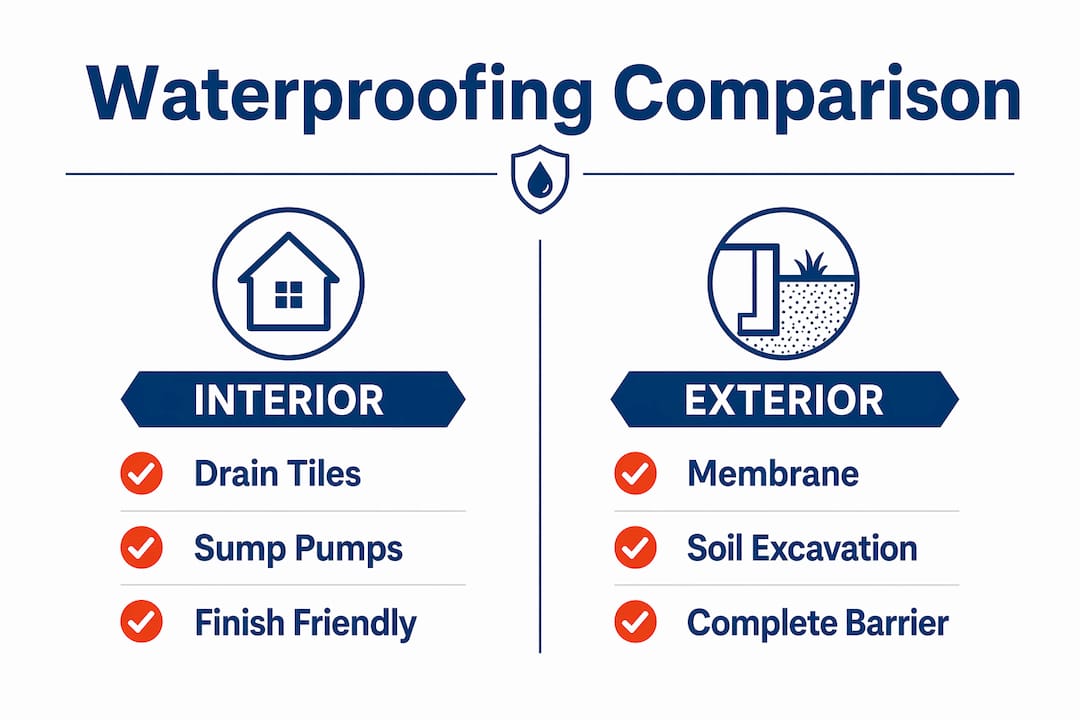
Interior and exterior waterproofing differ in where they intercept water. Interior systems let water enter the structure and then redirect it before it causes damage. Exterior systems block water at the source, outside the foundation wall.
Interior waterproofing components
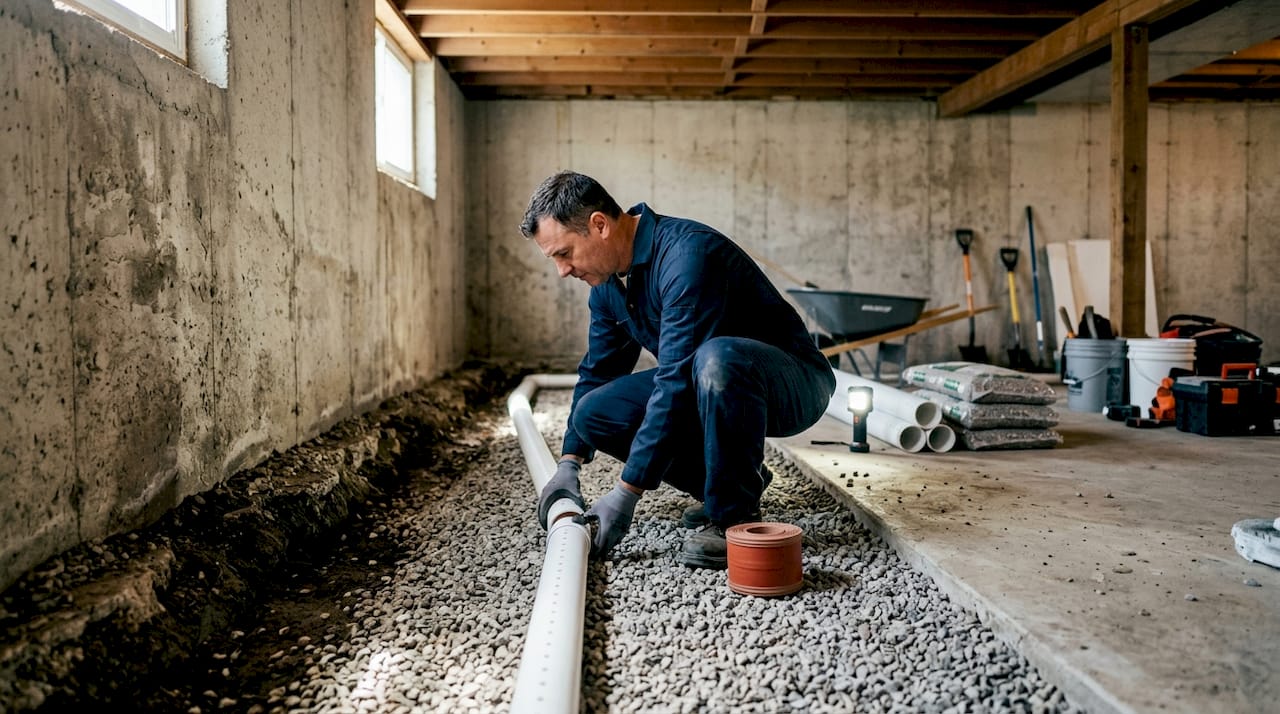
An interior system typically includes a perimeter drain tile installed along the base of the basement walls, a sealed sump basin, a sump pump, and a moisture barrier or liner fixed to the walls. Optional dehumidification manages residual humidity and reduces mould risk. The drain tile collects water that seeps through the wall base or floor joints and channels it to the sump basin, where the pump discharges it away from the building.
Exterior waterproofing components
An exterior system involves excavating the soil around the foundation, applying a waterproof membrane directly to the outside of the foundation wall, and installing drainage tiles or a drainage board to carry groundwater away from the structure. Hydrostatic pressure is the key engineering factor here. When saturated soil pushes water against your foundation, a membrane alone is not enough. Drainage must relieve that pressure, or the membrane will eventually fail.
| Feature | Interior waterproofing | Exterior waterproofing |
|---|---|---|
| Water control point | Inside basement, after entry | Outside foundation, before entry |
| Key components | Drain tile, sump pump, liner | Membrane, drainage board, excavation |
| Mechanism | Intercept and redirect | Block and drain |
| Disruption | Minimal, inside only | Significant, excavation required |
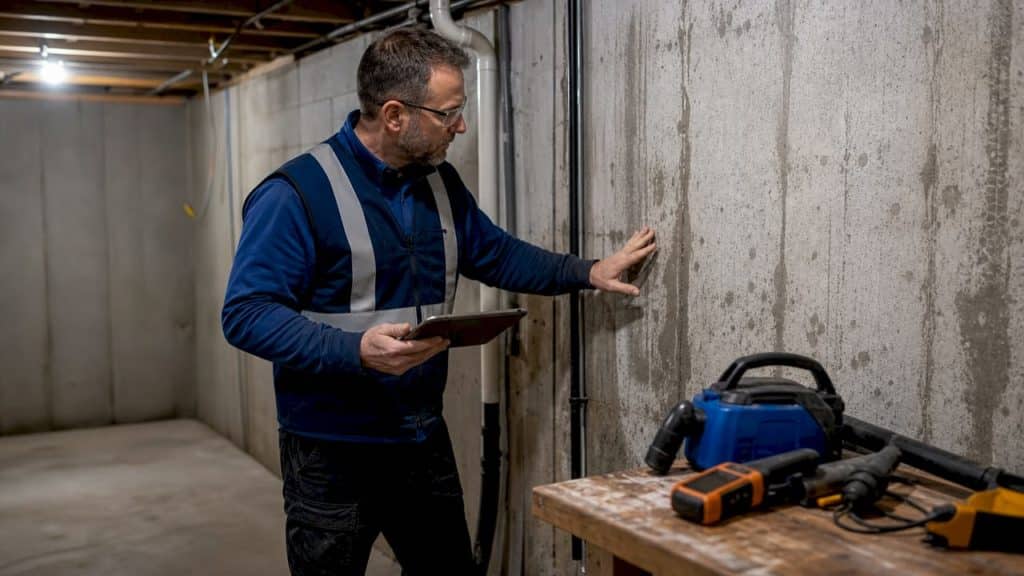
Pro Tip: If you can see white mineral deposits (efflorescence) on your basement walls, water has already been passing through the concrete. An interior drainage system addresses this directly, without the cost of full excavation.
What are the cost and disruption differences?
Cost is one of the clearest differences between the two approaches. Interior waterproofing costs typically range from $3,000 to $10,000 installed. Exterior waterproofing runs from $7,000 to $18,000, reflecting the labour and equipment needed for excavation and landscaping restoration.
Installation timelines follow the same pattern. Interior work completes in 1–3 days. Exterior projects take 5–14 days, depending on the depth of the foundation and the complexity of the site.
The disruption profile is equally different. Interior work stays inside your basement. Exterior work requires digging around the perimeter of your home, which affects driveways, garden beds, paving, and any structures close to the foundation. Restoring that landscaping adds both cost and time to the project.
Maintenance costs also differ over the long term. Interior systems rely on mechanical components, specifically the sump pump, which requires periodic testing and eventual replacement. Exterior membranes are largely passive once installed, but any repair requires re-excavation.
| Factor | Interior waterproofing | Exterior waterproofing |
|---|---|---|
| Typical cost (2026) | $3,000–$10,000 | $7,000–$18,000 |
| Installation time | 1–3 days | 5–14 days |
| Site disruption | Low | High |
| Repair access | Easy, inside basement | Requires excavation |
Pro Tip: Get a written scope of work that includes landscaping restoration before signing any exterior waterproofing contract. Restoration costs are frequently underestimated by homeowners and sometimes excluded from initial quotes.
Which conditions suit interior versus exterior waterproofing?
The correct method depends on diagnosing where and how water enters your basement. Exterior waterproofing is the right choice when hydrostatic pressure is causing your foundation walls to bow, crack, or shift. In those cases, the problem is structural and requires stopping water before it reaches the wall.
Interior waterproofing suits a different set of conditions. These include:
- Water seeping through cove joints (where the floor meets the wall)
- Sub-slab water entry caused by a high water table
- Minor wall cracks that allow localised seepage
- Finished basements where excavation would cause unacceptable disruption
- Sites where neighbouring structures, mature trees, or paving make exterior excavation impractical
Wall cracks are a useful diagnostic signal. Horizontal cracks indicate lateral soil pressure and point toward exterior intervention. Vertical or diagonal cracks from settling are often manageable with interior drainage and crack injection.
Site constraints are a deciding factor that many homeowners overlook. If your home is close to a boundary wall, has a shared driveway, or sits on a narrow plot, exterior excavation may simply not be feasible. Interior waterproofing is often more practical for existing homes precisely because it avoids these physical limitations.
Pro Tip: Before calling a contractor, photograph every damp patch, crack, and stain in your basement after a heavy rain. The pattern of water entry tells a specialist far more than a dry inspection ever can.
What are the long-term performance differences?
Exterior systems, when correctly installed with both membrane and drainage, offer the most complete protection. A well-installed exterior membrane can last 25–40 years. The trade-off is that any failure requires excavation to repair, which is expensive and disruptive.
Interior systems are easier and less costly to maintain. Sump pumps and drainage channels sit inside the basement, fully accessible. A pump can be tested, serviced, or replaced without disturbing the structure. This accessibility makes interior systems the practical choice for most existing homes.
The risk with interior systems is mechanical dependence. A sump pump that fails during a heavy storm will allow water to accumulate. A battery backup pump addresses this risk directly and is worth the additional cost.
Finished basements require particular attention. Interior damp-proof coatings applied on the negative pressure side can fail if water pushes against them with force. For finished spaces, a full drainage system with a dehumidifier is more reliable than a coating alone. Vapour barriers and careful insulation placement also matter for mould prevention.
- Test your sump pump every six months by pouring water into the basin
- Replace sump pumps every 7–10 years regardless of apparent condition
- Inspect drainage channels annually for sediment build-up
- Monitor wall liners for tears or separation from the wall
Pro Tip: A battery backup sump pump is the single most cost-effective upgrade for any interior waterproofing system. Power cuts and storms tend to arrive together.
Can interior and exterior methods be combined?
Combining both systems delivers the strongest protection available. The exterior membrane blocks water at the source. The interior drainage system manages any water that bypasses the exterior barrier. This dual approach is used in new construction on sites with severe groundwater, or in existing homes where structural conditions and high water tables create persistent problems.
The scenarios where combining methods makes sense include:
- New builds on sites with a high seasonal water table
- Existing homes with a history of repeated flooding despite single-system treatment
- Properties where structural repairs to the foundation are already requiring excavation
- Basements intended for habitable finished space where moisture tolerance is zero
The cost of combining systems is significant. You are paying for both the excavation and membrane work of an exterior system and the drainage and pump installation of an interior system. For most homeowners with moderate water entry, one well-chosen system is sufficient. For basement flooding solutions in severe cases, the combined approach removes the guesswork about which system carries the load.
Key takeaways
The most effective basement waterproofing choice is determined by where water enters, the degree of hydrostatic pressure, site constraints, and your budget for installation and long-term maintenance.
| Point | Details |
|---|---|
| Interior vs exterior distinction | Interior systems redirect water inside; exterior systems block it before it reaches the wall. |
| Cost difference | Interior costs $3,000–$10,000; exterior costs $7,000–$18,000 due to excavation. |
| Condition matching | Hydrostatic pressure and bowing walls require exterior; cove joint seepage suits interior. |
| Maintenance access | Interior systems are easier and cheaper to service; exterior repairs require re-excavation. |
| Combined approach | Pairing both systems gives maximum protection for severe groundwater or new builds. |
My honest view on choosing between these two approaches
After working through many basement waterproofing assessments, the single biggest mistake I see is homeowners choosing a method based on price alone, without first diagnosing the water entry point. Exterior waterproofing is not automatically superior. It is the right answer for specific structural and pressure-related conditions. For the majority of existing homes with seepage through joints or a rising water table, interior drainage is not a compromise. It is the correct solution.
The misconception that exterior is always the “proper” fix persists because it sounds more thorough. Stopping water outside the wall does feel more definitive. But interior waterproofing installed correctly, with a reliable sump pump and proper drainage channels, performs exceptionally well over decades. The key word is correctly. A poorly specified interior system that ignores humidity control will create a mould problem even as it manages the water.
My recommendation is always to start with a thorough inspection after rain, map the entry points, assess the foundation condition, and then match the system to those findings. Vendor selection matters as much as method selection. A contractor who pushes one solution for every basement is telling you something important about their diagnostic process.
— Eben
Prowaterproofing: expert assessment and installation for your basement
Choosing the right waterproofing system is straightforward when you have the right information and the right team. Prowaterproofing provides professional interior and exterior basement waterproofing services across South Africa, with detailed site assessments that identify exactly where water is entering and why.
Whether your basement needs an interior drainage system, an exterior membrane installation, or a combination of both, Prowaterproofing matches the solution to your specific conditions. The team handles everything from initial diagnosis through to installation, minimising disruption and maximising the lifespan of your waterproofing system. For a detailed quote and a no-obligation assessment, contact Prowaterproofing directly through the website.
FAQ
What is the main difference between interior and exterior basement waterproofing?
Interior waterproofing intercepts and redirects water after it enters the basement using drains and sump pumps. Exterior waterproofing blocks water before it reaches the foundation wall using membranes and drainage installed outside.
Which method costs less to install?
Interior waterproofing costs less, typically $3,000–$10,000 compared to $7,000–$18,000 for exterior systems. The lower cost reflects the absence of excavation and landscaping restoration.
How do I know which method my basement needs?
Bowing or cracking walls caused by hydrostatic pressure point to exterior waterproofing. Water entering through cove joints, sub-slab seepage, or minor cracks is better addressed with an interior system.
Can I use both interior and exterior waterproofing together?
Yes. Combining both systems offers the strongest protection and is recommended for new builds on high water table sites or existing homes with severe, recurring flooding.
How long does each system last?
A correctly installed exterior membrane lasts 25–40 years. Interior systems depend on mechanical components, particularly the sump pump, which needs servicing every few years and replacement every 7–10 years.