
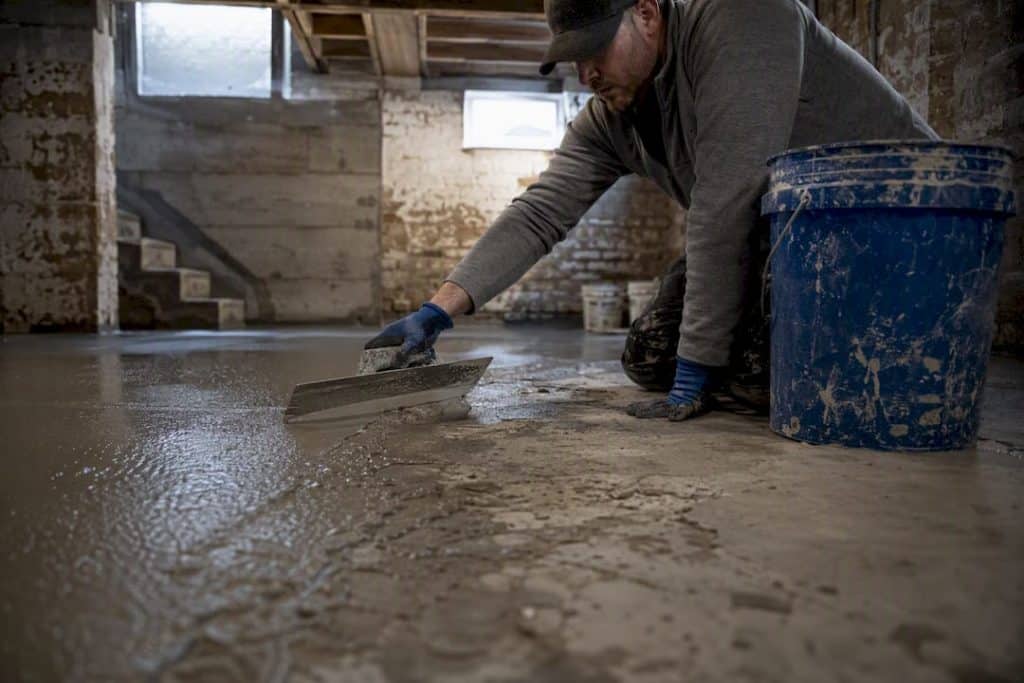
For most contractor-grade jobs, two systems dominate: two-part polymer-modified, fibre-reinforced cementitious membranes for wet areas, basements, roofs and terraces, and rigid calcium-aluminate coatings for chemically aggressive or high-pressure environments. Neither is universally “best.” Each solves a different failure mode.
- Flexible 2K membranes bridge hairline cracks and handle minor structural movement, making them the default for balconies, bathrooms and podium decks.
- Rigid calcium-aluminate coatings resist chemical attack and sustained hydrostatic pressure, common in basements, lift pits and reservoirs.
- Neither works alone against wide movement joints or severe hydrostatic head. Those need combination systems with dedicated membranes or injection resins.
One manufacturer datasheet for a calcium-aluminate coating recommends a minimum finished thickness of 3 mm for pressure resistance in many applications. That single number separates a coating applied properly from one applied to look finished.
Key Takeaways
Contractor-grade cementitious waterproofing succeeds when the product, thickness and test method are all named in the contract, not left to assumption.
| Point | Details |
|---|---|
| Match system to use case | Flexible 2K membranes suit wet areas and movement; rigid calcium-aluminate coatings suit chemical or high-pressure exposure. |
| Insist on named specs | Contracts should state product, datasheet reference, coat count and film thickness, typically 2 to 4 mm. |
| Demand real testing | Flood tests (48 hours) for horizontal areas and vacuum or spark tests for verticals should happen before finishes go down. |
| Watch termination detail | Failures cluster at outlets, corners and movement joints, not open field areas. |
| Work with a vetted contractor | Prowaterproofing writes specifications, vets contractors and supervises projects against SANS-based standards. |
Table of Contents
- Best cement for waterproofing: how contractors classify the systems
- Standards contractors should be quoting against
- What a proper application spec actually includes
- Testing before anyone signs off on the job
- Choosing a contractor and what the contract must say
- How long cementitious waterproofing lasts and what shortens it
- Comparing cement types used in waterproofing systems
- Cementitious systems versus other waterproofing methods
- Additives that improve cement’s resistance to water
- How weather and site conditions affect waterproofing cement
- What most contracts leave out, and why it matters
- Get a proper inspection before you commit to a system
- Sources
Best cement for waterproofing: how contractors classify the systems
Cementitious waterproofing is not one product. It is a category, and contractors split it two ways based on how the finished layer behaves under stress.
Two-component polymer-modified, fibre-reinforced membranes (often shortened to “2K” on datasheets) combine Portland cement, polymer resin and fibre reinforcement into a slurry applied in coats. The polymer content gives the cured layer flexibility and crack-bridging ability, so it moves slightly with the substrate instead of fracturing. A documented 2K product typically resists both positive and negative water pressure, which matters for basement walls facing groundwater pushing inward.
Rigid cementitious coatings and calcium-aluminate products sit at the other end of the spectrum. They cure hard, offer no meaningful elongation, and rely on dense impermeability rather than flexibility. That makes them suited to:
- Reservoirs, sumps and lift pits with constant water contact
- Areas needing chemical resistance (effluent, mild acids, sulfates)
- Substrates with minimal expected movement
Datasheet claims worth checking before you sign anything: stated crack-bridging width, resistance to positive versus negative pressure, and minimum cure temperature.
Standards contractors should be quoting against
Any waterproofing quote worth trusting references a standard, not just a brand name. In South Africa, that standard is SANS 10021, which classifies waterproofing materials into categories (including reinforced bituminous membranes, applied membranes and liquid-applied systems) and sets application and termination detail for roofs, balconies and below-ground structures. SANS 952 covers related material performance criteria contractors reference when specifying products.
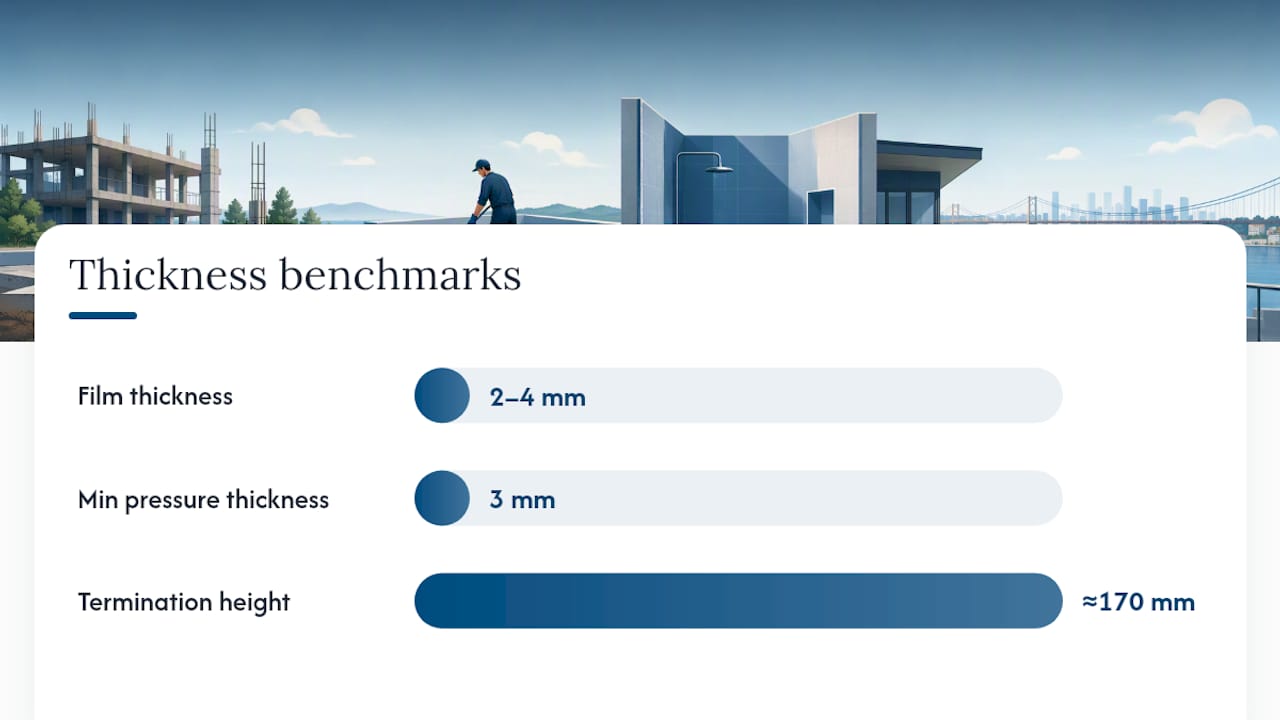
Three numeric benchmarks worth memorising before you read a quote:
- Film thickness: most cementitious membranes are specified at 2–4 mm total, applied in multiple coats rather than one thick pass.
- Minimum thickness for pressure resistance: some calcium-aluminate coatings require 3 mm minimum finished thickness in higher-pressure applications.
- Water:cement ratio: waterproof concrete mixes generally target lower ratios to reduce capillary porosity, a detail worth asking your contractor to confirm on structural pours.
Termination detailing matters just as much as the membrane itself. Good specifications call for turn-ups at wall junctions, terminations extending above finished floor level (often quoted around 170 mm), and proper dressing around pipe outlets and penetrations. The general specification PW371 lists exactly this kind of termination and testing guidance, and it is worth asking a contractor whether their spec aligns with it.
What a proper application spec actually includes
A contractor who skips substrate preparation is setting up a failure that will not show for a year or two. Mechanical preparation, removing weak or friable concrete, and repairing structural cracks come before any membrane touches the surface. Standards generally treat cracks up to about 0.3 mm as acceptable without special repair; anything wider usually needs routing and filling first.
Beyond prep, a competent spec should include details from the Oceancare Products Store to ensure correct types of sealers and cementitious products are used.
- A stated mix ratio and number of coats, not just “two coats” without quantities
- Fillet or coving mortar at internal corners to avoid stress concentration before the membrane goes down
- Glass-fibre net reinforcement in high-stress zones like corners, upstands and around outlets
- Named temperature limits for application, since most products cure poorly below roughly 8°C
- Curing and protection periods before the surface is walked on or covered
Some 2K products can go onto damp substrates and are self-priming, which speeds up programmes on wet sites, but that does not remove the need for correct cure time before finishes such as tiles, screeds or stone go down.
Pro Tip: Ask your contractor to write the reinforcement detail into the quote by name (“glass-fibre net at all internal corners and upstands”), not as a general note. Vague wording is where corners get cut on site.
Testing before anyone signs off on the job
A membrane that looks finished and a membrane that is actually watertight are not the same thing, and the only way to tell the difference is to test before the finishes go down.
- Flood test horizontal surfaces for 48 hours, checking the underside or adjoining spaces for any sign of moisture ingress.
- Vacuum, spark or air-pressure test vertical membranes and detailing, particularly at seams, penetrations and terminations where pinholes are most likely.
- Inspect outlets, movement joints and terminations specifically, since these are the points where most real-world failures start, not the flat field areas.
- Test before covering, and protect the tested membrane immediately with a board or screed layer so trades working afterwards do not puncture it.
Agrément guidance on water penetration testing describes both unpressurised and pressurised assessments, with test durations around 20 hours for certain wall applications. If a contractor cannot describe which test they will run and for how long, that is a specification gap worth pushing back on before work starts.
Choosing a contractor and what the contract must say
Licensing and product knowledge separate contractors who understand SANS specification from those reciting brand names. Ask for proof of manufacturer training or approval, not just years in business.
Before signing, the contract should name:
- The exact product by name and datasheet reference, not a generic description like “waterproof coating”
- Layer thickness and number of coats, matching the datasheet’s stated minimum
- Which tests will be performed (flood, vacuum, spark) and when
- Warranty length and its exclusions, since most warranties void if maintenance conditions are ignored
- References or documented case studies from similar projects
If a contractor cannot name the product, refuses to commit to a test, or has no warranty paperwork to show you, treat that as a serious red flag rather than a minor gap. Standards exist precisely so an owner does not have to take a verbal promise on faith, as SANS 10021 guidance makes clear in its material classification and application detail.
How long cementitious waterproofing lasts and what shortens it
Well-specified cementitious systems typically perform for well over a decade, but three things shorten that window fast: sustained UV exposure on unprotected surfaces, structural movement the membrane was never designed to absorb, and poor substrate preparation at installation.
Owners can catch problems early with a few habits:
- Walk exposed roof and terrace areas twice a year, checking for hairline cracking or blistering.
- Photograph and date any ponding that lingers more than a day after heavy rain.
- Log leaks with location and date, even minor ones, since this record supports any warranty claim later.
- Schedule re-inspection before a warranty period ends, not after symptoms appear.
A maintenance log is not paperwork for its own sake. Most manufacturer warranties require evidence of reasonable upkeep before they pay out.
Comparing cement types used in waterproofing systems
Not every cement performs the same way once water gets involved, and the type used underneath a membrane affects how the whole system holds up.
Ordinary Portland cement (OPC) forms the base of most waterproofing mortars and membranes because it is well understood and widely available, but on its own it has enough capillary porosity that it needs polymer modification or dense mix design to resist water pressure reliably.
Rapid-hardening cement speeds up early strength gain, useful where a contractor needs to get a protective screed or coving down quickly before weather or site traffic causes damage. It does not inherently waterproof better than OPC; the advantage is programme speed, not performance.
Sulfate-resisting cement matters specifically where groundwater or soil contains sulfates that attack ordinary Portland cement over years, slowly degrading the very structure the waterproofing depends on. Coastal and industrial sites are the usual candidates.
Calcium-aluminate cement, used in the rigid coatings discussed earlier, cures into a dense, chemically resistant layer suited to constant water contact and mild chemical exposure, at the cost of flexibility.
None of these is the single “best cement for waterproofing” in isolation. The right choice depends on ground conditions, exposure, and whether the design calls for flexibility or rigidity. A contractor who recommends the same cement type for every job regardless of site conditions probably has not looked closely at the site.
Cementitious systems versus other waterproofing methods
Cementitious membranes are not the only route to a dry structure, and knowing their trade-offs against the alternatives helps you judge whether a contractor’s recommendation fits your building.
Compared with bituminous membranes, cementitious systems bond more reliably to damp or slightly uneven concrete substrates and can often go on without extensive drying time first. Bituminous systems generally offer better raw flexibility and are a common choice for large flat roofs with significant thermal movement.
Compared with liquid-applied polyurethane or acrylic coatings, cementitious membranes typically cost less per square metre and cure into a harder, more abrasion-resistant surface, useful under tiles or where foot traffic is heavy. Polyurethane systems usually stretch further before cracking, which suits structures with more movement.
Compared with sheet membranes (torch-on or self-adhesive), cementitious systems avoid seam-related failure points since they cure as a continuous layer, but they demand more skill on site to achieve even thickness and full coverage across the whole surface.
The practical takeaway: cementitious systems suit substrates that are reasonably stable, need finishes like tiles or screed on top, and where installers are trained specifically in the mix ratios and reinforcement detail the job calls for.
Additives that improve cement’s resistance to water
The base mix rarely does the whole job. Additives and admixtures are what push a cementitious system from “resists damp” to “resists sustained water pressure.”
Polymer modifiers (acrylic or SBR-based) are blended into 2K membranes specifically to add flexibility and crack-bridging capacity that plain cement cannot achieve. This is the difference between a membrane that survives a hairline crack and one that fails at it.
Fibre reinforcement, usually polypropylene or glass fibre, distributes stress across the cured layer instead of letting it concentrate at one weak point, extending the crack width a membrane can tolerate before failing.
Crystalline waterproofing admixtures react with unreacted cement particles and water to grow crystals that block capillary pores from within the concrete, a technique increasingly specified for structural concrete in basements and water-retaining structures.
Waterproofing agents like integral pore blockers reduce capillary absorption in the concrete itself, complementing rather than replacing a surface-applied membrane. Contractors sometimes combine a pore-blocking admixture in the structural pour with a 2K membrane on top for belt-and-braces protection in high-risk basements.
None of these additives are visible once the job is finished, which is exactly why the datasheet reference in your contract matters. You cannot inspect an admixture after the fact. You can only check that the product named on paper matches what was actually specified for your risk level.
How weather and site conditions affect waterproofing cement
Cementitious systems are sensitive to the conditions they are applied and left to cure in, and ignoring this is one of the most common causes of early failure.
Temperature governs cure speed and final strength. Most 2K products should not be applied below roughly 8°C, since cold slows the polymer film formation that gives the membrane its flexibility. Applying in extreme heat causes the opposite problem: surface skinning before the layer beneath has properly cured, trapping weakness under a hard shell.
Moisture during application is more forgiving than most homeowners assume, since several modern 2K membranes are formulated for damp substrates and can even be self-priming. But moisture after curing, particularly standing water left to pond repeatedly on a roof or terrace, accelerates wear far faster than intermittent rainfall runoff.
UV exposure degrades unprotected cementitious surfaces over years, particularly on exposed roofs and terraces without a protective screed or paving layer on top. This is why most specifications call for a UV-resistant topcoat or physical covering rather than leaving a membrane exposed indefinitely.
Site conditions rarely act alone. A membrane applied in marginal cold weather onto a substrate that later ponds water under UV exposure will fail years before a correctly specified equivalent on a properly protected roof.
What most contracts leave out, and why it matters
Most waterproofing failures I have reviewed trace back to a contract, not a product. The membrane was often fine. What was missing was a named test, a stated thickness, or a clear reinforcement detail that never made it onto paper.
The gap usually shows up at terminations and penetrations, not the open field areas everyone inspects. Contractors also frequently skip the temperature and cure-time notes on datasheets, applying in conditions that void the warranty before the job even finishes.
When a structure has active movement or high hydrostatic pressure, Prowaterproofing typically recommends combining a cementitious system with an additional membrane or detailing rather than relying on cement alone.
Get a proper inspection before you commit to a system
Reading datasheets and standards only gets you so far. The real test is whether the system specified matches what your building actually needs, and that call is easiest to make with someone on site. Prowaterproofing writes specifications against the same standards discussed here, vets the contractors who carry out the work, and stays involved through supervision and warranty handling rather than disappearing after the quote.
Requesting an inspection is straightforward: send photos of the affected area, a short description of when the damp or leak first appeared, and details of access points such as roof hatches or basement entries. That gives an assessor enough to scope the job before ever setting foot on site. If you are dealing with a damp wall, a leaking terrace, or a basement that floods after heavy rain, get in touch with Prowaterproofing to request a quote and start with a proper site assessment rather than a guess.
Sources
- EUCOSEAL cementitious waterproof coating PDS
- Performance criterion: water penetration and damp-proofing (Board of Agrément South Africa)