
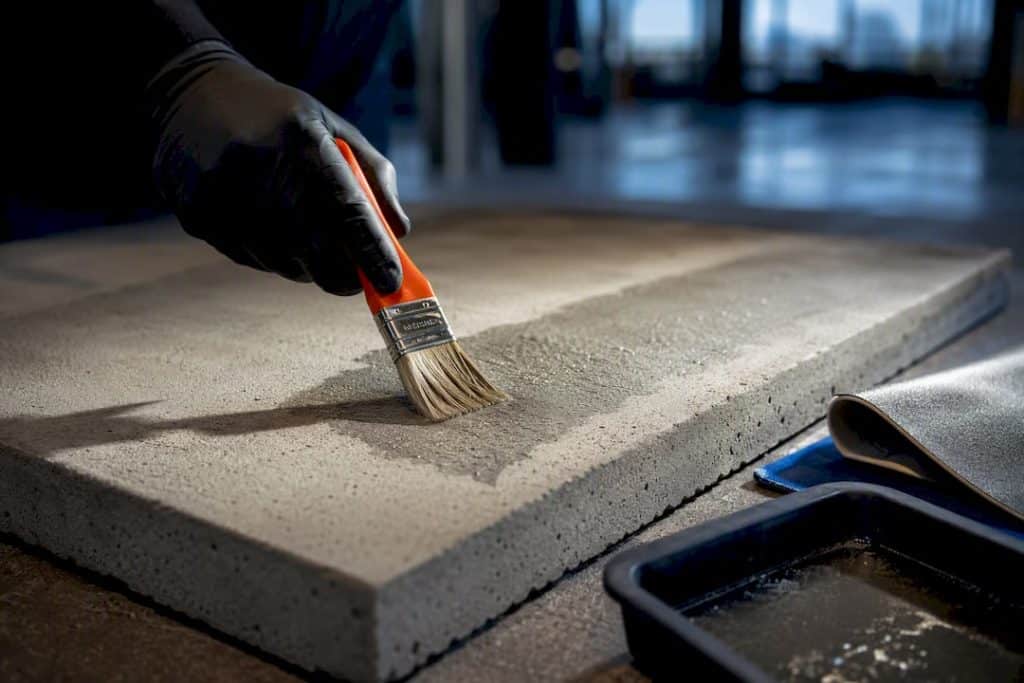
Primer coats are essential for reliable membrane adhesion in nearly every liquid-applied waterproofing installation, because bare concrete, metal, or old asphalt rarely bonds well to a membrane on its own. A primer seals surface pores, regulates how much resin the substrate absorbs, builds a chemical bridge to the membrane’s polymer, and, where aggregate is broadcast, provides a mechanical key. Skip it, or pick the wrong chemistry, and you’re gambling with delamination. The sections below cover primer types, substrate-specific choices, preparation limits, and application timing.
TL;DR:
- Proper primer selection depends heavily on substrate type, with penetrating primers for porous surfaces and epoxy or specialized primers for metals and plastics.
- Surface preparation must be thorough, involving mechanical removal of contamination and profiling to ensure primer penetration and adhesion.
- Timing is critical, as overcoating within the specified tacky window ensures strong chemical bonding, preventing delamination and blistering.
- Skipping or mismatching primer chemistry, or applying it over unprepared surfaces, significantly raises risks of membrane failure caused by trapped moisture or weak bonds.
- Verifying primer compatibility with techniques like pull-off adhesion tests and reviewing technical data sheets before application eliminates common installation issues.
Table of Contents
- The role of primer coat in membrane adhesion: what’s actually happening
- Primer types and chemistry: choosing the right formulation
- Which primer suits which substrate?
- Surface preparation: what priming can and cannot fix
- Getting primer application right on site
- What happens when primer gets skipped or mismatched
- A verification checklist before you sign off the job
- Why primer selection gets treated as an afterthought, and shouldn’t
- Sources
The role of primer coat in membrane adhesion: what’s actually happening
Adhesion failure rarely comes from a bad membrane. It comes from what happened underneath it, usually days before anyone applied a drop of membrane.
A primer’s first job is sealing porosity. Concrete, brick, and screed are full of capillaries and voids; without sealing, membrane binder migrates into the substrate instead of forming a continuous film on top of it, weakening the very layer meant to waterproof the surface. Ardex’s technical guidance on primers and bonding bridges notes this pore-sealing action also binds loose surface dust, giving the membrane a clean, stable base to grip.
The second function is absorption control. A thirsty substrate pulls solvent or moisture out of the membrane too fast, starving film formation before it cures properly.
Third, chemistry matters as much as mechanics. A primer needs to be compatible with the membrane’s resin system, epoxy to epoxy, polyurethane to polyurethane, or it simply won’t form a durable chemical bond.
Finally, where mechanical keying is specified, broadcasting aggregate into the wet primer roughens the surface and gives installers a visual gauge for coverage once the membrane later obscures the sand texture, an insight drawn from Henry Company’s continuing education material on cold fluid-applied systems.
- Seals pores and binds dust
- Regulates absorption so the membrane cures as a proper film
- Builds a chemical bridge between substrate and polymer
- Provides mechanical key via broadcast aggregate
Pro Tip: If your membrane spec calls for a broadcast primer, don’t skip checking coverage against the aggregate pattern before overcoating; uneven sand distribution usually means uneven primer thickness underneath.
Primer types and chemistry: choosing the right formulation
Not every primer does the same job, and picking by habit rather than substrate is where a lot of adhesion problems start.
- Two-part epoxies (100% solids) are the workhorse for horizontal, high-duty areas and instant-setting systems. They’re solvent-free, high-viscosity, and typically installed by squeegee with back-rolling, according to Henry Company’s guidance on cold fluid-applied membranes.
- Penetrating water or solvent-borne primers suit friable, dusty, or porous substrates where the priority is consolidating the surface before anything else touches it.
- Film-forming bonding bridges cut down prep time on dense, well-cured concrete. They form a skin rather than penetrating deeply, which is useful but has limits (more on that below).
- PMMA and specialty primers handle problem substrates such as PVC membranes or certain metals, where standard epoxy chemistry won’t key properly.
- Low-viscosity and low-temperature formulations allow fast-track schedules, with some products engineered to perform below roughly 10°C, per the same Henry Company material. Moisture-mitigating primers extend this further, letting crews work over green concrete sooner, though they mitigate vapour pressure rather than eliminate it entirely.
Choosing between these isn’t cosmetic. It’s the difference between a membrane that keys in and one that peels at the first thermal cycle.
Which primer suits which substrate?
Substrate dictates primer chemistry far more than membrane brand does. Here’s how the choice typically breaks down on site.
- Concrete: Use penetrating primers on cured, absorbent slabs; switch to moisture-mitigating primers on green concrete where schedules won’t allow the usual curing window, understanding this reduces rather than removes vapour risk.
- Metals: Clean and de-oxidise first. Zinc-rich, epoxy, or PMMA primers are the usual choices depending on the metal and exposure.
- PVC and single-ply membranes: These need thorough surface cleaning and a specialist primer formulated for that plastic chemistry; standard epoxies often won’t adhere.
- Asphalt or old membranes: Isolation primers stop bleed-through and prevent the old asphalt swelling the new coating, a common cause of blistering months later.
- Timber, OSB, and tiles: Sealing is the priority on timber to control absorption, while tiled surfaces often need an aggregate broadcast to give the membrane something to key into, since glazed tile offers almost no natural texture.
Reviewing membrane compatibility alongside substrate choice is worth doing before ordering materials; Prowaterproofing’s guide to liquid waterproofing membranes for concrete covers how substrate and membrane selection interact in more depth.
Surface preparation: what priming can and cannot fix
Priming is not a rescue treatment for a dirty substrate. Laitance, curing compounds, oils, grease, and loose dust all need mechanical removal before a primer goes anywhere near the surface, because priming over unprepared surfaces may still result in inadequate adhesion, as Ardex’s technical bulletin on primers and bonding bridges makes clear.
Mechanical profiling, grinding, shot-blasting, or diamond abrasion, opens the surface texture so primer can actually penetrate rather than sit on top.
- Remove laitance and curing compounds mechanically, not chemically
- Strip oils, grease, and loose dust before any primer touches the surface
- Profile dense or trowel-finished concrete to open the pore structure
- Confirm readiness with pull-off testing, not a visual check alone
Film-forming bonding bridges can tolerate less aggressive prep on already-dense substrates, but that’s a convenience, not a substitute for cleaning. Prowaterproofing’s surface preparation guide walks through the profiling standards most contractors work to.
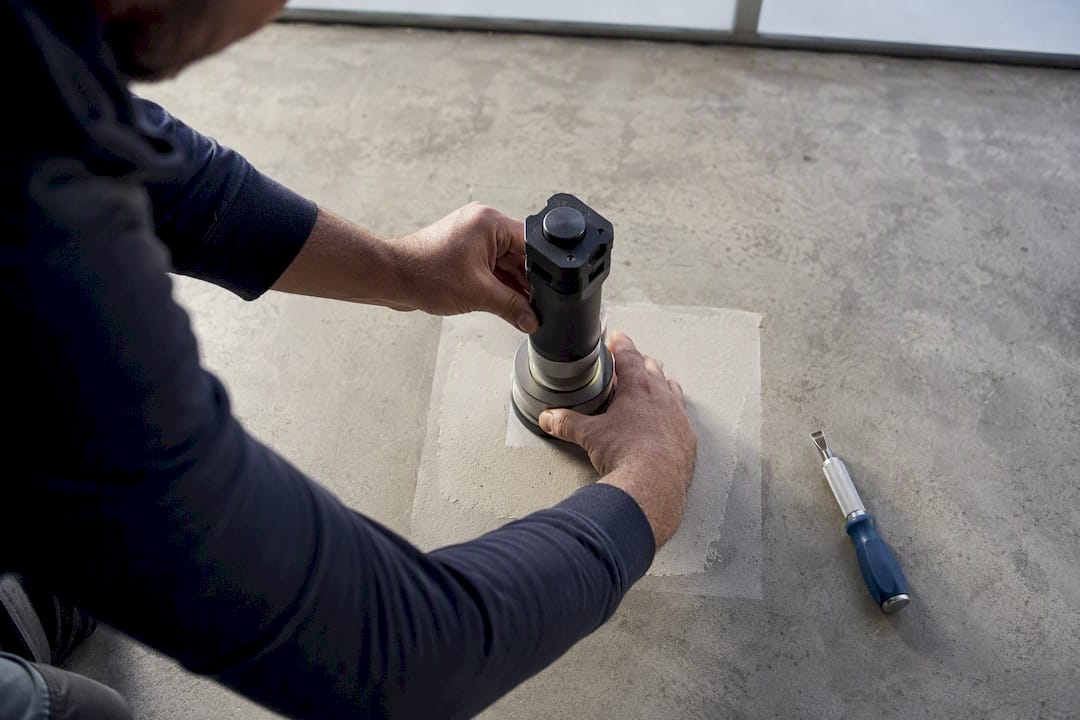
Pro Tip: Ask for a pull-off adhesion test on a small trial patch before committing to full-area application. It costs little and catches a bad substrate before the membrane does.
Getting primer application right on site
Application method depends on the primer’s viscosity and the substrate’s geometry. Brushes handle detailing and upstands; rollers and squeegees cover open field areas faster, with back-rolling used to work high-viscosity epoxies into the surface.
- Measure and apply at the manufacturer’s specified spread rate, not by eye.
- Broadcast aggregate into the wet primer where specified, using the sieve size the technical data sheet calls for.
- Watch the overcoat window closely. Duram’s DuraPrime technical data sheet specifies a 4 to 8 hour tacky window for intercoat adhesion, while Sika Concrete Primer allows notably faster overcoating thanks to its rapid-cure polyurea hybrid chemistry.
- Remove excess, unbonded aggregate before the membrane goes on; loose sand under a membrane is a bond failure waiting to happen.
- In cold weather, confirm the primer is rated for the temperature range on site, since standard formulations can struggle below 10°C.
Waiting too long past the tacky window is as risky as rushing. Once a primer fully cures and skins over, chemical bonding drops off sharply. Prowaterproofing’s step-by-step application guide sets out timing checkpoints crews can use on site.
What happens when primer gets skipped or mismatched
Delamination and blistering are the two failures that show up most, and both usually trace back to residual moisture. Trapped moisture outgasses under sun exposure, pushing the membrane away from the substrate from beneath.
- Chemistry mismatch (an epoxy membrane over an incompatible primer) causes weak bonding that fails under thermal movement, not immediately
- Over-diluting primer to stretch coverage thins the film below its effective sealing thickness
- Priming over contaminated or damp surfaces without addressing the contamination first
- Overcoating too late, missing the tacky window specified on the technical data sheet
Skipping primer entirely, or treating it as optional, tends to shorten membrane service life even when everything else in the specification is correct, a pattern noted in independent guidance on primer selection for waterproofing.
A verification checklist before you sign off the job
Specifiers shouldn’t take a contractor’s word on primer compatibility. Ask for the technical data sheet and check it covers substrate compatibility, overcoat timing, VOC content, and cure method before work starts.
- Request pull-off adhesion test results against the TDS acceptance threshold
- Confirm the primer’s stated overcoat window matches what’s planned on site
- Ask for photographs of a sample area, not just the finished job
- Request the same evidence Ardex’s bonding bridge bulletin treats as the definitive test of readiness
Pro Tip: A contractor who can’t produce a TDS on request is a red flag, regardless of how confident they sound about the product.
Why primer selection gets treated as an afterthought, and shouldn’t
The industry talks about membranes far more than it talks about what sits underneath them, and that’s backwards. A membrane is only as good as its bond, and the bond is decided at the primer stage, weeks before anyone judges the finished waterproofing job.
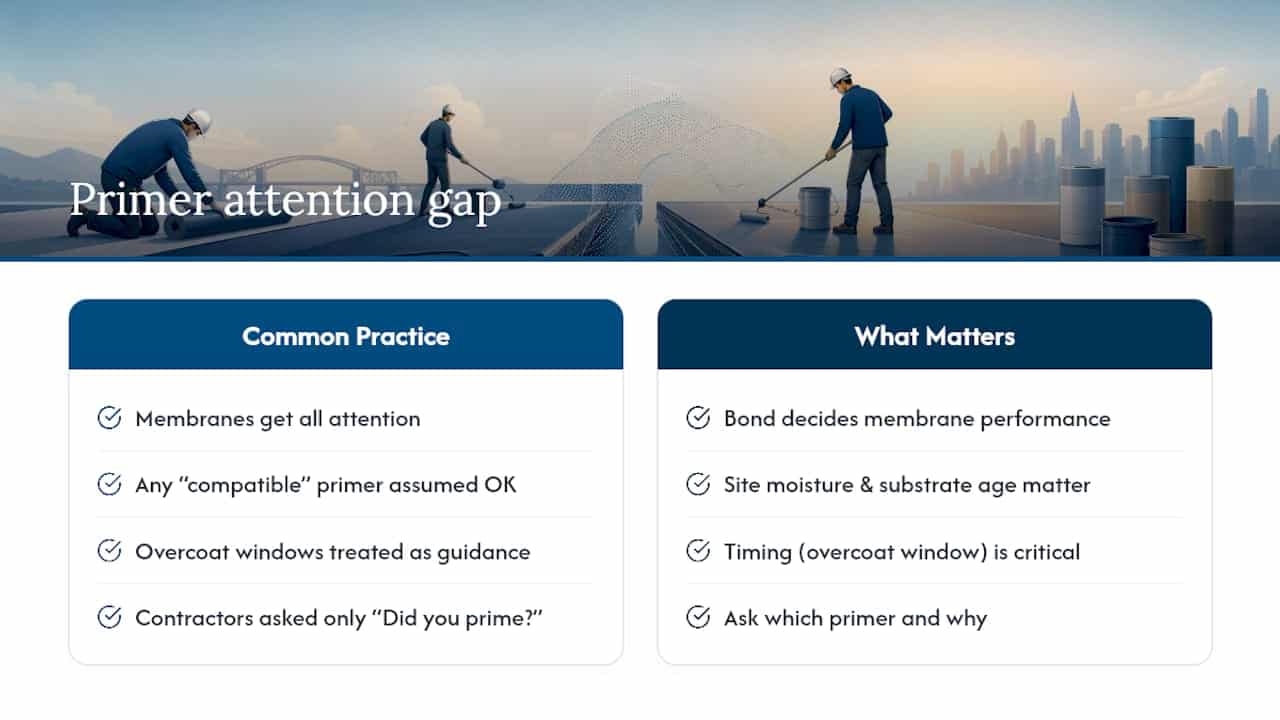
The overrated idea is that any primer will do as long as it’s “compatible” in a general sense. Compatibility on paper doesn’t account for site moisture, substrate age, or how long a crew actually waited before overcoating. The underrated factor is timing. Overcoat windows get treated as guidance rather than a hard limit, and that single lapse causes more comebacks than a wrong primer chemistry ever does.
If there’s one priority for property owners and specifiers, it’s this: don’t ask a contractor whether they primed the surface. Ask which primer, why that one, and whether they can show you the pull-off test. Prowaterproofing’s approach on every job is built around that verification step, because a membrane that looks perfect on installation day tells you nothing about how it will perform in three years.
— Eben
Ready to get your waterproofing project specified and installed correctly the first time? Get a professional quote from Prowaterproofing and have your substrate and primer choice checked by people who deal with this on site every week.
Sources
For readers who want to go straight to the source, Ardex’s technical bulletin on primers and bonding bridges covers preparation limits, Henry Company’s continuing education course explains epoxy and broadcast practice, Sika’s Concrete Primer page details rapid-cure timing, and Duram’s DuraPrime TDS sets out overcoat windows. Always defer to the current manufacturer TDS over any secondary guide, including this one.
For related reading on curing and tiled applications, see Prowaterproofing’s guide to waterproofing under tiles and this overview of waterproofing primers. Two further technical references worth bookmarking are TT Waterproofing’s site resources and Sealtek Cape’s technical pages, both useful for cross-checking regional application practice.
- Technical bulletin TB235 – Primers and bonding bridges (Ardex)
- Waterproofing solutions with instant‑setting cold fluid applied systems (Henry Company / BNP Media)
- Sika® Concrete Primer product page
- DuraPrime technical data sheet (Duram)