
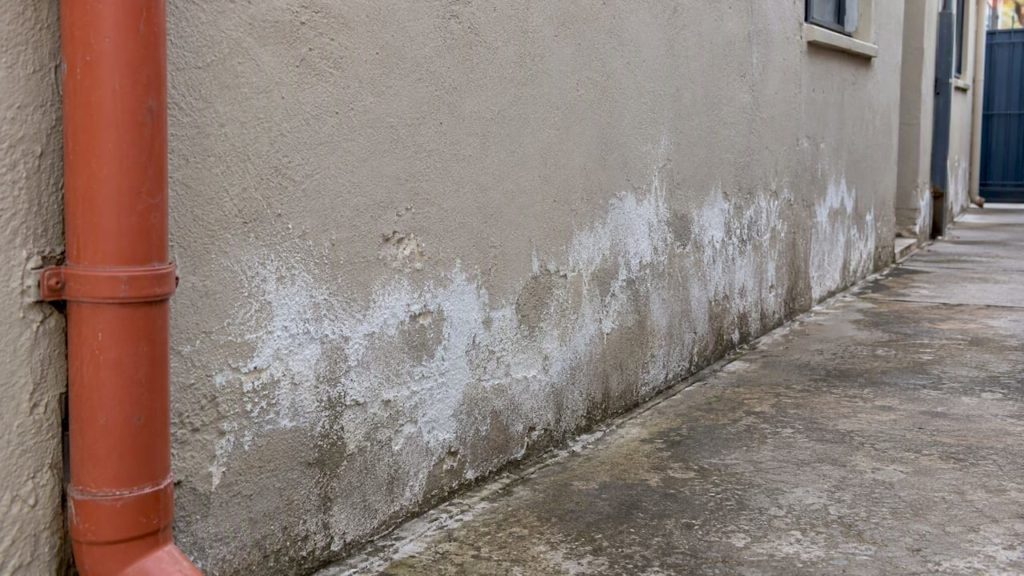
Efflorescence is a deposit of soluble salts, usually white and powdery, that appears on the surface of brick, concrete, stone and mortar. Water inside the wall dissolves salts from the building materials, carries them to the surface, and leaves them behind as it evaporates. According to the Concrete Masonry & Hardscapes Association, it needs three things: soluble salts, moisture and a force to move the solution to the surface. The salts themselves are rarely the real problem. The water that moved them is.
This guide explains how to recognise efflorescence, why it forms, how it differs from mould, when it is harmless, how to remove it without damaging the wall, and when a white crust is telling you that you need a waterproofing specialist.
TL;DR
- Efflorescence is a white (sometimes yellow, green or brown) crystalline deposit left when water carries salts out of masonry or concrete and evaporates.
- On its own it does not affect structural performance, but heavy, recurring or localised deposits show that water is getting into the wall.
- A quick test: efflorescence dissolves in water, whereas mould does not and tends to look fuzzy or stained rather than crystalline.
- Dry brushing and gentle washing remove it. Sealing over it, sandblasting or wire brushing usually make things worse.
- If it keeps coming back after a year or more, find and fix the moisture source rather than cleaning again.
Table of Contents
- What efflorescence looks like
- What causes efflorescence
- New building bloom versus persistent efflorescence
- Is efflorescence harmful?
- How to tell efflorescence from mould and other stains
- How to remove efflorescence safely
- Why it keeps coming back: finding the moisture source
- Preventing efflorescence in new work
- Our perspective
- When to get a professional involved
- Get a quote from a vetted waterproofing professional
- FAQ
- Sources
What efflorescence looks like
Most people describe it as a white, chalky bloom, like frost or flour dusted over a brick face. Research from New Zealand notes that it can also appear as a brown, green or yellow deposit on clay and concrete masonry and on concrete walls. The texture ranges from a faint haze to a thick, crusty layer, depending on how much salt is present and how quickly the water evaporates.
Common places to spot it:
- Lower courses of external brick walls, especially near the ground or flower beds.
- Below window sills, parapets and coping stones, where rain collects.
- Garden walls, retaining walls, paving and driveways.
- Basement and cellar walls, and the inside face of ground-floor walls.
- Freshly built brickwork, concrete floors and newly rendered or plastered surfaces.
The pattern matters as much as the colour. An even, light bloom across a new wall tells a different story from a thick band of crystals at one height, or a patch that reappears every winter.
What causes efflorescence
The CMHA guidance is clear that three conditions must all be present. Remove any one of them and efflorescence cannot form.
1. Soluble salts in the wall
Salts can come from the bricks or blocks, the mortar, the grout, or the cement itself. The same guidance adds groundwater as another source. In older buildings, salts may also come from the ground, from de-icing products or from earlier repairs.
2. Water to dissolve them
Rain, a leaking gutter, a defective flashing, a cracked render, rising ground moisture, a high water table or a plumbing leak can all supply it. Even construction water in fresh mortar and concrete is enough to cause early deposits.
3. A way for the solution to reach the surface
Usually this is evaporation: the wall dries, the water moves outward, and the salts crystallise where the water disappears. Hydrostatic pressure, where water is pushed through a wall from soil on the other side, can also drive it. Underground water can cause efflorescence even without rain when the water table is high, a point made by a mould specialist comparing the two problems.
New building bloom versus persistent efflorescence
Not all efflorescence means the same thing. The key question is how old the building or repair is.
New building bloom is early-age efflorescence on freshly built masonry. The CMHA notes that if left alone, rain will eventually wash its salts away. Masonry industry guidance from the International Masonry Institute describes it as usually harmless and temporary.
Late-age or recurring efflorescence is different. The same IMI document says that deposits appearing more than a year after construction usually signal excessive water penetration and poor drainage. The CMHA likewise says that heavy, localised efflorescence suggests water has entered, or is entering, the wall at a higher level.
| New building bloom | Persistent or late-age efflorescence | |
|---|---|---|
| When it appears | First weeks or months after building or repair | More than a year after construction, or after years of nothing |
| Pattern | Fairly even across the wall | Heavy, patchy or concentrated at one height |
| Behaviour | Fades as the wall dries and rain washes it | Returns after cleaning |
| What it tells you | Construction moisture is leaving the wall | Water is still getting in |
| Action | Wait, dry brush | Investigate and repair the water source |
Is efflorescence harmful?
The honest answer has two halves.
The deposit is generally cosmetic. Guidance from the US National Institutes of Health facilities team states that efflorescence itself is not harmful, and the CMHA says it does not affect structural performance.
What it signals can be harmful. Persistent, repeated or excessive deposits may indicate excessive internal moisture, rising damp or other problems that should be investigated, according to that same bulletin. And when salts crystallise inside the pores of the masonry rather than on the surface, the effect is more serious. A South Australian government technical guide describes salt attack as crystals forming within masonry pores, disrupting the material and causing fretting and loss of the surface skin.
In practice that means:
- A light white bloom on a new wall: leave it, brush it off, relax.
- Thick deposits, flaking brick faces, crumbling mortar or peeling paint above the deposit: water is doing damage. Treat it as a moisture problem.
- Damp patches, a musty smell or a tide-mark alongside the salts: look for rising damp, a failed damp-proof course, or water getting through the wall from outside.
How to tell efflorescence from mould and other stains
A white mark on a wall is not always efflorescence. The simplest checks are these.
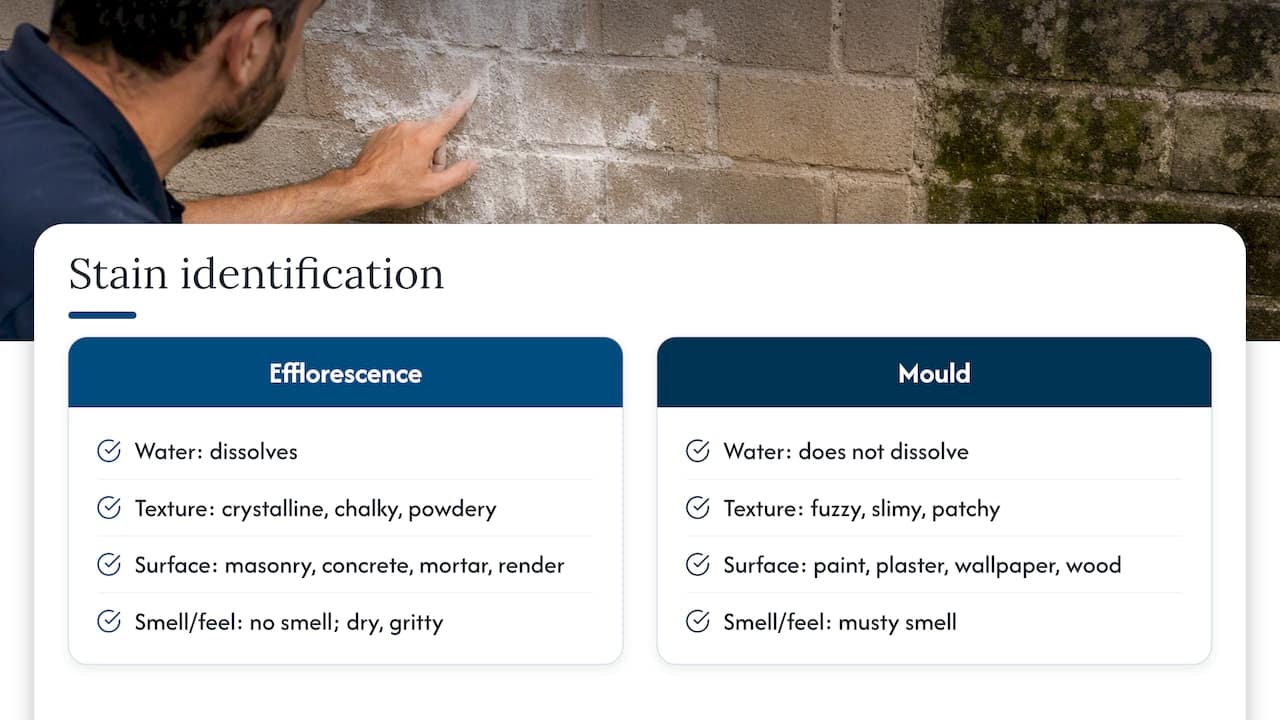
Try water. One mould remediation guide points out that efflorescence dissolves in water, while mould does not. Dab a small area with a damp cloth or a few drops from a spray bottle. If the crystals dissolve or smear away and the surface underneath looks like clean masonry, it is almost certainly salt.
Look at the texture. Efflorescence is crystalline, chalky or powdery. White mould tends to look fuzzy, slimy or patchy, and it is a living fungus that grows in damp conditions and feeds on organic material.
Check the surface it sits on. Efflorescence forms on masonry, concrete, mortar and render. Mould needs something to feed on, so it is more common on paint, plaster, wallpaper, wood and dust-covered surfaces, and often shows grey, green or black spots rather than a clean white bloom.
Smell and feel. A musty smell points towards mould. Efflorescence has no smell and feels dry and gritty.
If you are still unsure, or the patch is large, inside a bedroom or accompanied by a musty smell, have it assessed rather than guessing. Where you suspect mould and anyone in the household has asthma, allergies or a weak immune system, ask a doctor or a qualified mould specialist before disturbing it.
Keep in mind that the two can occur together, because both are driven by moisture. Finding efflorescence on a wall does not rule out damp-related problems elsewhere on it.
How to remove efflorescence safely
Removal is the easy part. Keeping it away is the real job, so treat cleaning as step one, not the whole answer.
Start dry
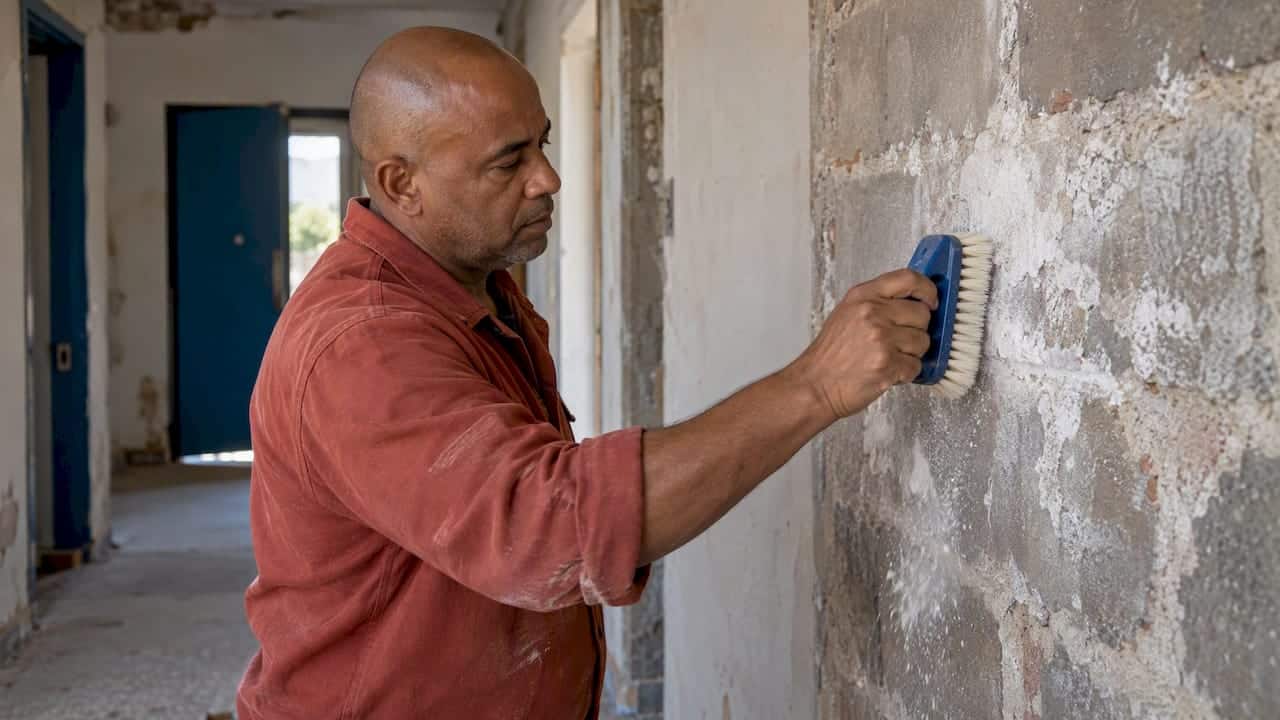
On light deposits, brush the surface with a soft, stiff-bristled brush and sweep or vacuum up the residue. Do not wet-wash too soon on a new wall: adding water can dissolve more salts and pull them back into the wall, only for them to reappear.
Then wash gently
The NIH bulletin recommends that existing walls are gently washed with water, or a mild detergent or acidic solution that dissolves the salts without damaging the wall. Work in small sections, rinse well and let the wall dry fully before judging the result. Wearing gloves and eye protection is sensible with any cleaning product.
Avoid harsh methods
The same bulletin says sandblasting and wire brushes are not recommended, especially on brick and soft stone, because they abrade the surface and can open it up to more water.
Acid cleaning is a last resort
As a final option, the CMHA says dilute muriatic (hydrochloric) acid may be used, and that integrally coloured masonry may need a more dilute solution to avoid etching that alters colour and texture. Acid can burn skin, damage mortar and release harmful fumes. Leave this to someone who cleans masonry for a living, test on a hidden patch first, and never mix acids with other cleaners.
Do not seal over it
People often ask whether they can simply paint or seal the white crust. You can, but it often fails. The NIH guidance says breathable sealants may help but must be used with caution, because applying them too early can trap moisture behind the surface and cause further damage. The South Australian guide takes the same view: walls need to breathe, and inappropriate coatings can trap moisture and salts and strip the surface skin.
The rule of thumb: dry the wall, stop the water, clean the salts, and only then consider a vapour-permeable finish.
Why it keeps coming back: finding the moisture source
If efflorescence returns after cleaning, the wall is telling you water is still entering. The CMHA advises investigating and repairing the source, and lists cracks, inadequate flashing and groundwater as routes. The New Zealand research adds a defective damp-proof course to the list.
Work through the likely culprits in this order:
- Roof edges and rainwater goods. Overflowing gutters, blocked downpipes and missing drip details soak walls from above. Deposits right beneath a parapet or sill point here.
- Flashings and copings. Missing or failed flashings let water run down behind the brickwork.
- Cracks and failed mortar joints. Even hairline openings admit wind-driven rain. Our guide to wall cracks and what they mean explains how to read them, and why concrete cracks let water in covers the smaller 1 to 2 mm cracks that owners often ignore.
- Ground level. Soil, paving or planting banked against a wall, poor drainage and a high water table all feed moisture upward and inward. Prevention guidance from the NIH lists flashing, weep holes and good site drainage among the basics.
- Below-ground walls. Basements and retaining walls under hydrostatic pressure often show efflorescence first, long before visible leaks. Our pieces on what to put on basement walls to stop water and stopping water seeping through basement walls cover that case.
- Plumbing and internal sources. A leaking pipe, shower or washing machine hose behind a wall can produce deposits on the opposite face.
If you suspect water is entering through the outside of the house, diagnose moisture first, then waterproof the exterior. Applying a coating before you know where the water comes from is how people end up repainting every two years.
Preventing efflorescence in new work
If you are building, extending or hiring a builder, most prevention happens before the first brick is laid or the first pour is made.
- Store materials properly. The NIH bulletin recommends keeping masonry units covered and off the ground, so they do not absorb excess moisture and contaminants.
- Detail the wall to shed water. Adequate flashings, weep holes and copings keep water from collecting in the wall.
- Get the drainage right. Ground should slope away from the building, and gutters and downpipes should discharge well clear of the walls.
- Protect fresh work. Cover walls during construction so that rain does not saturate them.
- Allow time to dry. Rushing paint, sealer or tiling onto damp masonry is a common cause of failure.
Our perspective
Most of the efflorescence calls we hear about start with a cleaning question and end with a water question. Owners scrub the white powder off, it returns, and they conclude the product failed. In our experience the product rarely failed: the wall kept receiving water.
We treat the salt as evidence. Where it sits, how thick it is, and whether it has appeared before tell you more about the building than the stain does. A fan of crystals under a cracked window sill, a band at one height on a boundary wall, a tide of salts on a basement wall: each points at a different repair. That is why we push owners to diagnose first and waterproof second, and why the questions we encourage you to ask any contractor are about diagnosis, licensing, experience and warranty, not just price per square metre.
Our advice is simple. Do not paint over it, and do not accept a quote that skips finding the source. A good contractor should be able to explain where the water is getting in, what they will do about it and what the guarantee covers. If they cannot, keep looking.
— Eben
When to get a professional involved
Call a specialist rather than reaching for a brush when:
- Efflorescence returns within a season of cleaning.
- You see it on a building that is more than a year old and it was never there before.
- Brick faces are flaking, mortar is powdery or paint is blistering above or around the deposit.
- There are damp patches, a musty smell or visible mould on the same wall.
- The wall is below ground level, retains soil or sits on a sloping site.
- You manage a commercial or industrial building where hidden moisture could reach stock, electrics or finishes.
A proper assessment traces the water path, checks drainage and joints, and then specifies a repair: re-pointing, flashings, drainage, crack injection or a membrane or coating system suited to the substrate.
Get a quote from a vetted waterproofing professional
Pro Waterproofing connects homeowners, building managers and commercial and industrial property owners with vetted waterproofing contractors for roofs, basements, bathrooms, foundations and concrete decks. Tell us what you are seeing, and we will help you find a contractor who can find the water source and fix it, not just clean the surface. You can request a waterproofing quote here.

When you speak to a contractor, ask about their licensing, their experience with your type of building, how they diagnose the moisture source and what warranty they give on the work.
FAQ
Can I paint over efflorescence?
Not until the wall is dry and the water source is fixed. Paint or sealer applied too early can trap moisture and salts behind the surface, which can cause blistering and loss of the surface skin. Brush off the deposits, repair the leak, let the wall dry fully and then use a breathable finish.
Will efflorescence damage my walls or foundation?
The white deposit itself does not reduce structural performance. The danger lies in the water behind it and in salts crystallising inside the masonry, which can cause fretting and flaking over time. Persistent deposits near the base of a wall or on basement walls deserve an inspection.
Does efflorescence mean I have rising damp?
Not necessarily. New building bloom, a leaking gutter or a defective flashing can all cause it. Persistent deposits low on a wall, especially with a tide-mark or damp patches, can point to rising damp or a failed damp-proof course, so have it checked by a damp or waterproofing specialist.
How long does efflorescence last?
On new masonry, early-age bloom usually fades as the wall dries and rain washes the salts away. On older walls, it lasts as long as water keeps moving through the masonry, so it will keep returning until you stop the moisture.
What is the best way to remove efflorescence from brick?
Start with a dry brush, then wash gently with water or a mild detergent solution. Avoid wire brushes and sandblasting, particularly on soft brick and stone. Reserve diluted acid for a trained cleaner and a last-resort situation.
Sources
- Control and Removal of Efflorescence, CMHA
- Efflorescence, New Zealand research document
- Efflorescence & New Building Bloom, International Masonry Institute
- Efflorescence in Masonry Walls, Technical News Bulletin, December 2017
- Salt Attack and Rising Damp Technical Guide, South Australia
- Efflorescence or White Mould: How to Spot the Difference
- White Mould: Is It Dangerous and How to Remove It