
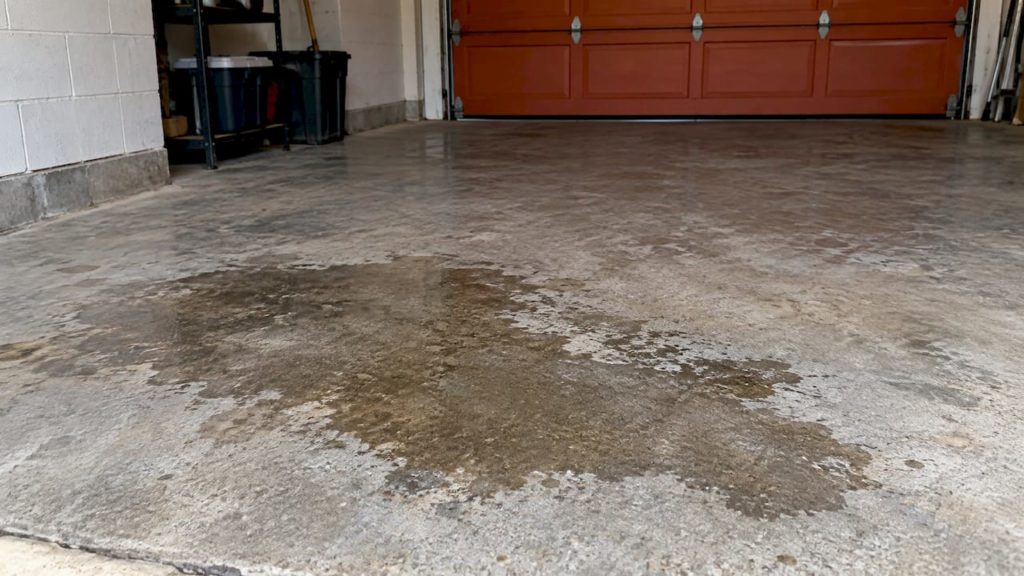
A garage floor takes in groundwater because it is usually a concrete slab laid straight onto soil, and concrete is porous. Moisture in the soil is drawn upwards through the tiny spaces in the ground and then through the slab. Where no damp-proof membrane was laid under the slab, or it was torn, badly lapped or never turned up at the walls, nothing stops that moisture. If your garage floor stays damp, darkens after rain or shows white salt marks, a waterproofing specialist can trace the entry point. Through our quote form we connect property owners with vetted waterproofing professionals who are assessed on experience, licensing and warranties.
TL;DR
- Water rises through soil and concrete by capillary action, so even a site that looks dry can send moisture up through an unprotected slab.
- The usual culprits are a missing, thin or torn membrane under the slab, a hardcore bed with nothing above it, and cracks or joints that let water through.
- Poor drainage around the garage adds pressure and keeps the ground wet for longer.
- A plastic-sheet test and the pattern of when the damp appears help separate groundwater from condensation or a plumbing leak.
- Surface sealing alone rarely settles the cause. Find the source first, then repair.
Table of Contents
- How water climbs into a concrete floor
- Why the garage is the weak spot
- Drainage and site conditions
- Is it really groundwater?
- What groundwater does to a garage
- What a properly protected floor looks like
- Repair: why the cause comes first
- A word on who does the work
- Get the garage floor assessed
- FAQ
- Sources
How water climbs into a concrete floor
Groundwater does not need to flood a garage to wet the floor. The South African standard for the waterproofing of buildings, SANS 10021, explains that water rises through soil by capillary action. The gaps between soil particles act like very narrow tubes, and the narrower the tube, the higher the water climbs. The standard stresses that even a “dry” site can have groundwater rising through an unprotected floor slab, where it attacks the slab, screeds and finishes.
How much water is involved? The CSIR’s National Building Research Institute, in its guide to damp in buildings, notes that the pore space in soil can reach 30% of its volume. A cubic metre of moist soil with 20% porosity can hold up to 200 litres of water. Even soil that feels dry holds a litre or two per cubic metre. That is a permanent reservoir directly under your floor.
The same guide makes a point that explains why garage damp keeps coming back. Moisture evaporates from the floor surface, and capillary action promptly replaces it from below. You can dry the floor, but the supply underneath carries on unless something blocks it.
Why the garage is the weak spot
A house floor is often covered by tiles, a screed and a sealed finish. A garage floor is commonly bare concrete, cast directly on the ground, with nothing to hide a problem. Three construction issues explain most cases.
No membrane, or a damaged one
SANS 10021 states that a concrete surface bed laid directly on compacted soil collects moisture on its underside and lets it migrate to the surface. It also says a hardcore layer alone does not prevent damp or vapour entering the slab. A waterproof membrane under the slab is good practice. Capillary rise can be reduced further with a 100 mm layer of coarse, hard, non-absorptive granular material between soil and slab.

AfriSam’s guide to waterproofing and rising damp lists how a slab ends up unprotected: no under-slab membrane was fitted, the overlaps were not sealed properly, or the sheeting was damaged while the slab was being laid. Once damp rises through the slab, it damages wooden flooring and carpets, and walls built directly on the slab suffer rising damp too.
The building guide BouWise says a torn membrane is one of the main ways damp gets into a new floor. In a garage, where steel-mesh placing, wheelbarrows and workers’ boots are all part of the pour, tears are easy to make and impossible to see afterwards.
Cracks and joints
Concrete is porous even when it is intact. Cracks, construction joints and the junction between floor and wall give moisture an easier path. Slabs cast in large panels shrink as they cure, and the resulting cracks go all the way through. If you are dealing with a cracked outdoor slab as well, this guide to cracked patio repair helps you decide what to fill, fix or rebuild.
A crack does not have to sit over the source. Ardex’s technical bulletin TB040 warns that moisture can travel hundreds of metres sideways through concrete by capillary action, so damp does not necessarily appear over the exact cause. A wet patch near the roller door may be fed from a point well away from it.
Wall and floor junctions
The joint where the slab meets the garage wall is where a floor membrane and the wall’s damp-proof course should connect. SANS 10021 specifies that the sheeting is turned up to the wall faces and lapped with, and bonded to, the horizontal damp-proof course by at least 150 mm. If that link was never made, ground moisture bypasses the barrier and shows up as a damp band along the base of the wall.
Drainage and site conditions
What happens outside the garage matters as much as what is under it. A driveway, paving and neighbouring hard surfaces shed rainwater quickly. If that water collects against the garage and the ground cannot take it away, the soil under and beside the slab stays saturated for longer, and the water can push through cracks and joints under pressure.
SANS 10021 advises that on sloped, low-lying, permanently damp or flood-liable sites, the water reaching the foundations should be restricted with land drains, French drains or cut-off trenches, together with adequate surface water drainage. On impervious clay sites, where surface water drains slowly, the horizontal waterproof membrane should be placed above the highest level the water is likely to reach.
A practical walk-around after rain tells you a lot. Look for water pooling against the garage walls, downpipes that discharge at the foundation, a driveway that falls towards the door, and soil built up above floor level.
Is it really groundwater?
Before anyone repairs anything, confirm what the water is. Three other causes look similar: condensation, a plumbing leak and surface water coming in under the door.
| Clue | Points to |
|---|---|
| Damp appears after rain and fades within days | Outside water, either surface water or groundwater |
| Damp returns every time it rains, along slab edges, wall bases or joints | Groundwater or poor drainage |
| Water appears in dry weather and grows, a water meter moves with everything off, a warm patch on the floor, or a rising water bill | Plumbing leak |
| Widespread dampness on a cold slab when the air is warm and humid | Condensation |
The table follows the diagnostic guidance in this plumber’s comparison of groundwater and leaks. It also lists a cool floor, an earthy smell and neighbours affected by the same storms as signs of outside water.
The plastic-sheet test
The same source describes a simple check for moisture coming up through the slab. Tape a square of clear plastic firmly to the dry concrete and leave it for about a day. If droplets form on the underside of the plastic, moisture is rising through the floor. If they form on top, you are looking at condensation from room air. It is an indication rather than proof, but it tells you which direction to investigate.
Condensation forms when the slab surface drops below the dew point of the surrounding air, according to Wagner Meters. The same page lists groundwater as a major outside source of slab moisture, particularly where no vapour retarder was installed, and says it can lead to failed adhesives and mould or mildew on the opposite surface.
Surface readings are not enough
Wagner Meters also points out that surface moisture meters read only near the surface and cannot show how far moisture has travelled into the slab. Testing the relative humidity inside the slab can show the extent of the intrusion and confirm afterwards that a repair has worked. For a commercial or industrial floor, where a coating or equipment is going on top, that depth reading is worth asking for.
Signs to look for
- Dampness that returns after the floor has dried.
- White mineral deposits (efflorescence) on the concrete. These show that water carried dissolved salts to the surface, though they do not on their own prove active seepage.
- Dark, damp bands along the base of walls.
- Lifting or staining of paint, coatings, carpet or timber stored on the floor.
- A musty smell in a closed garage.
What groundwater does to a garage
Damp stored boxes and a musty smell are the visible part. The structural risk is less obvious. SANS 10021 warns that sulfates in groundwater or hardcore can attack concrete floors. They react with the cement and cause the concrete to disintegrate or expand. Expansion can move foundation walls outward or cause the slab to bow or bridge. This is why a persistent damp floor deserves a proper look rather than a coat of paint.
Moisture also damages whatever sits on the floor: wooden flooring, carpets, adhesives and floor coatings that rely on a dry substrate. A garage that has been converted into a gym, workshop or office suffers the most.
What a properly protected floor looks like
Knowing the standard helps you judge an old floor or a new build. The Kwa-Zulu Natal provincial housing guidelines for site inspection set out these requirements for slab-on-ground foundations:
- A slab at least 75 mm thick, with concrete of at least 10 MPa compressive strength at 28 days.
- Fill compacted in layers no thicker than 150 mm.
- A damp-proof membrane at least 0.25 mm thick covering the whole area within the foundation walls, turned up around the perimeter by at least the slab thickness, with joints overlapped by at least 200 mm and effectively sealed.
SANS 10021 describes the minimum for a dry site as a 75 mm concrete slab on 250 µm polyolefin sheeting, laid with as few joints as possible and turned up to the wall faces. On wet or aggressive sites it recommends upgrading to 750 µm sheeting turned down into the excavations under footings and up into the wall damp-proof course.
BouWise’s summary of SANS 10400-J covers the concrete itself: a plain slab at least 75 mm thick, on a polyolefin underfloor membrane, with panel sides no longer than 3.5 m under flexible coverings or 2.5 m under tiles. Fill deeper than 400 mm needs to be designed by a competent person.
If your garage is older, or was built informally, there is a fair chance it does not meet these details. That is the most common reason a floor behaves like a sponge.
Repair: why the cause comes first
A coating over a floor that is being fed from below can fail, because the water pressure from beneath pushes at the coating. Sealing the surface does not remove the supply, and the capillary action described by the CSIR carries on. Effective repair starts by identifying whether the source is capillary rise through a slab with no membrane, water entering at cracks and joints, a wall-floor junction, or external drainage.
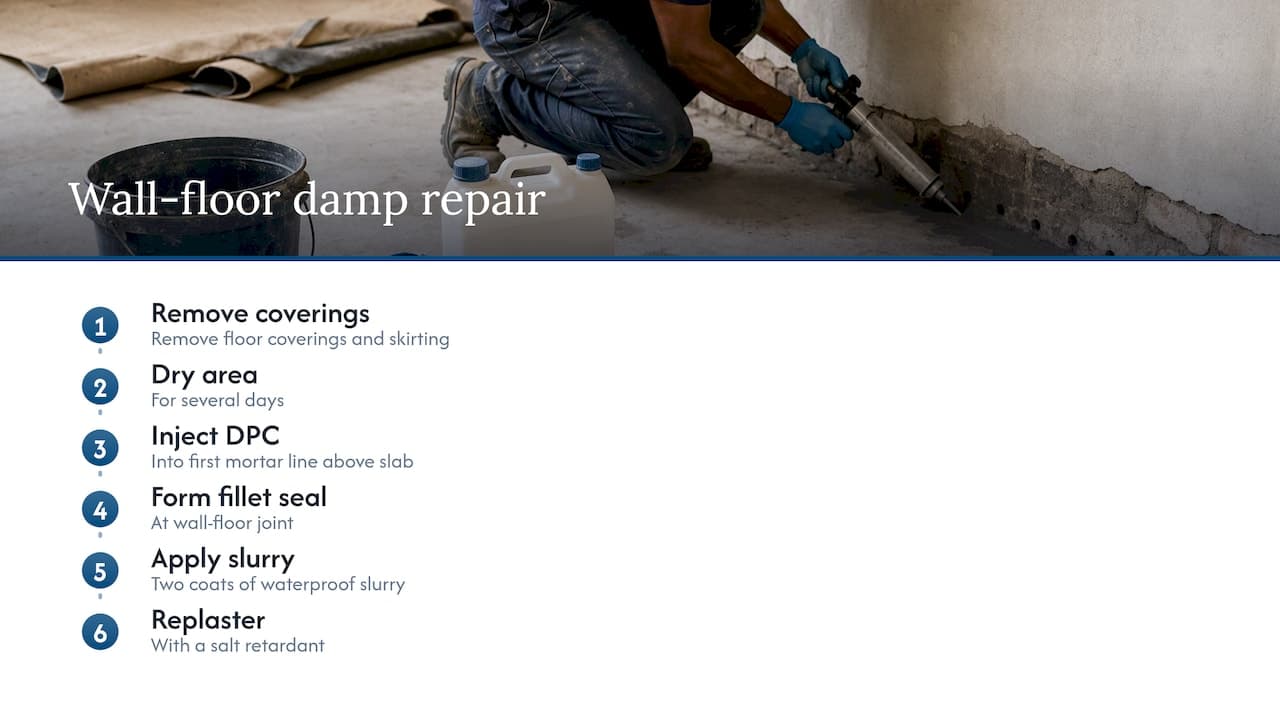
For rising damp at the wall and floor junction, AfriSam’s 2025 waterproofing guide sets out a sequence: remove floor coverings and skirting, dry the area out for several days, inject a chemical damp-proof course into the first mortar line above the slab, form a fillet seal at the wall and floor joint, apply two coats of waterproof slurry, and replaster with a salt retardant. It also notes that the most common modern cause of rising damp is external plaster bridging the damp-proof course.
On the outside, correct the falls, lead downpipes away from the foundations and keep soil and paving below the damp-proof course. Where the site is wet, land drains or French drains, as SANS 10021 advises, take the water away before it reaches the slab.
For background on what the work involves, our own guides on waterproofing versus damp proofing, below grade waterproofing and waterproofing regulations in South Africa explain the terms you will meet in a quote.
A word on who does the work
The fix for a groundwater problem is only as good as the diagnosis and the installer. Ask any contractor for their experience on similar floors, their licensing, what the warranty covers and for how long, and exactly what they propose to do about the source rather than the symptom. These are the questions we encourage every property owner to put to a contractor.
Our view
A damp garage floor is rarely a surface problem. The water has a route and a supply, and until both are understood any repair is a guess. In our experience of how owners approach this, the costly mistake is treating the visible stain, not the path the moisture takes into the building.
That is why we put so much weight on choosing the right contractor. Quality of workmanship, relevant experience, proper licensing and a clear warranty decide whether a waterproofing job holds. We built Pro Waterproofing so that property owners in Gauteng and the Western Cape, whether a home, a commercial unit or an industrial building, can ask the right questions and reach a qualified professional with confidence.
If your garage floor is taking in water, describe what you see and when it happens. The more precisely you can say where and after which rain, the faster a professional can narrow down the cause.
Eben
Get the garage floor assessed
If the plastic-sheet test points upwards, or the damp returns after every storm, the next step is a professional assessment. Pro Waterproofing offers waterproofing for residential, commercial and industrial properties, including foundation and concrete deck work. A completed quote request on our waterproofing page connects you with a vetted waterproofing professional.

When you request a quote, note where the damp appears, whether it follows rain, whether there is a visible crack or efflorescence, and whether the garage is used for storage, a workshop or living space. That detail helps the contractor quote accurately.
FAQ
Why is my garage floor damp when it has not rained?
It could be capillary rise, where moisture in the soil keeps being drawn up through the slab, or condensation on a cold floor in humid air. It can also be a plumbing leak if it grows in dry weather or your water meter moves with everything off. A plastic sheet taped down for about 24 hours helps separate condensation from moisture coming through.
Does a hardcore base stop groundwater coming through the slab?
No, not on its own. SANS 10021 says a hardcore layer alone does not prevent damp or vapour entering the slab. A waterproof membrane under the slab is good practice, and a 100 mm layer of coarse, hard granular material helps to reduce capillary rise.
Is a white powder on the garage floor a sign of groundwater?
It is a sign that water has carried dissolved minerals to the surface and dried there. It does not by itself prove an active leak, but combined with dampness that returns after drying or moisture along wall-floor joints, it suggests ground moisture is moving through the slab and deserves assessment.
Can I just paint or seal the floor?
A surface coating treats the symptom. If water is rising from below, it can push at the coating and cause it to fail. Finding the source, whether a missing membrane, a joint, a wall junction or drainage, comes first, and a contractor can then specify the right repair.
How thick should a garage slab and its membrane be?
SANS 10021 sets a minimum of a 75 mm slab on 250 µm polyolefin sheeting for a dry site, with lapped and sealed joints turned up to the walls. On wet or aggressive sites it recommends heavier 750 µm sheeting.
Sources
- SANS 10021: The waterproofing of buildings
- CSIR: Introductory guide to damp in buildings
- AfriSam: Waterproofing and rising damp (2015)
- AfriSam: Waterproofing and rising damp (2025)
- BouWise: Floor slabs, DPM and mesh
- Ardex Technical Bulletin TB040
- Downey Plumbing: Water seeping through floor after rain
- Wagner Meters: Concrete moisture outside sources
- KwaZulu-Natal guidelines for site inspection