
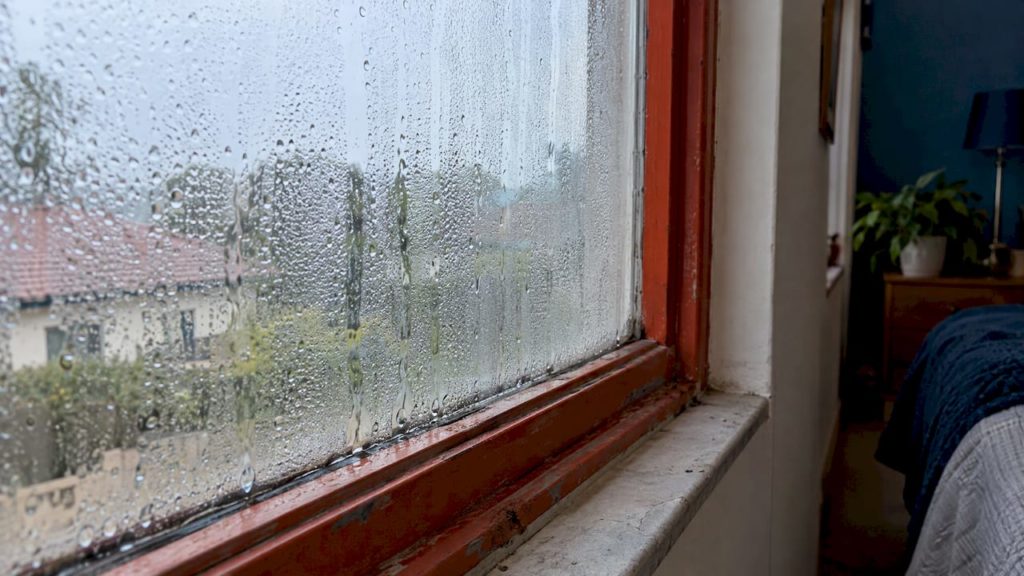
Condensation dampness is moisture that comes out of the air inside a building and settles on surfaces colder than that air. It is not water getting in from outside. It is water your own building produces and then fails to clear. That difference decides the fix: condensation is solved by managing moisture, heat and airflow, while leaks and rising moisture need work on the building fabric. If you are unsure which one you have, a proper diagnosis comes before any treatment, and our network can connect you with vetted waterproofing professionals who look at the cause before they quote.
TL;DR
- Condensation forms when warm, moist air cools to its dewpoint on a cold surface such as a window, a cold corner or an outside wall.
- It is a surface problem driven by indoor moisture, heating and ventilation. Penetrating and rising damp are building problems.
- Typical clues: worse in winter, wet windows, black mould in corners and behind furniture, and outside walls affected more than internal walls.
- Cooking, washing, breathing and drying clothes indoors add litres of water to the air every week, so extraction and steady background heat matter.
- If drying out the air and warming the walls changes nothing, look for a leak or a wall moisture source before you repaint.
Table of Contents
- What condensation dampness actually is
- Condensation, damp and mould: how the words fit together
- How to tell condensation from other kinds of damp
- Why it happens: moisture, cold and stagnant air
- Why it matters beyond the stain
- What to do about it
- When it is not just condensation
- Property managers and owners of larger buildings
- Getting the right answer for your building
- FAQ
- Sources
What condensation dampness actually is
Air holds water as invisible vapour. The warmer the air, the more it can hold. When air cools to its dewpoint, the temperature at which it can no longer carry all its vapour, the surplus turns to liquid. The SPAB, the UK’s Society for the Protection of Ancient Buildings, describes condensation in exactly these terms, and notes that it can happen indoors where warm, damp air meets colder building components, especially where ventilation is poor. It can also occur inside building materials.
A worked example makes the scale clear. CSIRO, Australia’s national science agency, explains that a cubic metre of air at 25°C can hold at most 23 grams of water. Cool that air to 15°C and its maximum falls to 13 grams, so 10 grams of water must condense out of every cubic metre. In a room with hundreds of cubic metres of air, that is a lot of water arriving on your cold windows and walls overnight.
The physics is the same in Leeds, Johannesburg and Cape Town. What changes is the season and the building. In the UK it peaks in winter. In South Africa, the cold, damp winters of the Western Cape and the cold nights of the Gauteng Highveld create the same conditions in poorly ventilated homes, offices and industrial units.
Condensation, damp and mould: how the words fit together
“Damp” is a loose term for excess moisture in a building. Condensation is one way that moisture shows up. Citizen Housing puts the difference simply: condensation is visible water on surfaces when warm, moist air meets a cold surface, while damp is excess moisture within the fabric of the building, often from leaks or moisture rising from the ground. Condensation is a surface issue; damp is a building issue.
The RICS consumer guide on damp and mould, written by a chartered building pathologist, adds a useful point. Penetrating damp, “rising damp” and condensation are not root causes. They are different ways moisture moves through or onto parts of a building, so the first job is to find where the moisture is coming from.
Mould is the consequence. Persistent condensation keeps surfaces wet, and mould then grows on them. Treating the mould without removing the moisture only buys you a few weeks.
How to tell condensation from other kinds of damp
Getting this right saves money. Misdiagnosis leads to unnecessary treatment, and the SPAB warns that diffuse damp readings on plaster, especially on north-facing walls, are commonly misread as rising damp and used to justify damp-course work that was never needed.
| Clue | Condensation | Penetrating damp | Rising damp |
|---|---|---|---|
| Season | Worse in cold weather | Any time of year, often after rain | Present year-round |
| Where | Windows, cold corners, outside walls, behind furniture | A defined patch, often under a roof, window or pipe | Low on ground-floor walls |
| Look and feel | Wet surface, streaming windows, black mould specks | Water staining and a definite damp area, little or no black mould | Tide mark, flaking plaster, sometimes a musty smell |
| Source | Indoor moisture meeting cold surfaces | Water entering through walls, roof or openings | A problem at the damp-proof course or ground level |
The signs in the first column come from Kensington and Chelsea council’s guidance: dampness in winter rather than summer, sweating walls and cold surfaces, water on the inside of windows, and outside walls affected rather than walls between rooms. The same page says leaks and penetrating damp can appear at any time of year, show a definite damp area with water staining, and carry little or no black mould. For the other two columns, Dartford Borough Council describes penetrating damp as water coming through walls or roof, for example under a loose roof tile, and rising damp as a damp-proof course problem whose usual evidence is a tide mark.
Where condensation likes to form
The SPAB’s technical note on dampness points out that single-glazed windows are usually the coldest surface in a room in winter, so they run with water first. On double glazing, condensation often moves to the plaster reveals around the window instead. North-facing walls, which get the least sun, are particularly prone. In the southern hemisphere the logic flips: it is the south-facing walls that stay coldest.
The same note adds a reassurance: rising damp is usually much less of a problem than commonly supposed, often reaching only 10 to 50 mm above internal floor level, though it can climb much higher depending on ground levels, masonry, water table and evaporation rate. And the RICS guide says failure of an original damp-proof course is extremely rare. Before anyone sells you a chemical injection, it is worth knowing that a wet-feeling wall is frequently just condensation.
A quick pattern check
- Note when it appears. Winter mornings and cold snaps point to condensation. A stain that grows after rain points to a leak.
- Note where it appears. Condensation favours cold, still spots: behind wardrobes, inside cupboards on outside walls, ceiling corners, window reveals.
- Look at the surface. Condensation sits on the surface and wipes off. Staining that returns through fresh paint, or plaster that is salt-streaked and flaking, suggests moisture in the wall.
- Check what is above and outside. Blocked gutters, cracked render, loose roof sheets or tiles and leaking pipes all mimic condensation.
If these clues conflict, the cause is probably more than one thing. That is common, and it is when a trained eye and a moisture meter earn their keep.
Why it happens: moisture, cold and stagnant air
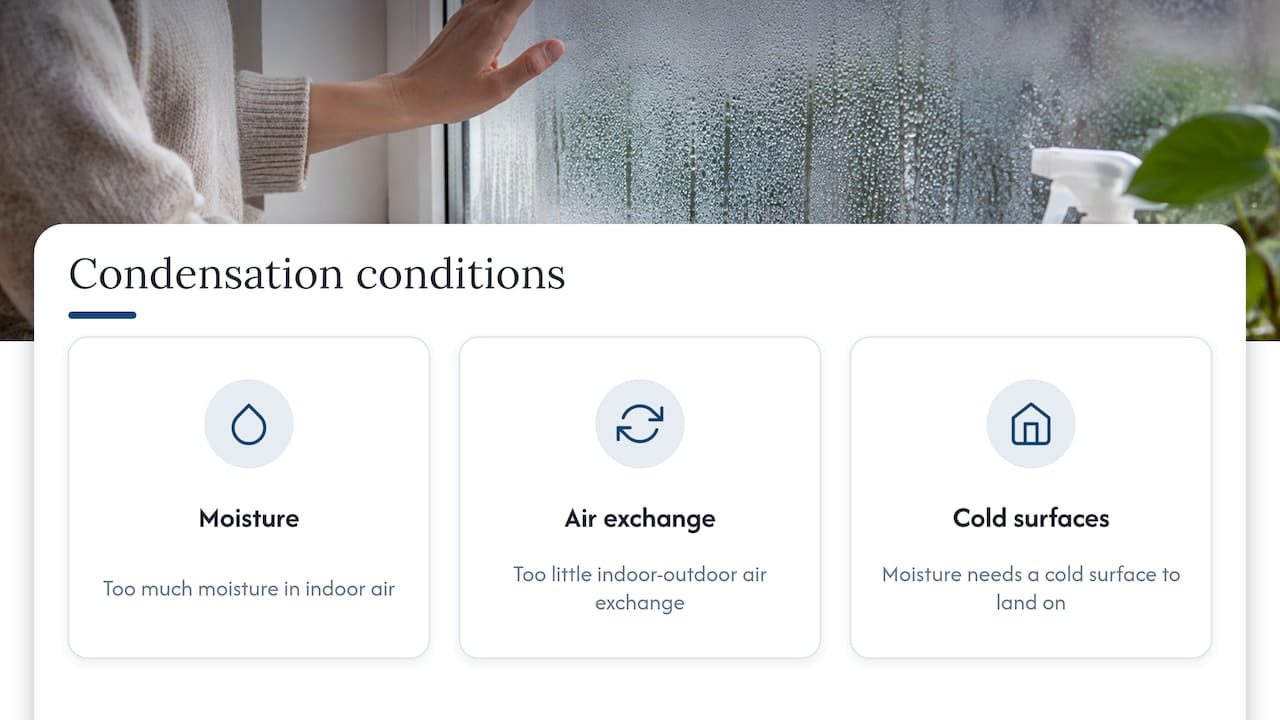
Canada’s housing agency, CMHC, says condensation needs three things at once: too much moisture in the air, too little exchange between indoor and outdoor air, and cold surfaces for the moisture to land on. Remove any one and the problem eases.
Moisture you make every day
Households produce far more water vapour than most people expect. Aberdeenshire Council’s leaflet estimates:
- showering, cooking, bathing and washing add 15 to 20 litres a week;
- drying clothes indoors adds 10 to 15 litres a week;
- a family of four breathing adds the equivalent of 30 to 40 litres a week.
CSIRO gives the rates behind this: an adult breathing releases around 0.1 litres of vapour an hour, while hot baths, showers or unvented clothes dryers can release 1.5 to 10 litres an hour. It also notes that new masonry walls, concrete floors and timber framing can take up to 12 months to dry out, releasing stored construction moisture that causes temporary condensation. That matters for anyone who has just built, extended or poured a new concrete deck.
The RICS guide lists the everyday habits behind it: drying washing on radiators, leaving kitchen and bathroom doors open or windows shut while cooking and bathing, uncovered pots, badly vented tumble dryers, recirculating-only cooker hoods, poor ventilation, insufficient heating and overcrowding.

Cold surfaces and thermal bridges
A thermal bridge is a part of the structure that conducts heat out faster than its surroundings, such as a concrete lintel, an uninsulated corner or a steel frame member. It stays colder than the wall around it, so moisture lands there first. Australia’s YourHome guidance notes that reducing thermal bridging with insulation, thermal breaks and double or triple glazing lowers condensation risk. In commercial and industrial buildings, large uninsulated roof sheets and concrete slabs make the same effect much bigger.
Weak airflow
The air has to go somewhere. Without trickle vents, extractors or opened windows, moist air stays put and finds the nearest cold surface. Blocked air bricks and furniture pushed hard against outside walls make it worse, because the wall behind the furniture is both cold and still.
Why it matters beyond the stain
The World Health Organization’s guidelines on dampness and mould report sufficient epidemiological evidence that people living in damp or mouldy buildings face a higher risk of respiratory symptoms, respiratory infections and asthma flare-ups. They estimate indoor dampness affects 10 to 50 per cent of indoor environments in Europe, North America, Australia, India and Japan.
The Rent Smart Wales booklet names the people at greater risk: elderly people, young children and people with chronic illness. It also lists the damage to the building: peeling paint and wallpaper, rotting wood, warped floorboards and rusting metal, plus higher heating costs in a damp home. If anyone in the building has asthma or another respiratory condition, speak to their doctor about symptoms linked to mould.
What to do about it
The order matters: cut moisture at source, keep surfaces warm, then ventilate. The WHO guidance on moisture control says that in most climates adequate ventilation, heating with proper moisture control and thermal insulation will keep relative humidity in acceptable limits.
Reduce moisture at source
- Cover pans, and close the kitchen or bathroom door while you cook or bathe.
- Run extractor fans during and after use, and vent tumble dryers outside.
- Avoid drying washing on radiators or indoors on cold days where you can.
- Leave gaps between furniture and outside walls.
These steps come from the City of Edinburgh Council’s guide, which also suggests airing rooms for at least ten minutes a day before turning on the heating and not blocking air bricks.
Heat sensibly: low and steady
Does leaving the heating on stop condensation? Largely, yes, if it is steady. Aberdeenshire Council advises keeping heating on low for longer rather than high for short bursts, so the walls do not get too cold. The WHO chapter explains why warmth helps: heating air from 15°C to 18°C drops relative humidity from 50 per cent to 40 per cent. Mould fungi generally do not grow below about 75 to 80 per cent relative humidity, and dust mites need more than 45 to 50 per cent. Edinburgh’s guide suggests heating rooms above 15°C where possible.
Ventilate without wasting heat
Short, purposeful ventilation beats constant draughts. Open windows wide for a few minutes after showering and cooking, and keep trickle vents open. For how airflow and waterproofing work together in South African homes, see our piece on how ventilation boosts waterproofing. For general room-level steps, our guide to reducing dampness in a room covers what to check first.
Clean mould safely
For small patches, Aberdeenshire Council recommends avoiding bleach-based products and using an 80:20 mix of white vinegar and water on thick mould, or a bicarbonate of soda and vinegar paste on stubborn areas. CMHC says areas of fewer than three patches, each under 1 m², can be cleaned with unscented detergent and water, while larger areas need a professional. Wear a mask and gloves, and keep children and anyone with asthma out of the room while you work.
When it is not just condensation
If you have done all of the above for a few weeks and the wall still stays wet, or a patch keeps returning in the same place, the moisture probably has another source. In South Africa, heavy rain, failed flat-roof or deck membranes, cracked plaster and poor drainage around foundations are frequent culprits. Our articles on why walls get damp in South African homes and the signs of damp walls and how to solve them show how to read the evidence. If the mould is on the ceiling, why mould grows on ceilings explains the usual roof-side causes.
A building moisture audit settles the question with measurements rather than guesses. Our page on what a building moisture audit is explains how thermal scans are checked with meters, which is the same logic the SPAB recommends when it says tests showing no dampness within the wall thickness can pinpoint condensation as the true source.
Property managers and owners of larger buildings
For commercial and industrial sites the pattern is the same but the numbers are bigger: more people, more process moisture, large cold roof surfaces and slabs. Recurrent condensation drips onto stock, equipment and finishes, so tenants notice quickly. Record where and when it appears, keep ventilation and heating schedules, and note any roof or gutter faults, so that whoever inspects can separate condensation from a leak in one visit.
Getting the right answer for your building
Prowaterproofing helps property owners in South Africa find the right waterproofing professional for residential, commercial and industrial buildings, including roof, basement, bathroom, foundation and concrete deck work. You send a quote request through the Pro Waterproofing site, and we connect you with vetted waterproofing professionals. Tell them what you have seen: the season, the location, whether it dries out, and what you have already changed. That history is what lets a contractor tell condensation from a leak, and it keeps you from paying for treatment you do not need.

When you speak to contractors, the questions we encourage owners to ask are about experience, licensing and warranties, and about whether the contractor surveys the building before quoting.
Our view on condensation
Most of the damp complaints we see described are filed under the wrong name. An owner sees a wet wall, assumes the walls are failing, and goes looking for a product. The better first question is where the water comes from. If the answer is the air inside, the fix is moisture control, steady heat and ventilation. If it is the building, the fix is waterproofing done properly.
That is why we put so much weight on diagnosis. Our approach is to help owners judge contractors on quality, experience, licensing and warranties, and to give them region-specific information so they can brief a professional with confidence.
Whatever the cause, a lasting result starts with a site survey and a clear scope. If it turns out your building needs waterproofing, we connect you with a vetted professional who can do it.
Eben
FAQ
What is the difference between damp and condensation?
Condensation is water that forms on surfaces when warm, moist indoor air meets a cold surface. Damp is excess moisture in the fabric of the building itself, usually from leaks or ground moisture. Condensation tends to be worse in winter and shows on windows and outside walls, while leaks show a defined stained patch.
Will leaving the heating on stop condensation?
It helps when the heat is low and steady, because warmer walls give moisture fewer cold places to land. Short bursts of high heat leave walls cold. Pair steady heating with extraction and short bursts of ventilation, since heat alone does not remove the moisture.
Is condensation dampness harmful to health?
Persistent condensation leads to mould, and the WHO reports that people in damp or mouldy buildings are at greater risk of respiratory symptoms, infections and asthma flare-ups. Elderly people, young children and people with chronic illness are more at risk. Anyone with symptoms should see their doctor.
How can I tell condensation from rising damp?
Condensation wipes off the surface, is worse in cold weather and favours windows, cold corners and outside walls. Rising damp sits low on walls, leaves a tide mark and shows flaking plaster. Because rising damp is often misdiagnosed, have the wall measured before agreeing to any damp-proofing work.
Can new buildings get condensation?
Yes. CSIRO notes that new masonry, concrete floors and timber framing can take up to 12 months to dry out, releasing moisture that causes temporary condensation. Good ventilation during that first year helps the building dry.
Sources
- Condensation | The SPAB
- Control of Dampness, SPAB technical advice note
- Condensation in Buildings, CSIRO
- Get help with damp, mould or condensation, Citizen Housing
- Damp and mould, RICS consumer guide
- Condensation, damp and mould, Royal Borough of Kensington and Chelsea
- Damp or condensation, Dartford Borough Council
- Damp & Condensation Leaflet 2023, Aberdeenshire Council
- A guide to reducing damp, condensation and mould, City of Edinburgh Council
- Moisture control and ventilation, WHO Guidelines
- Dampness and Mould, WHO guidelines for indoor air quality
- How to prevent Condensation, Damp and Mould, Rent Smart Wales
- Moisture and Air guide, CMHC
- Condensation, YourHome