
TL;DR:
- Choosing the wrong waterproofing product can lead to recurring dampness and costly structural deterioration. Proper selection, surface preparation, and ensuring adequate dry film thickness are critical for a long-lasting, effective membrane system.
Choosing the wrong waterproofing product for a concrete structure is not just a costly mistake. It can mean recurring damp, structural deterioration, and repairs that dwarf the original project budget. Yet many property owners and contractors still treat all waterproofing membranes as broadly interchangeable. The reality is that a liquid waterproofing membrane for concrete behaves very differently from a sheet membrane, and understanding those differences determines whether your waterproofing system lasts a decade or a lifetime. This guide covers everything from base materials and ASTM standards to application workflows and real-world usage scenarios.
Table of Contents
- Key takeaways
- What liquid waterproofing membranes actually are
- ASTM standards and performance criteria
- Liquid vs sheet membranes: the real differences
- Best practices for liquid membrane application
- Where liquid membranes are used in practice
- My perspective on what actually matters
- Protect your concrete with Prowaterproofing
- FAQ
Key takeaways
| Point | Details |
|---|---|
| Liquid membranes conform to complex shapes | They bond directly to irregular concrete surfaces without joints, reducing infiltration risk. |
| DFT governs performance, not just coverage | Plan membrane application around dry film thickness targets (60, 90, or 120 mils) rather than nominal spread rates. |
| ASTM C836 is the benchmark standard | Products complying with this specification are tested for hydrostatic pressure resistance and elastomeric performance. |
| System details are the failure point | Cracks, joints, and penetrations need specific treatment; the membrane alone cannot compensate for poor substrate prep. |
| Environmental conditions affect curing | Substrate moisture levels and temperature shifts must be controlled during application to achieve a durable bond. |
What liquid waterproofing membranes actually are
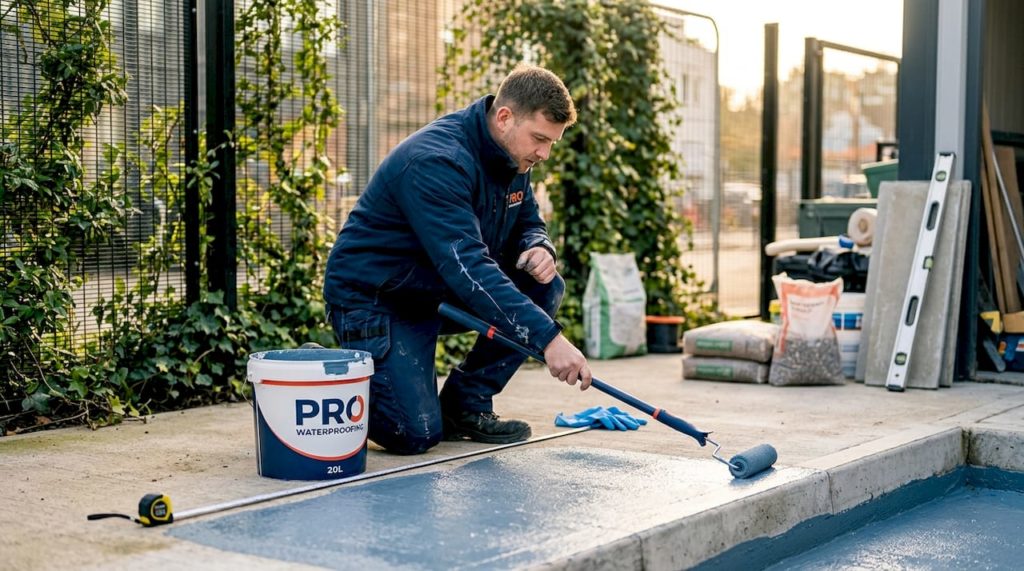
A liquid waterproofing membrane for concrete is a fluid-applied coating that cures to form a seamless, elastomeric film directly on the substrate. Unlike pre-manufactured sheet membranes that arrive on site as rolls and require lapping and bonding, liquid membranes are applied wet and cure in place. The result is a continuous film with no seams.
The base chemistry varies significantly across products, and the choice of chemistry affects performance. The most common types include:
- Polyurethane membranes, which offer excellent elongation and UV resistance, making them well suited to exposed decks and roofs
- Bitumen-based systems, including modified bitumen and bitumen emulsions, which are popular for below-grade foundations and areas requiring fast application
- Elastomeric acrylic compounds, which are water-based, easier to clean up, and commonly used on balconies and low-slope roofs
- Epoxy liquid waterproofing systems, which bond exceptionally well to dense concrete and are used in tank linings and wet areas with chemical exposure
Flexibility is a non-negotiable property for any liquid waterproof coating on concrete. Concrete structures expand, contract, and settle. A membrane that cannot move with the substrate will crack and fail. Elongation values, which indicate how far the cured film can stretch before breaking, are one of the most important figures on any product datasheet.
The concept of dry film thickness (DFT) is central to planning any liquid membrane application. DFT refers to the thickness of the cured membrane once all solvents have evaporated. Cold fluid-applied membranes come in discrete DFT ranges such as 60, 90, or 120 mils, and the target DFT governs both performance and the quantity of material you need to purchase.
Pro Tip: Always calculate material quantities from the DFT target and the product’s solids content percentage, not from the nominal coverage rate printed on the pail. Liquid membranes lose volume as solvents evaporate, so the wet application rate is always higher than the final DFT.
ASTM standards and performance criteria
Specifying a liquid membrane without understanding the relevant standards leaves you exposed to product claims that sound impressive but may not hold up under real conditions. The primary benchmark for cold-applied elastomeric membranes in concrete applications is ASTM C836, which defines requirements for high-solids, cold liquid-applied membranes intended for use with a separate wearing course.
ASTM C836 covers test methods for properties including low-temperature flexibility, resistance to heat ageing, and crucially, behaviour under hydrostatic pressure. Hydrostatic pressure resistance is a central criterion for any membrane used on below-grade concrete, and it is tested even when specific hydrostatic head values do not appear on the product datasheet. Compliance with the standard is what confirms fitness for purpose.
Here is how the common DFT ranges relate to performance and coverage planning:
| DFT target | Typical application | Coverage per litre (approx.) |
|---|---|---|
| 60 mils (1.5 mm) | Exposed decks, balconies | Higher coverage area |
| 90 mils (2.3 mm) | Foundations, wet areas | Moderate coverage area |
| 120 mils (3.0 mm) | Below-grade, high-pressure zones | Lower coverage area |
Two important limitations apply to liquid membranes under this standard. First, products complying with ASTM C836 are not designed for permanently submerged conditions without additional protection layers. Second, reinforcement fabric is typically required at expansion joints or cracks greater than 1/16 of an inch, though adding fabric does reduce the overall elongation of the membrane system at those points.
Pro Tip: When reviewing product submittals from contractors, ask specifically whether the product carries ASTM C836 compliance. ASTM compliance confirms that the membrane has been tested to a recognised performance standard, even when the product datasheet does not list every test result explicitly.
Liquid vs sheet membranes: the real differences
The debate between liquid and sheet membranes for concrete waterproofing comes down to a handful of practical realities. Neither system is universally superior, but liquid membranes hold clear advantages in specific scenarios.
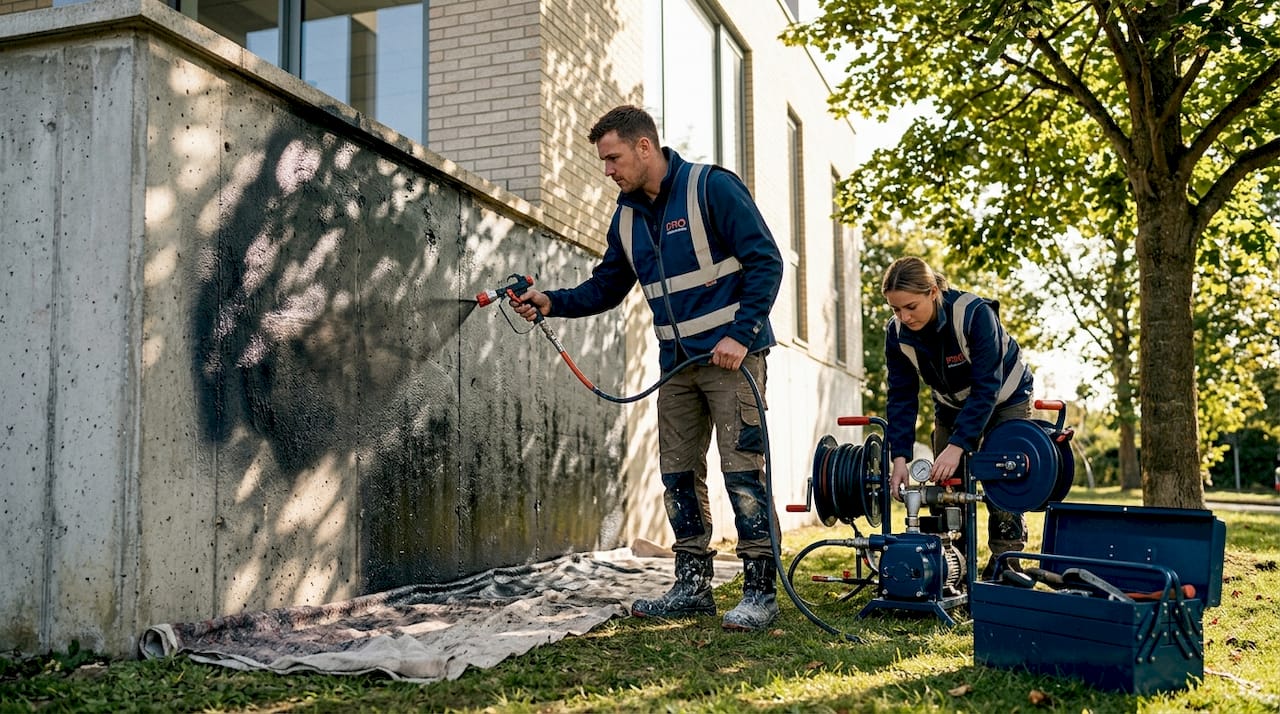
Liquid membranes offer major application speed advantages over sheet membranes, particularly on complex geometries. Spray application allows a contractor to cover large areas quickly and conform to curves, re-entrant corners, and irregular blockwork without any of the cutting, lapping, or welding that sheet membranes require. Every lap joint in a sheet membrane is a potential infiltration point. Liquid membranes applied correctly eliminate that risk entirely.
A useful way to compare the two systems:
| Factor | Liquid membrane | Sheet membrane |
|---|---|---|
| Application speed | Fast, especially by spray | Slower on complex shapes |
| Seam risk | None when applied correctly | Laps and seams are failure points |
| Conformity to substrate | Bonds to all profiles | Bridges over irregular surfaces |
| Sensitivity to conditions | Higher (moisture, temperature) | Lower |
| High hydrostatic pressure | Requires careful specification | Often better suited |
The weaknesses of liquid membranes are worth being clear about:
- Liquid applied waterproofing is sensitive to substrate moisture at the time of application. Too much moisture in the concrete can cause adhesion failure or blistering.
- Cold temperatures slow curing and can prevent proper film formation. Most products have a minimum application temperature, typically around 5°C.
- High hydrostatic pressure situations, such as deep basement walls with a high water table, may require a specialist liquid membrane product or a combined approach with drainage systems.
For most residential and commercial concrete waterproofing solutions in South Africa, liquid membranes applied by spray or roller represent the most practical and reliable option, particularly on roofs, decks, and foundations with irregular surfaces. For more detail on liquid vs sheet membrane systems, the comparison of joints, speed, and substrate conformity is worth reading before specifying.
Best practices for liquid membrane application
Getting the chemistry right is only half the battle. Long-term performance depends far more on application discipline than on product selection alone.
- Surface preparation. The concrete substrate must be clean, sound, and free of laitance, oil, dust, or loose material. Grind or blast if necessary. Any contamination between the substrate and the membrane will compromise adhesion at that point.
- Moisture control. Test substrate moisture before application. Most manufacturers specify a maximum moisture content, typically measured with a hygrometer or carbide bomb test. Substrate moisture and temperature must be controlled to achieve reliable adhesion and film formation.
- Treat system details first. Before applying field coats, address cracks, joints, and penetrations. Cracks over 1/8 inch require special treatment and should not simply be bridged with membrane material. Embed reinforcement fabric at expansion joints and any cracks wider than 1/16 inch.
- Apply in correct passes. Apply the first coat and allow it to reach the correct degree of cure before applying subsequent coats. Applying all coats wet-on-wet traps solvents and undermines DFT accuracy.
- Verify DFT as you go. Use a wet film thickness gauge during application to monitor coverage. The relationship between wet film thickness and DFT is determined by the product’s solids content. Plan applications around DFT and solids content rather than relying on approximate spread rates.
- Protect the cured membrane. On traffic-bearing decks, apply a wearing course or protection board before backfilling or allowing foot traffic. The membrane film, though tough, is not designed to withstand direct abrasion.
For advanced spray applications, co-spraying bitumen emulsion with a saline solution at around 1,500 psi triggers an immediate chemical reaction on contact, forming a continuous, touch-dry film within minutes. This technique significantly reduces cure waiting times and works well on foundations where programme pressure is a factor.
Pro Tip: On vertical substrates like foundation walls, apply thicker coats than you would on horizontal surfaces. Gravity causes the wet membrane to sag before it cures, so you often lose effective DFT on verticals without compensating with additional material.
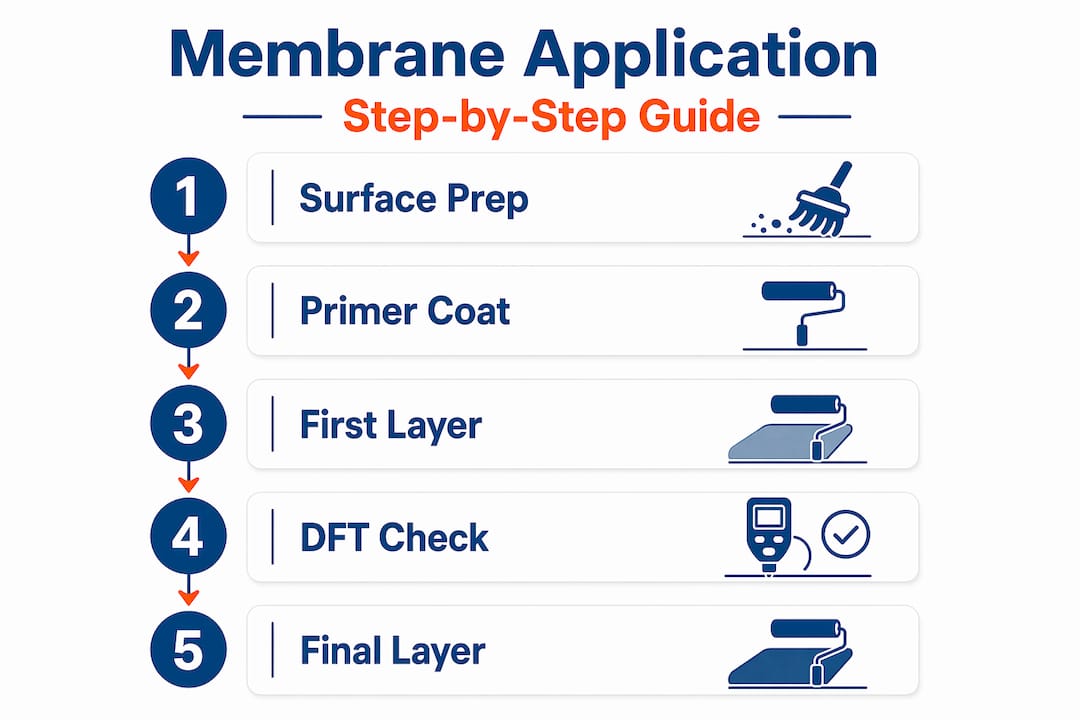
For a step-by-step breakdown of the full waterproofing application process, including spraying techniques and curing timelines, that resource is particularly useful for contractors preparing method statements.
Where liquid membranes are used in practice
The versatility of liquid applied waterproofing is best understood through the range of concrete structures it protects. In South Africa, where temperature swings and seasonal rainfall create demanding conditions, the ability of liquid membranes to accommodate movement without failing is a practical necessity.
Common applications include:
- Flat and low-slope roofs. Liquid polyurethane and acrylic systems are widely used on concrete roof decks because they can be applied over existing surfaces with minimal disruption, handle ponding water effectively, and reflect UV radiation when finished with a light-coloured topcoat.
- Basement walls and foundations. Bitumen-based and polyurethane systems applied to the positive or negative face of foundation walls provide the continuous, joint-free coverage that below-grade conditions demand.
- Podium decks and parking structures. These high-traffic concrete surfaces need membranes with both waterproofing performance and wear resistance. Systems with a designated wearing course or protection layer are specified here, often in compliance with ASTM C836.
- Wet rooms and bathrooms. Elastomeric liquid membranes applied under tile finishes protect concrete slabs in bathrooms, shower areas, and commercial kitchens from moisture infiltration into the structure.
- Retaining walls and planter boxes. Liquid coatings conform to blockwork and cast concrete profiles that sheet membranes handle poorly. A drainage layer placed against the membrane completes the system.
For a broader comparison of waterproofing products for concrete, including product comparisons for each application type, the overview of materials for 2025 and 2026 is a practical reference point.
My perspective on what actually matters
I have seen more waterproofing failures caused by poor preparation and rushed detailing than by inferior product choice. The industry spends a disproportionate amount of energy debating which liquid membrane brand or chemistry is best, when the real differentiator is almost always how the system is installed.
What I have learned is this: a competent contractor using a mid-range product that complies with ASTM C836, applied to a properly prepared substrate with correct DFT and detailed joints, will consistently outperform a premium product slapped over a damp, dusty surface with cracks left untreated.
The other mistake I see regularly is ignoring environmental conditions on the day of application. Contractors who push ahead in cold, humid weather to meet a deadline often end up back on site within a year repairing blistered or delaminated membranes. That is not a product problem. It is a discipline problem.
My practical advice: treat the system details as non-negotiable. Joints, cracks, and penetrations deserve more attention than the field application. And always verify DFT before calling a coat complete. A membrane that looks well-applied but falls short of the target thickness will not perform to specification, and you will not know it until water finds its way through.
— Eben
Protect your concrete with Prowaterproofing
If you are specifying or sourcing a liquid waterproofing membrane for concrete, Prowaterproofing brings the technical knowledge and application expertise to get the system right from the first coat. Whether the project is a residential foundation, a commercial roof deck, or a below-grade parking structure, the team at Prowaterproofing works with products that meet relevant performance standards and are matched to the specific demands of your substrate and conditions. Proper preparation, verified DFT, and correctly detailed joints are built into every project. Contact Prowaterproofing for an assessment or quote and get concrete waterproofing solutions backed by real field experience.
FAQ
What is a liquid waterproofing membrane for concrete?
A liquid waterproofing membrane for concrete is a fluid-applied coating that cures to form a seamless, elastomeric film on the substrate. It provides continuous moisture protection without the seams or laps associated with sheet membranes.
How does DFT affect liquid membrane performance?
Dry film thickness (DFT) determines the protective capacity of the cured membrane. Products are specified at 60, 90, or 120 mils depending on the application, and falling short of the target DFT reduces both waterproofing performance and durability.
What is the ASTM C836 standard?
ASTM C836 is the specification for high-solids, cold liquid-applied elastomeric membranes used on concrete with a separate wearing course. Compliance confirms that the product has been tested for hydrostatic pressure resistance and elastomeric properties.
Can liquid membranes be used below ground?
Yes. Bitumen-based and polyurethane liquid membranes are commonly used on below-grade foundations and basement walls. For permanently submerged conditions, additional protection layers and specialist product selection are required beyond standard ASTM C836 compliance.
Why do liquid membrane applications fail?
Most failures occur at system details rather than in the field-applied membrane. Untreated cracks, inadequately prepared substrates, poor moisture control, and insufficient DFT are the primary causes, not product quality alone.