

TL;DR:
- Effective metal roof waterproofing requires a layered system of butyl tape, sealants, and liquid coatings applied to properly prepared surfaces. Cut edge corrosion at profiled steel sheets is the leading cause of leaks, and early treatment prevents costly repairs. Proper diagnosis, surface prep, and annual inspections are essential for long-lasting, waterproof metal roofing.
Metal sheet roof waterproofing is defined as the application of specialised sealants, tapes, and liquid-applied coatings to create a continuous, flexible barrier that prevents water ingress and corrosion on profiled or corrugated steel and aluminium roofing. The industry term for this process is “metal roof refurbishment waterproofing,” and it covers everything from sealing individual fasteners to coating entire roof planes. Done correctly, it extends a roof’s service life by decades without requiring a costly strip-out. Done poorly, it creates a false sense of security while corrosion continues beneath the surface. This guide explains the methods, the failure points, and the application practices that actually work for property owners and building managers.
What are the best waterproofing methods for metal sheet roofs?
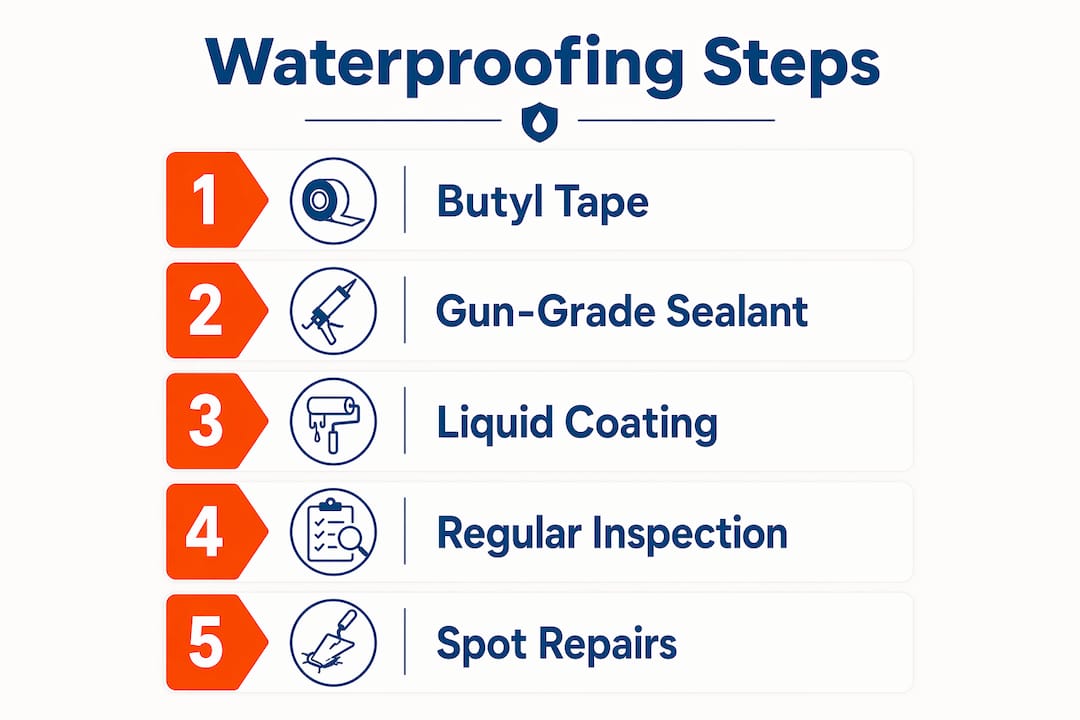
Three primary methods define metal sheet roof waterproofing: butyl tape, gun-grade sealants, and liquid-applied coatings. Each addresses a different part of the roof assembly, and the most durable systems combine all three rather than relying on a single product.

Butyl tape functions as a compression gasket. It is pressed between metal laps before sheets are fixed, creating a watertight seal at the overlap joint. Butyl tape lasts 20+ years under compression and maintains permanent elasticity, meaning it moves with the metal through thermal cycles without cracking. The critical limitation is UV exposure: butyl degrades when left uncovered, so it must sit beneath overlaps or be protected by a coating.
Gun-grade sealants fill exposed seams, penetrations, and fastener heads where tape cannot reach. Silicone sealants are the preferred choice for exposed joints because silicone accommodates ±50% joint movement and bonds effectively to polymer-coated metals such as Kynar. Polyurethane sealants offer stronger adhesion on bare steel but are less UV-stable over time. Both outperform basic mastic products, which harden and crack within a few years.
Liquid-applied coatings are the most comprehensive solution. Products such as GacoFlex create a seamless membrane across the entire roof surface, bridging fixings, laps, and corroded edges in a single application. Liquid coatings extend service life by 20+ years by eliminating the discrete failure points that tape and sealant alone cannot address. They also reduce waste and carbon cost compared to full roof replacement, which matters for building managers with sustainability targets.
| Method | Best use | Typical lifespan | UV resistance |
|---|---|---|---|
| Butyl tape | Lap joints, under overlaps | 20+ years (covered) | Low (must be shielded) |
| Silicone sealant | Exposed seams, fasteners | 10–20 years | High |
| Polyurethane sealant | Penetrations, complex geometry | 10–15 years | Moderate |
| Liquid-applied coating | Full roof surface, corroded areas | 20+ years | High |
Pro Tip: Never treat these methods as alternatives. Use butyl tape at laps during installation or re-roofing, gun-grade sealant at penetrations and fastener heads, and a liquid coating as the final protective layer over the whole surface.
How does cut edge corrosion affect metal roofs?
Cut edge corrosion is the single most common cause of waterproofing failure on metal sheet roofs. It occurs at the sheared edges of profiled steel sheets where the factory-applied coating is absent, exposing bare steel directly to moisture and oxygen. Two thirds of metal roofs in the UK show signs of cut edge corrosion, and the problem is progressive: once the zinc layer is consumed, rust spreads laterally beneath the coating, causing it to peel in strips.
The consequences extend beyond aesthetics. Corroded edges allow capillary water ingress along the lap joint, which bypasses the butyl tape entirely. Over time, the sheet itself thins and perforates, at which point repair becomes structurally complex and expensive. Early treatment costs a fraction of remedial work or replacement.
Effective treatment follows a clear sequence:
- Remove loose rust scale and flaking coating using wire brushing or mechanical grinding
- Apply a corrosion inhibitor or rust converter to stabilise any remaining oxidation
- Prime the cleaned edge with a metal primer compatible with the chosen topcoat
- Apply a liquid-applied coating that bridges the edge and bonds to the adjacent sheet surface
- Re-inspect annually and re-coat before the protective layer shows signs of wear
Pro Tip: Do not apply a liquid coating directly over loose rust. Sealants bond to the rust layer, not the steel beneath, and when the rust flakes off, the coating goes with it. Preparation is not optional.
Modern liquid waterproofing systems that perform on concrete substrates use the same chemistry as those designed for metal, which means the application principles transfer directly. The key difference is surface profile: metal requires degreasing in addition to rust removal.
What are the best practices for applying sealants and coatings?
Correct application technique determines whether a waterproofing system lasts five years or twenty. The most common failure mode is not product quality. It is preparation and application shortcuts.
Follow this sequence for a durable result:
- Clean the surface thoroughly. Remove dirt, oil, moss, and loose rust using a pressure washer followed by a degreasing agent. Surfaces bonded to loose rust will fail when the rust flakes, regardless of sealant quality.
- Remove rust scale mechanically. Wire brushing or angle grinding removes unstable oxidation. A rust converter can stabilise light surface rust, but it does not replace mechanical removal of heavy scale.
- Allow the surface to dry completely. Most sealants and coatings require a dry substrate. Some premium products tolerate damp surfaces in emergencies, but clean and dry surfaces maximise adhesion and longevity.
- Apply butyl tape without tension. Zero-tension tape application prevents retraction at the joint. Stretched tape springs back under heat, opening the very gap it was meant to seal.
- Apply gun-grade sealant in a thick, tooled bead. A thin smear is ineffective. A properly tooled bead accommodates the thermal movement of metal roofing, which can be significant across a large roof plane. Tool the bead into the joint with a wet finger or spatula to ensure full contact.
- Apply liquid coatings in two passes. The first coat seals the substrate; the second builds film thickness. Pay particular attention to fixings, laps, and cut edges, which require additional material.
- Observe temperature windows. Butyl tape performs best between 4°C and 38°C. Most liquid coatings require a minimum of 5°C and a dry forecast for at least 24 hours after application.
Annual roof inspections are the maintenance practice that preserves the system between major applications. Check fastener integrity, look for sealant cracking at joints, and re-coat any areas showing UV degradation before water finds a path through. Sealant tape and liquid membranes typically last 10 to 12 years when properly maintained, but neglected systems fail in half that time.
Pro Tip: Schedule inspections in autumn before the rainy season. Problems found in October are far cheaper to fix than leaks discovered in July after months of water ingress.
For a structured approach to the full process, the roof waterproofing steps guide from Prowaterproofing covers the procedural detail that building managers need for planned maintenance programmes.
How to identify common metal roof leaks and choose the right repair
Diagnosing the actual source of a leak is the step most property owners skip, and it is the reason the same roof leaks repeatedly after repair. Misidentified water entry points lead to misapplied fixes and wasted spending. Water travels along the underside of sheets before dripping, so the visible stain on the ceiling is rarely directly below the entry point.
The most common leak sources on metal sheet roofs are:
- Backing-out fasteners. Self-drilling screws work loose over time due to thermal cycling. The neoprene washer beneath the head compresses, hardens, and splits, allowing water to track down the screw shank.
- Seam separations. Lap joints that were never sealed, or where butyl tape has degraded, allow capillary water ingress, particularly on low-pitch roofs where water sits rather than drains.
- Cut edges. As described above, corroded edges create a direct path for water into the lap zone.
- Penetrations. Pipe boots, vents, and flashings are the highest-risk points on any metal roof. Sealant at these junctions ages faster than the surrounding sheet because it is exposed on all sides.
- Ridge and hip cappings. Foam closures beneath cappings compress and deteriorate, and the sealant at the capping edges cracks under UV exposure.
Matching the repair to the cause is non-negotiable. Replacing a fastener and washer without sealing the surrounding area leaves the adjacent corrosion untreated. Applying a liquid coating over a mechanically failed seam without re-fixing the sheets first means the coating bridges a moving joint and will crack within a season. The most durable repairs combine mechanical correction with waterproofing: fix the structural cause, then seal and coat.
Avoid sealing over rust without treatment, ignoring a loose sheet in favour of a sealant patch, or using general-purpose silicone from a hardware shop in place of a metal-rated product. These shortcuts are the primary reason building managers find themselves on the same roof every two years.
Key takeaways
Metal sheet roof waterproofing works best as a system: butyl tape at laps, gun-grade sealant at penetrations, and a liquid-applied coating across the full surface, all applied to a properly prepared substrate.
| Point | Details |
|---|---|
| Use a layered system | Combine butyl tape, gun-grade sealant, and liquid coating for complete protection. |
| Treat cut edge corrosion early | Two thirds of metal roofs are affected; early treatment avoids full replacement costs. |
| Preparation determines longevity | Remove loose rust and degrease before applying any sealant or coating. |
| Apply sealant correctly | A thick, tooled bead outperforms a thin smear under thermal movement. |
| Inspect annually | Re-coat before visible wear appears to maintain the 10 to 20-year service window. |
Why diagnosis matters more than product choice
I have seen property managers spend significant sums on premium liquid coatings, only to find the same leak reappearing six months later. In almost every case, the product was not the problem. The diagnosis was. Someone identified a stain on the ceiling, found the nearest penetration on the roof above it, applied a generous bead of sealant, and called it done. The actual entry point was a row of backing-out fasteners two metres away.
My view is that liquid-applied coatings are the most cost-effective refurbishment tool available for metal sheet roofs. Modern coatings sustain performance across thermal cycles and avoid the environmental cost of tear-off and replacement. But they are not a substitute for understanding what is actually failing. A coating applied over a mechanically unsound roof is an expensive delay, not a solution.
The other lesson I keep returning to is surface preparation. Manufacturers publish minimum preparation standards, and those standards exist because the chemistry demands them. Skipping the degreasing step or leaving loose rust in place does not save time. It transfers the cost to a repeat application in three years instead of a system that lasts twenty.
For complex roofs, penetrations, or roofs showing significant corrosion, a professional inspection before any product is applied is the most valuable investment a building manager can make. The commercial roof waterproofing steps that experienced contractors follow exist precisely because the sequence matters as much as the materials.
— Eben
Get expert waterproofing for your metal sheet roof
If your metal sheet roof is showing signs of corrosion, leaking at fasteners, or failing at lap joints, Prowaterproofing provides professional inspection, surface preparation, and warranty-backed waterproofing services for residential, commercial, and industrial properties across South Africa.
The team at Prowaterproofing applies the full system approach described in this guide: mechanical repairs first, correct product selection for each joint type, and liquid-applied coatings that protect the entire roof surface. Every project includes a detailed survey, a tailored waterproofing plan, and a warranty on completed work. Contact Prowaterproofing for a free roof survey and a quote that addresses the specific failure points on your property. You can also find additional guidance on effective waterproofing workflows to understand what a professional process looks like before you commit.
FAQ
What is the most durable waterproofing method for metal sheet roofs?
Liquid-applied coatings combined with butyl tape at laps and silicone sealant at penetrations form the most durable system. Liquid coatings backed by 20-year warranties outperform single-product approaches by eliminating discrete failure points across the entire roof surface.
How long does metal roof sealant last?
Silicone sealants last 10 to 20 years when correctly applied to a clean, dry surface. Butyl tape under compression lasts 20 or more years, while liquid membranes achieve similar lifespans with annual inspection and timely re-coating.
Can I waterproof a metal roof without replacing it?
Yes. Liquid-applied coatings applied over existing sheets extend service life by 20 or more years without strip-out, making refurbishment significantly cheaper and less disruptive than replacement for most metal roofs in serviceable condition.
What causes most leaks on metal sheet roofs?
The most common causes are backing-out fasteners with failed washers, cut edge corrosion at lap joints, and deteriorated sealant at penetrations. Misdiagnosed entry points are the primary reason repairs fail to resolve recurring leaks.
How often should a metal sheet roof be inspected?
Annual inspections are the recommended minimum, ideally before the rainy season. Re-coating before visible wear appears maintains the waterproofing system’s full service life and prevents minor degradation from becoming a structural water ingress problem.