
TL;DR:
- Waterproofing flat roof slabs involves applying a durable membrane to prevent water ingress and protect structural integrity. Proper surface preparation, effective drainage design, and meticulous detailing at transitions are critical for long-term success, regardless of the membrane type chosen. Regular maintenance and inspections significantly extend the lifespan of the waterproofing system by identifying issues early and ensuring optimal performance.
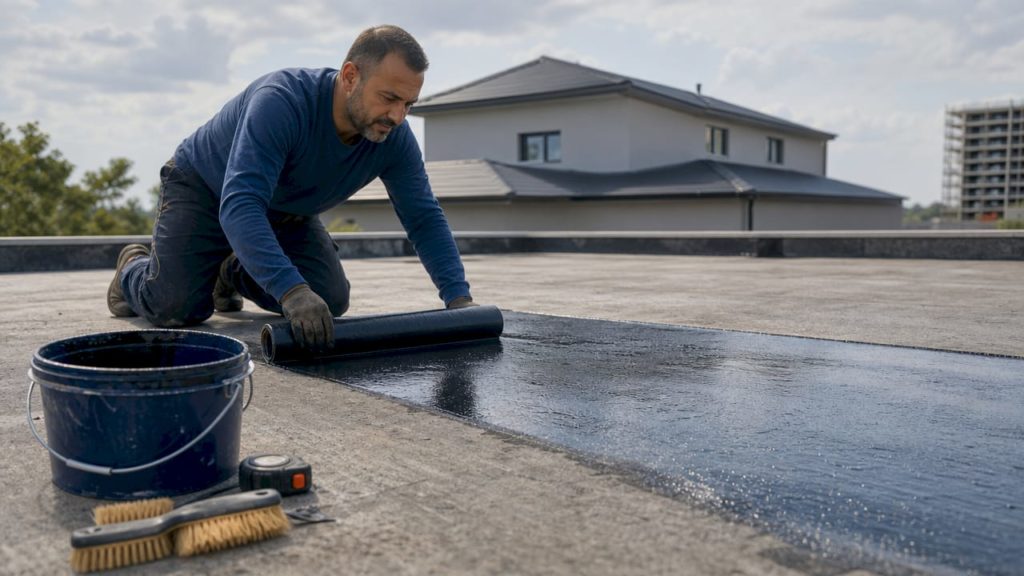
Waterproofing on a flat roof slab is the process of applying a continuous, durable membrane or coating system to prevent water penetration and protect the structural integrity of a building. Unlike pitched roofs that shed water by gravity alone, flat slabs accumulate water and rely entirely on their waterproofing layer to stay dry. The right system, whether a liquid-applied membrane such as polyurea or acrylic, a sheet membrane such as EPDM or TPO, or a bituminous coating, must be matched to the substrate, climate, and drainage design. Get any one of those factors wrong and the roof will fail, often within years rather than decades.
What are the best waterproofing methods and materials for flat roof slabs?
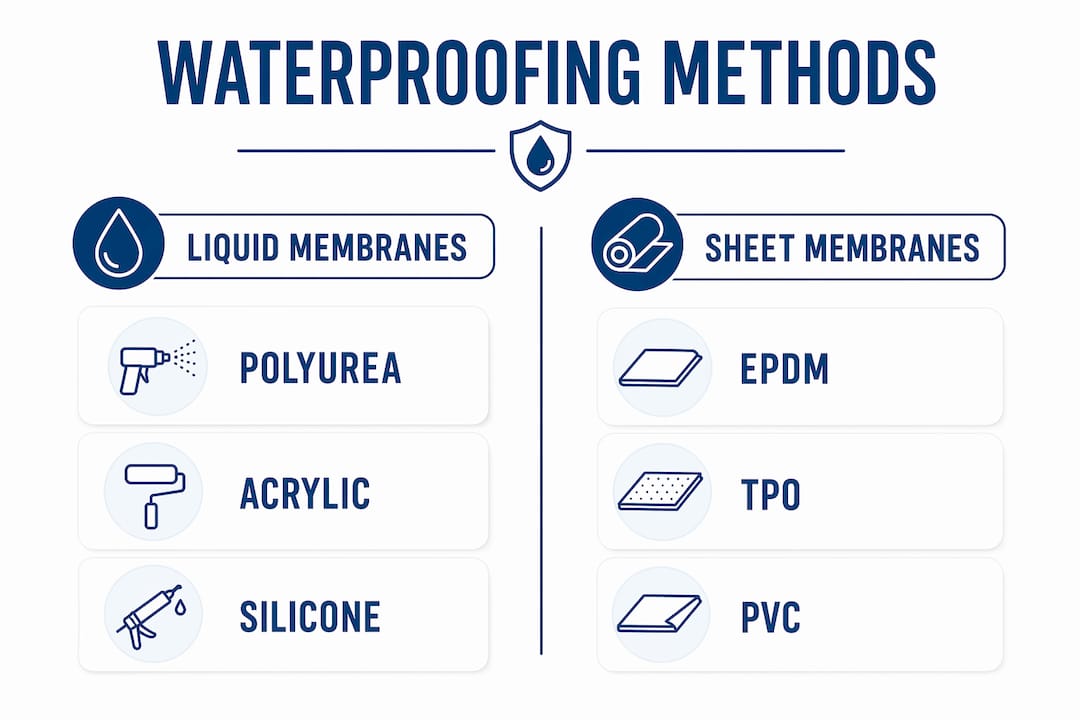
Flat roof waterproofing materials fall into three broad families: liquid-applied membranes, sheet membranes, and cementitious or bituminous coatings. Each suits different roof conditions, budgets, and performance expectations.
Liquid-applied membranes
Liquid systems, including polyurea, acrylic, and silicone coatings, are sprayed or rolled directly onto the slab and cure into a seamless monolithic barrier. That seamless quality is their defining advantage: there are no laps or seams where water can track. Polyurea specifically offers a lifespan of 20 to 30-plus years with rapid cure times, making it the top performer for roofs that experience ponding water. Acrylic coatings cost less but require recoating every five to eight years. Silicone sits between the two in terms of durability and is particularly resistant to UV degradation in high-sun climates like South Africa.
Sheet membranes: EPDM, TPO, and PVC
Sheet membranes are factory-manufactured rolls bonded to the substrate by adhesive, heat welding, or mechanical fastening. EPDM (ethylene propylene diene monomer) is the most widely used single-ply option for residential flat roofs because of its flexibility and 20-plus year track record. TPO and PVC membranes are heat-welded at seams, producing a strong, watertight joint that outperforms adhesive-bonded systems in high-traffic or commercial settings. The trade-off is that sheet membranes demand a very flat substrate: flatness tolerance within 2mm over 3 metres is required, or voids form beneath the sheet and allow lateral water travel.
Bituminous and cementitious options
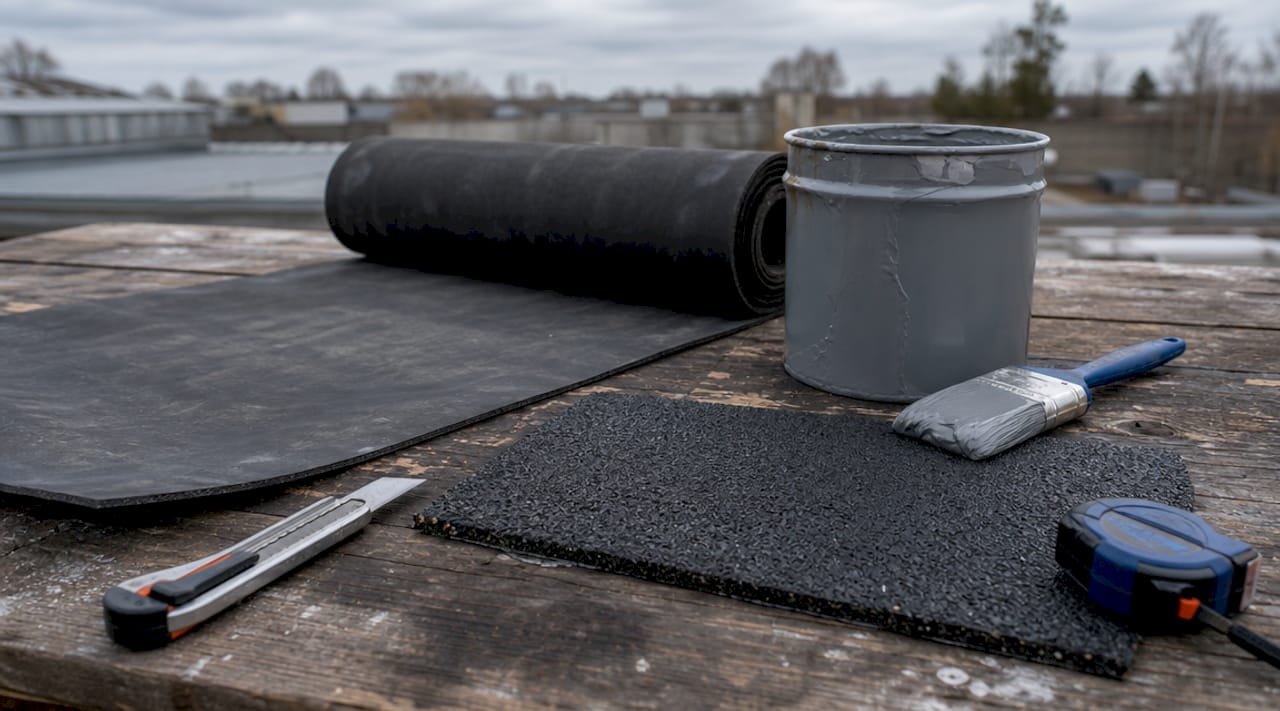
Torch-on bituminous membranes remain common in South Africa for their low material cost and contractor familiarity. They perform well when correctly installed but are vulnerable to UV degradation without a reflective cap sheet. Cementitious waterproofing is rigid, bonds well to concrete, and suits below-slab or wet-area applications, though it lacks the flexibility needed for roofs subject to thermal movement.
| Material | Typical lifespan | Relative cost | Flexibility | Best suited for |
|---|---|---|---|---|
| Polyurea (liquid) | 20 to 30+ years | High | Excellent | Complex roofs, ponding risk |
| EPDM (sheet) | 20+ years | Medium | Good | Residential, uniform slabs |
| TPO / PVC (sheet) | 15 to 25 years | Medium | Moderate | Commercial, high-traffic |
| Torch-on bitumen | 10 to 15 years | Low | Low | Budget projects, simple slabs |
| Cementitious | 10 to 20 years | Low to medium | Rigid | Below-slab, wet areas |
Pro Tip: Always confirm that your chosen membrane carries a manufacturer’s warranty that covers both the material and the application method. A product warranty without an installation warranty leaves you exposed.
How does surface preparation impact waterproofing success?
Surface preparation is the single greatest predictor of waterproofing success on a flat roof slab. Experts confirm that waterproofing cannot fix structural or moisture problems; those defects must be resolved before any membrane goes down. Applying a coating over a damp or cracked substrate leads directly to blistering and delamination, which means the membrane separates from the slab and water tracks freely beneath it.
Follow this preparation sequence before any membrane application:
- Inspect the slab thoroughly. Check for cracks, spalling, previous patch repairs, and any signs of moisture. Use a moisture meter on concrete before proceeding.
- Clear the surface completely. Remove all debris, moss, algae, and loose material. Pressure washing followed by priming is the industry-standard cleaning method for concrete slabs.
- Repair all defects. Fill cracks with a flexible polyurethane or epoxy filler. Patch spalled areas with a cementitious repair mortar and allow full cure time before waterproofing.
- Check flatness for sheet membranes. Use a 3-metre straight edge. Any deviation greater than 2mm must be ground down or filled before a sheet system is laid.
- Apply the correct primer. Primers improve adhesion and seal the substrate’s porosity. Liquid membranes and sheet membranes each require a specific primer type; using the wrong one reduces bond strength significantly.
- Pre-treat all details. Parapets, pipe penetrations, and drainage outlets must be reinforced with compatible fabric or flashing tape before the main membrane is applied.
The last step is where most failures originate. Membrane failures concentrate at transition points such as parapets and penetrations, which is why pre-treating these areas with reinforcing fabrics and sealants is non-negotiable. You can read a detailed step-by-step breakdown in Prowaterproofing’s substrate preparation guide.
Pro Tip: Never waterproof over a surface that has been wet within the previous 48 hours. Even if the surface looks dry, residual moisture trapped beneath a membrane will cause blistering within months.
What are effective flat roof drainage solutions for waterproofing longevity?
Drainage design and waterproofing are inseparable on a flat roof slab. A perfectly applied membrane will still fail prematurely if water is allowed to pond on it. Standing water beyond 24 to 48 hours accelerates membrane deterioration and must be eliminated through correct drainage design. This is not a maintenance issue; it is a design issue that must be resolved before or during the waterproofing installation.
A complete flat roof drainage system includes the following components:
- Primary drains. These are the main outlets, typically positioned at the lowest point of the roof. They must be sized based on the roof area and regional rainfall intensity.
- Overflow drains or scuppers. Building codes require overflow drains set 2 to 4 inches above the primary drain height to provide a backup path if the primary drain blocks. Scuppers through parapet walls serve the same function.
- Tapered insulation or screed falls. A minimum fall of 1:80 (approximately 12mm per metre) directs water toward drains. Many existing flat slabs are dead-level and require a tapered screed layer to create positive drainage.
- Maintenance access. Every drain must be accessible for regular clearing. Blocked drains are the leading cause of ponding on otherwise well-designed roofs.
Drainage capacity should be calculated based on regional rainfall intensity and designed with multiple drainage paths rather than a single outlet. In South Africa’s summer rainfall regions, this calculation is critical: a single blocked drain on a 100m² roof during a heavy storm can deposit hundreds of litres of water onto the membrane within minutes. A well-maintained roof with effective drainage can last over 25 years; poor drainage reduces that lifespan to under 10 years. That gap represents tens of thousands of rands in premature replacement costs.
How do liquid-applied and sheet-applied membranes compare?
Choosing between liquid and sheet membranes for flat roof slab waterproofing comes down to roof geometry, substrate condition, and budget. Neither system is universally superior; each has clear strengths in specific situations.
| Factor | Liquid-applied membrane | Sheet membrane |
|---|---|---|
| Substrate tolerance | Tolerates minor imperfections | Requires flatness within 2mm/3m |
| Seams | None (monolithic cure) | Welded or adhered seams |
| Complex shapes | Excellent (penetrations, curves) | Difficult without custom fabrication |
| Puncture resistance | Moderate (depends on thickness) | High (especially TPO and PVC) |
| Labour requirement | Lower for complex roofs | Lower for large, uniform roofs |
| Typical cost | Higher material cost | Lower material cost at scale |
Liquid membranes cure seamlessly and tolerate minor substrate imperfections, which makes them the better choice for roofs with multiple penetrations, irregular shapes, or surfaces that cannot be ground perfectly flat. Sheet membranes deliver superior puncture resistance and are cost-effective on large, uniform commercial roofs where the substrate can be properly prepared. For a deeper comparison of these systems in the South African context, Prowaterproofing’s guide on membrane types for flat roofs covers the practical trade-offs in detail.
The most common failure point for sheet membranes is not the field area but the seams and terminations. A sheet that is perfectly welded across 95% of its area but poorly terminated at a parapet will leak at that parapet within one or two wet seasons. Liquid systems eliminate that risk in the field but still require careful detailing at transitions, which is why pre-treatment of all penetrations and parapets applies to both membrane types equally.
What are best practices for maintaining waterproofing on flat roof slabs?
Maintenance is where most property owners lose the value of their waterproofing investment. Biannual inspections combined with debris clearing reduce waterproofing failures by up to 70%. That figure reflects the difference between a roof that reaches its full design lifespan and one that fails halfway through it.
Follow this maintenance schedule to protect your waterproofing system:
- Inspect twice yearly. Schedule inspections in autumn before the rainy season and in spring after it. Look for ponding water, membrane blisters, surface cracks, open seams, and damaged flashings.
- Clear all drainage outlets after every significant rainfall. Leaves, debris, and silt accumulate quickly in drains and scuppers. A blocked drain can cause ponding within a single storm event.
- Address mechanical damage immediately. Foot traffic, dropped tools, and rooftop equipment installations all create puncture risks. Repair any damage within days, not months.
- Keep a maintenance log. Record every inspection, repair, and cleaning event with dates and photographs. This log is invaluable when assessing warranty claims or planning a full re-waterproofing.
- Engage a professional contractor for any repair beyond surface patching. Seam repairs, flashing replacements, and membrane re-terminations require the same skill and materials as the original installation. A poor repair can introduce new failure points. For guidance on fixing roof leaks before they escalate, addressing the source rather than the symptom is always the correct approach.
Flat roof maintenance is not expensive when done consistently. The cost of two professional inspections per year is a fraction of the cost of a full membrane replacement triggered by a neglected blister or blocked drain.
Key takeaways
Effective waterproofing on a flat roof slab requires the right membrane, a properly prepared substrate, and a drainage system designed to eliminate ponding water from day one.
| Point | Details |
|---|---|
| Match membrane to roof conditions | Liquid membranes suit complex or uneven slabs; sheet membranes suit large, flat, uniform roofs. |
| Preparation determines success | Clean, dry, primed, and defect-free surfaces are non-negotiable before any membrane is applied. |
| Drainage design is not optional | Overflow drains, correct falls, and multiple drainage paths prevent ponding that destroys membranes. |
| Detailing at transitions is critical | Parapets, penetrations, and flashings account for the majority of membrane failures and must be pre-treated. |
| Biannual maintenance extends lifespan | Regular inspections and drain clearing can reduce waterproofing failures by up to 70%. |
What I have learned from years of flat roof failures
After seeing hundreds of flat roof waterproofing projects across South Africa, the pattern of failure is almost always the same. It is rarely the membrane itself that fails first. It is the detail work: a parapet that was not properly reinforced, a drain collar that was not bonded correctly, a penetration that was sealed with the wrong product. The membrane in the open field area is almost always intact. The failure is at the edges and transitions.
The second most common cause I encounter is waterproofing applied over a substrate that was not genuinely dry. Property owners are often under time pressure to complete a project, and a surface that looks dry after two days of sunshine may still carry enough residual moisture to cause blistering within a season. I have seen brand-new membranes delaminate within six months because the contractor did not use a moisture meter before application.
What I tell every property manager I work with is this: your waterproofing budget should allocate at least as much to preparation and detailing as to the membrane material itself. A cheap membrane properly installed on a well-prepared substrate will outlast an expensive membrane rushed onto a damp, unprimed slab. The best flat roof waterproofing is not the most expensive product on the market. It is the one applied correctly, on the right surface, with the right drainage behind it.
Drainage is the factor that property managers most consistently underestimate. I have seen roofs where the waterproofing was technically excellent but the drainage was an afterthought. Within three years, the ponding water had degraded the membrane to the point of replacement. Spend the money on tapered screed and overflow scuppers at the outset. It is far cheaper than replacing a membrane five years early.
— Eben
How Prowaterproofing can help with your flat roof slab
Prowaterproofing provides professional waterproofing assessments and full installation services for residential, commercial, and industrial flat roof slabs across South Africa. Every project begins with a thorough site inspection covering substrate condition, drainage design, and existing membrane performance before any material is specified.
The team at Prowaterproofing uses only industry-approved materials and applies them to manufacturer specifications, ensuring that both product and installation warranties are valid from day one. Whether you need a new waterproofing system, a targeted repair, or a maintenance inspection, professional intervention now costs far less than reactive replacement later. Contact Prowaterproofing to schedule an assessment and get a tailored solution for your flat roof slab.
FAQ
What is the best waterproofing material for a flat roof slab?
Polyurea liquid membrane offers the longest lifespan of 20 to 30-plus years and performs best on roofs prone to ponding water. EPDM sheet membrane is the most cost-effective option for residential flat roofs with uniform, well-prepared substrates.
How long does waterproofing on a flat roof slab last?
A properly maintained flat roof with effective drainage can last over 25 years, while poor drainage and neglected maintenance reduce that lifespan to under 10 years. The membrane type, substrate preparation quality, and maintenance frequency all directly affect longevity.
Why does my flat roof waterproofing keep failing at the edges?
Most membrane failures originate at transition points such as parapets, pipe penetrations, and drainage outlets rather than in the open field area. These details must be pre-treated with reinforcing fabrics and compatible sealants before the main membrane is applied.
How much does flat roof waterproofing cost in South Africa?
Waterproofing flat roof cost varies significantly based on membrane type, roof area, substrate condition, and drainage requirements. Liquid polyurea systems carry a higher material cost than torch-on bitumen but deliver a longer lifespan and lower lifetime maintenance cost.
How often should a flat roof waterproofing system be inspected?
Biannual inspections, once before the rainy season and once after, are the recommended minimum. Regular inspections combined with drain clearing reduce waterproofing failures by up to 70% compared with reactive maintenance alone.